
When an owner decides to try an AI Employee, the first question is nearly always which job to give it. And the first answer they reach for is usually the most impressive one: a sales rep who closes deals, or an assistant who does "a bit of everything."
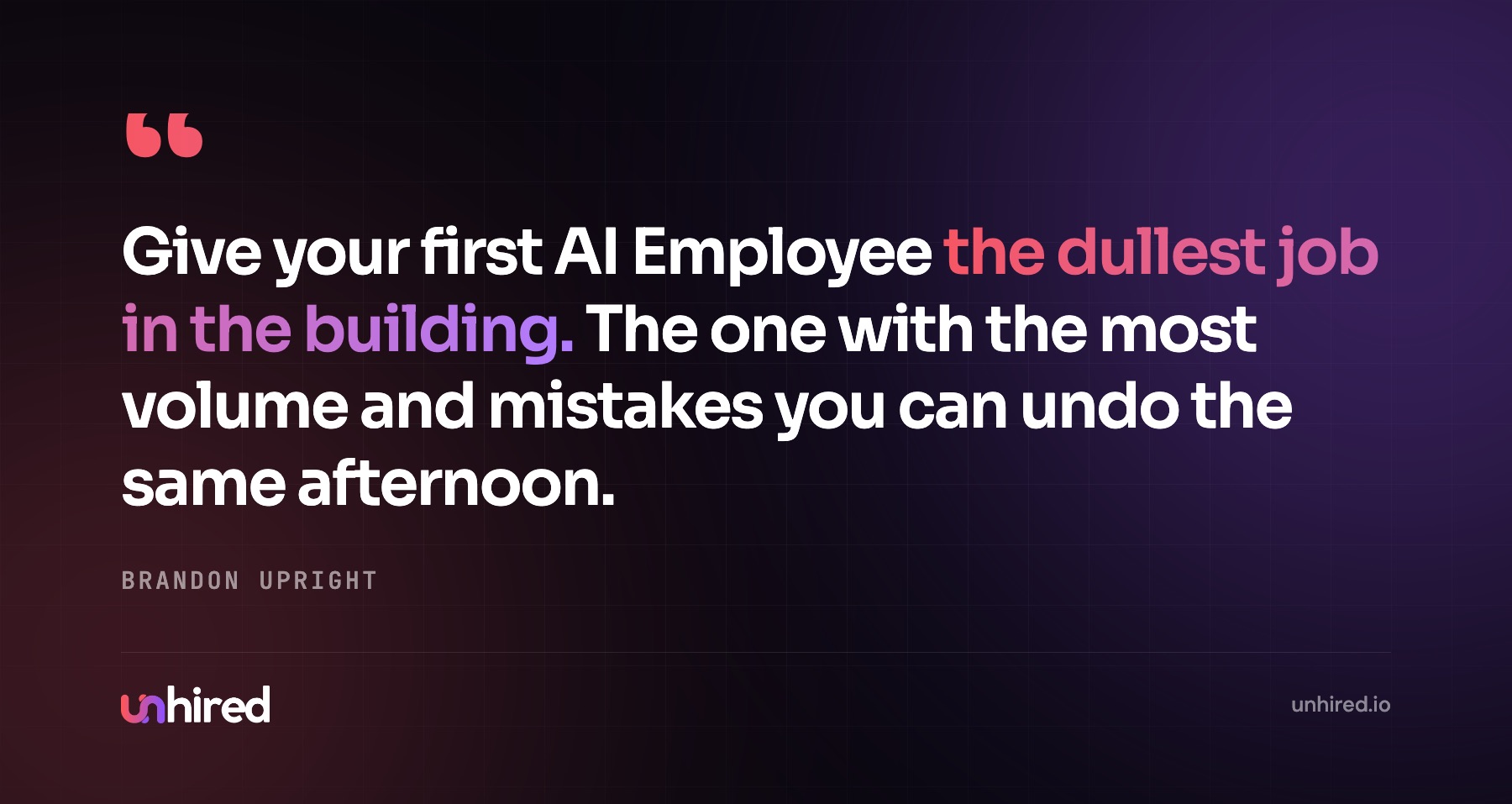
I've spent the last four years building AI systems and agents for businesses, and I'd steer almost every owner the other way. Your first AI Employee should do the dullest job in the building. The one with the most volume, rules you could write on a page, and mistakes you can undo the same afternoon.
The biggest payoff can come later. The first job is where you learn how an AI Employee behaves in your business and what your own process looks like once someone has to write it down. A boring job teaches you all of that cheaply.
What makes a good first job
An AI Employee is AI that holds one job on a team, with its own logins and a person it reports to. Some jobs suit that setup on day one. Others need a few months of experience first, on your side as much as the AI's.
I run five tests on any role before I'd suggest it as a first job.
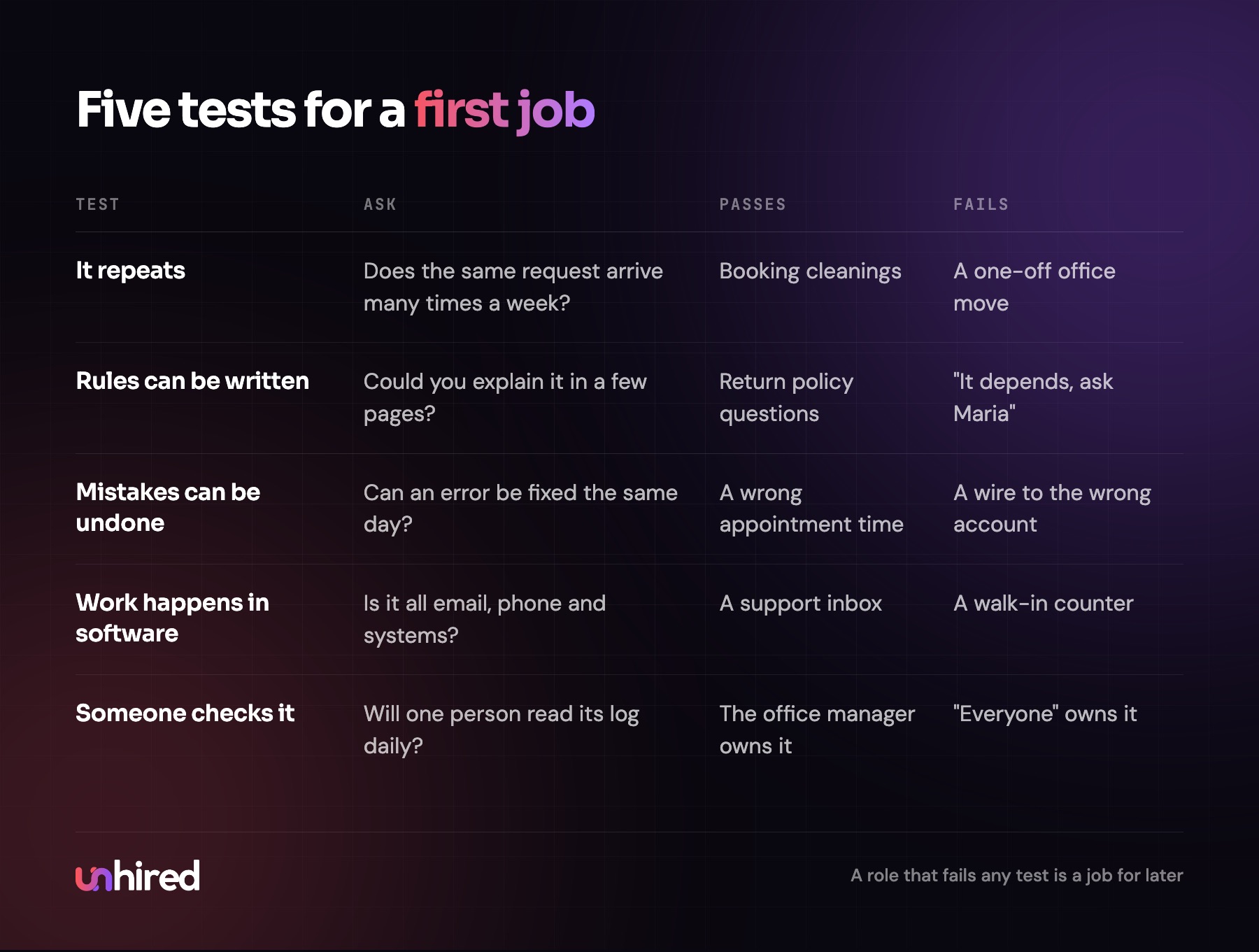
It repeats. The same kinds of request arrive many times a week. A dental office booking cleanings passes. A one-off office move doesn't.
The rules can be written down. If you can explain how the job is done in a few pages, including the exceptions, an AI Employee can follow them. If the honest answer is "it depends, ask Maria," you have a writing problem to solve first, and that's worth knowing before you hire anyone.
A mistake can be undone. A wrong appointment time gets fixed with a text. A wire sent to the wrong account doesn't. First jobs should sit on the reversible side.
The work happens in software. Email, a phone line, a booking system, a CRM, an accounting tool. If the job needs hands, a vehicle or a face at a counter, it's not a first job.
One person will check on it. Every AI Employee needs someone who reads its log and updates its rules when they turn out wrong. If nobody in the business has 20 minutes a day for that in the first month, wait until someone does.
The jobs that usually pass
Across clinics, law firms, property managers, online stores and agencies, the same handful of jobs pass all five tests most often.
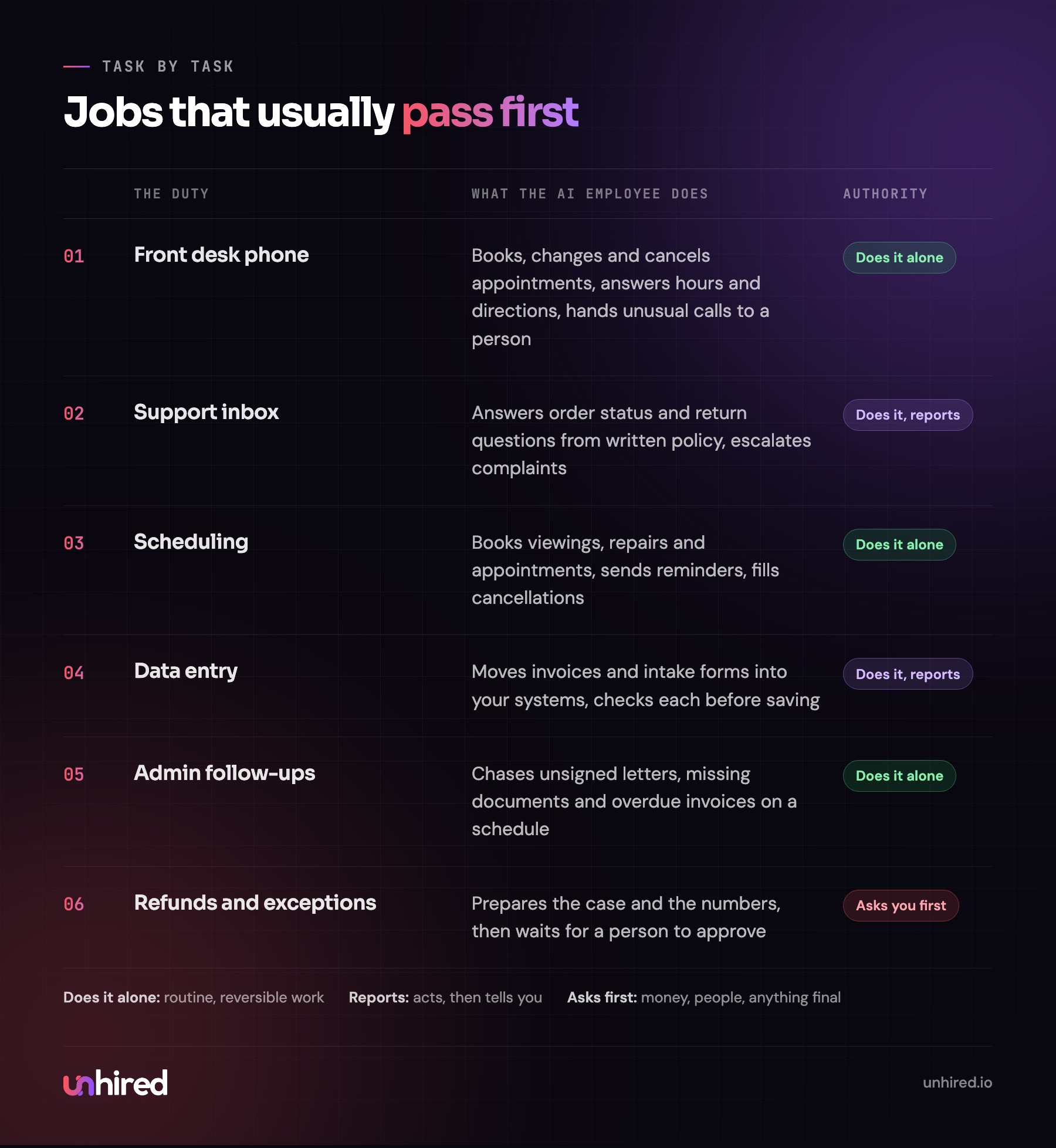
The front desk phone is the most common one I'd point to. Missed calls are easy to count, the requests are mostly the same few (book, change, cancel, hours, directions), and anything unusual can be handed to a person with a note. I went through it in detail in the AI Receptionist breakdown.
A support inbox is a close second for e-commerce and software businesses. "Where's my order" and "how do I return this" make up a large share of most inboxes, and each has a written answer somewhere already.
Scheduling and rescheduling suits any business that runs on appointments: physiotherapy clinics, dental offices, accounting firms in tax season, property managers booking viewings and repairs.
Data entry is the quietest option and often the safest. Moving invoices or intake forms into a system, with a check before anything is saved, never talks to a customer. That makes it a good choice for owners who are nervous about how an AI Employee will sound. More on that in AI Data Entry.
Admin follow-ups round out the list: chasing unsigned engagement letters at a law firm, missing documents from a mortgage applicant, overdue invoices at an agency. People put this work off because it's tedious, and an AI Employee will send the third reminder on schedule without anyone remembering to.
Jobs I'd leave for later
Some jobs are a poor first choice even when an AI Employee could eventually do parts of them.
Closing sales is one. Replying to a new lead within a minute is a fine early job. Negotiating price and deciding which discount to offer is not, at least until you've watched your AI Employee with real customers for a while.
Judgment calls on money, health or legal matters are another. An AI Employee can prepare a refund, flag an unusual lab result for the clinic or collect the facts of a potential case, but a person should make the call. I covered where those lines usually fall in what an AI Employee can't do.
Then there are roles where customers come partly for the person. A walk-in counter at a café or a pharmacy, or a client manager whose relationship is the reason clients stay. A machine could take the order. The business may still want a human there, and that's a fair business decision.
The last group is any job whose process lives entirely in one person's head and changes week to week. Write it down first. Sometimes that exercise alone shows the job is three jobs, and one of them is a good first candidate.
Score your own roles in an afternoon
You don't need a consultant to run this. You need a list and an honest hour with whoever does the work today.
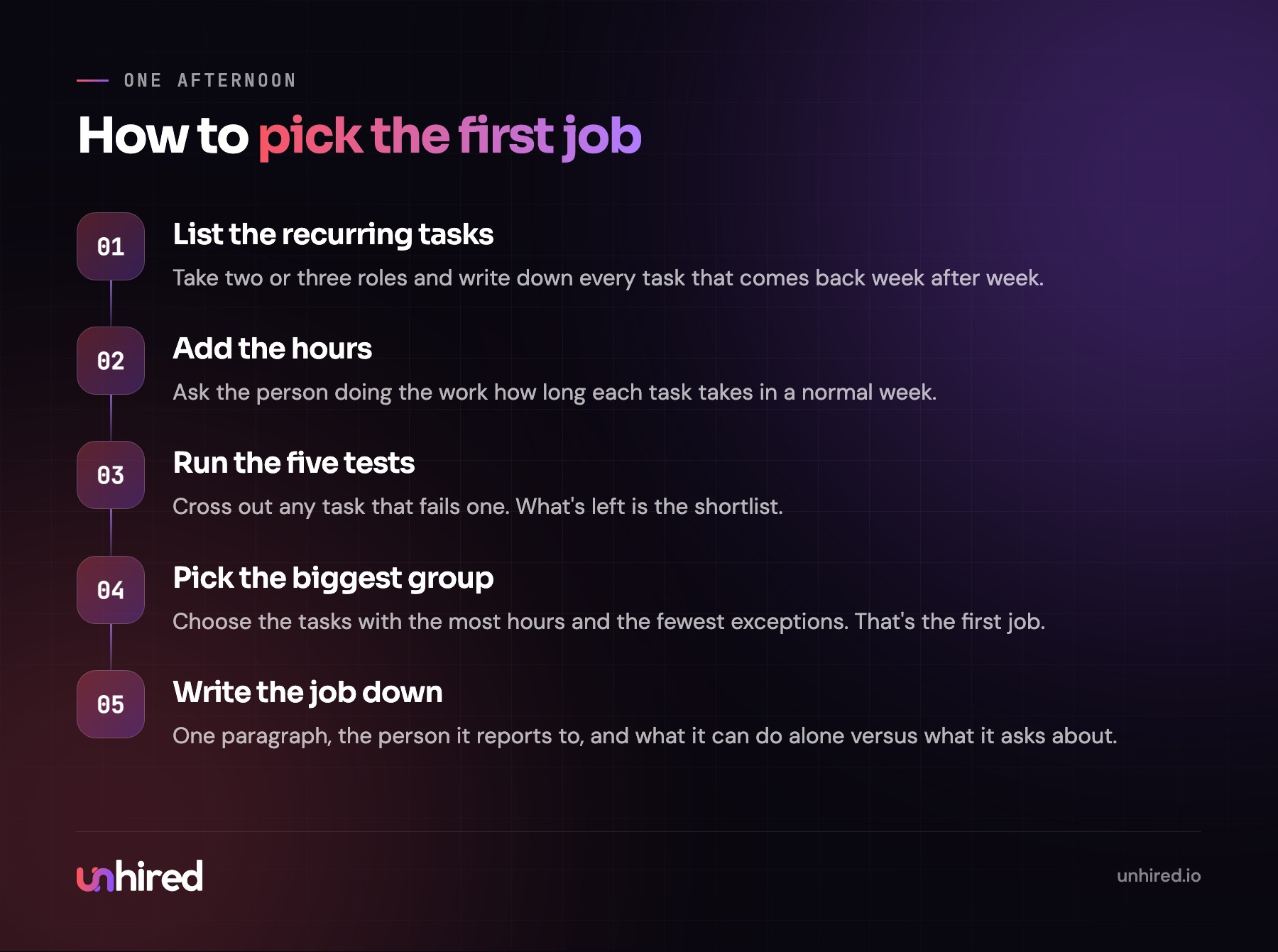
Start by listing every recurring task across two or three roles you're thinking about, and next to each, the hours it takes in a normal week. Ask the person doing it, because owners usually underestimate this by a lot.
Run each task through the five tests. Cross out anything that fails one. What's left is your shortlist.
From the shortlist, pick the group of tasks with the most hours and the fewest exceptions. That group, and only that group, is the first job. Write a one-paragraph job description for it, name the person it reports to, and decide what it can do alone and what it has to ask about.
If you'd rather have a second opinion on whether a role fits, AI Employee assessments, such as the one offered by Unhired, can be a good place to start.
What the seat costs with a person
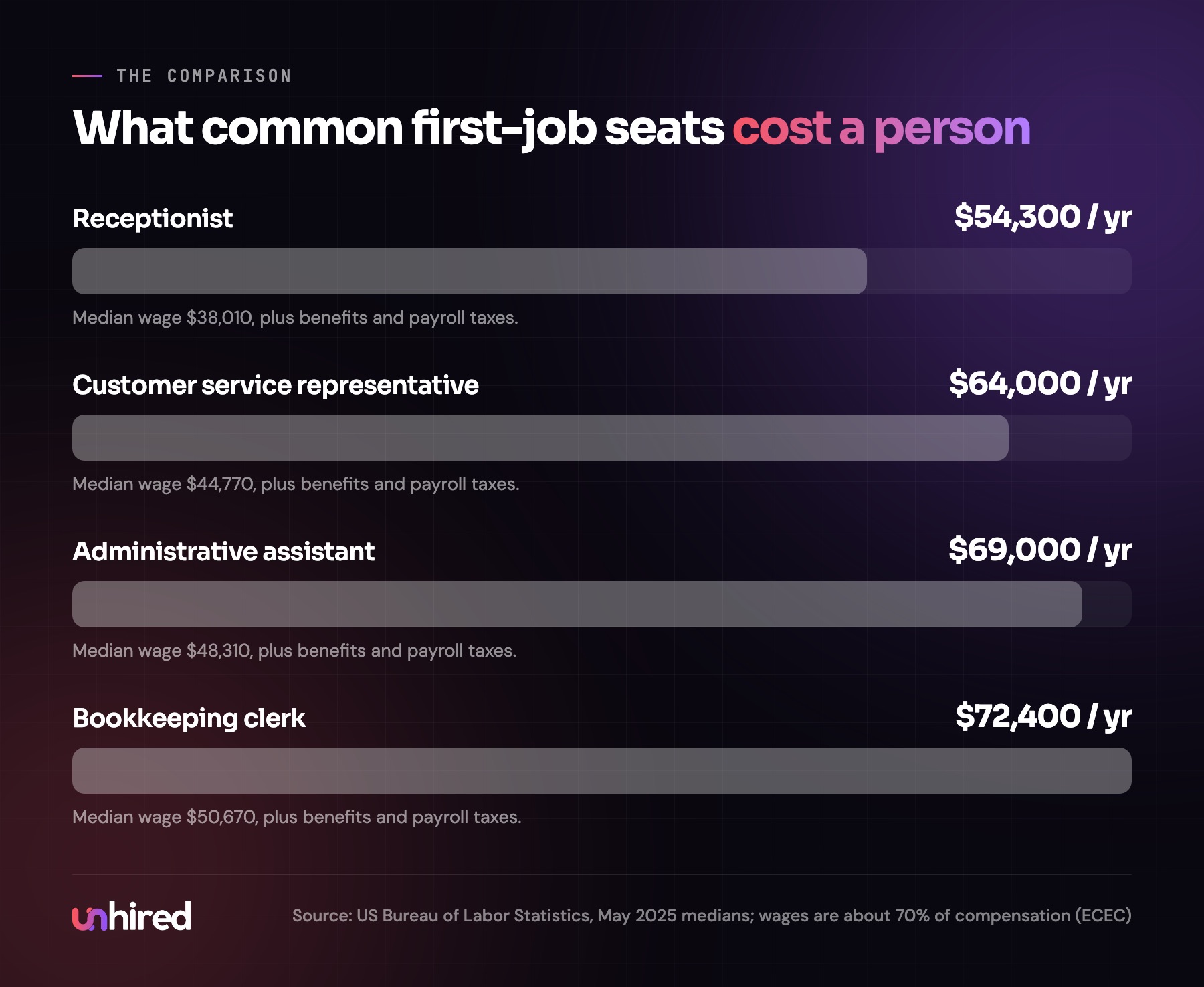
To judge whether a first job is worth filling with an AI Employee, compare it with the full cost of a person in the same seat. The US Bureau of Labor Statistics puts the May 2025 median wage at $38,010 for receptionists, $44,770 for customer service representatives, $48,310 for administrative assistants and $50,670 for bookkeeping clerks.
Wages are about 70% of total compensation in US private industry, according to the BLS Employer Costs for Employee Compensation report. Add benefits and payroll taxes and those seats cost roughly $54,300, $64,000, $69,000 and $72,400 a year, before recruiting and training.
How much a first AI Employee costs
There are two usual ways to get one. You can assemble it from software (an AI agent platform, a phone or email connection, and links into your booking system or CRM) and have someone on staff design, test and maintain it. Or you can have a provider build and maintain it, which is normally a monthly fee.
The price follows the same few things whichever route you take. Each channel adds cost, and the phone costs more than email or text. Each system it logs into is a connection someone has to build and keep working. Jobs with many exceptions take longer to set up and need more review. And someone has to read the log and keep the rules current after launch.
This is one more reason to start narrow. A first job on one channel, touching two or three systems, with rules that fit on a few pages, sits at the low end of whatever pricing you're quoted. My longer breakdown is in how much an AI Employee costs.
Start narrow, then widen
Once the first job is running, resist adding to it for a month. That month is when you find out which rules were wrong and which questions it keeps bringing to its manager. AI Employee onboarding covers what those first 30 days usually look like.
After that, widening is easy. The receptionist that books appointments starts sending reminders. The data entry job starts flagging invoices that don't match the purchase order. Each addition goes through the same five tests.
This week, pick two roles and list every recurring task in them with the hours each takes. Cross out anything that fails a test. Whatever has the most hours left is the job I'd give your first AI Employee.
Wage data: US Bureau of Labor Statistics, Occupational Outlook Handbook, May 2025 medians for receptionists, customer service representatives, secretaries and administrative assistants and bookkeeping, accounting and auditing clerks; full-cost figures use the BLS Employer Costs for Employee Compensation share of wages in total compensation. The clinic, law firm, store and other businesses are examples, not clients.