
A clinic manager gets two quotes for an AI Employee to answer phones and book appointments. One is a software subscription at a low monthly price. The other is a monthly fee several times higher, from a company that says it will build the thing and look after it. On paper the first one wins. In practice the manager is comparing a set of parts with a finished job, and the quotes can't be lined up until that's clear.
I've spent the last four years building AI systems and agents for businesses, and "what does it cost?" is always the first question. The useful answer starts with how the price is put together, because each pricing model moves the cost to a different place.
What you're paying for
An AI Employee is AI set up to hold one job on a team: a title, a manager, logins to the systems the job runs on, and written rules about what it does alone and what it brings to a person. Whatever the pricing model, the money goes to the same handful of things.
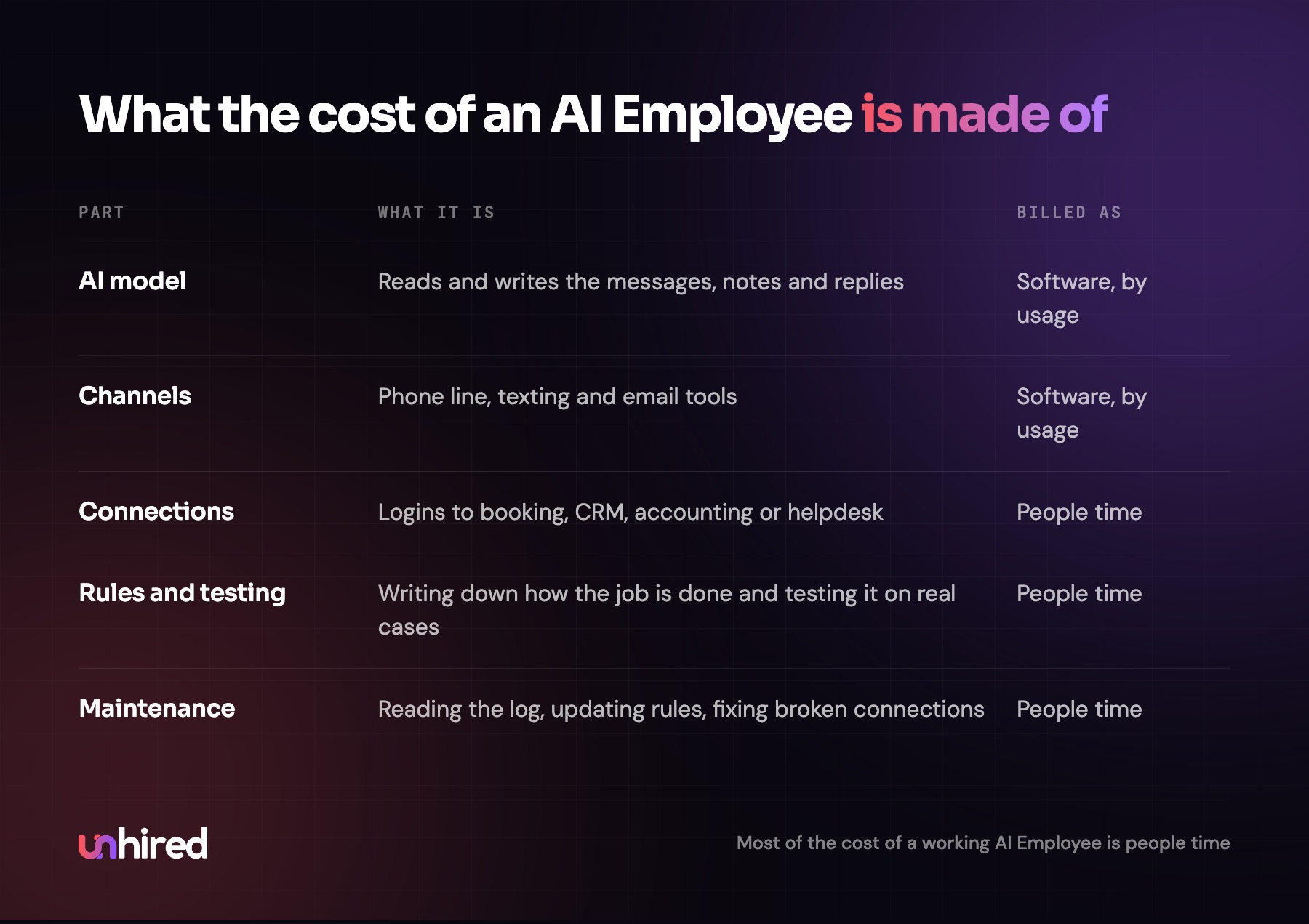
There's the AI model itself, which is billed by how much text it reads and writes. Then the phone line and email tools it works through, and the connections into your booking system, CRM, accounting software or helpdesk. Someone has to write down how your business actually does the job, test it on real cases and fix what goes wrong. After launch, someone reads its log, updates the rules when something changes and catches it when a system it relies on changes its login or layout.
The first two are software bills. The rest is people's time, and that is where most of the cost of a working AI Employee sits.
The four ways AI Employees are priced
Software you assemble yourself
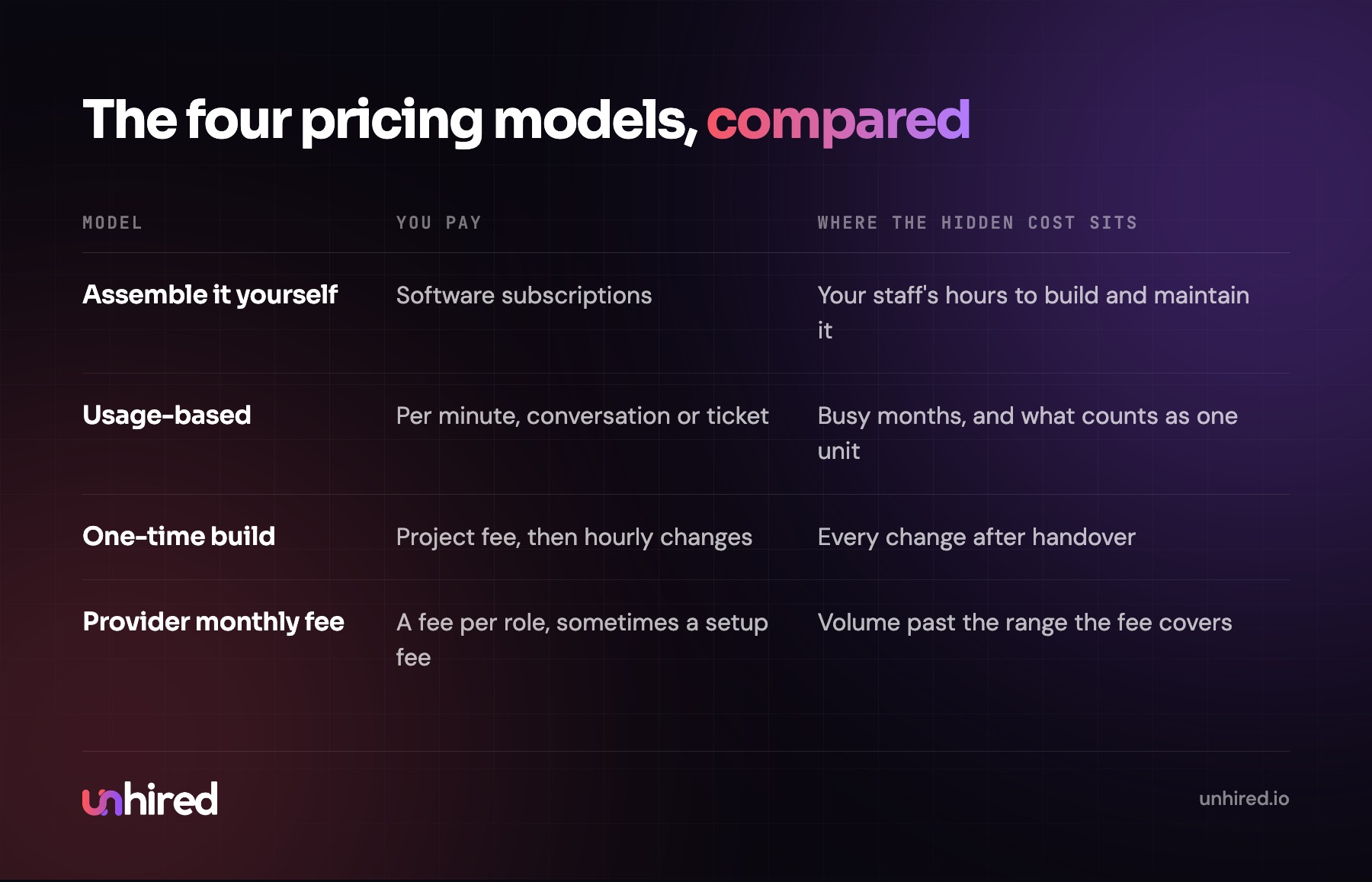
You subscribe to an AI agent platform, connect it to your email, calendar and the rest, and build the workflows. Many platforms bill per seat, per task run or by usage, and some booking, helpdesk and phone systems now include AI features in a higher plan.
The software bill is usually the smallest number in this model. The real cost is the hours of whoever on staff builds and runs it, and that person is often the owner or office manager doing it at night. It works well for a business with someone technical who enjoys this kind of work and a job with simple rules, like answering the same dozen questions by email.
Usage-based billing
Some tools charge per unit of work: per call minute, per conversation, per resolved ticket, per document processed. The monthly bill moves with volume, which works out fine for a business with steady work. A property manager whose phones triple in the first week of the month, or an e-commerce store in December, will see the bill jump at the busiest time.
When you see usage pricing, ask what counts as one unit. A "conversation" that is billed again every time the customer replies a day later costs very differently from one billed once until it's closed.
A one-time build plus maintenance
A consultant or agency builds it for a project fee and then charges hourly or a retainer for changes. You usually also pay the software and usage bills directly. This makes sense when the job is stable and someone in-house can watch the log after handover.
The risk is the period after the project ends. Jobs change: a law firm adds a practice area, or an accounting firm switches document portals. An AI Employee nobody updates gets a little more wrong every month, and each fix is a new invoice.
A monthly fee to a provider
A provider builds it, connects the systems, writes the rules with you and keeps it maintained, usually for a monthly fee per role. Some charge a setup fee as well, and most set a volume range that the fee covers. The number on the quote is higher than a software subscription because it includes the people time the other models leave with you.
This is the model closest to hiring, since you pay each month for a job that gets done. The things to check are what happens when volume goes past the range, how fast changes are made, and whether you can leave and keep your rules and logs.
What drives the price up or down
Whichever model you're quoted, the same few things move the number.
- Volume. A dental office booking 40 appointments a week needs much less than a home care agency rescheduling hundreds of visits.
- Systems. Each login it needs (booking software, CRM, accounting, helpdesk, a payment portal) is a connection someone has to build and keep working. Older software that has no way for other programs to connect costs more, because the AI Employee has to work through the screen the way a person does.
- Channels. Email and text are the cheapest. Answering the phone adds call minutes, voice software and a lot more testing, since people on the phone interrupt, mumble and change their minds mid-sentence.
- Rules and risk. A job with a few clear rules costs less than one with many exceptions. Anything touching patient records, client funds or legal deadlines needs tighter approval steps and more review.
- Maintenance. How often someone reads the log, how quickly changes go in, and who notices when something breaks.
The cheapest AI Employee I'd consider worth running handles one channel, connects to two or three systems and has rules that fit on a few pages. Prices climb from there.
What the same job costs with a person
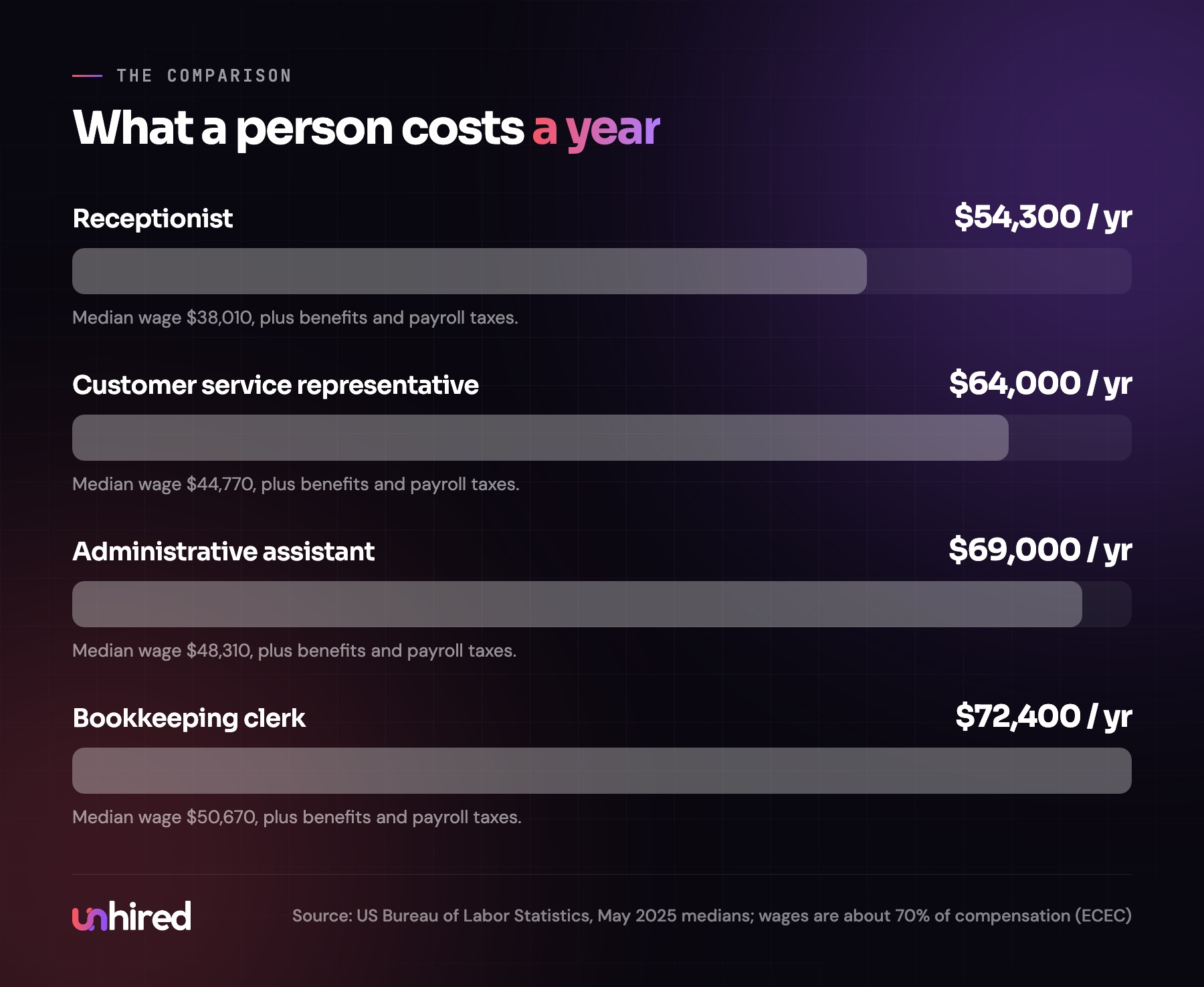
To judge any quote, you need the full cost of the person who would do the work. The wage is only part of it. Across US private industry, wages and salaries are about 70% of what employers spend on compensation, according to the BLS Employer Costs for Employee Compensation report. The rest is benefits and payroll taxes.
Applied to US median wages for the office jobs AI Employees most often take on, the receptionist median of $38,010 (May 2025) becomes about $54,300 a year. A customer service representative at $44,770 is closer to $64,000. An administrative assistant at $48,310 is about $69,000, and a bookkeeping clerk at $50,670 is about $72,400.
Those figures come before recruiting and training, and they buy about 40 hours of coverage a week. Calls, emails and booking requests arrive in the evening and on weekends too. When you set a quote against these numbers, count the hours each option actually covers.
The costs that show up later
Most surprises I see come from the same few places.
Usage overages are the first. Phone minutes and AI model usage can run past the plan in a busy month, so ask for the price per unit above the limit, in writing.
Setup fees are the second. Connecting your systems and writing the rules is real work, and some quotes leave it out of the monthly number. Ask whether there is a setup fee and what it includes.
Changes after launch are the third. A new service, a new location or a new piece of software means the rules need updating. Find out whether changes are included or billed separately, and how long they take.
The last is your own staff's time. Even a well-built AI Employee needs someone to approve the things it holds for a person and to read its log now and then. In the first few weeks that is more time, because it runs in draft mode while a person approves its work. After that it should drop to a short weekly review. If a quote assumes nobody on your side spends any time at all, it's leaving something out.
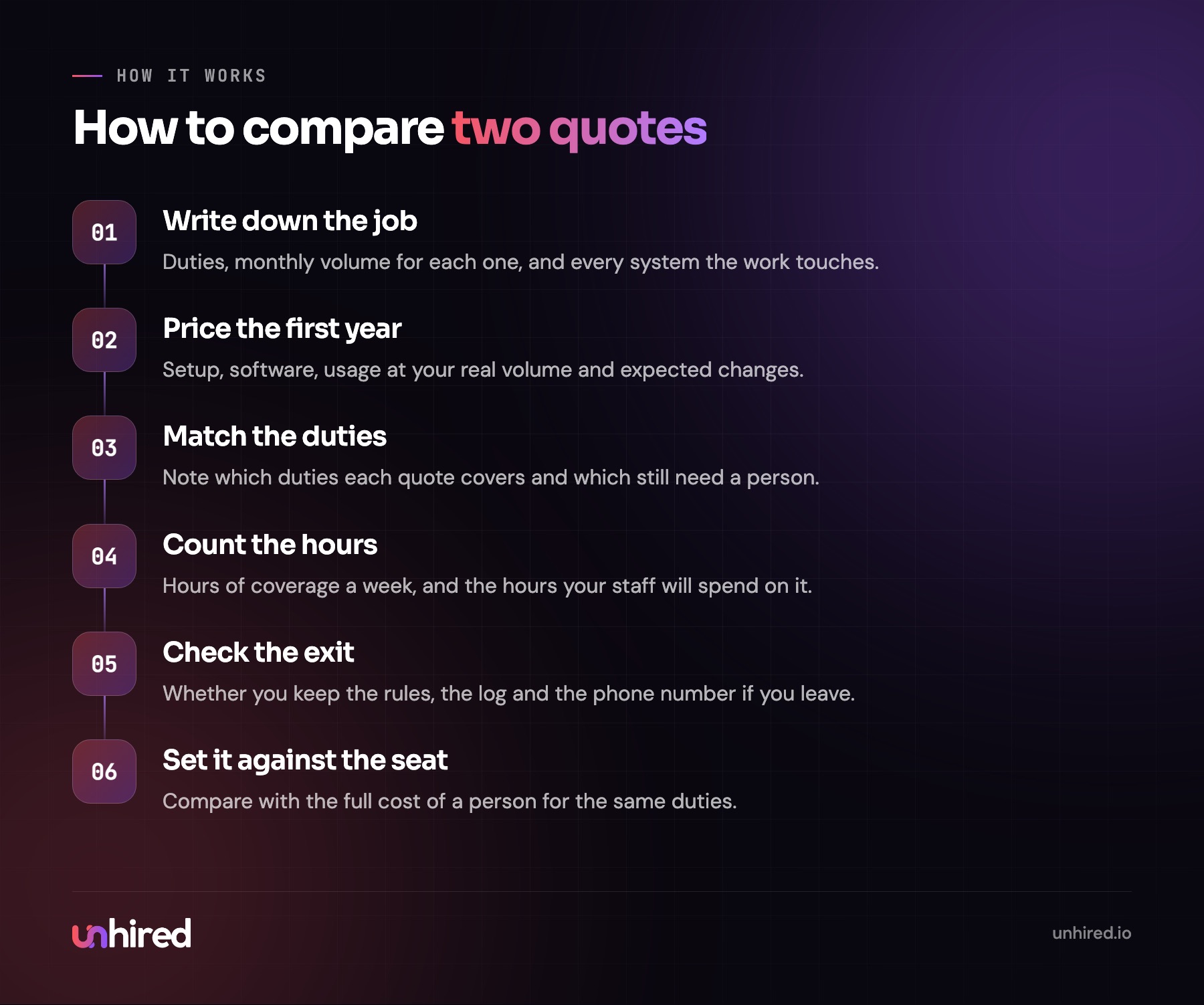
How to compare quotes
Put every quote in the same terms before comparing them. For each one, I'd write down:
- The total for the first year, including setup, software, usage at your real volume and expected changes.
- Which duties it covers and which still need a person.
- The hours of coverage each week.
- The hours your staff will spend on it each month, at a realistic hourly cost.
- What happens if you leave: whether you keep the rules, the log and the phone number.
Then set the first-year total against the full cost of the person for the same duties. If the AI Employee only covers half the job, compare it with half the seat.
Working out your own number
Before asking anyone for a price, write down the job. List the duties, roughly how many calls, emails, bookings or documents each one involves in a normal month, and every system the work touches. Mark the duties that need a person's judgment. A clinic, a law firm and an online store will each end up with a different list, and that list is what a fair quote is built from. Some websites offer free assessments that check whether a role can be filled by an AI Employee, which can help if you're unsure where your role lands.
With that page in hand, ask each provider or tool to price the same list. If two quotes can't be compared against it, one of them is missing something. If you're still deciding between an AI Employee and a person, my post on why your next hire should be an AI Employee covers when a person is still the better call, and the AI Receptionist post works through the cost comparison for one role.
Wage data: US Bureau of Labor Statistics, Occupational Outlook Handbook, May 2025 medians for receptionists, customer service representatives, secretaries and administrative assistants and bookkeeping, accounting and auditing clerks; full-cost figures use the BLS Employer Costs for Employee Compensation share of wages in total compensation.