
A front desk loses most of its calls at two moments: when the receptionist is already on another line, and after they've gone home. A dental clinic that closes at 5 pm still gets calls at 6:15 from people who just got off work. A property manager gets a leak report at 11 pm on a Saturday. A law firm gets an intake call while the only person at the front is walking a client to a boardroom.
An AI Receptionist covers those moments and the ordinary ones in between. This post walks through the job when an AI Employee holds it: what it does on its own, what it always passes to a person, how a day goes, and what it costs next to a hire.
What an AI Receptionist is
An AI Receptionist is an AI Employee that holds the front-desk job. It has a title, a manager (usually the office manager or the owner), logins to the tools the front desk uses, and written rules about what it can do alone and what it has to bring to a person. Every call, chat and email it handles goes into a log your team can read.
That's different from an answering service or a phone menu. An answering service takes a message and someone calls back tomorrow. A phone menu makes the caller do the sorting. An AI Receptionist answers the question, books the appointment, and only passes the call on when a person is actually needed.
It's also different from a chatbot sitting on your website. A chatbot waits to be asked something. An AI Receptionist works the whole front desk: the phone line, the web chat, the general inbox and the appointment reminders that go out each afternoon. The article on AI Employees vs. AI agents covers that difference in more detail.
What it does on the job
Most front-desk work falls into a handful of duties. I'd split them like this, with the authority level that goes with each one.
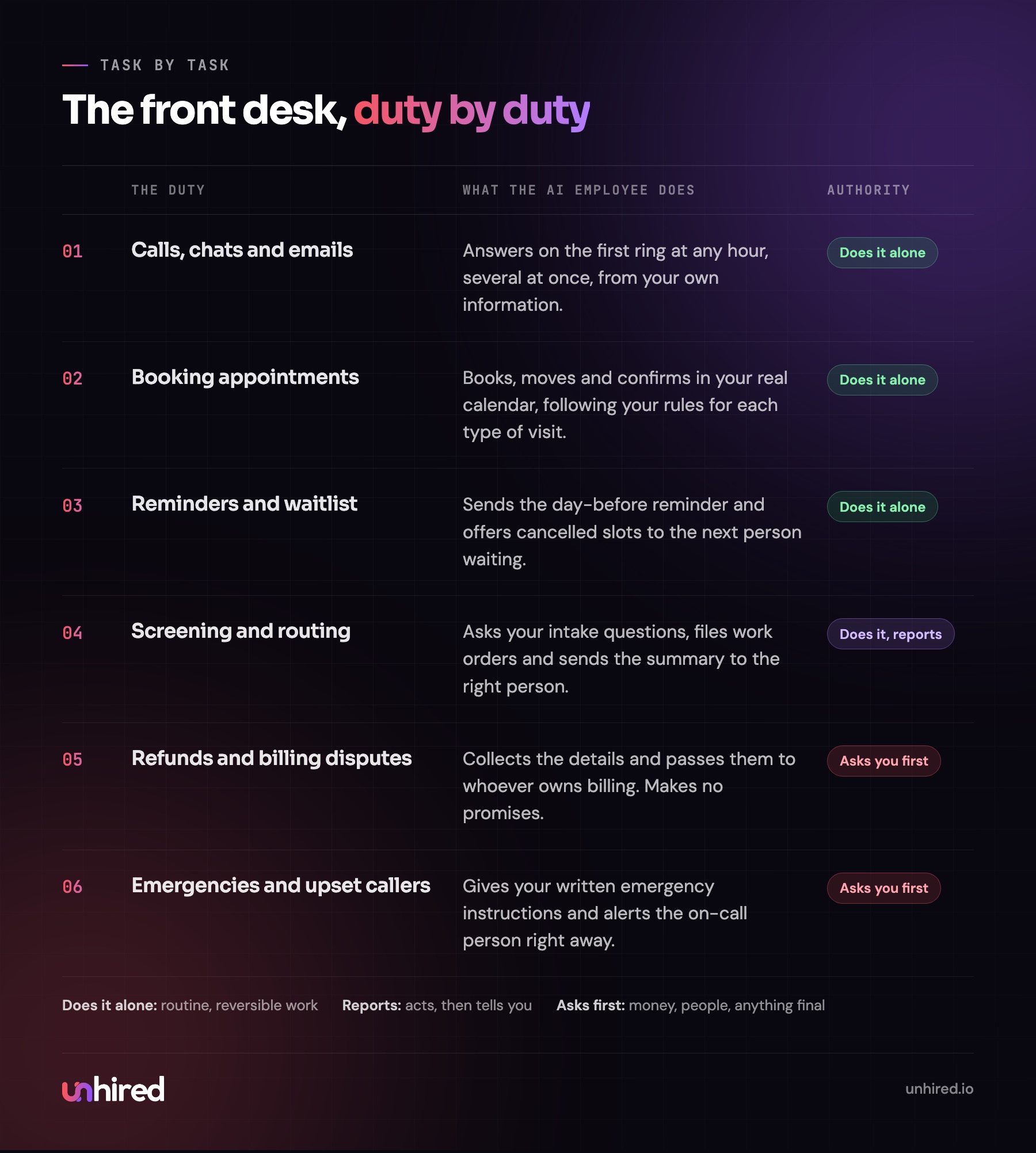
Answering calls, chats and emails
It picks up on the first ring, any hour, and it can take several calls at once. At a vet clinic that means the 8 am rush of people calling about the same-day slots doesn't turn into a wall of busy signals. At an online store, the "where's my order?" email at 10 pm gets a tracking link before the customer goes to bed.
The answers come from your own information: hours, services, prices you publish, parking, intake forms, return policy. When a caller asks something its training doesn't cover, it says it will find out and takes a message for the right person. It doesn't guess.
Booking, moving and confirming appointments
This is where most of the value sits. The AI Receptionist books straight into the system you already use, whether that's Dentrix at a dental office, Clio at a law firm, or a shared Google Calendar at a marketing agency. It follows your rules: new patients get a 60-minute slot, consults only on Tuesday and Thursday afternoons, no bookings within two hours of closing.
It also sends the reminder the day before, handles the "can I move it to Friday?" reply, and offers the freed slot to the next person on the waitlist.
Screening and routing
A law firm doesn't want a family law call landing on the corporate lawyer's desk. The AI Receptionist asks the intake questions you'd ask (what kind of matter, any deadlines, has the other side retained counsel), runs a conflict check request if you use one, and sends the summary to the right lawyer or paralegal.
A property management office works the same way with maintenance requests. It collects the unit number, what's wrong, photos if the tenant can send them, and whether there's water or no heat, then files the work order.
Messages and handoffs
When something needs a person, it doesn't just say "someone will call you." It sends your team a written summary: who called, what they need, what's already been tried, and how urgent it is. The person picking it up doesn't have to start the conversation over.
What it should always hand to a person
An AI Receptionist that knows when to stop is the only kind worth having. These are the calls I'd never let one handle on its own, at any business:
- Emergencies. A tenant reporting a gas smell or a client describing chest pain gets the emergency instructions you've written (call 911, the after-hours line, the on-call manager), and your on-call person is alerted right away.
- Advice that needs a licence. It can book a consult with a lawyer. It can't tell someone whether they have a case. It can tell a patient the clinic's hours. It can't tell them whether a symptom is serious.
- Money in dispute. Refund requests outside your written policy, billing disputes and collections go to whoever owns them.
- Upset callers. If a caller is angry or asks for a person, it hands off. Arguing with an upset customer is a job for someone who can make an exception.
- Anything new. A question your rules don't cover gets logged and passed on, and the answer gets added to its training so next time it knows.
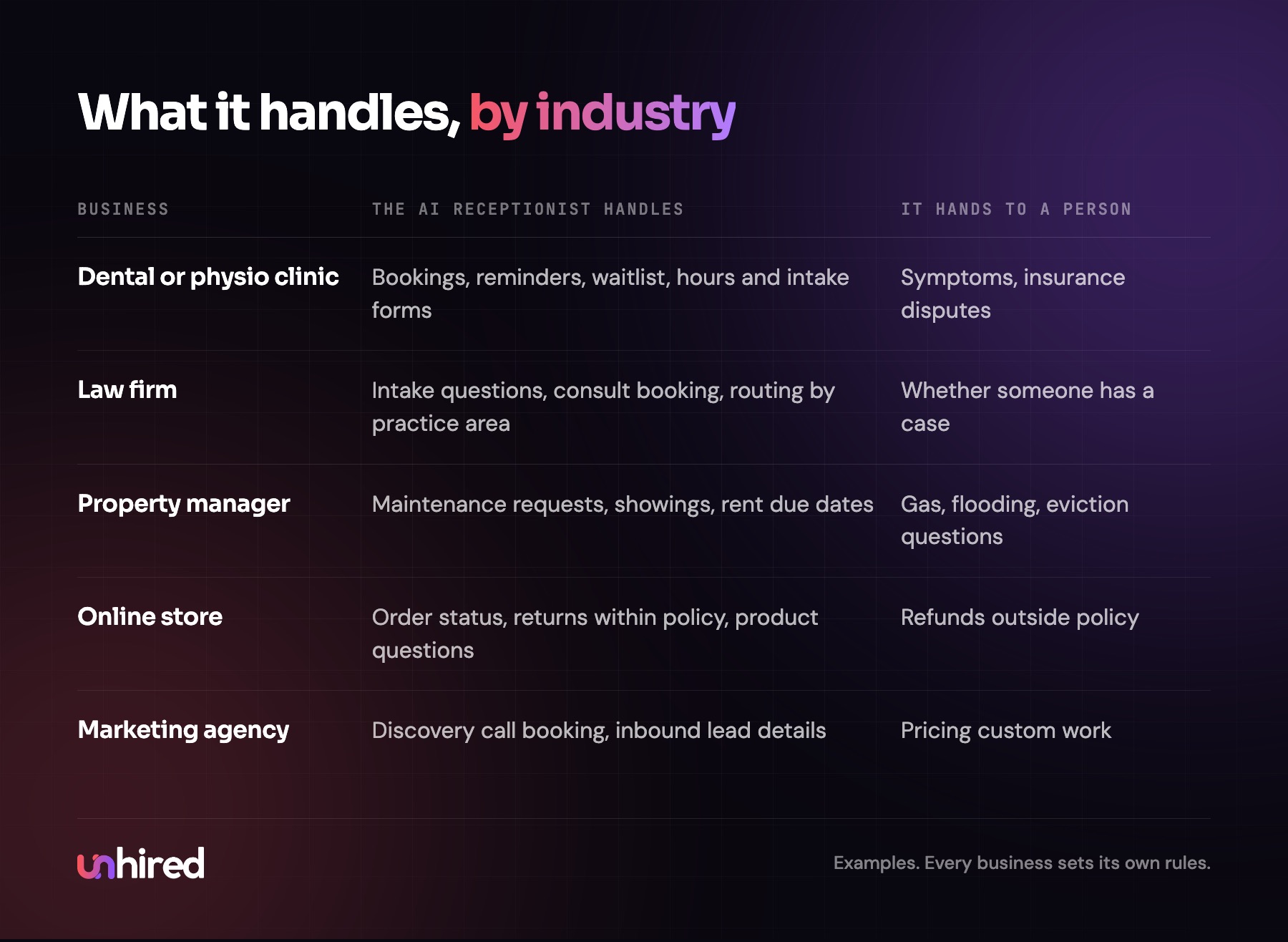
A day at a busy front desk
Here's an example day for an AI Receptionist at a physiotherapy clinic. Two items on it go to a person, and that's how it should look.
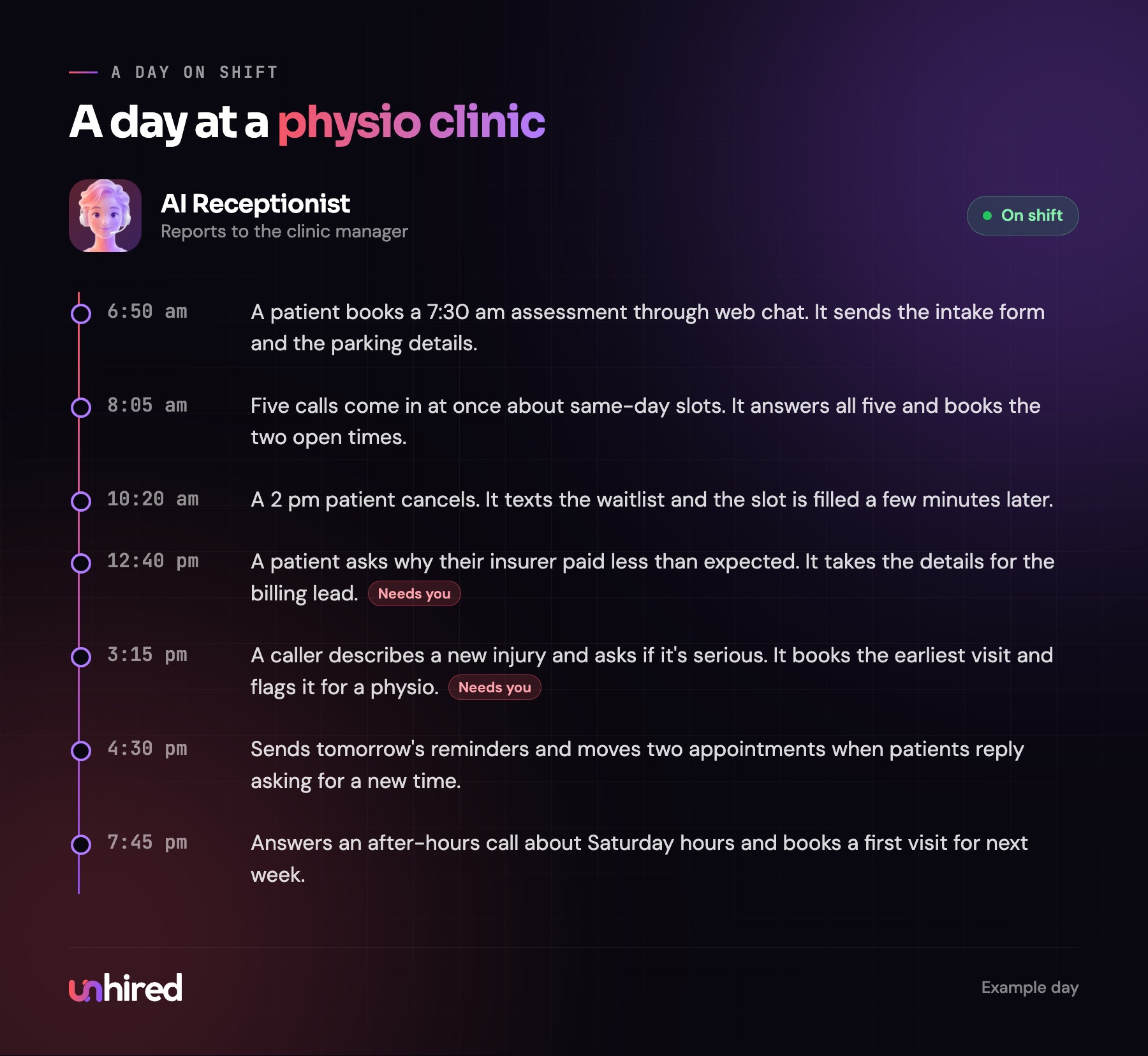
The 6:50 am booking happens before anyone has opened the clinic. The cancellation at 10:20 fills from the waitlist inside a few minutes, which is a slot that would otherwise sit empty. The billing question and the caller asking about a new injury both land with a person, with a summary attached.
What a front-desk hire costs
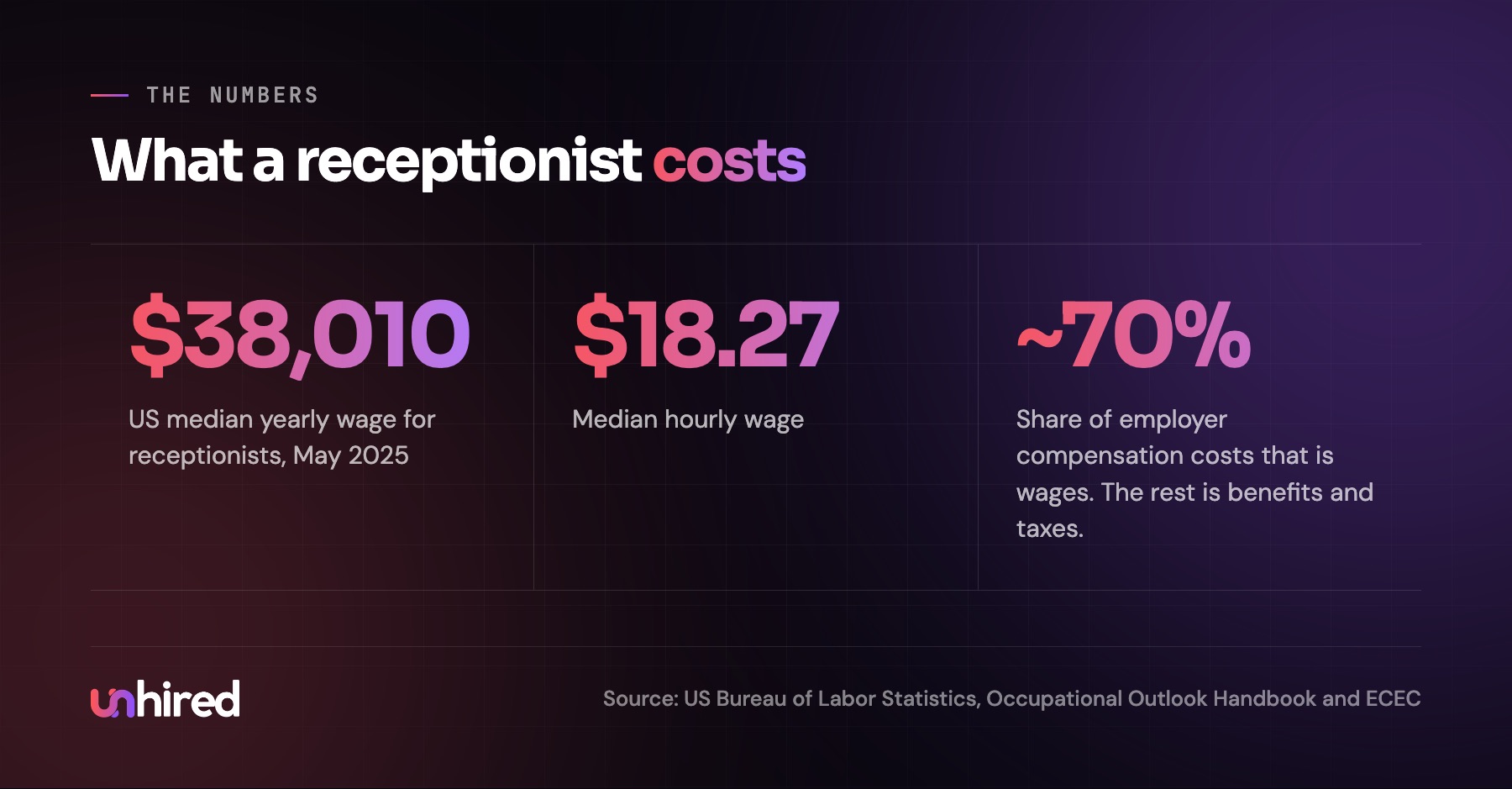
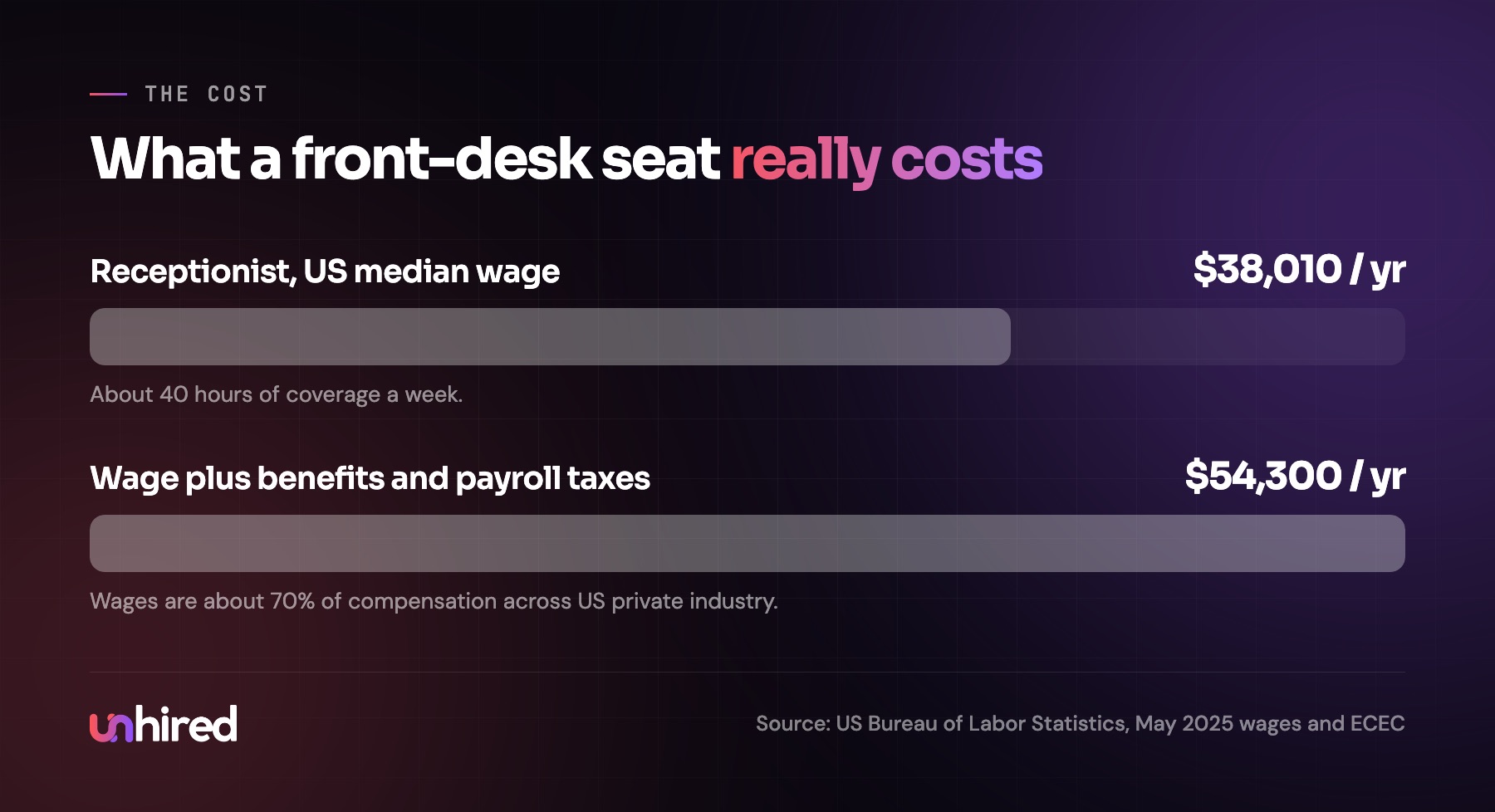
The US Bureau of Labor Statistics puts the median wage for receptionists at $38,010 a year, or $18.27 an hour, as of May 2025. In healthcare and social assistance, where many receptionists work, the median is $19.00 an hour.
The wage is only part of the bill. Across US private industry, wages and salaries are about 70% of what employers spend on compensation, according to the BLS Employer Costs for Employee Compensation report. Benefits and payroll taxes make up the rest. Then add the costs that never show on a pay stub: the job ad, the interviews, training, and someone to cover lunch breaks, sick days and vacation.
There's also the coverage gap. One full-time receptionist works about 40 hours a week. The other 128 hours, the phone goes to voicemail, and covering evenings and weekends with people means a second or third hire.
How much you'd pay for an AI Receptionist
There are two ways to get one, and they're priced differently.
Building it yourself. AI agent platforms and phone-answering tools sell the parts as monthly subscriptions. The software can be cheap. The real cost is the time it takes someone on your team to map the calls, connect the booking system, write and test the instructions, and keep all of it current. If that person is you, count your hours.
Having it built and maintained. A provider sets it up, connects your tools, trains it on your business and keeps it updated, usually for a monthly fee. You pay more than the bare software, and in return nobody on your team has to run it.
Prices vary with a few things: how many channels it covers (phone, chat, email, text), how many systems it connects to, how many calls it handles, whether it needs more than one language, and how much ongoing maintenance is included.
To compare a quote fairly, set it against the full cost of the seat. A receptionist at the US median wage costs $38,010 a year in pay. If wages are about 70% of compensation, as the BLS figures show across private industry, the full cost is closer to $54,300 before you count hiring and training. That buys about 40 hours of coverage a week. An AI Receptionist covers all 168.
How an AI Receptionist is set up
The setup looks a lot like training a new front-desk hire, because that's most of what it is.
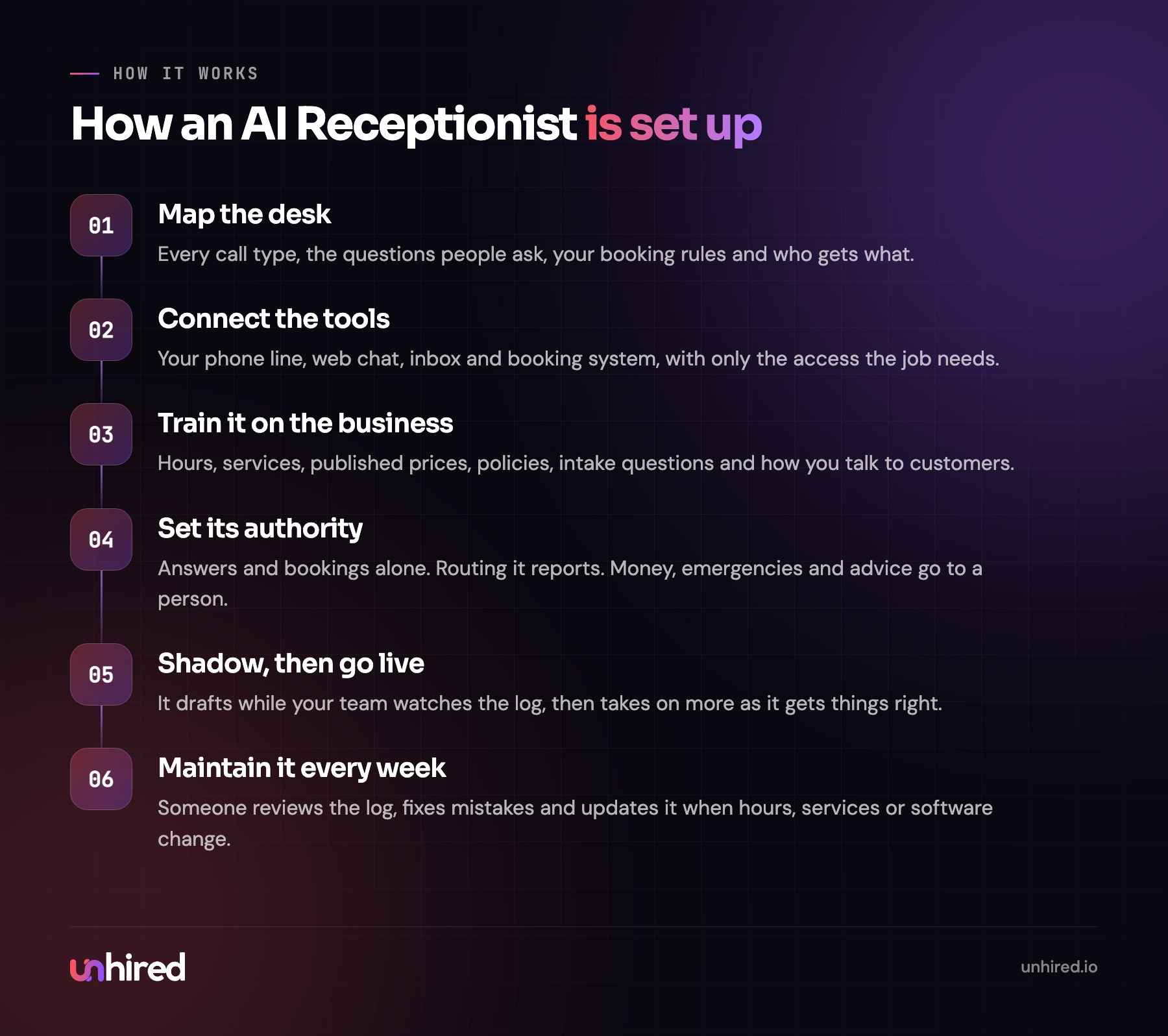
The step owners skip is the last one. You'll add a service, change your hours for the holidays, hire a new associate or switch booking software. An AI Receptionist nobody updates drifts out of date and starts giving last month's answers. Whoever builds it, decide up front who reviews its log and updates it, and how often.
When to keep a person at the front desk
Some front desks are mostly in-person work. If your receptionist spends the day greeting walk-ins, taking payments at the counter or calming a nervous patient in the waiting room, you still need a person there. An AI Receptionist can take the phones and inbox off their plate, which is usually the part that makes the job impossible to do well.
If the desk is mostly phones, email and booking, an AI Receptionist can hold the whole seat. The seven reasons to hire an AI Employee apply here more than to almost any other role.
Before you post a receptionist job, list every duty in the description and sort each one into three groups: what an AI Employee could own, what it could do with a person checking, and what needs someone at the desk. The second group is usually smaller than people expect. AI Employee assessments, such as the one offered by Unhired, can do that sorting for you and are a good place to start.