
An online store switches on an AI Employee for customer emails on a Monday morning. By lunch it has answered 60 messages, and two of them promised refunds on items that were past the return window. Nobody had looked at a single reply before it went out, because the setup had passed its tests and everyone wanted to see it work.
I've spent the last four years building AI systems and agents for businesses, and the first month is where I see most of them succeed or fail. The model is rarely the problem. The problem is that the business skipped onboarding: the weeks where a new hire is watched, corrected and given more responsibility only as they earn it. An AI Employee needs the same month, and it needs it written down more carefully than a person would.
What onboarding means for an AI Employee
An AI Employee is AI set up to hold one job on a team, with a manager, its own logins and written rules about what it can do alone. Training gives it the knowledge, meaning the handbook and the documents it works from. I covered that part in how to train an AI Employee. Onboarding is what happens next, when it starts doing the job and the business decides how much to trust it.
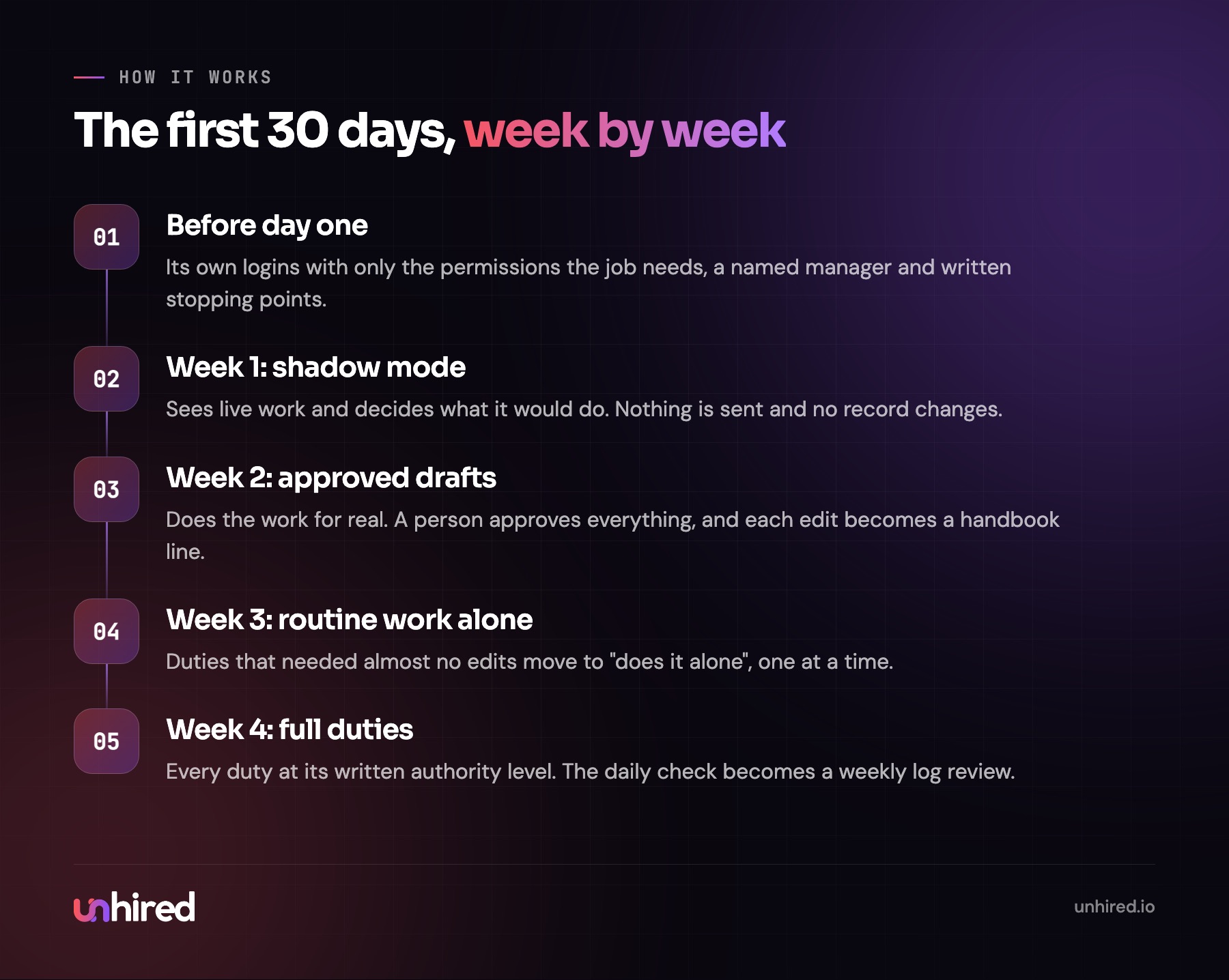
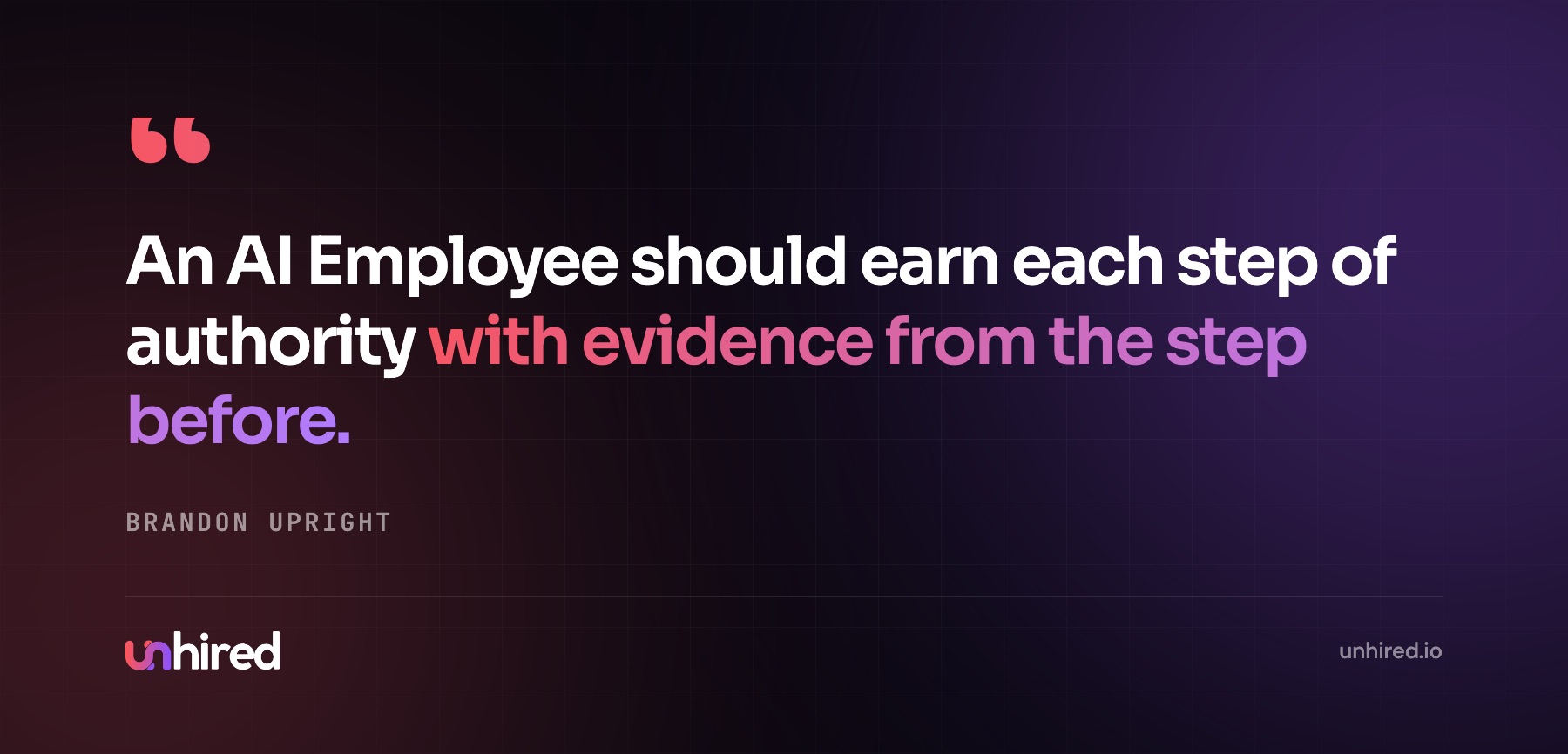
The idea is simple. Authority goes up in steps, and each step is earned with evidence from the step before. In week one it watches. In week two it drafts and a person approves. By week three it handles the routine work alone, and by the end of the month it has its full set of duties and a manager who reads its log every week.
Before day one: accounts, limits and a manager
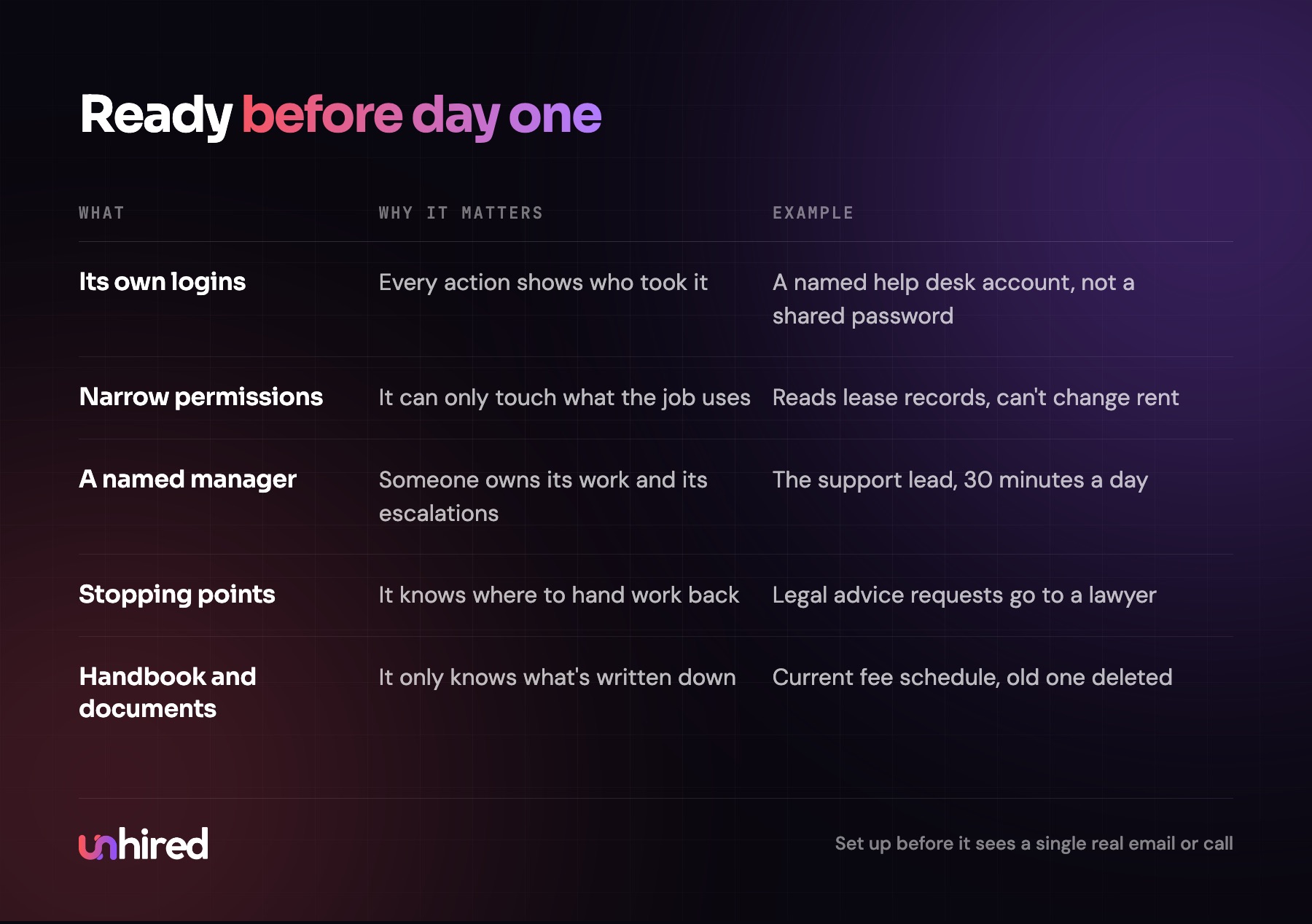
Three things need to be in place before it sees a single real email or call.
The first is its own accounts. Give it a named login on each system the job uses, such as the help desk or the practice management software, rather than sharing a person's password. That way every action in the system's history shows who took it. Set the permissions to the job and nothing wider. An AI Employee answering tenant emails for a property manager needs to read the lease records and write notes. It doesn't need to change rent amounts.
The second is a manager with a name. Pick the person who manages the job today: the office manager for front desk work, the controller for bookkeeping, the support lead for customer email. They know what a good reply looks like, and they are the person it escalates to. For the first two weeks, block about half an hour a day in their calendar for its work. If nobody can find that time, wait to start.
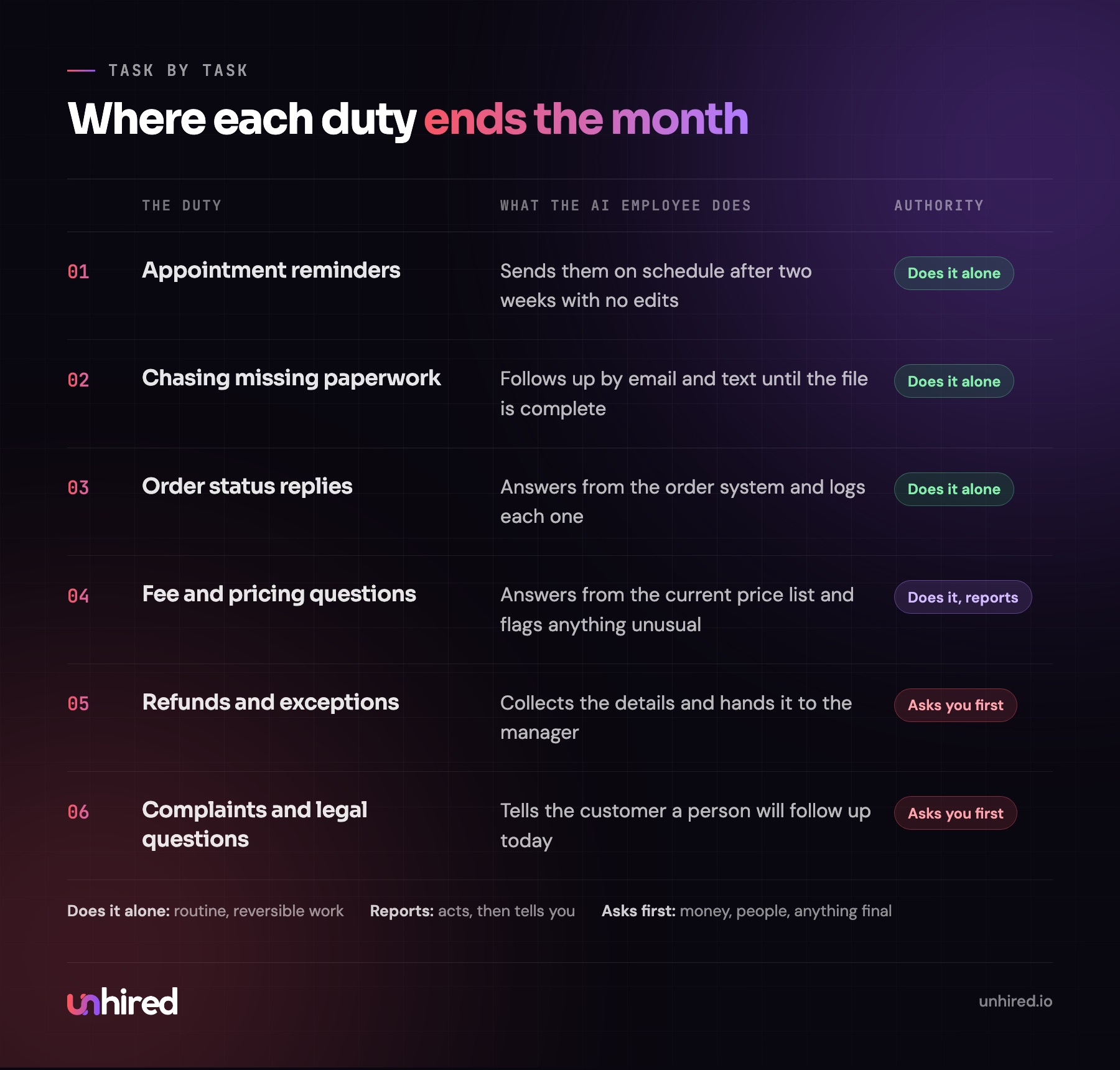
The third is the list of stopping points, written per duty: what it does alone, what it does and reports, and what it has to ask about first. A law firm's intake role might book consultations alone, answer fee questions and report them, and stop completely on anything that sounds like a request for legal advice.
Week 1: shadow mode on live work
In the first week the AI Employee sees real incoming work and decides what it would do, but nothing goes to a customer and no record changes. At a dental clinic, it reads every booking request that reaches the front desk and writes the reply it would have sent and the appointment it would have booked. The receptionist works exactly as before.
At the end of each day, the manager compares the two. I'd sort every difference into one of four causes, because each has a different fix: a missing instruction, an out-of-date document, a bad example, or a limit that's too loose. Fix the cause and the whole category of mistake goes away, where fixing the single reply only fixes that reply.
Shadow week is also the honest test of whether the job suits an AI Employee. If most of the week's work turns out to need judgment calls that only a person can make, that's worth knowing before anything goes out. Some websites offer free assessments that check whether a role can be filled by an AI Employee, which is a cheaper way to find out before the setup starts.
Week 2: drafts a person approves
In week two it does the work for real, but a person approves everything before it reaches a customer or changes a record. For an accounting firm's document requests, it drafts the reminder email to each client with missing bank statements, and the manager reads it, edits it if needed and sends it.
Every edit is information. When the manager changes a reply, they write one line about why, and that line goes into the handbook the same day. If they change "we'll have it back to you tomorrow" to "within three business days" twice in a week, the handbook was missing a sentence about turnaround times.
This week usually shows whether the review time is going to come down. By Friday the manager should be approving more drafts unchanged than on Monday. If they aren't, look at which kind of edit keeps repeating and fix that before moving on.
Week 3: routine work on its own
In week three, the duties that went through week two with almost no edits move to "does it alone". Usually that means the predictable, easy-to-undo work: booking confirmations, appointment reminders, order status replies, chasing missing paperwork. Anything involving money or a complaint stays with approval or escalation.
Move duties over one at a time, and keep a short list of which ones have changed. A recruiting agency might let it schedule interviews alone in week three while candidate rejections still go through a recruiter. The manager stops approving each item and reads the day's log instead, which takes far less time.
Week 4: full duties and a weekly review
By the last week it has every duty the role was set up for, each at the authority level you wrote down before day one. The daily check becomes a weekly review of the log, with most of the attention on what it escalated and anything a customer pushed back on.
At the end of the month, sit down with the manager and decide three things. Which duties stay at their current level, which can move up a step, and which should move back down because the evidence isn't there yet. Write the answers into the handbook. Most roles keep at least one duty on "ask first" for good, and that's a sign the limits are set properly.
What to measure in the first 30 days
Four numbers tell you whether onboarding is working. I'd track them in a plain spreadsheet, one row per week.
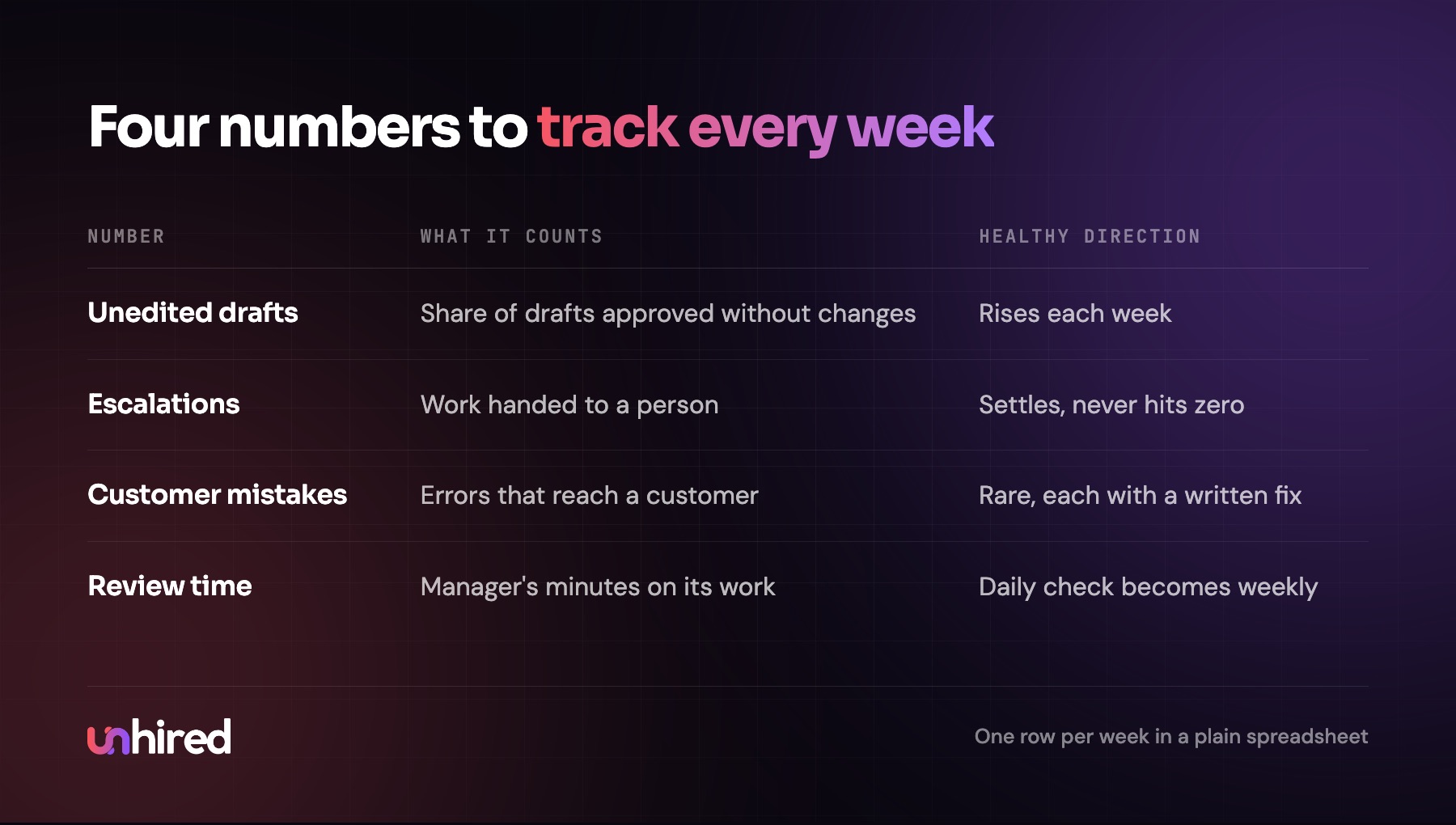
The share of drafts approved without edits should rise each week of the approval stage. The number of escalations should settle at a steady level rather than drop to zero, because some work always belongs with a person. Mistakes that reach a customer should be rare and each one should lead to a written fix. The manager's review time should fall from daily to weekly. If that last number doesn't come down, the onboarding hasn't finished, whatever the other three say.
What the first month costs
Most of the cost of onboarding is the manager's time: about half an hour a day for two weeks, then less as the daily check turns into a weekly review. When a provider builds and maintains the AI Employee, they usually run the shadow week and the fixes with you as part of their monthly fee. When you assemble it yourself from software, someone on your staff does the comparing, fixing and retesting.
Compare that with the month a new person spends getting up to speed. The US median wage for a receptionist was $38,010 in May 2025, according to the Bureau of Labor Statistics. Wages make up about 70% of what private employers spend on compensation (BLS Employer Costs for Employee Compensation), so the seat costs closer to $54,300 a year. A new hire's first month is paid at full rate while they learn, and a coworker spends part of their own time covering and answering questions. What the AI Employee learns in its month stays in the handbook if anything changes later.
When to slow down or stop
Three signs mean it should go back a step. The first is the same kind of mistake coming back after it was corrected, which usually points to two documents that disagree or an instruction that's too vague. The second is a rise in escalations on work it was handling fine, which often means something in the business changed and nobody told it. The third is a manager who has stopped reading the log. That one is the most dangerous, because the first two can't be caught without it.
Going back a step is normal. A new receptionist who books a double appointment gets watched a bit more closely for a week, and nobody treats it as a failure. I covered the jobs that should never leave a person's hands in what an AI Employee can't do.
Where to start
Before anything else, pick the manager and get half an hour a day into their calendar for two weeks. Then write the list of duties for the role with a stopping point next to each one, and open a spreadsheet with the four weekly numbers as columns. With those three things ready, the first day of shadow mode can start whenever the setup is, and every step after it has a clear test for when to move on.
Wage data: US Bureau of Labor Statistics, Occupational Outlook Handbook, receptionists, May 2025 median; full-cost figure uses the BLS Employer Costs for Employee Compensation share of wages in total compensation. The opening example is illustrative.