
A property management office switches on an AI Employee to answer tenant emails. In its first week it tells a tenant that pets are allowed with a deposit. That was the policy two years ago. The current one is a PDF on the office manager's desktop, and the AI Employee was given the old version from a shared drive, so it repeated it to the tenant with full confidence.
I've spent the last four years building AI systems and agents for businesses, and that is the most common mistake I see. The software did what it was told. Nobody had trained it on how the business works today. Training an AI Employee is less technical than people expect and more work than they hope, because most of it is writing down things your staff carry in their heads.
What training means for an AI Employee
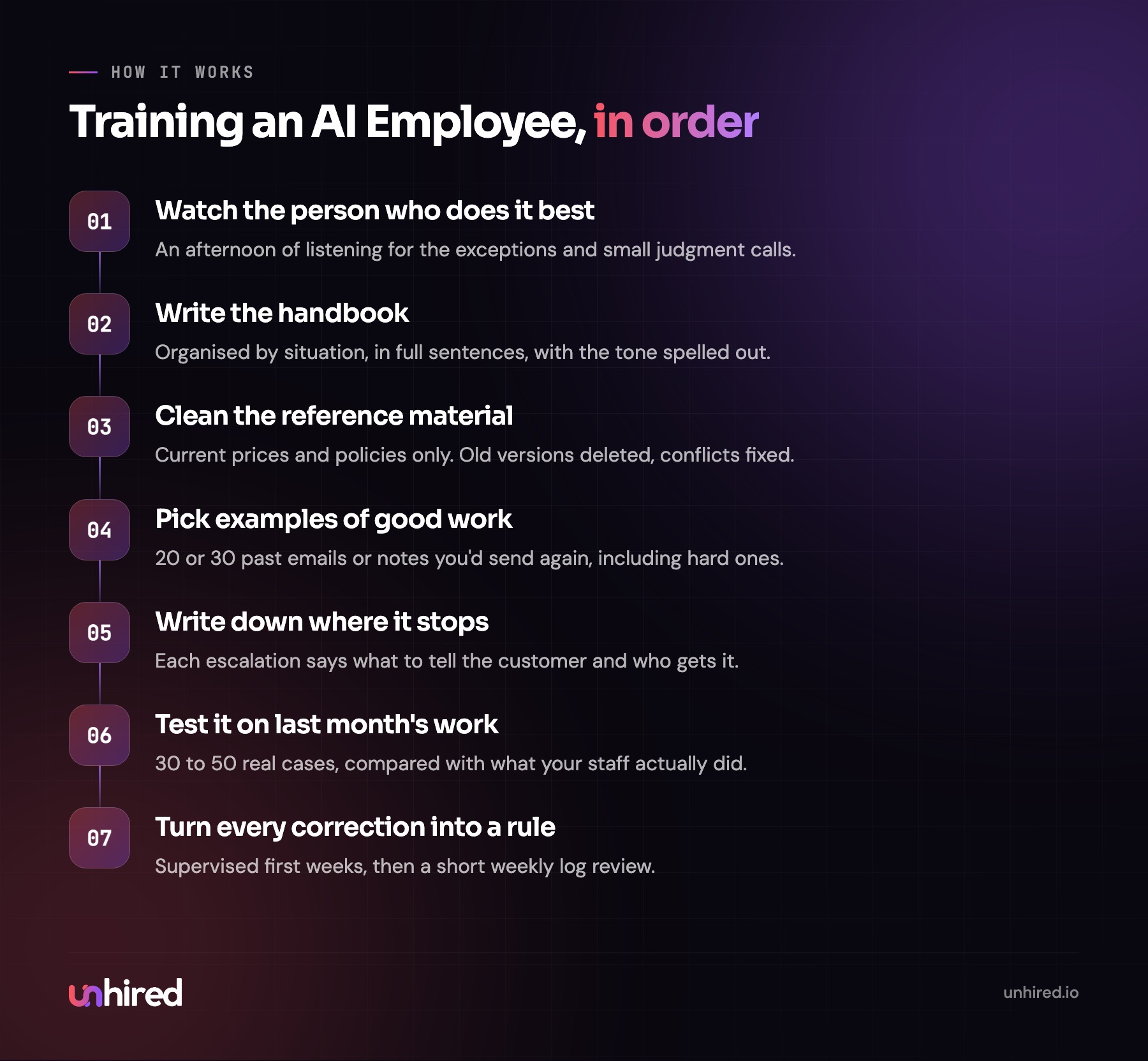
An AI Employee is AI set up to hold one job on a team, with a manager, logins to the systems the job uses and written rules about what it can do alone. It runs on an existing AI model from one of the large AI companies, and training it on your business doesn't touch that model. You give it the same things a good new hire gets in their first two weeks: instructions for how the job is done here, reference material, examples of good work, limits on what it decides alone, and feedback once it starts.
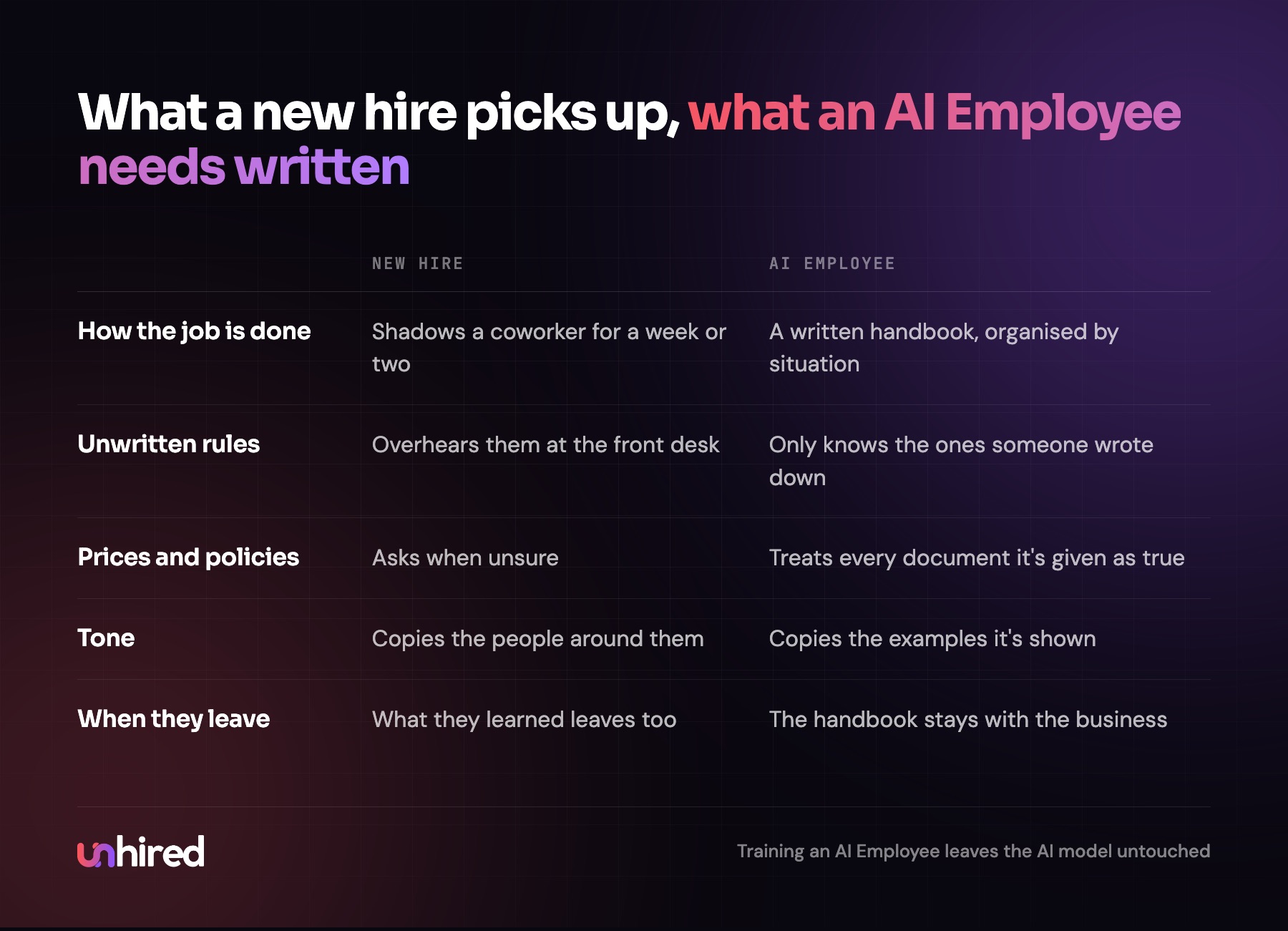
The difference from a new hire is that an AI Employee only knows what's written down. A receptionist learns "we never book Dr. Patel before 10" by overhearing it at the front desk. An AI Employee needs that sentence in its instructions, or it will book the 8:30.
Start by watching the person who does it best
Before writing anything, sit with whoever does the job well for an afternoon, or ask them to talk you through a normal day. At an accounting firm, the person handling client document requests knows which clients always send bank statements late, which ones need a phone call instead of an email, and that any letter from the tax authority goes to a partner the same day. None of that is in a manual.
Write it down the way they say it. You're listening for the exceptions and the small judgment calls. The routine steps are easy to describe, and the exceptions are where an untrained AI Employee goes wrong.
If you do the job yourself, this step is harder, because you've stopped noticing your own habits. Keep a notepad for a week and write down every decision you make that someone else would have to ask you about.
Write the handbook like you would for a new hire
Turn those notes into a plain document. I'd organise it by situation rather than by topic: "When a new client emails asking for a quote" or "When a supplier invoice doesn't match the purchase order". Under each one, write what to do, in order, and what a good outcome looks like.
Use full sentences, the way you'd explain it to a smart person on their first day. "Reply within the hour during business hours. If the property address or move-in date is missing, ask for it. Don't promise a viewing time; offer the three open slots on the calendar." Specific instructions beat general ones. "Be helpful and professional" tells it nothing it wasn't going to do anyway.
Put the tone in writing too. If your law firm never uses a new client's first name, or your online store signs every email with the support person's first name, say so.
Clean the reference material before you hand it over
An AI Employee treats every document it's given as true. That makes the reference material the riskiest part of training, and it's the part owners spend the least time on.
Gather what a new hire would need: the current price list or fee schedule, policies on cancellations, refunds and returns, service descriptions, opening hours and the list of who handles what. Then go through each file with one question: is this still how we do it? Delete old versions instead of leaving them in the same folder. If two documents disagree, fix one. A dental clinic with last year's fee schedule and this year's in the same folder will get both quoted back to patients.
Pick one place where the current version of each document lives, and make updating it part of the job of whoever changes the policy. After launch, that habit matters more than anything else in this article.
Show it examples of your best work
Instructions say what to do. Examples show what it sounds like when it's done well. Pull 20 or 30 emails or call notes from your files that you'd be happy to see go out again, and include some hard ones, like a refund declined politely or a client told their deadline has moved.
Leave out anything you wouldn't send again. If your team has been firing off one-line replies during a busy season, those examples will teach it to send one-line replies.
Write down where it stops
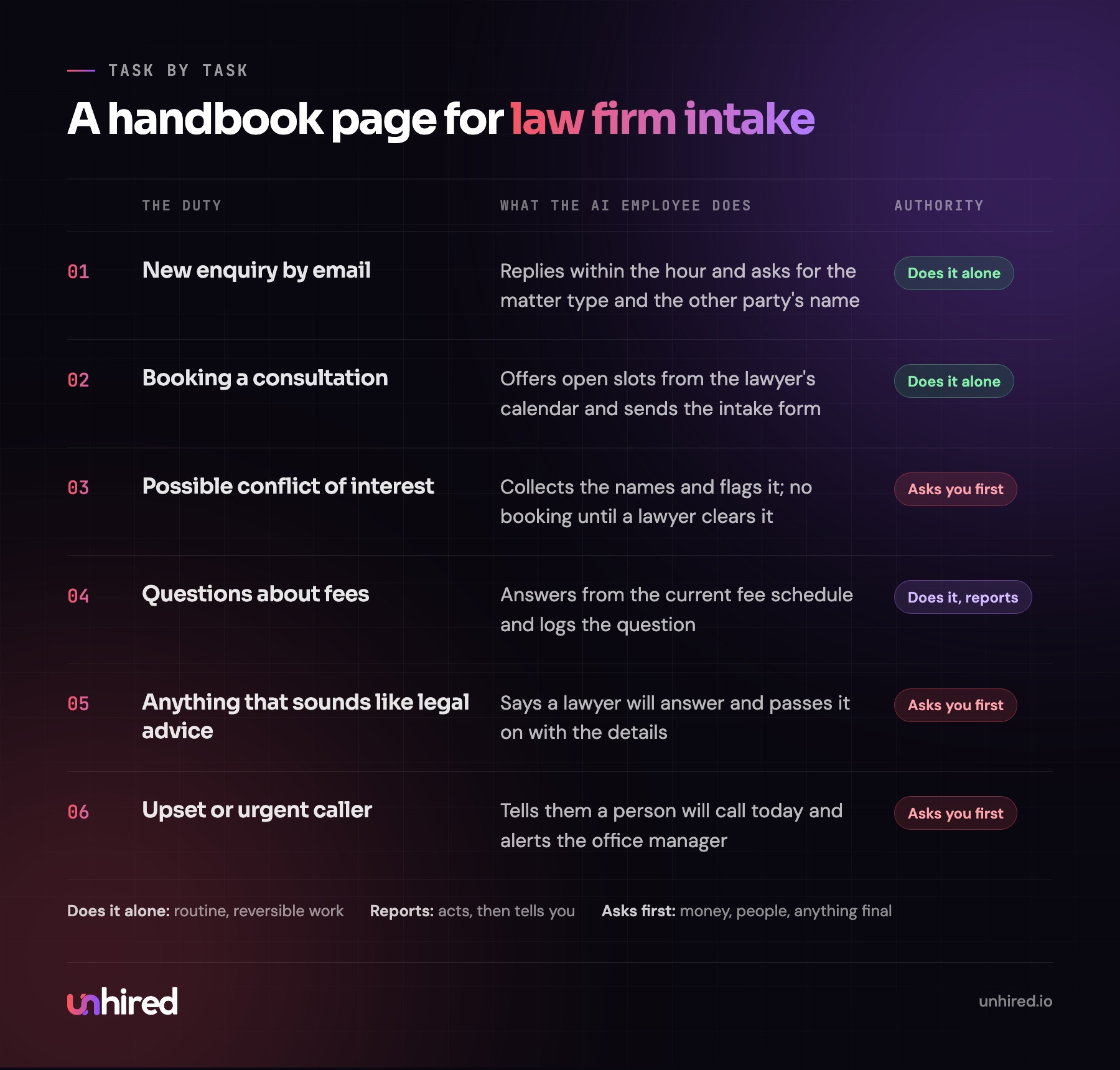
Every duty needs an authority level: it does it alone, it does it and reports back, or it asks a person first. I covered how to sort them in how to hire an AI Employee. For training, the important part is writing the stopping points as clearly as the instructions.
"Anything about money goes to the office manager" is too loose. "Refund requests and any message that mentions a lawyer: reply that a person will follow up today, then send it to the office manager with the order details" is something it can follow. Each escalation rule should say what to tell the customer while they wait and what to hand to the person.
This is also where you find out whether the role suits an AI Employee at all. If most of the handbook turns out to be judgment calls that need a person, the job may not be a good fit yet. Some websites offer free assessments that check whether a role can be filled by an AI Employee.
Test it on last month's work
Before it talks to a customer, run it against 30 to 50 real cases from the last month and compare what it would have done with what your staff actually did. Every miss traces back to something above: a missing instruction, an old document, a bad example or a vague limit. Fix the cause rather than the single reply, then run the whole set again.
Keep training it after it goes live
For the first few weeks, a person approves its work before it goes out. Every time that person edits something, ask why, and turn the answer into a written rule or a corrected document. If the manager changed "we'll call you tomorrow" to "we'll call you within two business days", the handbook needs that sentence.
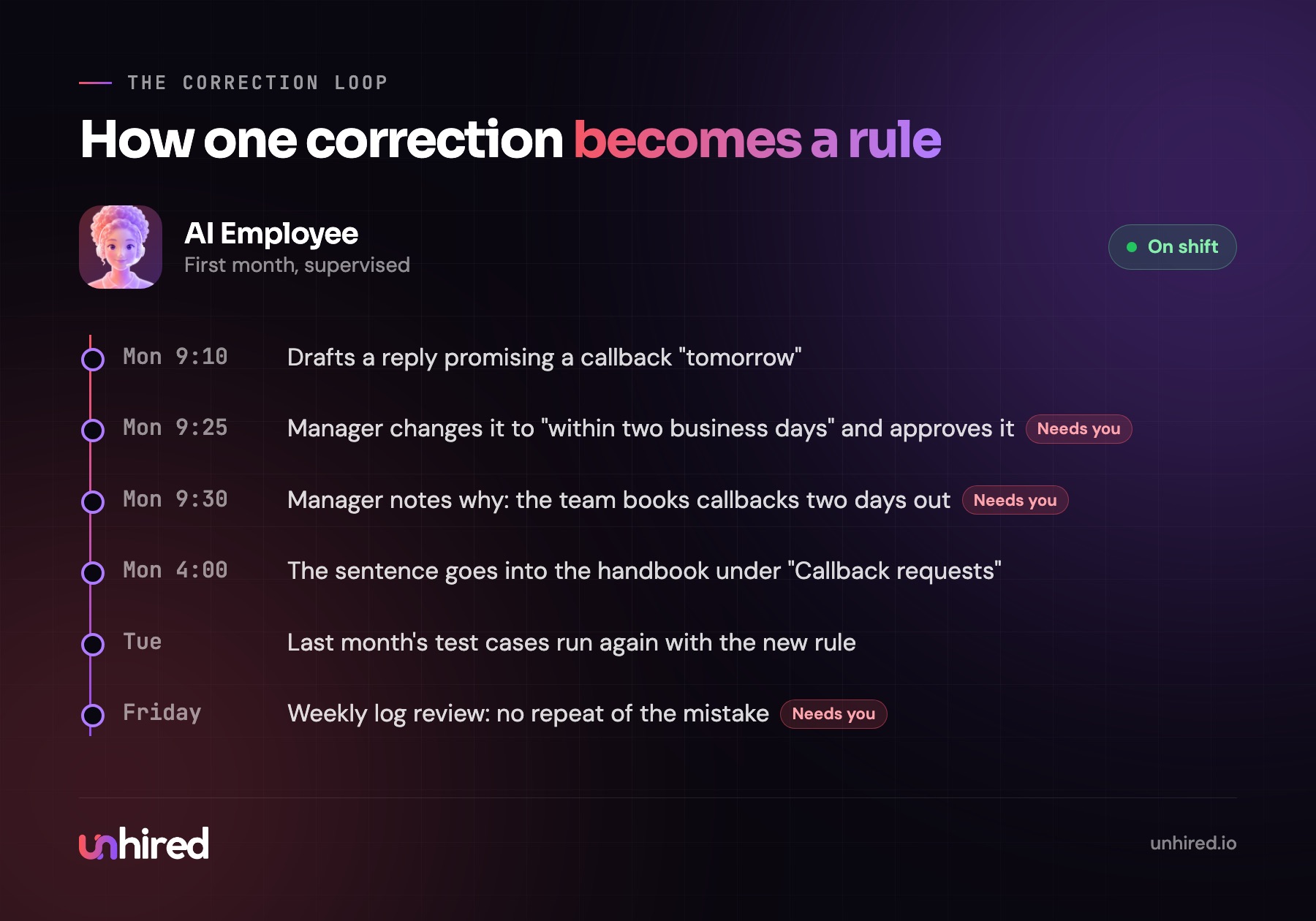
After the first month, a short weekly review of its log keeps it current. Businesses change all the time: a clinic adds a practitioner, or a property manager takes on a building with different rules. Each change should reach the handbook the same week. An AI Employee nobody updates falls a little further behind every month, and its mistakes look exactly like that pet policy.
What training an AI Employee costs
Most of the cost is the manager's time. Watching the job, writing the handbook, cleaning up documents and testing usually adds up to a few days of work over a couple of weeks, then an hour or so a week of review. When a provider builds and maintains the AI Employee, they usually do the writing and testing with you, and that work is part of what their fee covers. When you assemble it yourself from software, the hours are yours or a staff member's.
Compare that with training a person. The US median wage for a receptionist was $38,010 in May 2025, according to the Bureau of Labor Statistics. Wages are about 70% of what private employers spend on compensation (BLS Employer Costs for Employee Compensation), so the seat costs closer to $54,300 a year. A new person in that seat also spends their first weeks learning while someone else covers for them, and if they leave, what they learned leaves with them. A written handbook stays with the business.
Where to start this week
Pick one job. Spend an afternoon with whoever does it best and write down every exception they mention. Then open the shared folder for that job and delete or fix anything out of date. That takes less than a day, it helps whoever does the job next, and it gives you the first two chapters of the handbook any AI Employee would need. If the job is customer-facing, my AI Customer Support Employee post covers what that role looks like day to day.
Wage data: US Bureau of Labor Statistics, Occupational Outlook Handbook, receptionists, May 2025 median; full-cost figure uses the BLS Employer Costs for Employee Compensation share of wages in total compensation. The opening example is illustrative.