
It's 9:40 on a Saturday night. A customer of an online store emails to say their order shows as delivered, but it isn't on their porch. The chat widget on the site sends them a link to the shipping policy. They email again on Sunday morning, then leave a one-star review on Monday before anyone on the team has opened the inbox.
The fix would have taken a person four minutes: check the tracking, see the parcel went to the address from a previous order, and send a replacement. The store's chatbot couldn't do any of that, because all it had was the help centre.
That gap is what this post is about. When an AI Employee holds the customer support job, it works the ticket the way a person on the team would. Below is what it does, where it has to stop and hand over, and what the job costs next to a hire.
What an AI Customer Support employee is
An AI Customer Support employee is AI that holds the support job for a business. It has logins to the systems a support person uses, such as the helpdesk and the store or billing system, a written set of rules about what it can fix on its own, and a person it reports to. Every reply it sends and every change it makes goes into a log.
I've spent the last four years building AI systems and agents for businesses, and support is where I see the most confusion between a chatbot and an employee. A chatbot answers questions from a set of articles. It doesn't know who the customer is or change anything, and when the chat window closes the conversation is over. A support person owns the problem until it's solved, and that ownership is what the AI Employee version has to copy.
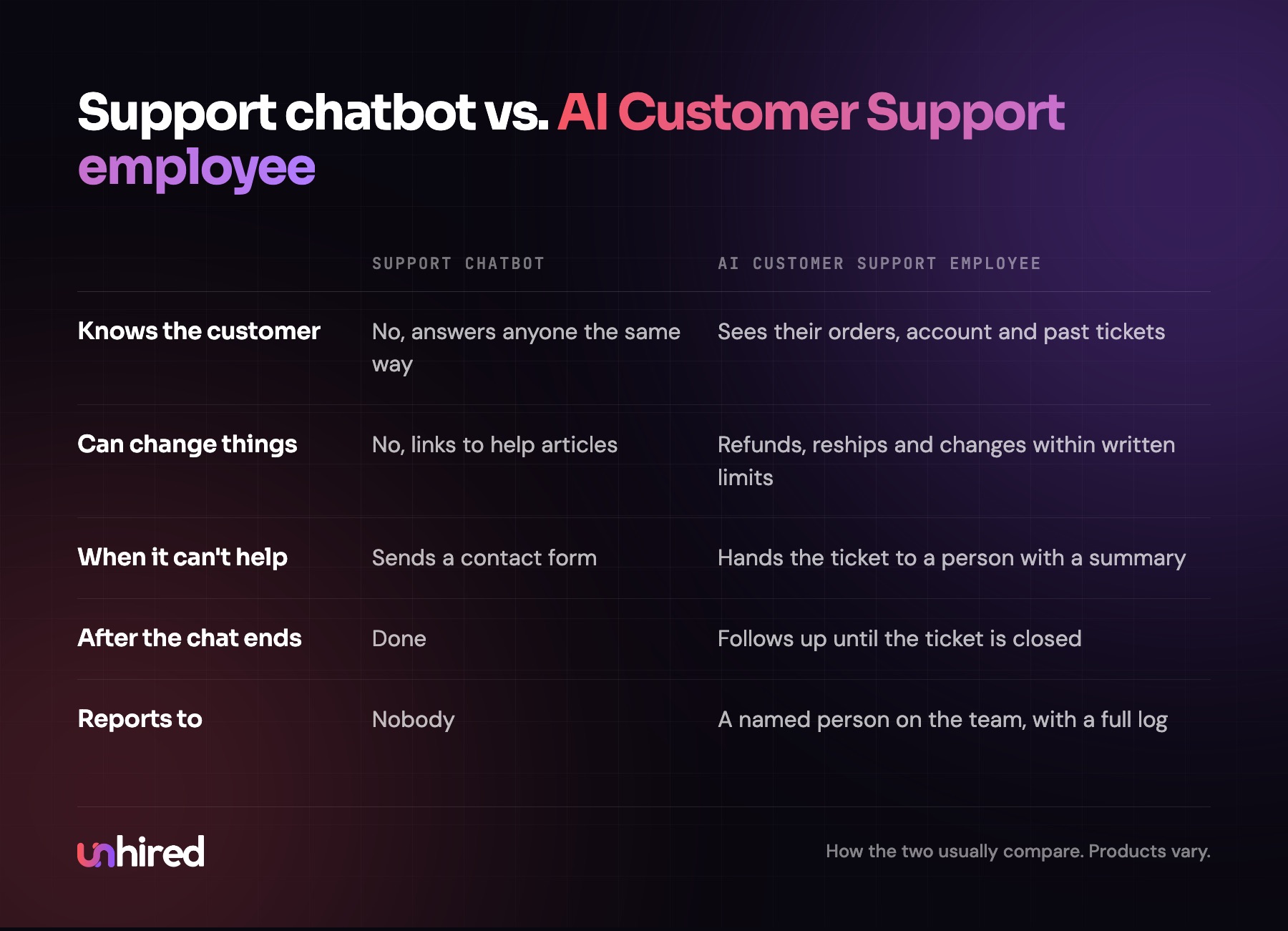
If the terms are muddy, the post on AI Employees versus AI agents draws the line in more detail.
What it does, duty by duty
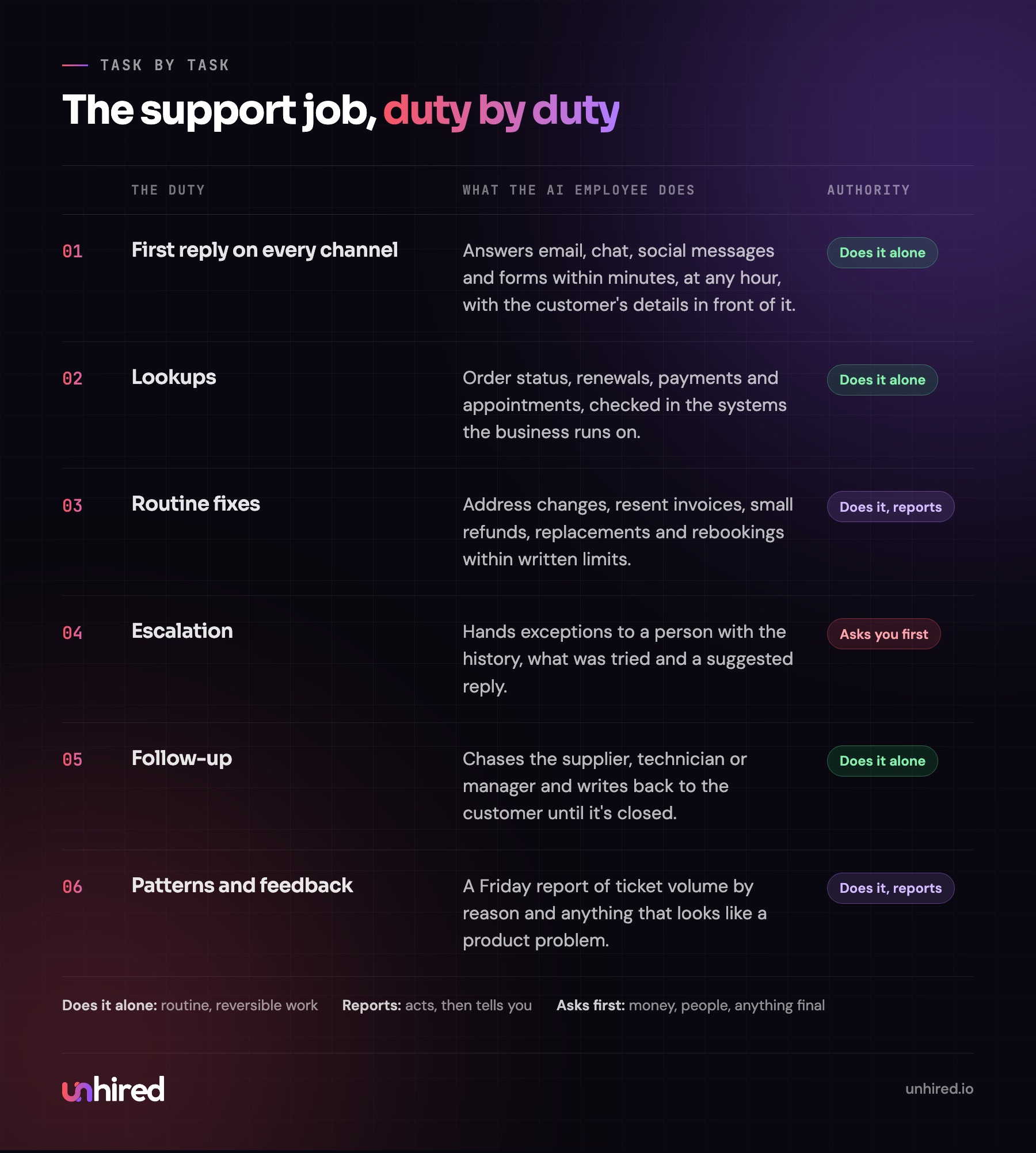
I'd split the support job into six duties, each with the authority I'd give it on day one.
First reply on every channel
Email, website chat, Instagram and Facebook messages, and the contact form all land in one queue, and every message gets a real answer within a minute or two, at any hour. A real answer means the customer's actual question, answered with their order or account in front of it, rather than "we've received your message."
Lookups
Most support tickets are a question about something the business already knows. Where is my order? When does my plan renew? Did my payment go through? Is my appointment still on Thursday? The AI Employee looks it up in Shopify, Stripe, the practice management system or whatever the business runs on, and answers with the specifics.
Routine fixes within limits
This is the duty a chatbot can't do. Within written limits, it changes a shipping address before the parcel leaves, resends a lost invoice, issues a refund under a set amount, sends a replacement for a parcel the carrier confirms was misdelivered, resets a login or moves an appointment. Each limit is a number or a rule someone at the business agreed to, like "refunds up to $75 on orders under 30 days old."
Escalation with a summary
Anything outside the limits goes to a person, and it arrives ready to decide: who the customer is, what they've bought, what they asked, what's already been tried, and a suggested reply. The person reads one paragraph instead of a 14-message thread.
Follow-up until it's closed
When the answer depends on someone else (a supplier confirming stock, a technician checking a fault, a manager approving a credit), the AI Employee tells the customer when to expect news, chases the person internally and writes back when it has the answer. Nothing sits in "pending" for a week because the person who owned it went on holiday.
Patterns and feedback
Every Friday it sends a short report with ticket volume by reason and anything that looks like a product or process problem. If 40 people asked the same thing about a new feature, the team hears about it that week, not at the quarterly review.
What it looks like in different businesses
The six duties are the same everywhere. What changes is which systems it reads and where the limits sit.
An online store's AI Employee lives in the order system and the carrier's tracking, and most of its work is "where is it" and "can I change it." A software company's support person needs the billing system and the account admin panel, and handles password resets, plan changes and bug reports, which it writes up with steps to reproduce for the developers. At a clinic, it answers billing and insurance questions and moves appointments, and never touches anything clinical. A property manager's version takes maintenance requests from tenants, asks for photos, opens the work order and keeps the tenant posted until the repair is done.
What should always go to a person
Support is the job where a bad answer is seen by the customer straight away, so the limits need to be written down before it starts. These are the lines I'd draw at any business:
- Money above the limit. Refunds, credits and discounts beyond the agreed amount go to a person with a suggested decision.
- Exceptions to policy. A return on day 45 of a 30-day window might be worth doing for a good customer, and that's a call for someone who knows the account.
- Customers who are angry, upset or threatening to cancel. The AI Employee replies politely, says a person will follow up, and flags it at the top of the queue.
- Anything about safety, health or legal claims. A product that injured someone, a question about a diagnosis or a mention of a lawyer goes straight to a person, untouched.
- Changes to payment details or account ownership. These are where fraud happens, so they get confirmed by a person through a channel already on file.
Customers should also be able to reach a person when they ask. An AI Employee that pretends to be human, or keeps someone in a loop when they've asked twice for a person, will cost more goodwill than it saves time.
A day on the job
Here's an example day for an AI Customer Support employee at an online store selling kitchenware. Three items go to the store's support lead.
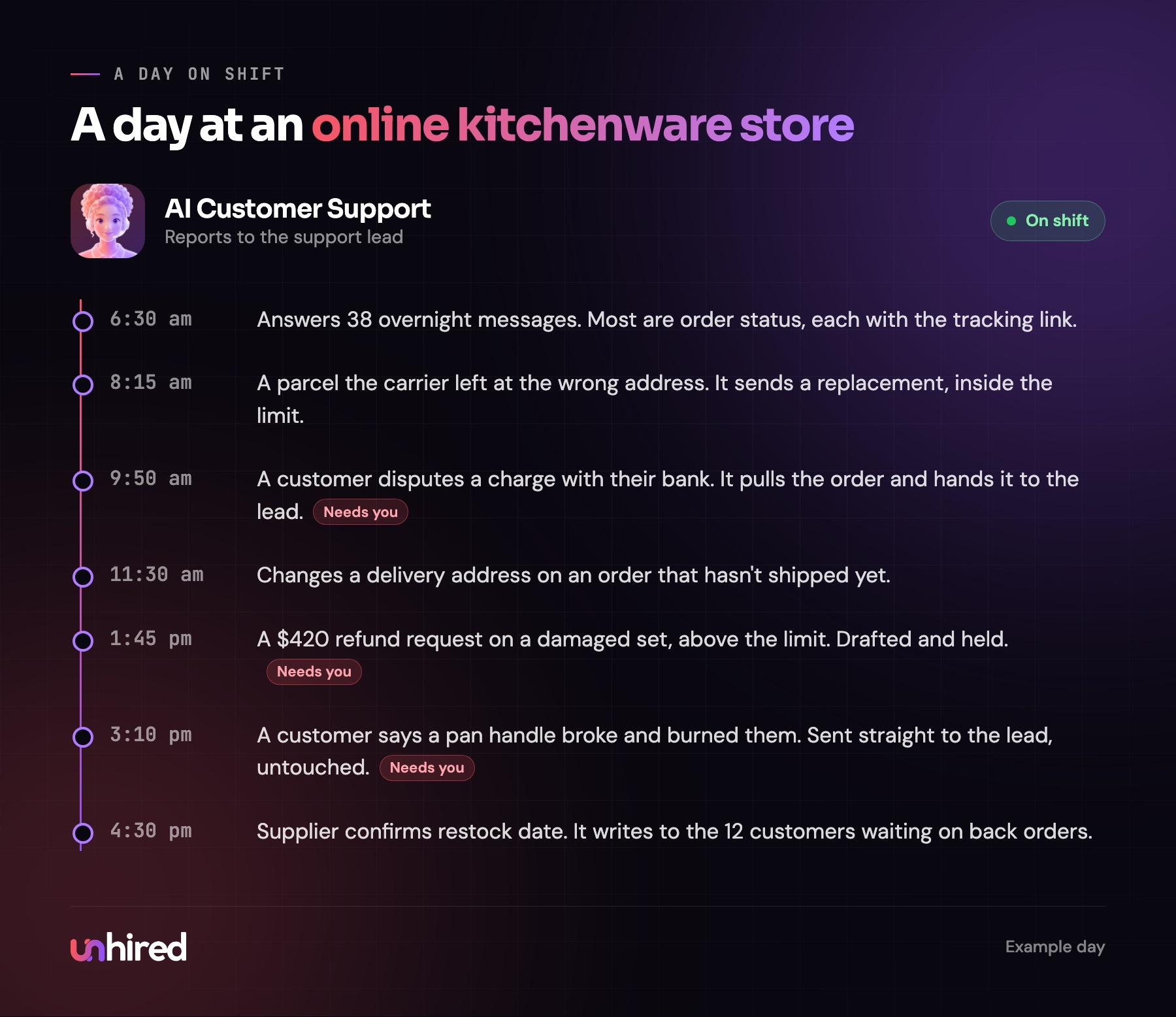
Overnight messages are answered before anyone is in. The misdelivered parcel gets replaced inside the limit, without anyone approving it. The chargeback, the large refund and the customer who mentions an injury all land with the support lead, each with the order history attached.
What a customer service representative costs
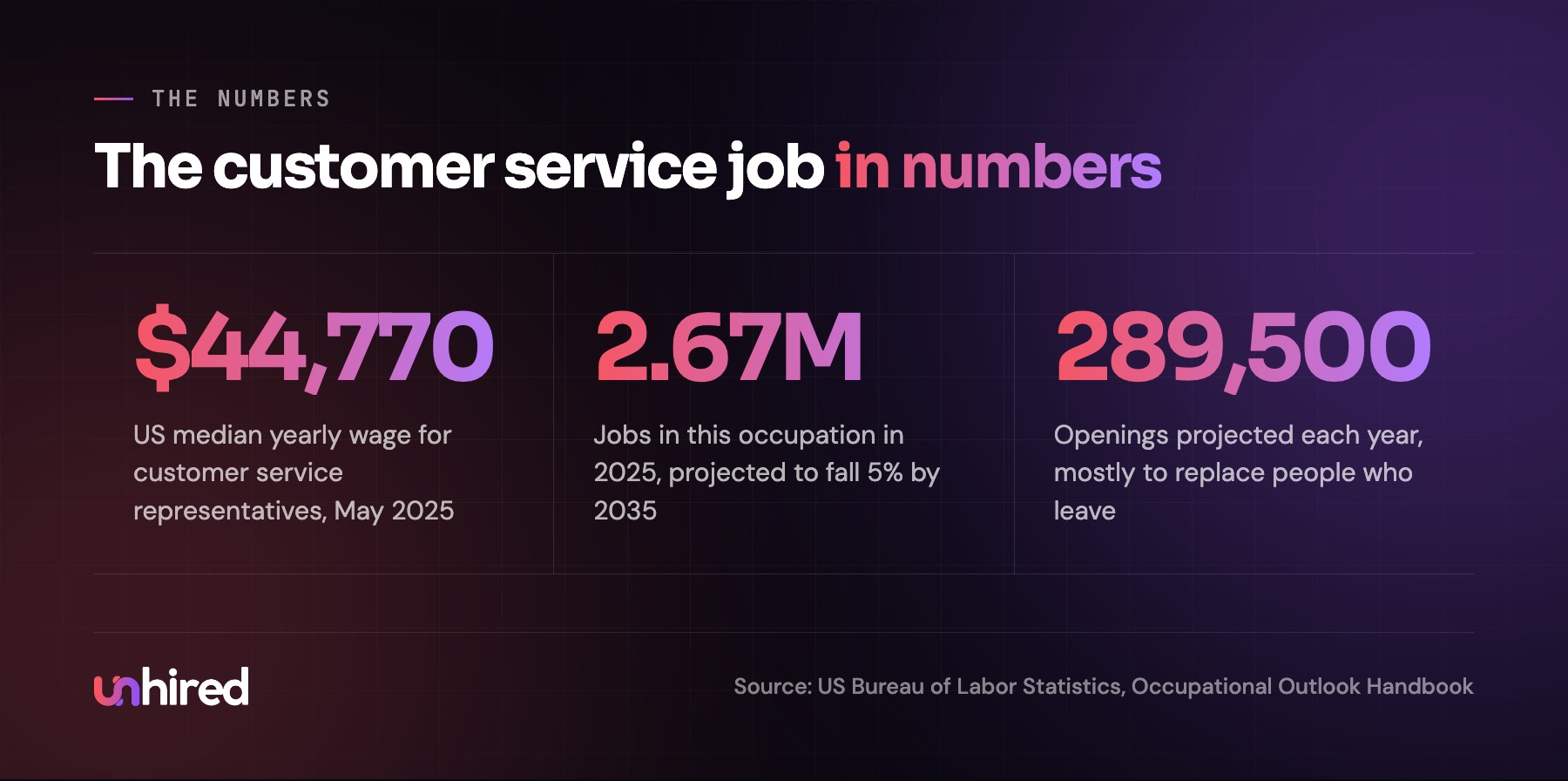
The US Bureau of Labor Statistics puts the median wage for customer service representatives at $44,770 a year as of May 2025, or $21.53 an hour. There were about 2.67 million of these jobs in 2025, and BLS projects the number to fall 5% through 2035, with about 289,500 openings a year as people leave the role.
That last number matters for a small business. A role with that much turnover means hiring and training the seat again, often more than once.
Wages are only part of the cost. Across US private industry, wages and salaries are about 70% of what employers spend on compensation, according to the BLS Employer Costs for Employee Compensation report. At the median wage, that puts the full cost of one representative closer to $64,000 a year before recruiting and training.
One person also covers about 40 of the 168 hours in a week. Messages that arrive on evenings and weekends wait until Monday unless someone pays for a second shift.
How much you'd pay for an AI Customer Support employee
There are two ways to get one.
Building it yourself. Most helpdesks now sell AI add-ons, and some charge per conversation the AI resolves rather than a flat fee. AI agent platforms can connect to the store, the billing system and the calendar. The software is the smaller cost. The bigger one is the time to connect everything, write the rules and limits, test it against real tickets, and keep it current every time a policy, product or price changes.
Having it built and maintained. A provider sets it up, connects the systems, writes the rules with the business and keeps it updated, usually for a monthly fee.
What drives the price is mostly ticket volume, the number of channels and systems it connects to, and how much authority it has. A store with 300 tickets a month on email only needs much less than a software company running chat, email and phone across thousands of customers with refunds and plan changes in scope.
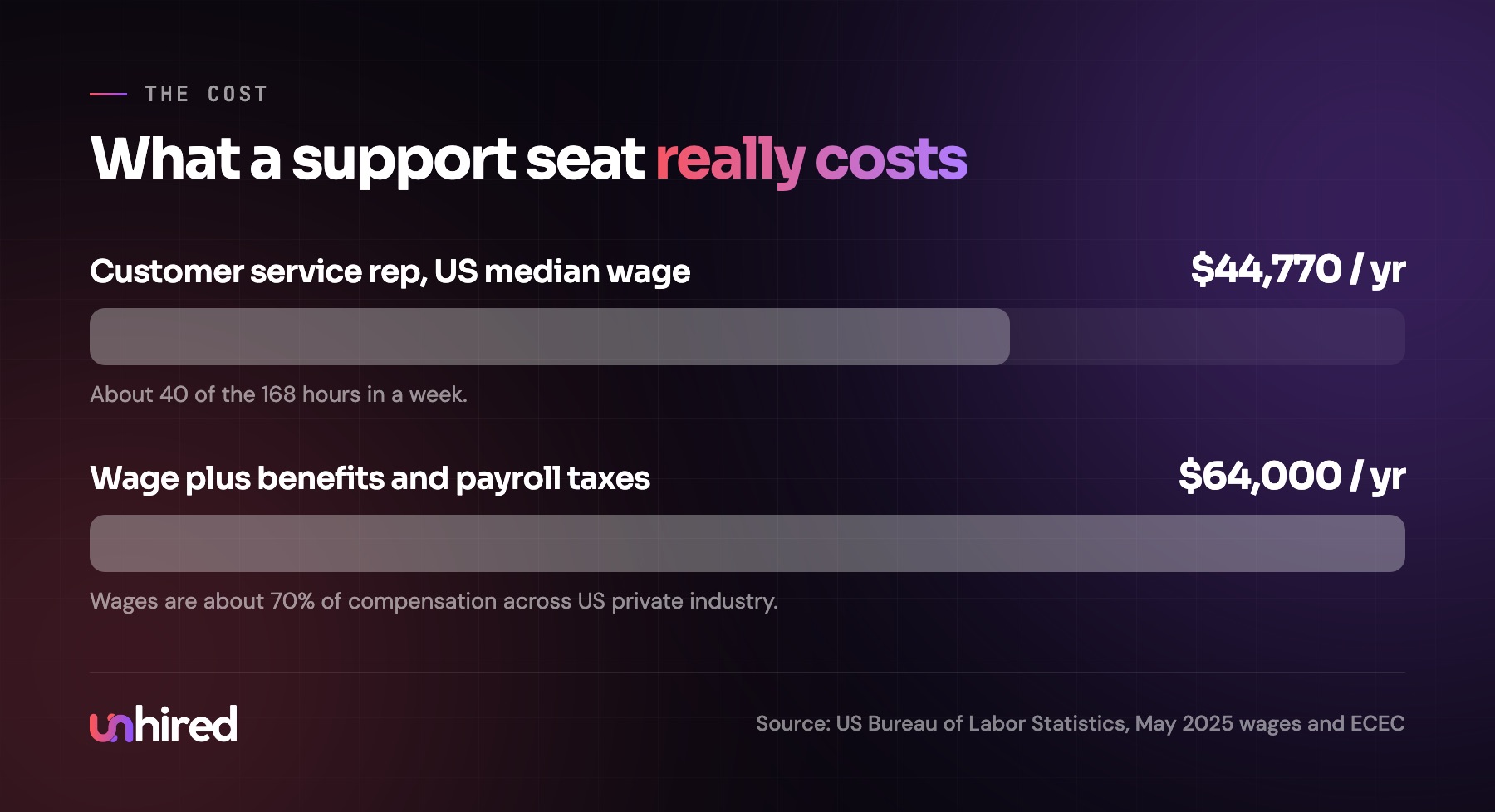
When comparing quotes, line them up against the full cost of the seat (about $64,000 a year for one full-time representative at the US median), and remember that figure buys 40 hours of coverage a week.
How an AI Customer Support employee is set up
Setup starts with the tickets you already have.
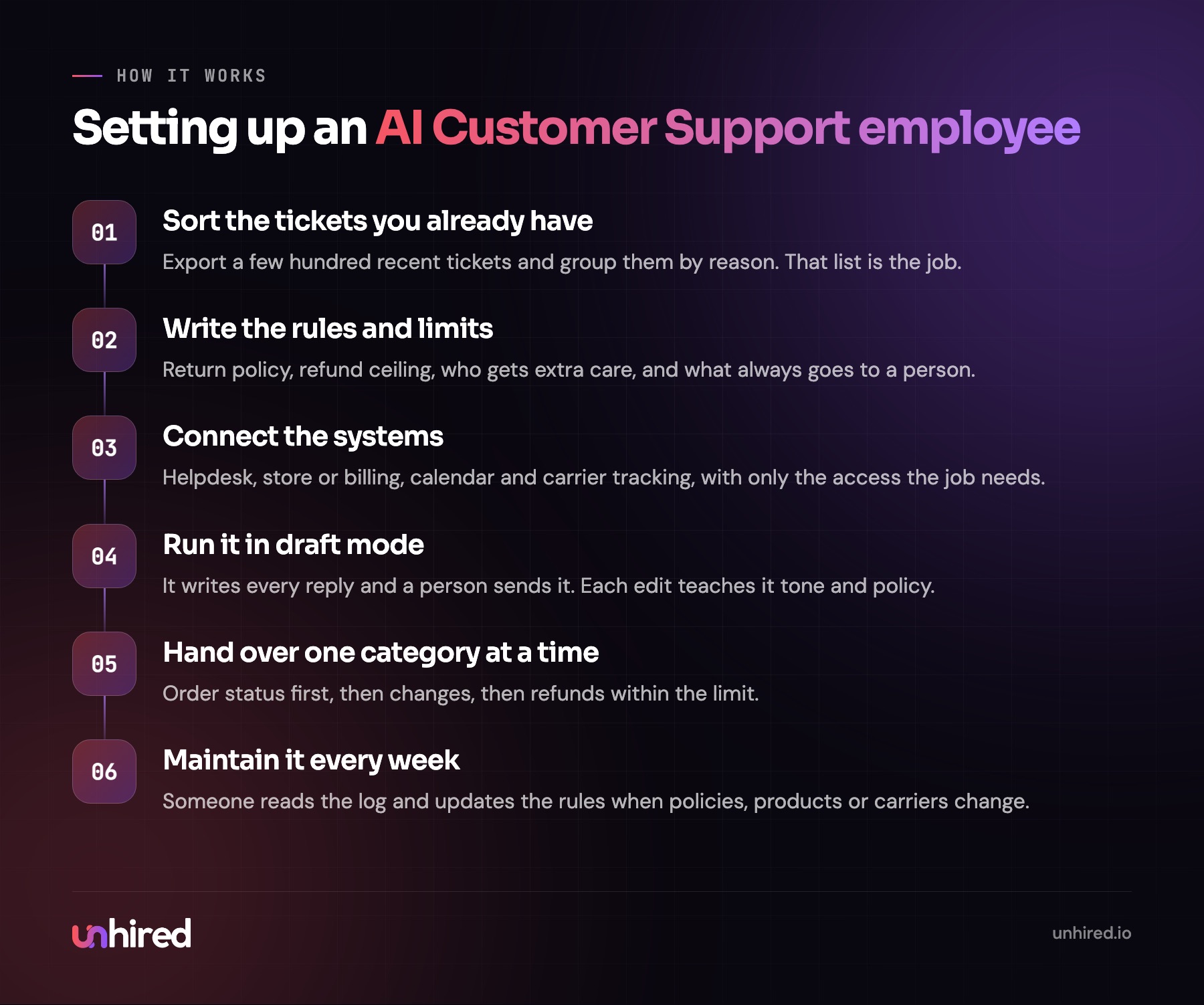
The step I'd never skip is running it in draft mode first. For the first couple of weeks it writes every reply and a person sends it. Each edit is a lesson about tone and about the policies that exist in someone's head but not in the help centre. Once a category of ticket, like order status or appointment changes, stops needing edits, that category moves to sending on its own. Refunds come last.
After launch, someone has to read the log every week and update the rules when the business changes, like a new return policy or a switch to a different carrier.
When it fits
If most of your tickets are about something your systems already know (an order, a booking, a bill, an account), an AI Employee can hold the support seat, and a person handles the exceptions. If most of your support is complex troubleshooting on site or long consultative conversations, keep a person in the seat and let an AI Employee take the first reply and the lookups off their desk. The AI Receptionist post draws a similar line for phone calls.
To see where you stand, export your last 300 tickets and sort them into three piles: answered with a lookup, fixed with a routine action, and needed someone's judgment. The first two piles are the job an AI Employee would own, and the third is where your support person's time should go. Some websites offer free assessments that check whether a role can be filled by an AI Employee, which runs the same sort on a whole job.
Wage data: US Bureau of Labor Statistics, Occupational Outlook Handbook, May 2025. The online store day is an example built from the duties in this post.