
A physiotherapy clinic with two front-desk staff starts missing calls between 4 and 7 pm, when patients finish work and phone to book. Voicemails pile up overnight. The owner's first thought is the one most owners have: hire someone part-time, 20 hours a week, to catch the overflow.
That can be the right call. I've spent the last four years building AI systems and agents for businesses, and the question I now ask before anyone posts that job is simple: which hours does the overflow actually arrive in? If the answer is "a few busy afternoons," a part-time person fits. If it's "evenings, weekends and whenever someone fills in the web form," a 20-hour shift misses most of it, and an AI Employee is worth a serious look.
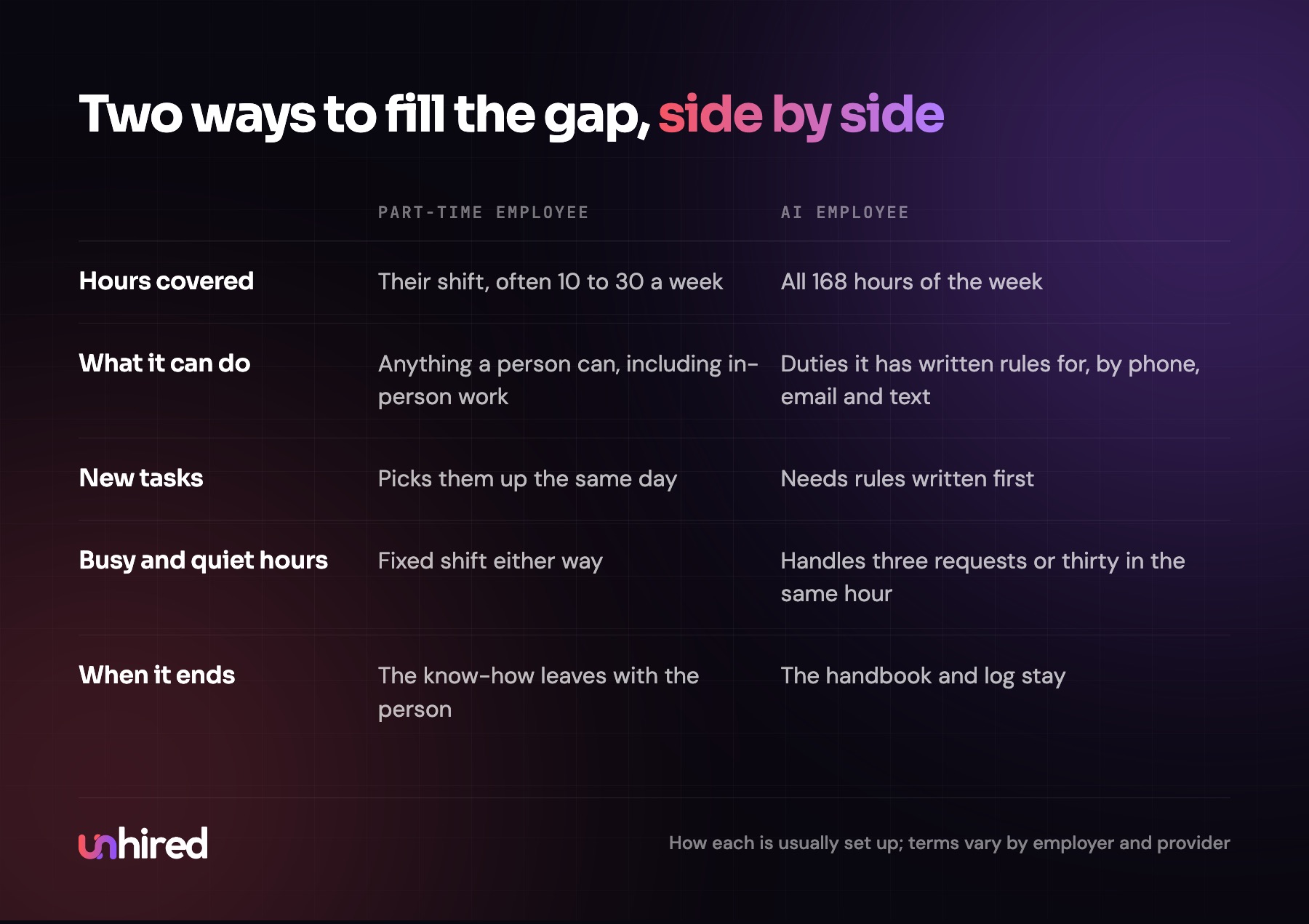
What a part-time hire gives you
A part-time employee is a person on your payroll for a set block of hours, usually somewhere between 10 and 30 a week. You get everything a person brings. They can stand at a counter, notice that a regular client sounds upset and call them back, or handle a new task the day it shows up without anyone writing instructions first.
You also get the limits of a person working part of the week. They're there for their shift and not the rest of the time. They need training, and most of it happens in the first two months, when they're slowest. They take holidays and sick days. And plenty of people take a part-time role as a bridge to something else, so plan on hiring for it again.
What an AI Employee gives you
An AI Employee is software set up to hold one defined job on your team. It has a title, a manager, logins to the systems the job runs on, written rules about what it does on its own and what it brings to a person, and a log of everything it did.
It works every hour of the week, at the same quality on a Sunday night as on a Tuesday morning. Duties with rules get handled; anything outside them goes back to a person. Nothing physical is possible, and that boundary of written rules is both the point and the main limitation. I covered the full list of what it can't do in what an AI Employee can't do.
Which hours does the work arrive in?
A week has 168 hours. A 20-hour part-time shift covers about 12% of them. A full-time person covers about 40 hours, still under a quarter.
For a lot of jobs that's fine. A bookkeeper's data entry can wait until Thursday morning. But front-desk work tends to arrive when people are free, which is the opposite of when your staff are. Patients book after work. A law firm's prospects fill in the intake form on Sunday afternoon. A property manager's tenants report the leak at 10 pm. An online store's customers ask about a missing order during their lunch break in a different time zone.
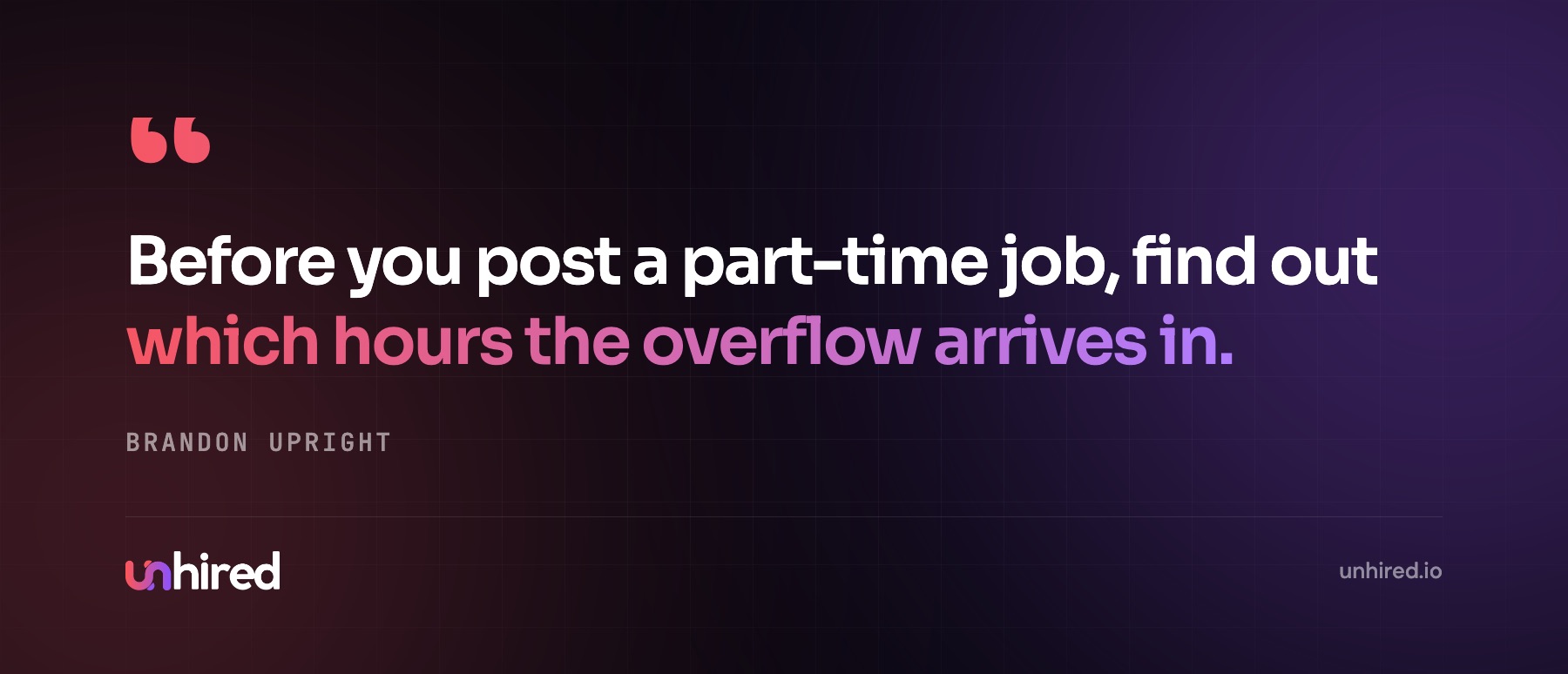
So before deciding, pull two weeks of data: call logs, form submissions, email timestamps, missed-call reports from your phone system. Plot when the overflow lands. If it clusters in a few predictable daytime blocks, a part-time shift can be scheduled right on top of it. If it's spread across evenings and weekends, no shift you can realistically staff will catch it.
What a part-time seat costs
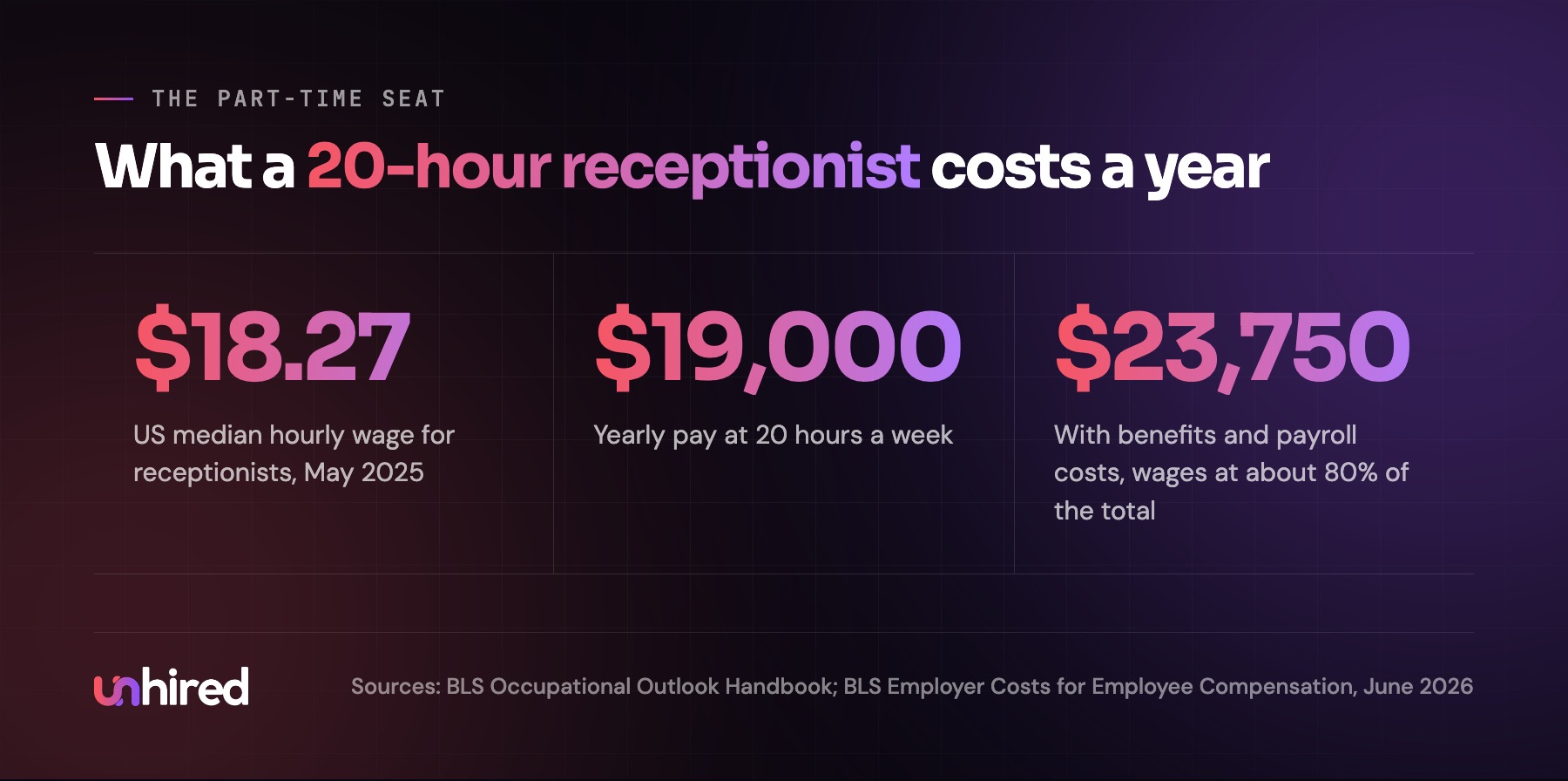
The US median wage for receptionists was $18.27 an hour in May 2025, according to the Bureau of Labor Statistics. At 20 hours a week for 52 weeks, that's about $19,000 a year in pay.
Pay isn't the whole cost. The BLS Employer Costs for Employee Compensation report for June 2026 puts wages at about 80% of what private employers spend per hour on part-time workers, with the other 20% going to benefits and payroll costs. That brings the 20-hour seat to roughly $23,750 a year, before the cost of hiring and training.
Part-time workers cost less in benefits per hour because they get fewer of them. In the BLS benefits survey for March 2026, 23% of part-time workers in private industry had access to medical care benefits, against 87% of full-time workers. That keeps the part-time seat cheap, and it's also part of why people leave part-time jobs when a full-time one with benefits comes along.
Then there's turnover. Each time the person leaves, you pay again for the ad, the interviews, the first slow weeks and the time someone else spends training them. Nobody puts that on the budget line, and in front-desk roles it can happen more than once a year.
How an AI Employee is priced
There are two ways to get one. You can assemble it from software subscriptions, an AI agent platform plus connections to your phone line, booking system, email and CRM, and have someone on staff design, test and maintain it. The software bill is usually small, and the staff hours are the real cost.
Or a provider builds and maintains it, which is usually a monthly fee, sometimes with a setup fee and a volume range the fee covers. What drives the price is how many conversations and tasks it handles in a month, how many systems it logs into, whether it answers the phone as well as email and text, and how much ongoing maintenance is included. I went through the pricing models in more detail in how much an AI Employee costs.
To compare the two fairly, put them in the same terms. For the same list of duties, work out the first-year cost of each, the hours of coverage per week each buys, and the hours a month someone on your team spends managing it. A part-time person at about $23,750 for 20 hours a week and an AI Employee covering all 168 hours on a narrower job are different products, and the comparison should show that.
Where a part-time person is the better hire
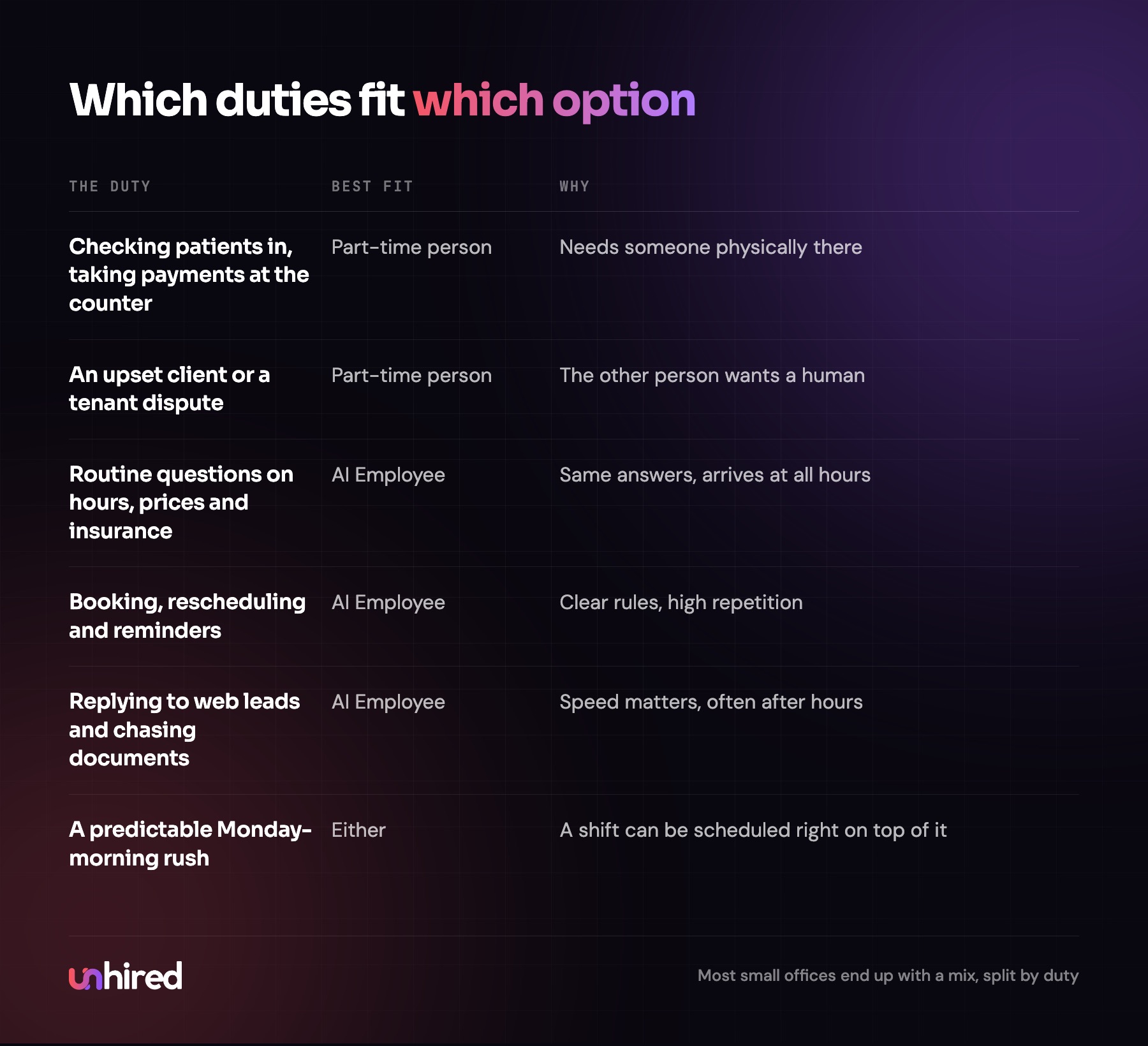
I'd hire the person whenever the job needs someone physically there. A clinic's front counter, where patients check in, hand over insurance cards and pay. A shop floor. Restocking shelves or setting up the boardroom. An AI Employee can't do any of it.
I'd also hire the person when the job is mostly judgment with no written rule behind it, or when the relationship is the work. An agency's long-time client who wants to talk through a problem, a law firm's prospect who is upset and needs someone to listen before booking anything, a property manager's tenant in a dispute with a neighbour. Those calls go better with a human on the line.
And if the work really does arrive in one predictable block, say the Monday-morning rush at a clinic or month-end at an accounting firm, a part-time shift scheduled on that block is simple and works.
Where an AI Employee is the better fit
An AI Employee fits work that repeats, follows rules you could write down, and arrives at all hours. Answering the same thirty questions about hours, insurance, parking and prices. Booking, rescheduling and confirming appointments. Replying to a web lead in the first two minutes and booking the call. Chasing a client for the two documents they haven't sent. Copying details from an intake form into the practice management system.
It also fits when the volume swings. A part-time person has a fixed shift whether it's busy or quiet. An AI Employee handles three calls or thirty in the same hour, and nobody sits idle on the quiet afternoons.
The trade-off is setup. Someone has to write down how your business handles each of those duties, including the steps nobody ever wrote down, and then review its work closely for the first few weeks. I wrote about that period in AI Employee onboarding: the first 30 days.
What happens when it ends
When a part-time person leaves, the way they handled your front desk leaves with them unless someone made them write it down, and most small businesses never do. The next hire starts from scratch.
An AI Employee can't work without its process written down, in a handbook of rules, examples and the documents it answers from. That handbook stays. If you build it yourself, it's yours. If a provider builds it, ask in writing whether you keep the rules, the log and the phone number if you leave.
Most offices end up with both
The physiotherapy clinic from the start would likely do best with a split. The AI Employee answers the phone and the web form after 4 pm and on weekends, books into open slots, sends reminders and handles cancellations. The two front-desk staff keep the counter, the payments and the patients who need a person. If the clinic still wants a part-time hire, that job becomes the in-person half, which tends to be easier to fill because it's the more interesting work.
A law firm could do the same with intake, and an online store with order-status questions. The split follows the duties and the hours, so start there.
How to decide for your own role
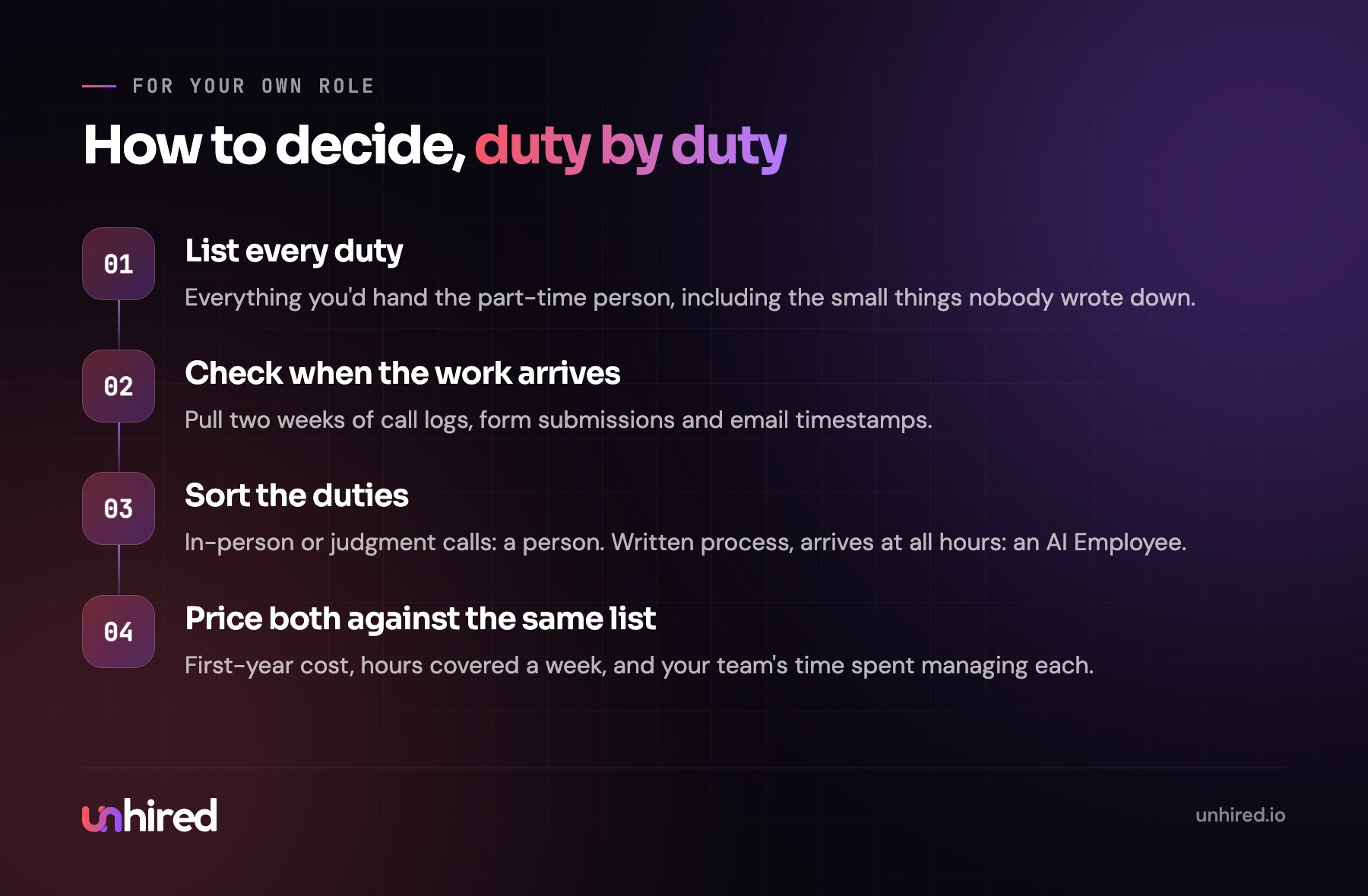
Write down every duty you'd give the part-time person. Next to each, note when it arrives and whether there's a process you could write down. Then mark the ones where the person on the other end needs a human in the room. Then pull two weeks of timestamps to check when the work actually comes in.
Duties that need someone physically there, or a judgment call, go to a person. Duties with a written process that arrive at all hours point to an AI Employee. Some websites offer free assessments that check whether a role can be filled by an AI Employee, which can help with the first sort.
Then price both against the same list, including the hours your own team will spend managing each. If the list comes out mostly in-person work, post the part-time job. If it comes out mostly evening calls and booking requests, the part-time job you were about to post would have spent its shift waiting for work that shows up after it goes home.
Wage data: US Bureau of Labor Statistics, Occupational Outlook Handbook, May 2025 median for receptionists. Full-cost estimate uses the part-time wage share in the BLS Employer Costs for Employee Compensation, June 2026. Benefit access from the BLS Employee Benefits in the United States, March 2026. The physiotherapy clinic is an example, not a client.