
Say the office manager at a twelve-person accounting firm gives notice in the middle of tax season. The partners have four ways to fill the seat: hire again, bring on a virtual assistant, hand the work to an outsourcing firm, or put an AI Employee in the job. The hire takes weeks. The other three can start inside a month, and they get compared on one line, which is the monthly price.
I've spent the last four years building AI systems and agents for businesses, and I've watched a lot of owners make this choice. Price is the least useful place to start, because the three options sell three different things. A virtual assistant sells you a person's hours. An outsourcing firm sells you a function, run on its process. An AI Employee is a job held by software. Once that's clear, most of the comparison does itself.
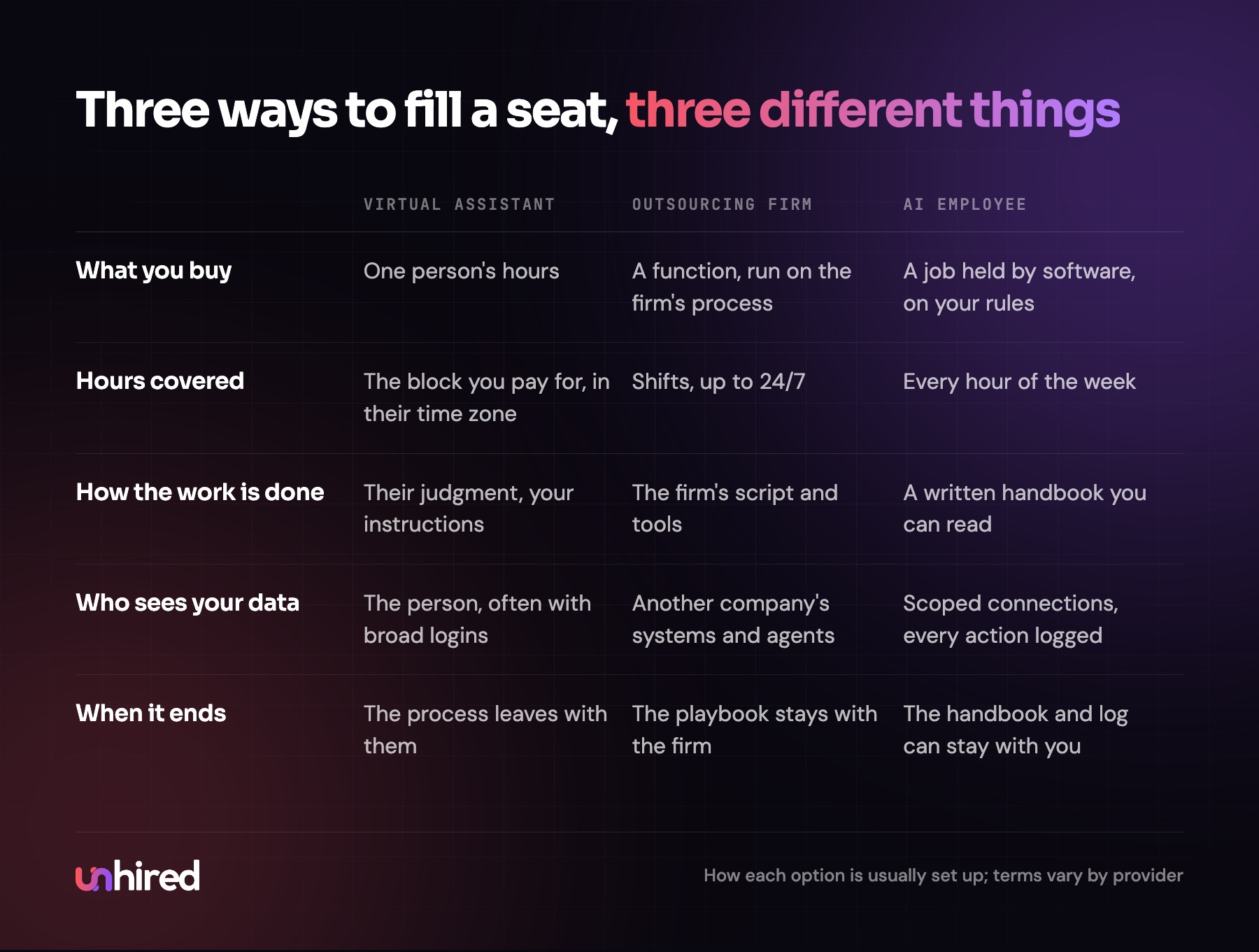
What you're buying in each case
A virtual assistant is one person, usually working remotely, often part-time, hired through a marketplace or an agency. You pay for a block of hours and you decide what goes into them. The assistant brings their skills and whatever process they've learned at other jobs, and they adapt to yours over the first few weeks.
An outsourcing firm takes over a whole function: the phones, first-line support, bookkeeping, payroll, data entry. It runs a team across many clients, usually on its own software and its own script, and prices by the seat, the hour, the call or the ticket, often with a monthly minimum. You get coverage and redundancy. You give up a lot of say in how the work is done.
An AI Employee is software set up to hold one defined job on your team. It has a title, a manager, logins to the systems the job runs on, a written set of rules about what it does on its own and what it brings to a person, and a log of everything it did. It works the way you wrote the job, every hour of the week, and it does nothing it wasn't given rules for.
Where a virtual assistant is the right call
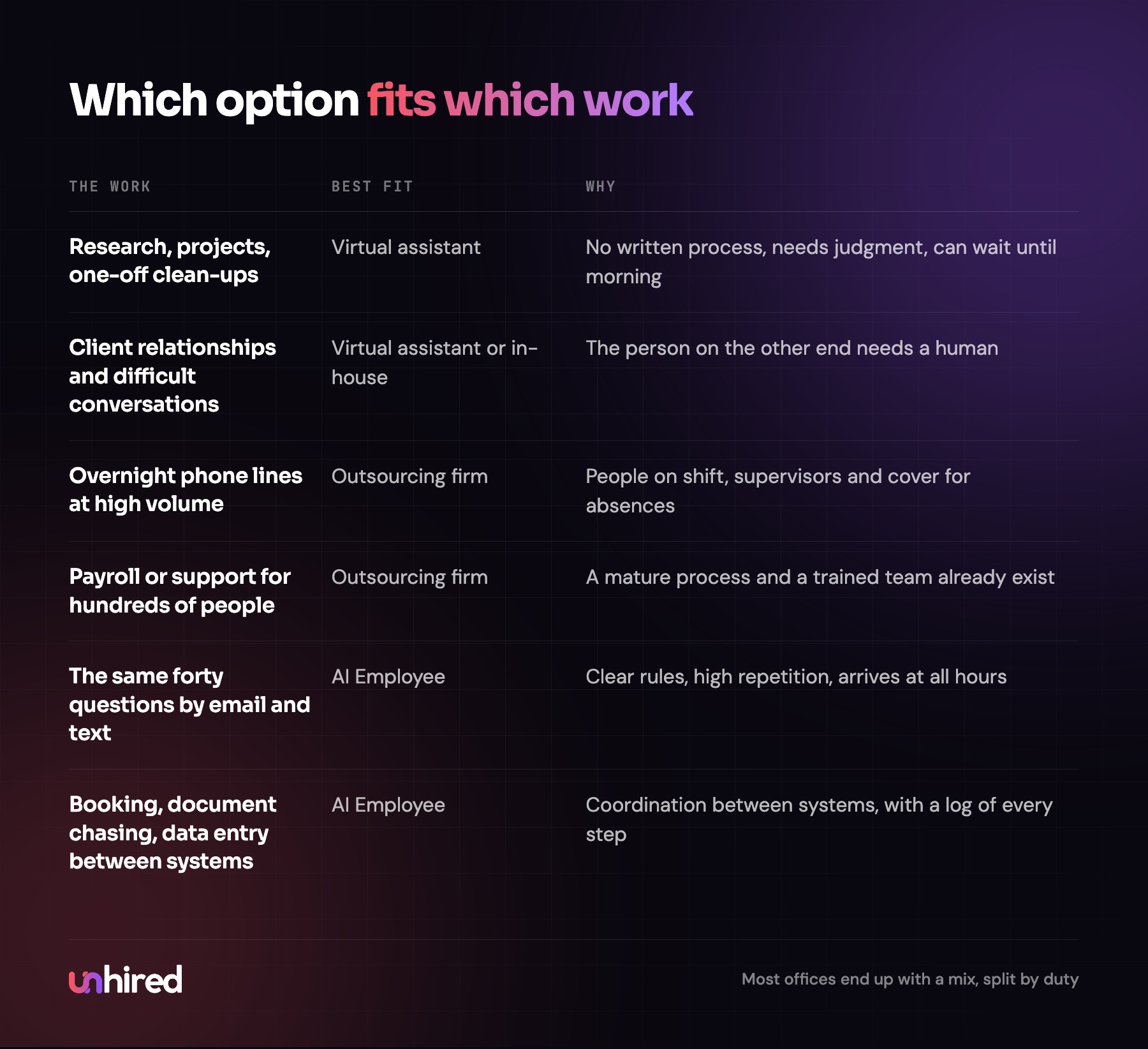
A good assistant is the best of the three at work that changes shape every day. Research three vendors and summarize them. Build the spreadsheet for the partner retreat. Call the landlord about the lease, then draft the email to the team. Nobody has written a process for any of it, and nobody needs to, because the person uses judgment.
They're also the right pick for one-off projects: cleaning up a CRM, migrating files to a new system, setting up a newsletter, chasing down a year of receipts for the accountant. And for relationships. If the job is mostly knowing which client to call back first and how they like to be spoken to, that's a person.
The limits are the limits of one person. You get their hours and their time zone, and the work waits when they're on holiday or sick. When they take a better offer, the way your business does onboarding or billing follow-up leaves with them, and you train the next one from the start. Assistants hired through marketplaces also turn over for reasons that have nothing to do with you.
Where outsourcing is the right call
Outsourcing wins on volume and coverage. A firm answering overnight calls for a property management company has people on shift at 3 am, a supervisor, and a replacement when someone is off. For payroll across a few hundred employees, or support for an online store doing thousands of tickets a month, a firm with a mature process and trained staff is hard to beat, and it handles the share of calls that need a human on the line.
What you give up is control. The firm's agents follow the firm's script and use the firm's tools, and the same agents may be working for several of its other clients that day. Changing how something is handled means a request to an account manager and a wait. Your customer data now sits with a third company, sometimes in another country, under a contract someone should read closely. And when the agents rotate, the new ones know your business from a two-page brief.
Where an AI Employee is the right call
An AI Employee fits work that is mostly coordination between systems, with rules you can write down and enough volume to matter. Answering the same forty questions by email and text, booking and rescheduling appointments, chasing a new hire for the two forms they haven't sent, moving data from documents into the accounting system, or replying to a web lead in the first two minutes and booking the call.
It wins on hours, because it works all of them. It wins on consistency, because it does the job the way it was written on a Tuesday night the same as on a Monday morning. It never leaves, so the knowledge of how your business does the work builds up instead of walking out. And it keeps a log, which neither of the other two options gives you in the same detail.
The limits are real. It needs rules, so a job nobody can describe is a job it can't do yet. It handles the cases the rules cover and hands back the ones they don't, and a business that wants every edge case handled by software will be disappointed. It needs someone to approve the items it holds for a person and to update the rules when the business changes. I covered the full list in what an AI Employee can't do.
Coverage and consistency
A week has 168 hours. A full-time person covers about 40 of them, and a part-time assistant covers fewer. Calls, booking requests and web leads don't keep to those hours. A clinic's patients book at 9 pm, and a law firm's prospects fill in the intake form on Sunday afternoon.
Outsourcing solves coverage with shifts, which is why it costs what it does. An AI Employee solves it by never being off shift. The assistant doesn't solve it at all, and that's fine for work that can wait until morning, which is most project work and not much front-desk work.
Consistency goes the same way. A person has good days and bad days and learns the job over months. A firm's quality depends on which agent picked up. An AI Employee gives the same answer to the same question every time, which is a strength when the answer is right and a problem when it's wrong, which is why it needs a weekly review of a sample of its work in the first months.
Who keeps the process
This is the question I'd put first, and it's the one most owners skip.
With an assistant, the process lives in their head. Some write it down if you ask them to, and most don't, because nobody's paying for that hour. When they leave, you find out how much they were handling without telling anyone.
With an outsourcing firm, the process lives in the firm's playbook, and the playbook is theirs. You can usually get call recordings and reports. You rarely get the right to take the scripts and the trained team with you, so switching firms means starting from a brief again.
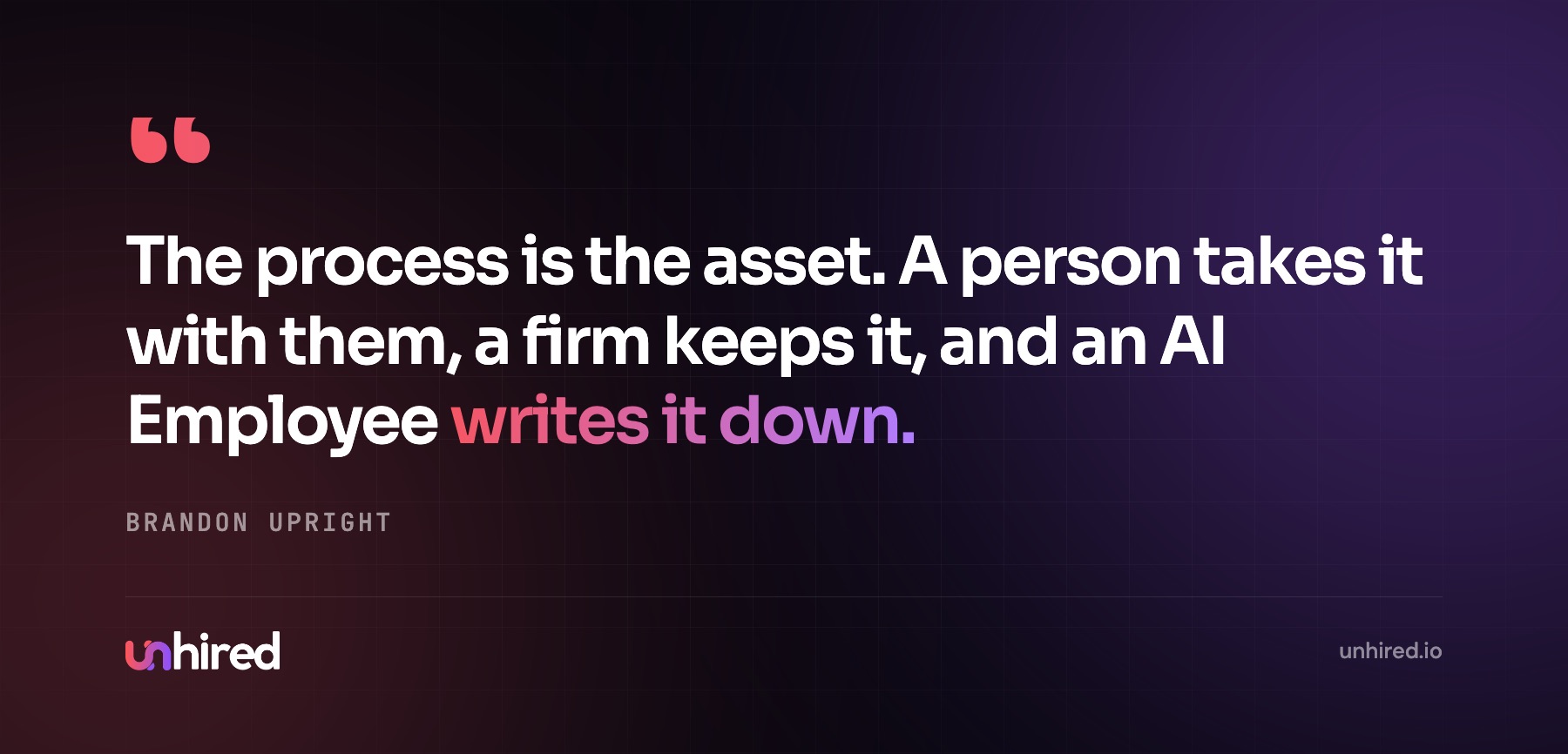
With an AI Employee, the process has to be written down before the thing can work, in a handbook of rules, examples and the documents it answers from. That handbook is the most valuable thing produced in the whole setup, and whether you own it depends on the arrangement. If you build it yourself, it's yours. If a provider builds it, ask in writing whether you keep the rules, the log and the phone number if you leave. A provider that says no is renting you the job rather than filling it.
Data and access
An assistant logs into your systems as a person, which usually means they have the same access the last office manager had, often through a shared password. The practical risk is less theft than sprawl: logins nobody turns off, documents downloaded to a personal laptop, a client list in a spreadsheet somewhere, a forwarding rule on the old mailbox.
Outsourcing moves your data to another company's systems, so the questions are about the contract: where the data is stored, who can see it, what happens to it when you leave, and whether their agents can see other clients' data on the same screen.
An AI Employee is given the narrowest access the job needs, one connection at a time, and every action it takes lands in the log. That's a better starting point than either of the other two, provided someone set it up that way. I wrote up the questions to ask in is an AI Employee safe with customer data.
What each one costs
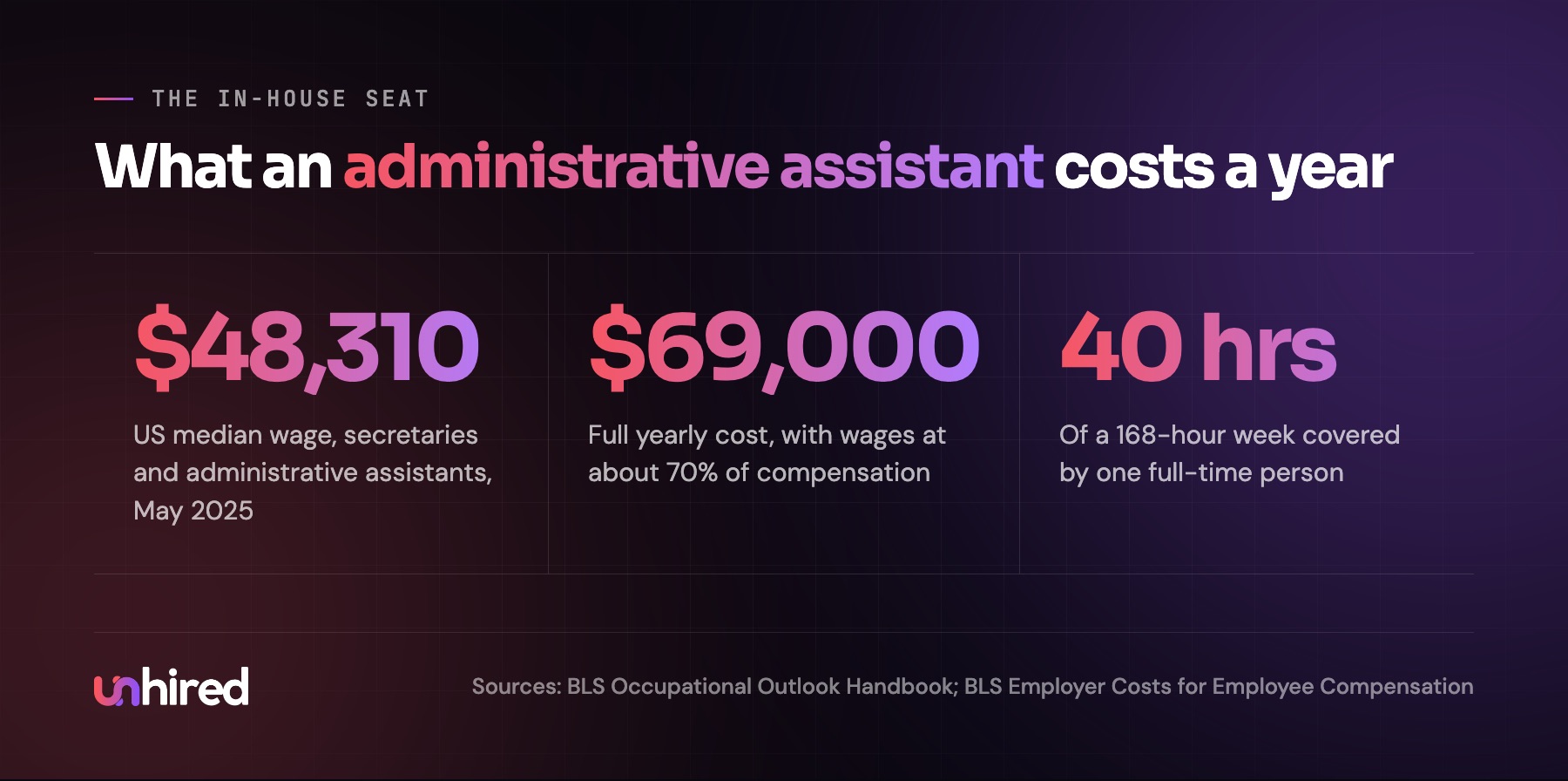
Start with the seat you'd otherwise fill. The US median wage for secretaries and administrative assistants was $48,310 in May 2025, according to the Bureau of Labor Statistics. Wages are about 70% of what private employers spend on compensation, per the BLS Employer Costs for Employee Compensation report, so the full cost of that seat is closer to $69,000 a year before recruiting and training, for about 40 hours of coverage a week.
A virtual assistant is priced by the hour, and the rate varies widely with the country they work from, their experience and whether an agency sits in between. You pay for the hours whether or not work arrived in them, and part-time blocks tend to be sold in packages. Two things the hourly rate hides: the time you spend assigning and reviewing work, and the retraining cost each time the person changes.
An outsourcing firm prices per seat, per hour, per call or per ticket, usually with a setup fee and a monthly minimum. The headline rate looks low because you're buying a slice of a shared team. Ask what the minimum is, what an escalation to a supervisor costs, and what a change to the script costs.
An AI Employee is priced two ways. You can assemble one from software subscriptions, an AI agent platform plus the connections to your booking, email and accounting systems, and have someone on staff design, test and maintain it. The software bill is small and the staff time is the real cost. Or a provider builds and maintains it for a monthly fee, sometimes with a setup fee and a volume range the fee covers. What drives the price is volume, the number of systems it logs into, whether it works the phone as well as email and text, how many exceptions the rules carry, and how much maintenance is included. I went through all four pricing models in how much an AI Employee costs.
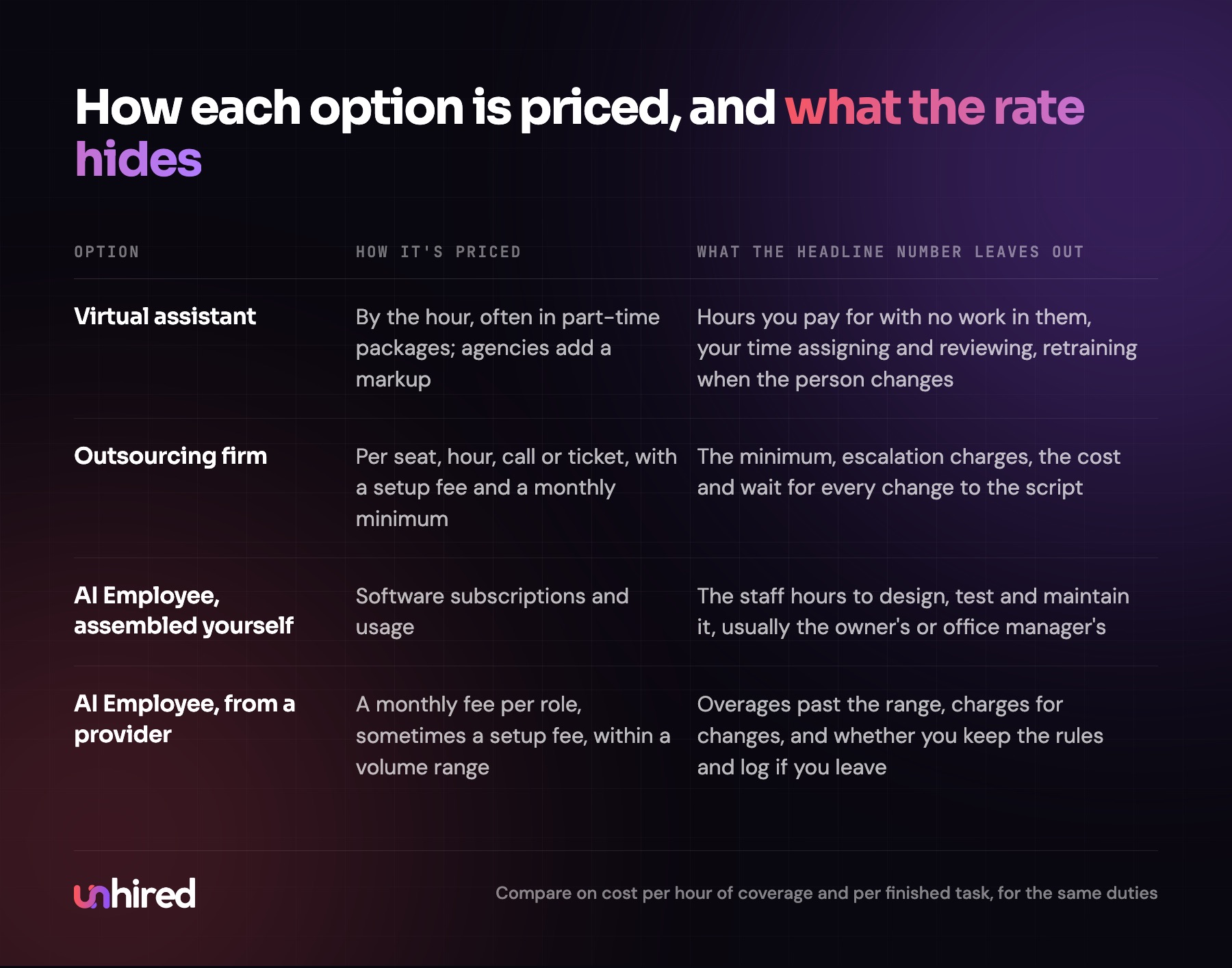
To compare the three, put them in the same terms. For the same list of duties, work out the first-year cost of each option at your real volume, the hours of coverage per week it buys, and the hours a month someone on your team will spend managing it. Then divide by finished tasks if you can count them. A low hourly rate for ten hours a week of coverage and a higher monthly fee for every hour of the week are different products, and the division makes that visible.
How much of your own time each one takes
None of the three runs itself, and the management load is different in shape.
An assistant needs a steady supply of assigned work, a weekly check-in and someone to review the output, and the load stays roughly flat for as long as they're with you. An outsourcing firm needs an account relationship, a look at the quality reports and someone on your side to take escalations, and the load is low once it's running but rises every time you want something changed. An AI Employee needs the most time at the start, to write the rules and approve its work while it runs in draft mode, and then drops to approving held items and a short weekly review of its log. If a quote for any of the three assumes your side spends no time at all, it's leaving something out.
Most offices end up with a mix
The useful version of this comparison is rarely one option for the whole job. The accounting firm I started with would likely put an AI Employee on the inbox, the document chasing, the appointment booking and the deadline reminders, which is most of the volume and all of the off-hours work, and have a part-time assistant or a junior staffer take the client conversations and the judgment calls, plus the items the AI Employee holds for a person. A law firm might run intake the same way. An online store might outsource the overnight phone line, give the AI Employee every email and chat it has rules for, and keep one person in-house for the angry ones.
The split follows the duties, so write the duties down first.
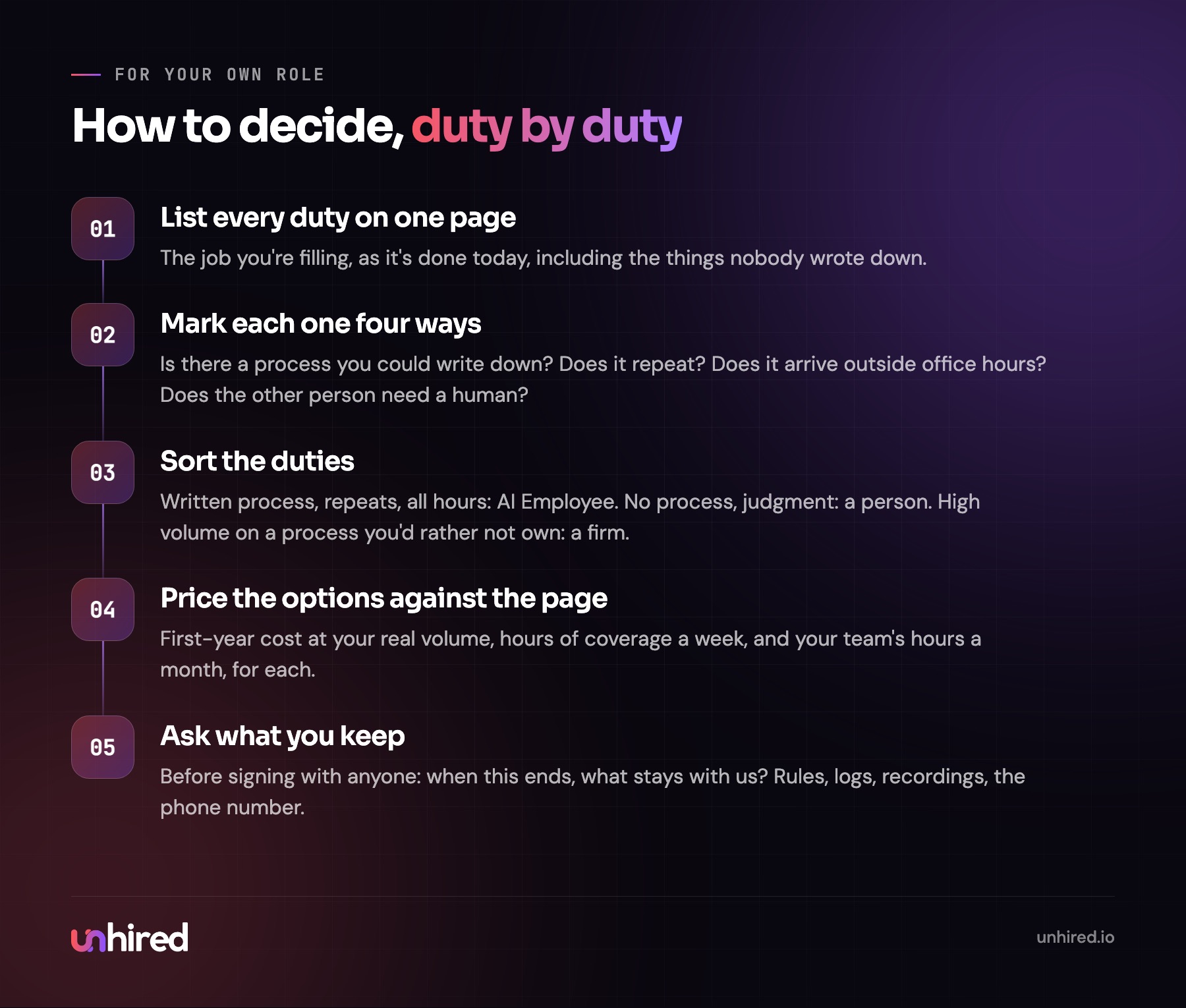
How to decide for your own role
Take the job you're trying to fill and list every duty on one page. Next to each, mark four things: whether there's a process you could write down, whether it repeats, whether it arrives outside office hours, and whether the person on the other end needs a human in the room. Duties with a process that repeat and arrive at all hours point to an AI Employee. A duty with no process and a lot of judgment points to a person. High volume on a process you'd rather not own points to a firm.
Then price the options against that page rather than against each other. Some websites offer free assessments that check whether a role can be filled by an AI Employee, which can help with the first sort. Whatever you choose, get the answer to one question in writing before you sign: when this ends, what do we keep?
Wage data: US Bureau of Labor Statistics, Occupational Outlook Handbook, May 2025 median for secretaries and administrative assistants; the full-cost figure uses the BLS Employer Costs for Employee Compensation share of wages in total compensation. The accounting firm is an example, not a client.