
It's 8:15 on a Monday at a property management company with 14 staff. The office manager opens the shared inbox to 63 new emails. Two tenants want to book the amenity room for the same Saturday. A plumbing contractor's certificate of insurance expired on Friday. The weekend's maintenance requests need to go into the work order system, and every one of them came in by email, so somebody has to retype them. The owner wants the vacancy report by 10.
None of that is hard. All of it has to happen, and in most small offices one person does it, between phone calls, every week. That is the job an AI Administrative Assistant is built for. Below is what it does, where it stops, and what the job costs next to hiring a person.
What an AI Administrative Assistant is
An AI Administrative Assistant is an AI Employee that holds the general admin job in an office. It has logins to the shared inbox, the calendar, document storage and the software the business already runs on, a written set of rules for what it can do alone and what it brings to a person, and an office manager or owner it reports to. Every email it sends and every record it changes goes into a log someone can read.
I've spent the last four years building AI systems and agents for businesses, and admin is the job where owners underestimate how much time goes where. When someone sits down and lists their week, most of it turns out to be moving information from one place to another: from an email into a spreadsheet, from a form into the client file, from a supplier's invoice into the purchase log. An AI Employee is good at that. It's also where I'm strictest about limits, because admin touches money and client records all day.
The admin job, duty by duty
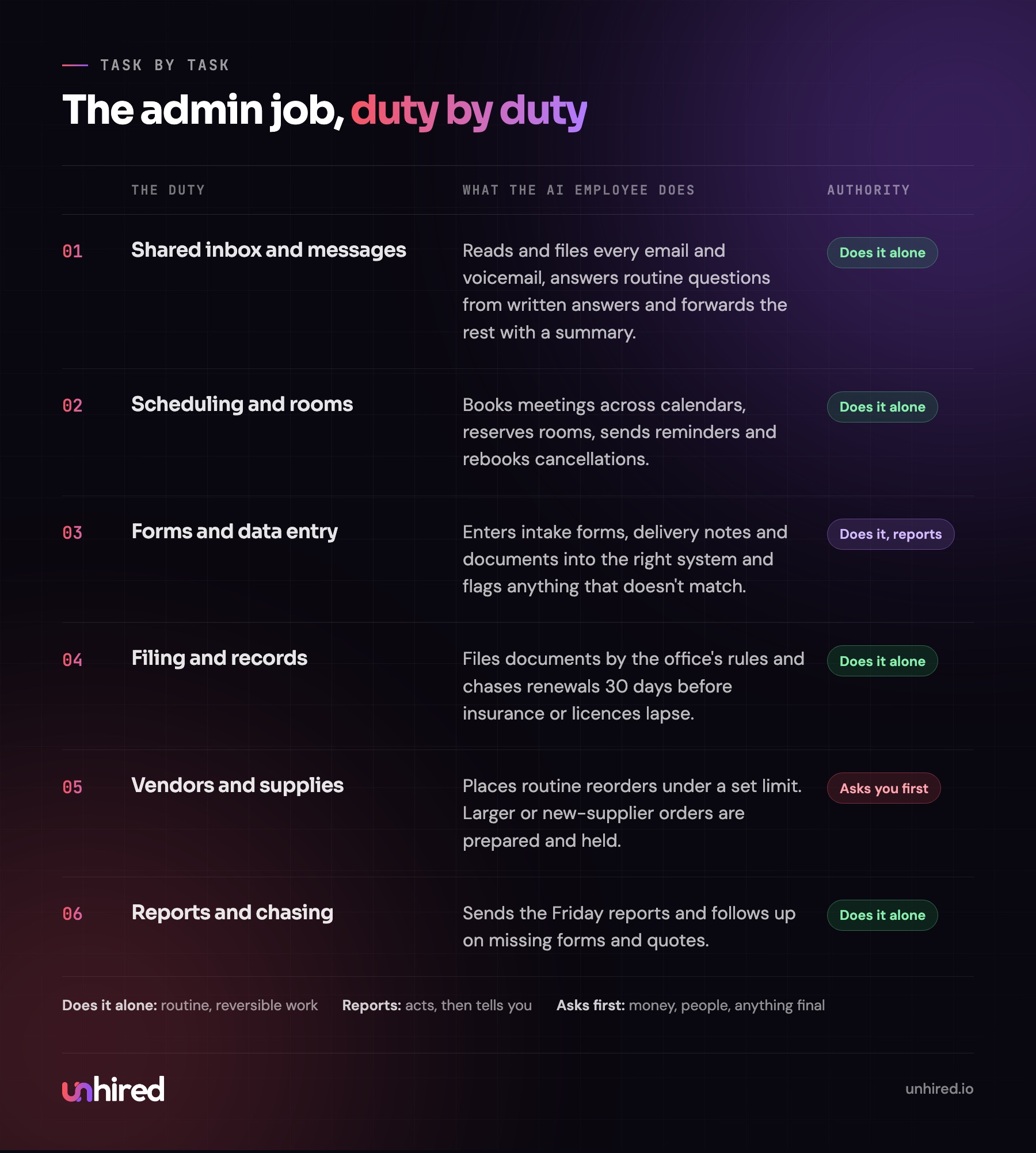
I'd split the job into six duties, each with the authority I'd give it on the first day.
The shared inbox and phone messages
Every office has an info@ or office@ address that collects everything: client questions, vendor invoices, job applications, spam, delivery notices. The AI Administrative Assistant reads each one, files it, answers the routine ones from written answers (hours, directions, what to bring, where to send a document) and forwards the rest to the right person with a one-line summary on top. Voicemail transcripts get the same treatment.
Scheduling, rooms and reminders
It books meetings across several people's calendars, reserves the boardroom or the amenity room, sends reminders the day before and offers new times when someone cancels. Double bookings get caught when the request comes in, not on the morning of.
Forms and data entry
A lot of admin is typing the same details twice. A new client fills in an intake form and someone copies it into the practice software. A delivery note arrives as a PDF and someone keys the quantities into the inventory sheet. The AI Employee reads the document, enters it, checks it against what's already on file and flags anything that doesn't match. My AI Bookkeeper post covers the accounting side of the same work.
Filing and records
It names and files documents where the office's rules say they go, keeps contact lists current, and tracks things with an expiry date: vendor insurance certificates, professional licences, equipment service dates, lease renewals. Thirty days before something lapses, it starts asking for the new copy.
Vendors, orders and supplies
Routine reorders under a set amount (printer paper, coffee, cleaning supplies, the same box of gloves every month) it can place on its own from approved suppliers. Anything above that limit, or from a new supplier, it prepares and holds for a person to approve.
Reports and chasing
Every Friday it sends the reports someone builds by hand today, such as open requests and overdue documents. It also does the chasing nobody enjoys, like the third reminder about a signed form or the follow-up on a quote that never arrived.
What it looks like in different offices
The duties are close to identical everywhere. What changes is the software and the rules.
At a small law firm, the AI Administrative Assistant sends engagement letters for signature, opens the matter folder with the firm's naming rules, books client meetings and logs every incoming document against the right file. At a physiotherapy clinic, it handles intake forms, confirms appointments, and keeps practitioner licences and insurance papers current. For an e-commerce brand with a small team, it's the supplier emails, purchase orders, delivery tracking and returns paperwork. A marketing agency uses it for the parts of client work that aren't creative: booking the review calls, collecting approvals, chasing assets the client promised last week. And at the property management company from the opening, it books the amenity room, logs maintenance requests into the work order system and chases the contractor for a new insurance certificate.
What should stay with a person
These are the lines I'd draw at any business:
- Money above a set limit. The AI Employee can place a $90 supply order. A $2,400 furniture order waits for approval, with the quote attached.
- Signing or agreeing to anything. Contracts, lease terms and service agreements get prepared and routed, never accepted.
- Pay, banking and personal records. Changes to payroll details, direct deposit or employee files go to a person every time. A request to change a vendor's bank account is one of the most common fraud attempts a small office sees, so it should always be confirmed by phone with someone the office already knows.
- Deleting records. It archives. A person deletes.
- Upset clients and sensitive situations. A complaint, a legal threat or a personal emergency goes to the office manager untouched, with the history attached.
- Anyone who asks for a person gets one.
It should also say it's an AI when it writes to clients and vendors. Most people don't mind, and the ones who do can ask for someone else.
A day on the job
Here's an example day for an AI Administrative Assistant at that same property management company. Two items go to the office manager.
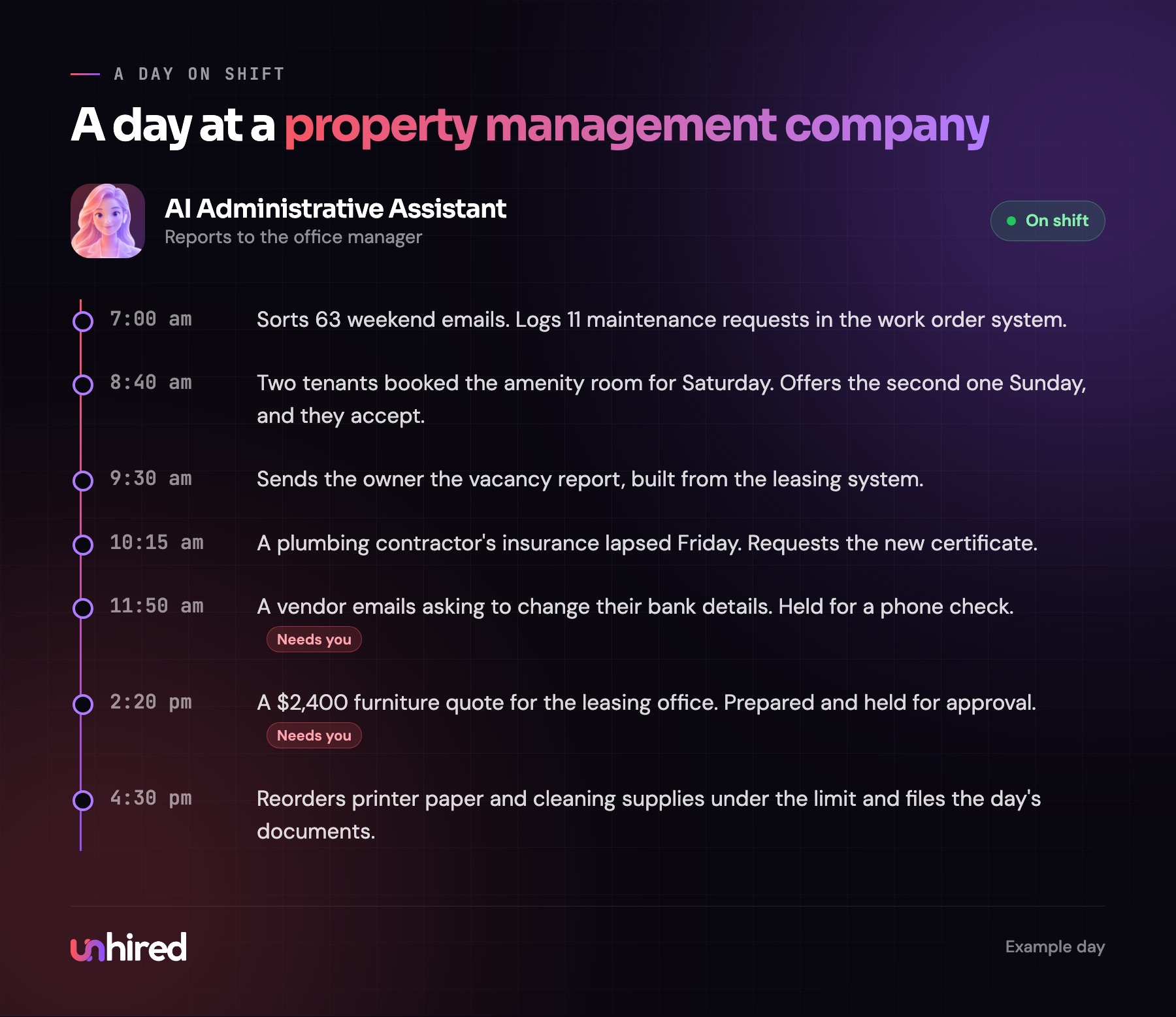
The weekend's email backlog is sorted and the maintenance requests are in the work order system before the office opens. The amenity room clash is settled with both tenants by 9. The vacancy report reaches the owner before 10. And the vendor asking to change their bank details, along with the furniture order over the spending limit, both land on the office manager's desk with everything needed to decide.
What an administrative assistant costs
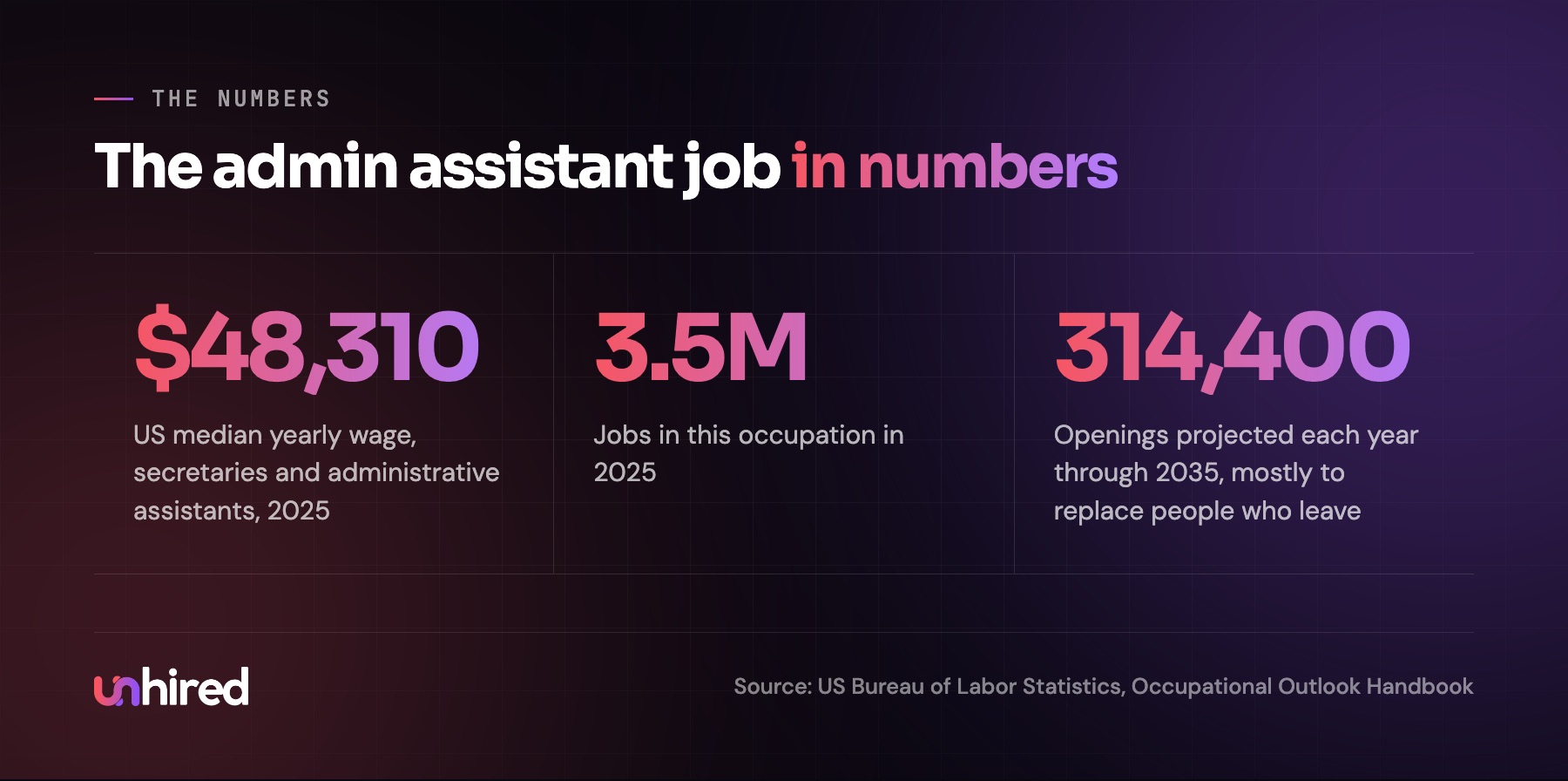
The US Bureau of Labor Statistics puts the median wage for secretaries and administrative assistants at $48,310 a year in 2025, or $23.23 an hour. It varies by specialty: legal secretaries and administrative assistants had a median of $55,570, medical $45,930, and general administrative assistants $47,540. BLS counts about 3.5 million of these jobs and projects around 314,400 openings a year through 2035, even though total employment is expected to shrink by 2%. Most of those openings come from people leaving the job.
The wage is only part of the cost. Across US private industry, wages and salaries are about 70% of what employers spend on compensation, according to the BLS Employer Costs for Employee Compensation report. At the median wage, that puts one administrative assistant at about $69,000 a year, before recruiting, training and covering vacations and sick days.
How much you'd pay for an AI Administrative Assistant
There are two ways to get one.
Building it yourself. Email and office suites now include AI features for drafting and summarizing, and AI agent platforms can connect to the inbox, the calendar, shared drives and many business systems. The software is usually the smaller cost. The bigger one is the time it takes someone on staff to write down how the office works, connect each system, test it on real emails and documents, and keep it current.
Having it built and maintained. A provider sets it up, connects the systems, writes the rules with the business and keeps it updated, usually for a monthly fee.
What drives the price is volume (how many emails, bookings and documents a month), how many systems it has to connect to, whether those systems have a way for software to log in and work in them, and how much it's allowed to do without asking. A five-person agency with one shared inbox needs much less than a clinic group running three locations on two different booking systems.
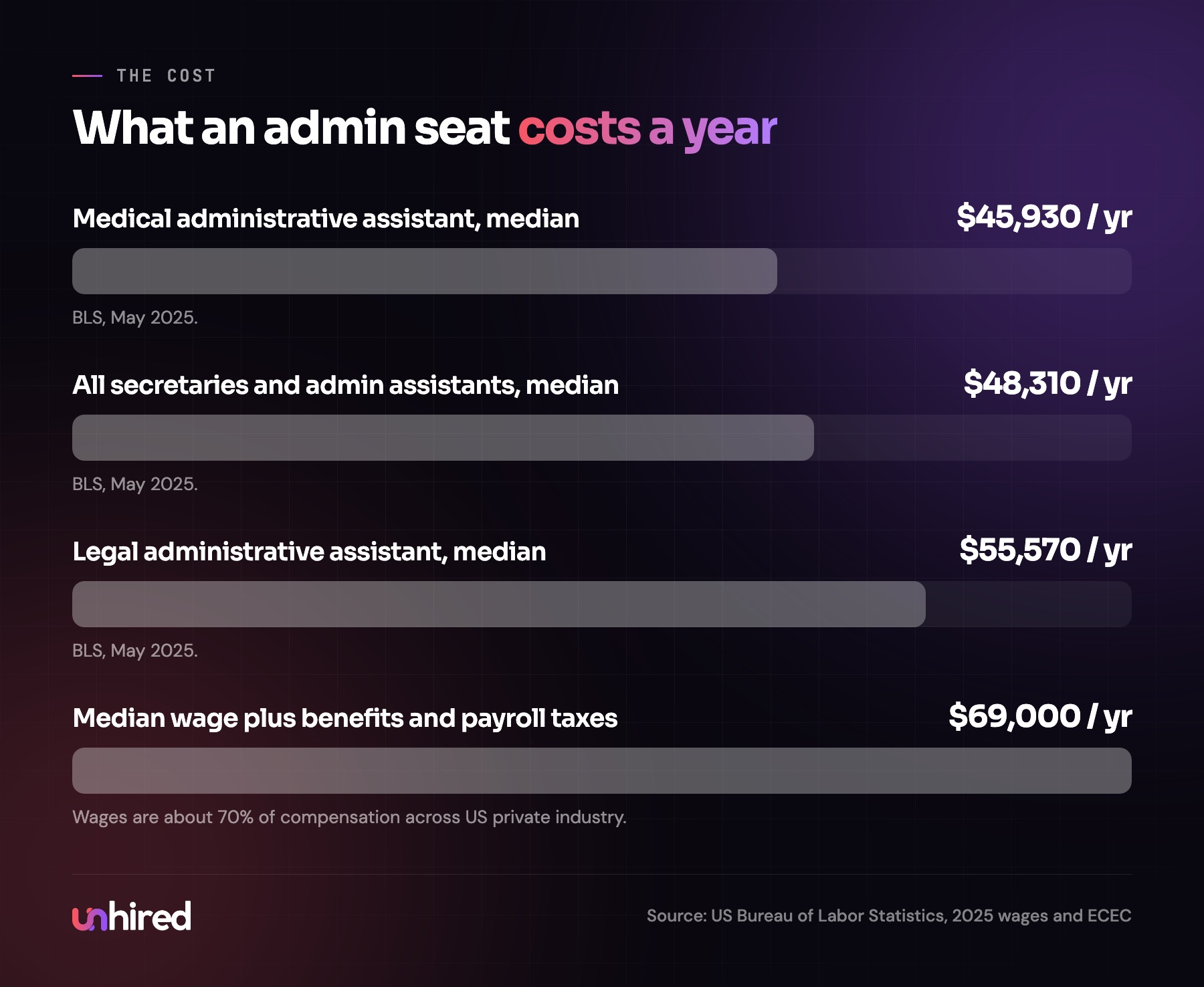
When you compare quotes, line them up against the full cost of the seat, about $69,000 a year at the US median, and against the hours covered. A person covers about 40 hours a week, and a fair amount of office email arrives in the evenings and on weekends.
How an AI Administrative Assistant is set up
Setup starts with the work as it's done today, which is rarely the way it's written down.
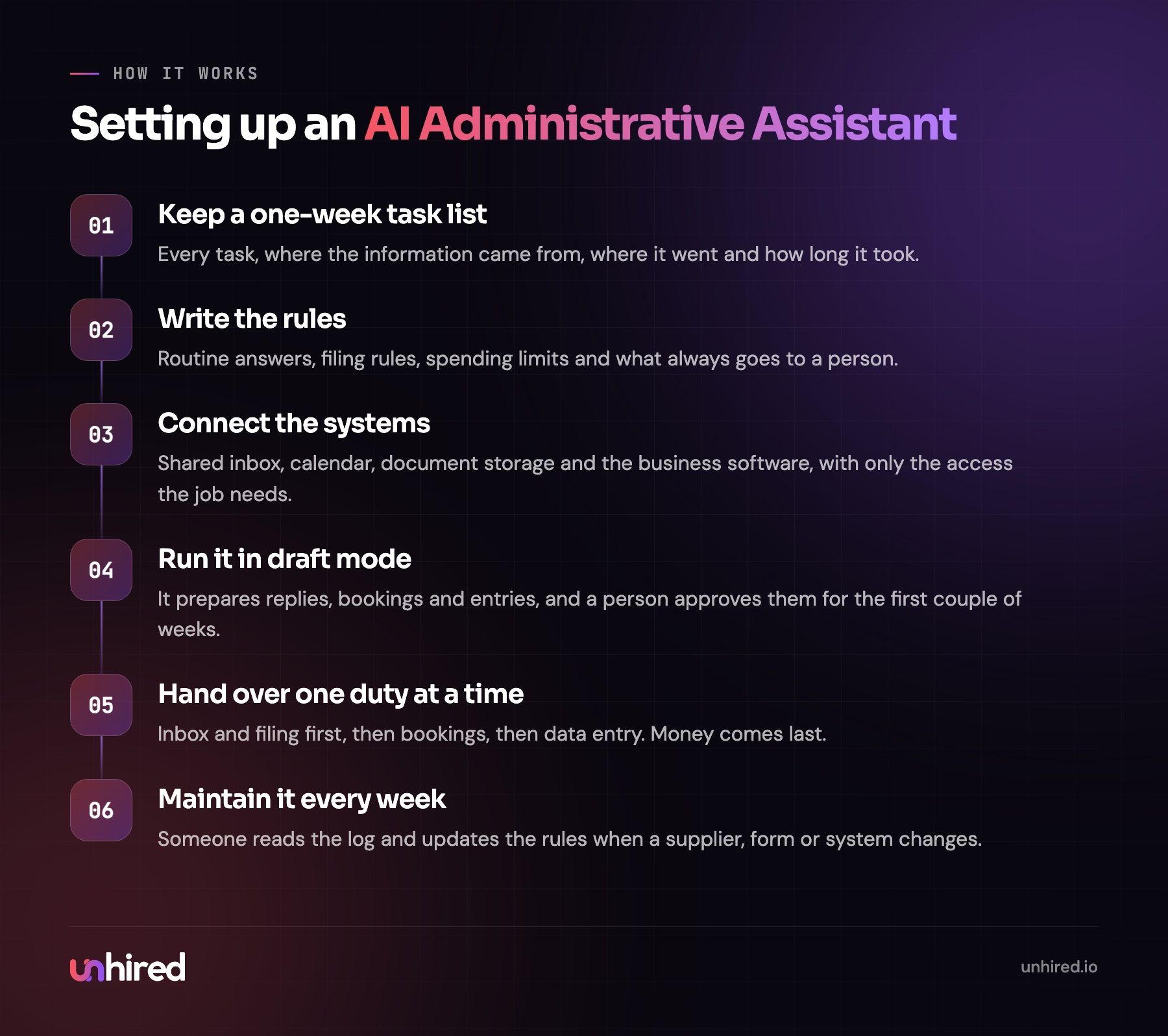
The step I'd never skip is the one-week task list. Whoever does the admin now writes down every task, where the information came from, where it went and how long it took. That list becomes the job description, and it always contains a few tasks nobody knew about, like the spreadsheet that gets updated by hand every Tuesday because two systems don't talk to each other.
After that, it runs in draft mode for the first couple of weeks: it prepares replies, bookings and entries, and a person approves them. Inbox sorting and filing usually go live first, then bookings, then data entry once the checks prove reliable. Anything involving money comes last. After launch, someone reads the log every week and updates the rules when a supplier, a form or a system changes.
Where it fits and where it doesn't
If your office runs on a shared inbox, a calendar and a handful of systems that someone keeps in sync by hand, an AI Administrative Assistant can hold most of that job, and the person who does it today gets their time back for the clients in the room and the calls that need judgment. If your admin is mostly paper, phone calls and walking around the building, an AI Employee has less to hold, and I'd start with the inbox and the reminders. If the work is really one executive's calendar and travel, the AI Executive Assistant post is the closer fit.
A useful first step takes one week. Ask whoever handles the admin to keep a simple list for five working days: each task, roughly how long it took, and whether it was moving information between places or making a decision. Add up the hours in the first group. That number is the size of the job an AI Administrative Assistant would own. Some websites offer free assessments that check whether a role can be filled by an AI Employee, which runs the same sort on the whole job description.
Wage data: US Bureau of Labor Statistics, Occupational Outlook Handbook, May 2025, and Employer Costs for Employee Compensation. The property management day is an example built from the duties in this post.