
At the end of most months, a small business has the same pile waiting: a handful of clients more than 30 days late, receipts scattered through someone's email, and a couple of hundred bank lines in QuickBooks or Xero that nobody has matched. The bookkeeper, if there is one, spends the first week of the next month catching up. If there isn't one, the owner does it on a Sunday.
Almost all of that is work moving between systems: the bank feed, the accounting software and the inbox where bills land. That's the kind of work an AI Employee is good at. This post walks through the bookkeeping job when an AI Employee holds it, what it should never do on its own, and what it costs next to a hire.
What an AI Bookkeeper is
An AI Bookkeeper is an AI Employee that holds the bookkeeping seat. It has a title, a manager (usually the owner or a controller), logins to the accounting software and the tools around it, and written rules about what it can do alone and what needs a person's sign-off. Everything it posts, sends or changes goes into a log.
That's different from the automation already built into accounting software. Bank rules in Xero will code every Shell charge as fuel. They won't email a client about an invoice that's 45 days late, notice that a vendor billed you twice, or ask the office manager what the $1,180 Amazon charge was for. An AI Bookkeeper does the follow-up that rules can't. The article on AI Employees vs. AI agents covers that difference in more detail.
What it does, duty by duty
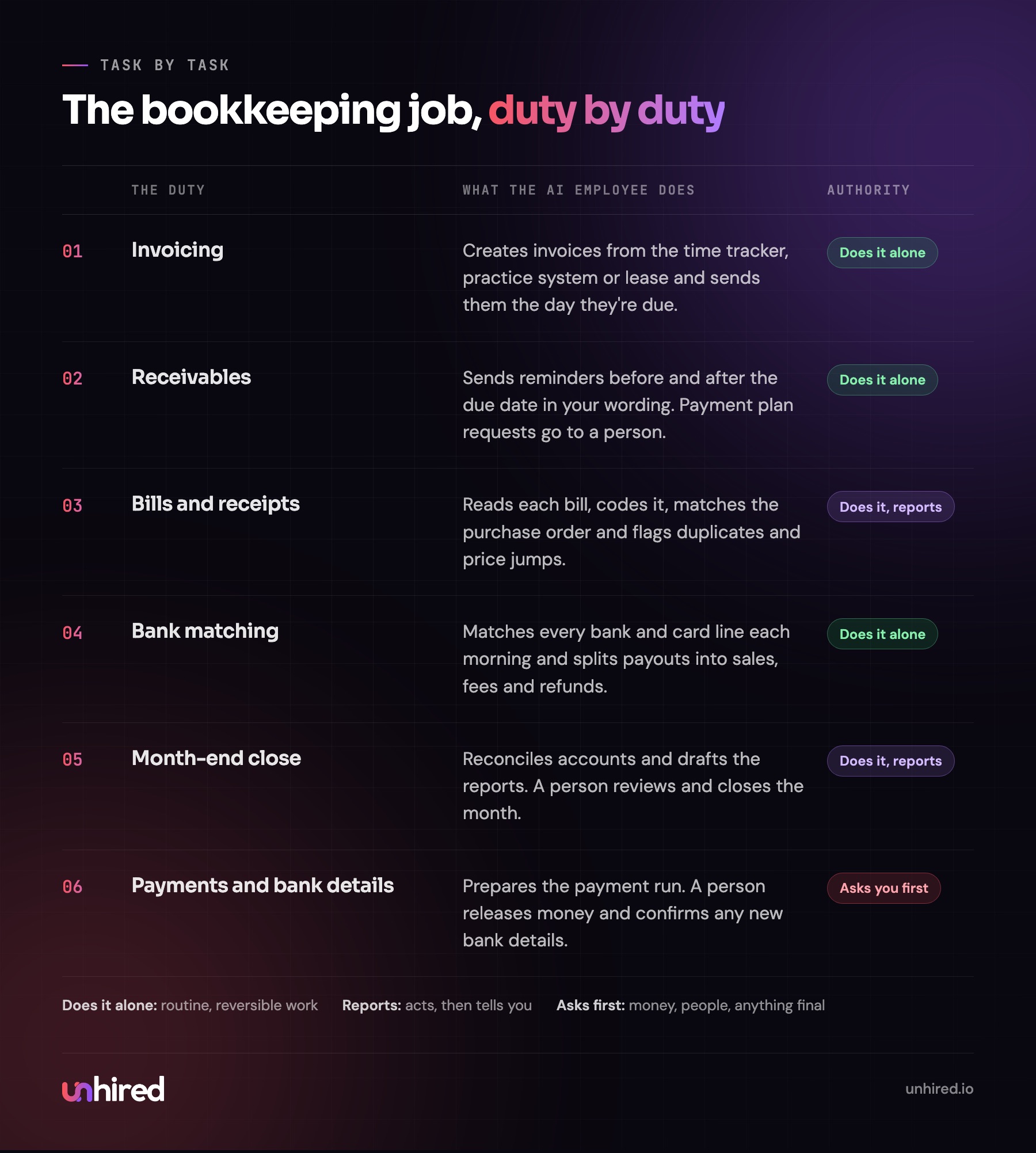
I'd split a small business bookkeeping job into these duties, each with the authority level I'd give it.
Invoicing
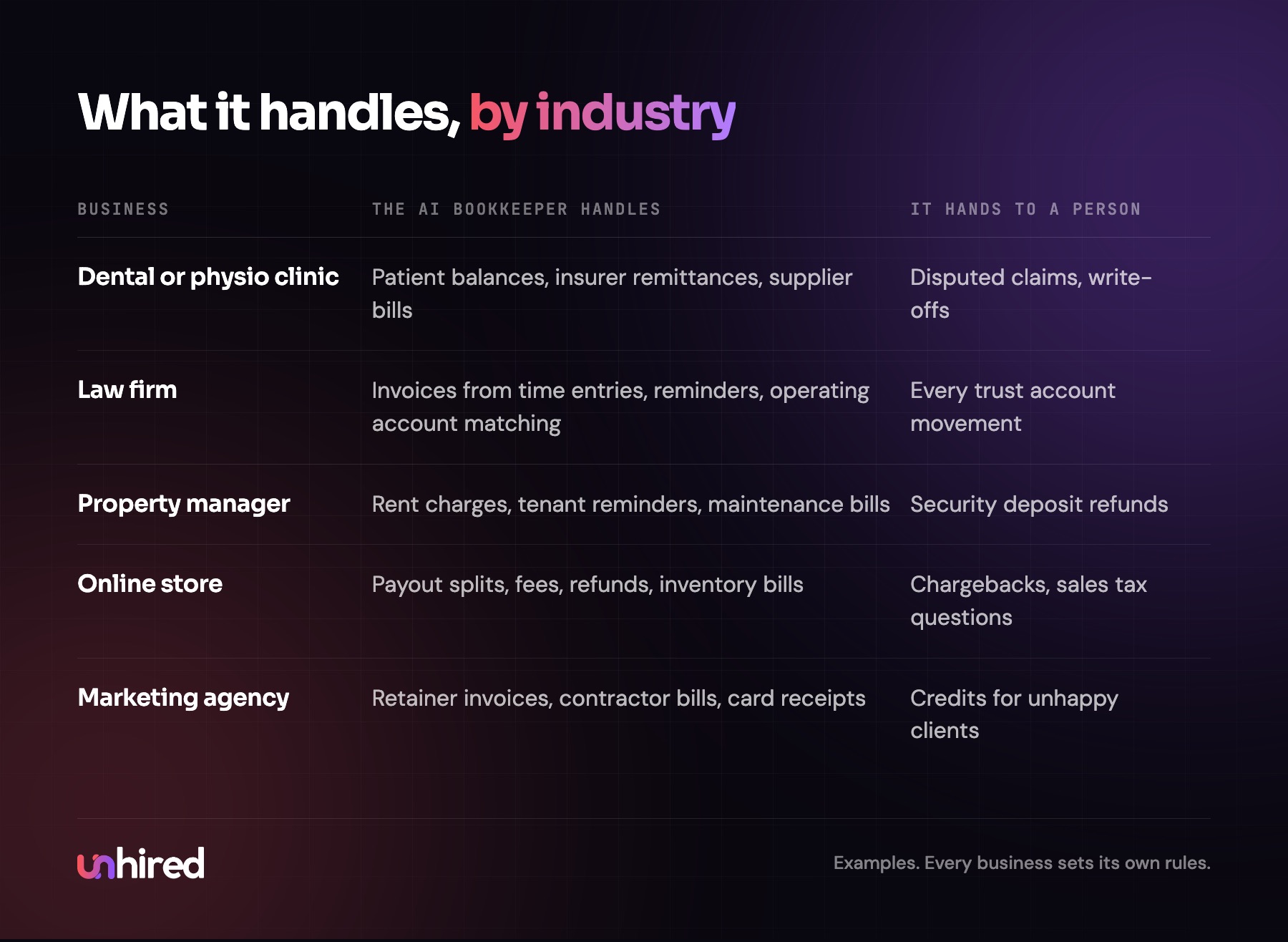
An agency bills retainers on the 1st and project work when a milestone closes. A clinic bills insurers and patients for the balance. A property manager posts rent charges to every tenant ledger. The AI Bookkeeper creates those invoices from the source, whether that's the time tracker, the practice management system or the lease, and sends them the day they're due instead of the day someone remembers.
Receivables and collections
This is where small businesses lose the most money without noticing. The AI Bookkeeper sends a friendly reminder a few days before the due date, another at 7 days late, and a firmer one at 30, all in your wording. When a client replies "we never got it" or "can we split it into two payments?", it resends the invoice or passes the payment plan request to whoever approves those. It doesn't negotiate, and it doesn't threaten collections.
Bills and receipts
Bills arrive as PDFs in an inbox and as photos taken on someone's phone. The AI Bookkeeper pulls each one in, reads the vendor, date, amount and tax, matches it to a purchase order if you use them, codes it to the right account and queues it for approval. It also catches the things people miss when they're rushing: the same invoice number twice, a price that jumped from last month, a bill from a vendor you've never paid before.
Bank matching
Every morning it goes through the new bank and card lines and matches them: deposits to invoices, payments to bills, payouts to the sales behind them. An online store's Stripe or Shopify payout is a good example. One $4,812.40 deposit is really 63 orders minus fees and two refunds, and the AI Bookkeeper splits it out so revenue and fees land in the right accounts. Anything it can't match goes on a short list with a question attached.
Month-end close
By the second or third business day of the month, it has the bank and card accounts reconciled, a list of open receivables and payables, and draft reports for the owner or the accountant, starting with profit and loss and the balance sheet. It flags what looks off, like a category that doubled or a deposit with no invoice behind it. A person reviews and closes the month.
What it should always hand to a person
Bookkeeping touches money, so the limits matter more here than in almost any other role. These are the things I'd never let an AI Bookkeeper do on its own, at any business:
- Releasing payments. It can prepare the payment run and show what's due. A person approves before money leaves the account.
- Changing where a vendor gets paid. An email saying "we've changed banks, please update our details" is a classic setup for payment fraud. Any change to bank details goes to a person, who confirms it by phone with a number already on file.
- Write-offs, credits and refunds outside your written policy.
- Tax filings and anything that needs a professional's judgment, like how to treat a large equipment purchase. That's your accountant's job.
- Trust and client-money accounts, such as a law firm's trust account or a property manager's security deposits. The rules on those are strict, and a person should approve every movement.
Payroll changes belong on this list too, for the same reason as vendor bank details.
A day in the books
Here's an example day for an AI Bookkeeper at a small marketing agency. Two items go to a person, and that's how it should look.
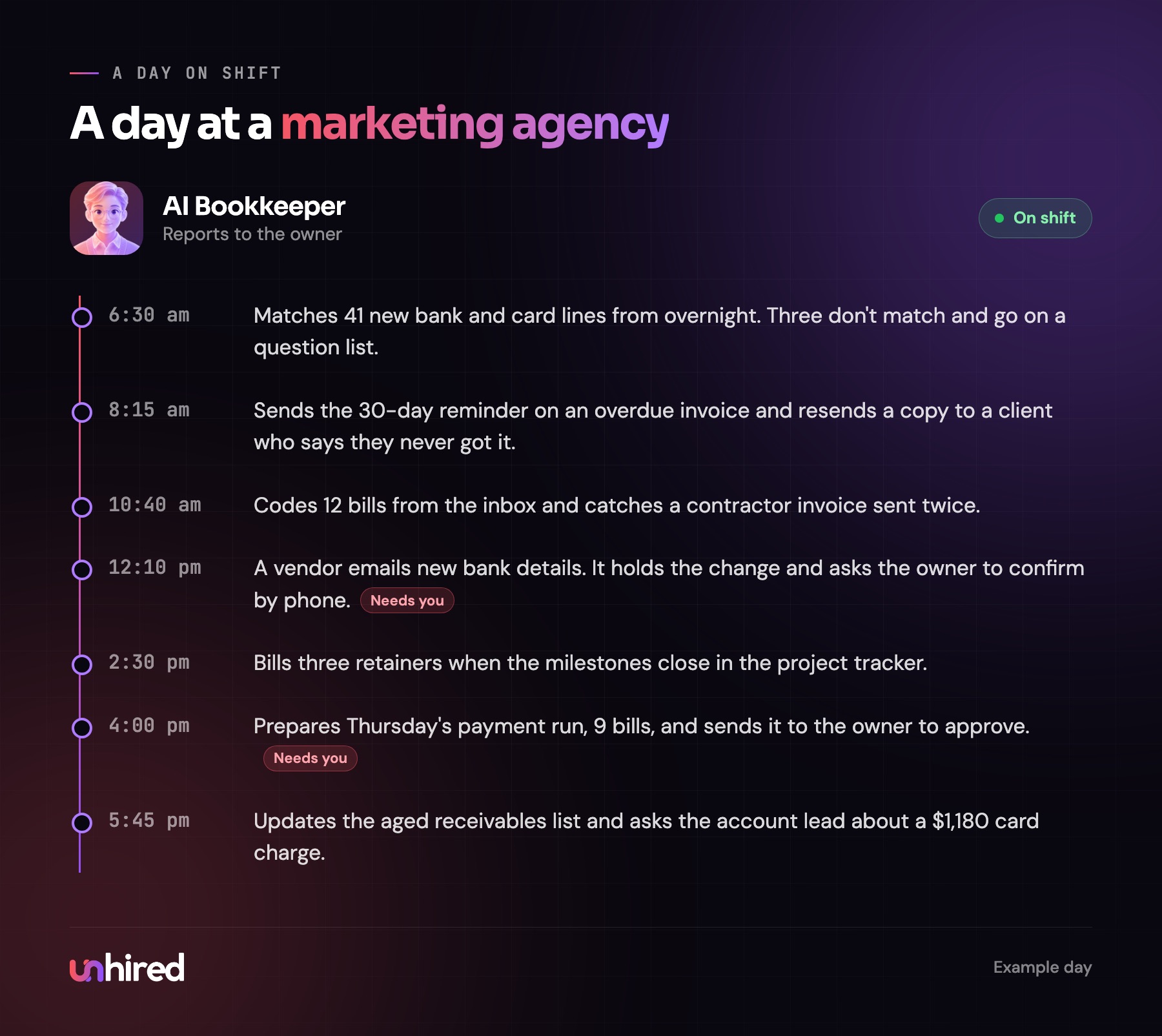
The bank lines are matched before anyone opens the laptop. The overdue invoice gets its 30-day email without anyone having to remember. The new vendor bank details and the payment run both wait for the owner, with everything they need to decide in one message.
What a bookkeeping hire costs
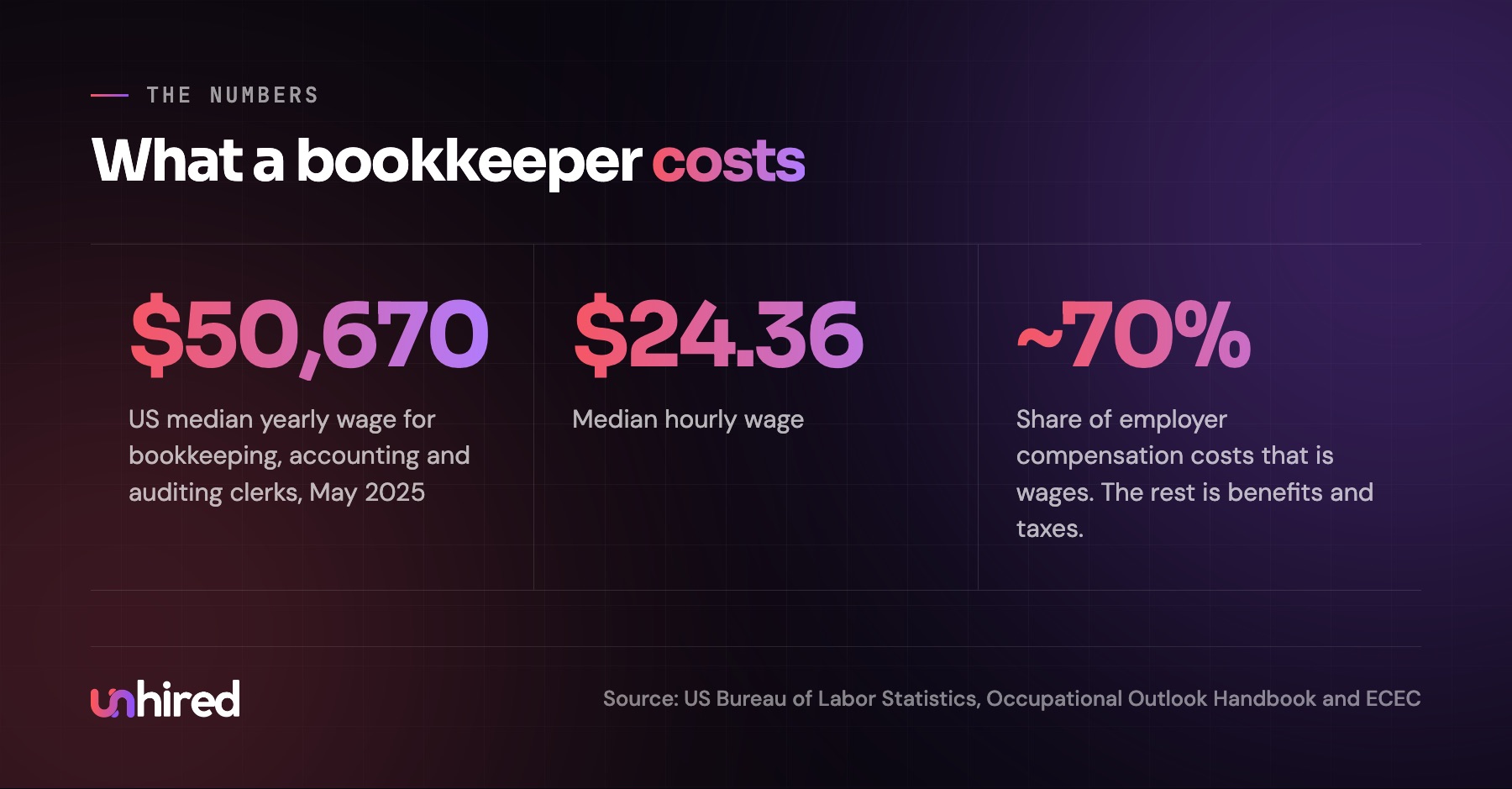
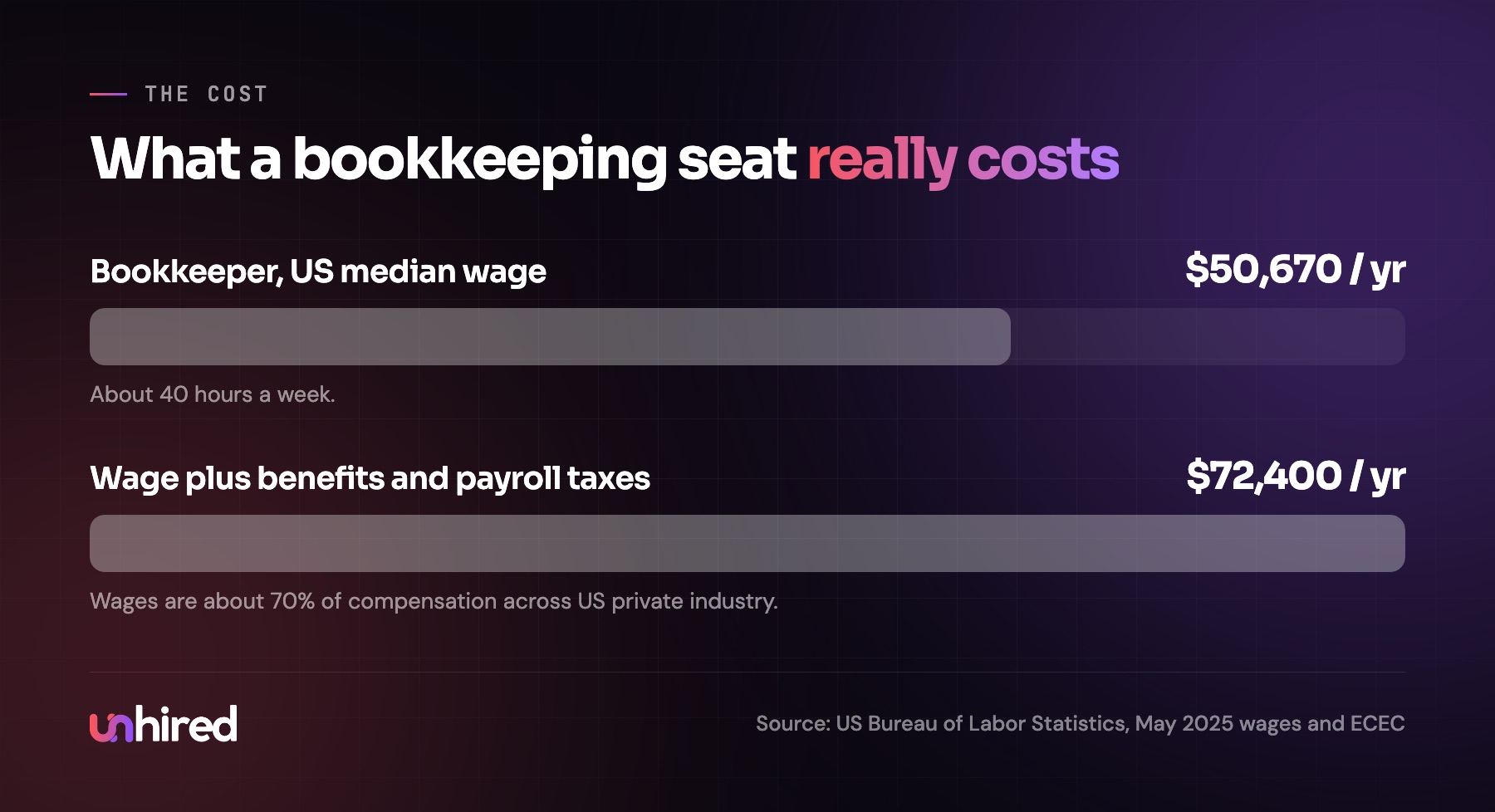
The US Bureau of Labor Statistics puts the median wage for bookkeeping, accounting and auditing clerks at $50,670 a year, or $24.36 an hour, as of May 2025. There were about 1.5 million of these jobs in 2025, and BLS projects a 6% decline in employment from 2025 to 2035.
The wage is only part of the cost. Across US private industry, wages and salaries are about 70% of what employers spend on compensation, according to the BLS Employer Costs for Employee Compensation report. At the median wage, that puts the full cost closer to $72,400 a year before recruiting and training.
Many small businesses don't have a full-time bookkeeper at all. They have a part-time one, an outside bookkeeping firm that comes in once a month, or an owner doing it at night. In those cases the useful comparison is what you pay now plus what late books cost you: invoices that go out a week late, receivables nobody chases, and the accountant's hours spent cleaning up before they can start.
How much you'd pay for an AI Bookkeeper
There are two ways to get one.
Building it yourself. AI agent platforms, receipt-capture apps and the AI features inside QuickBooks and Xero are sold as monthly subscriptions. The software costs are usually modest. The real cost is the time it takes someone to connect it all, write the coding rules and approval limits, test it on a few months of real transactions, and keep it current.
Having it built and maintained. A provider sets it up, connects your accounts, trains it on your chart of accounts and your clients, and keeps it updated, usually for a monthly fee.
The price depends on how many transactions you run through each month, how many bank accounts, cards and payment processors it has to match, whether it handles one company or several, and how much review and maintenance is included. A clinic with one bank account and a few hundred transactions a month needs far less than an online store with three sales channels.
To compare a quote, set it against the full cost of the seat: about $72,400 a year for a full-time bookkeeper at the US median, or whatever your current mix of part-time help, outside firm and owner time adds up to.
How an AI Bookkeeper is set up
Setup looks like training a new bookkeeper, with more time spent on the rules.
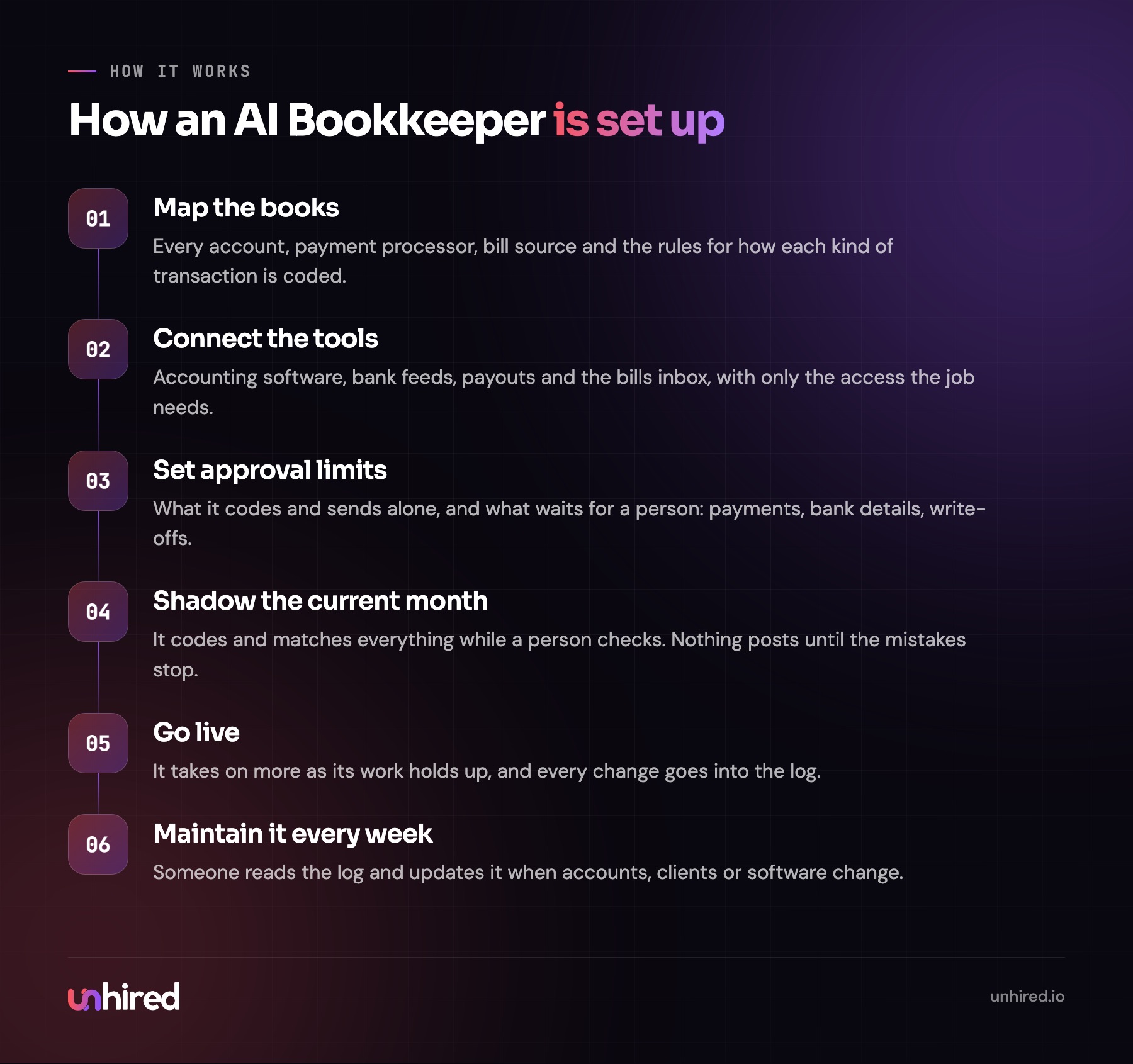
I'd always start it in shadow mode on the current month: it codes and matches everything, a person checks its work, and nothing posts until the mistakes stop. Bookkeeping errors compound, so a wrong rule in week one is a mess by month-end. After that, the work is the step people skip: someone has to read the log every week and update it when you add a bank account or change your chart of accounts.
When to keep a person on the books
If your books involve a lot of judgment, like inventory with landed costs or several entities with transfers between them, you need an experienced person in the loop. An AI Employee can do the entry and matching under them, but it shouldn't be making those calls.
If your bookkeeping is mostly invoicing, chasing, coding and matching, an AI Bookkeeper can hold the seat, and your accountant gets clean books at month-end. It's a similar split to the one in the AI Receptionist post: let the AI Employee own the repeatable work and send every exception to a person.
Before you hire, pull last month's bank statement and go down it line by line. Mark each line as something a rule could code, something that needed a question answered, or something that needed a decision. The first two columns are what an AI Bookkeeper would own. Some websites offer free assessments that check whether a role can be filled by an AI Employee, which is a quick way to do the same sort for the whole job.