
It's 7:10 on a Monday. The owner of a 30-person company opens their laptop to 140 unread emails, two meetings booked into the same 10:00 slot, a client asking to move Thursday's call, and a note from the airline saying Wednesday's flight now leaves three hours later. None of it is hard. All of it has to be dealt with before the real work starts, and on most days it takes until 9:00.
That first two hours is what an executive assistant takes off someone's plate. Most small and medium businesses have never had one, because a full-time assistant for one person is hard to justify. This post walks through the job when an AI Employee holds it: what it does, where it has to stop and ask, and what it costs next to a hire.
What an AI Executive Assistant is
An AI Executive Assistant is an AI Employee that holds the assistant job for one person, usually the owner, a managing partner or a department head. It has delegate access to that person's email and calendar, logins to the few other systems the job needs, and written rules about what it can do on its own and what it has to bring back. Everything it sends, books or changes goes into a log the person can read.
I've been building AI systems and agents for businesses for four years, and this is the role where the rules matter most. A receptionist talks to callers. An executive assistant writes in someone else's name. The setup work is mostly about deciding exactly what it can say for you, and in which situations.
What it does, duty by duty
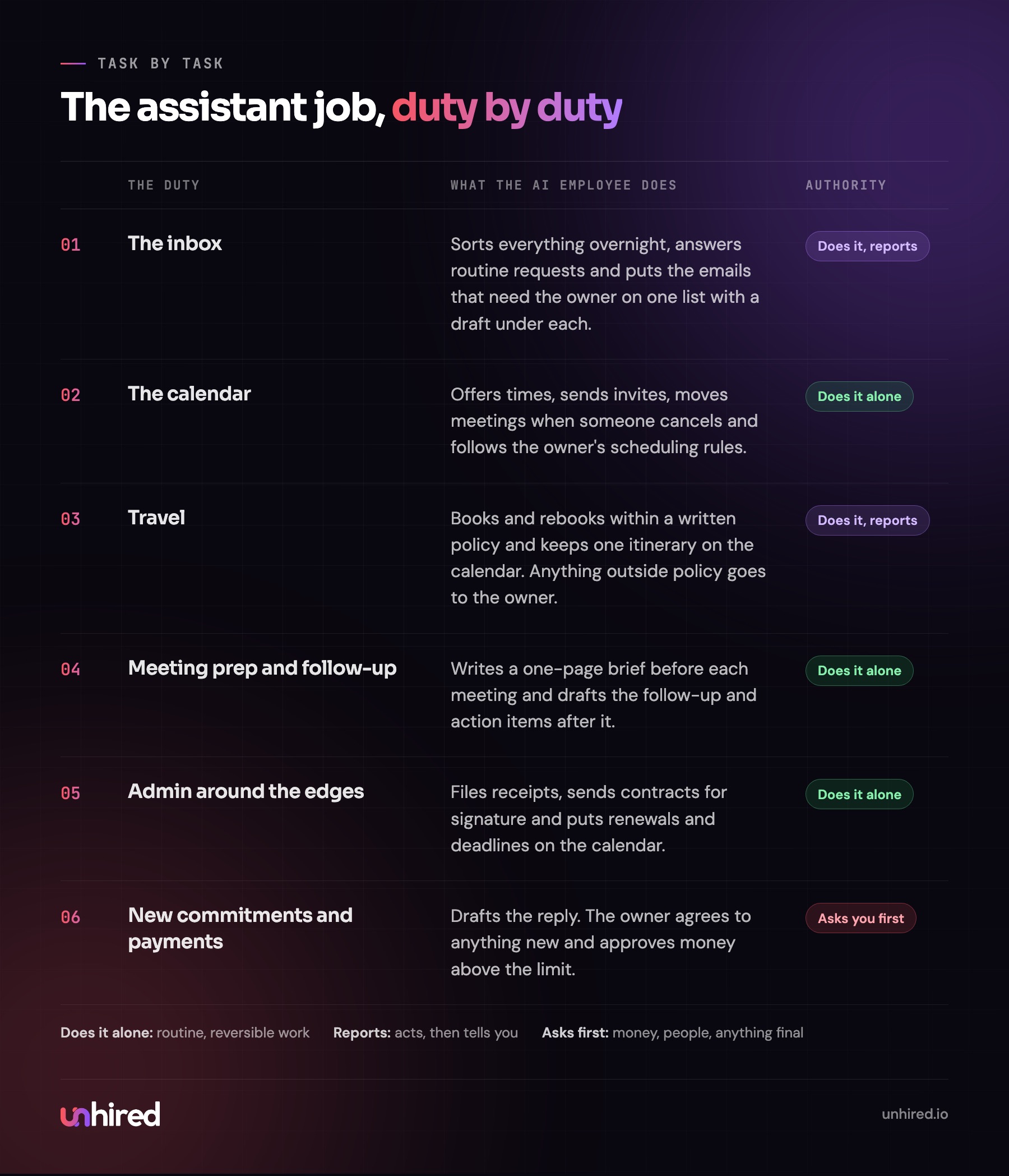
I'd split the job into five duties, each with the authority level I'd give it at the start.
The inbox
Every morning it goes through everything that came in overnight and sorts it: what needs the owner today, what it can answer, what can wait for Friday, and what is noise. A vendor asking for a W-9 or a client asking for last month's report gets handled without the owner seeing them. The owner gets a short list at 7:00 with the eight emails that need them and a drafted reply under each one.
It also tracks what's waiting on other people. If the owner asked a supplier for a revised quote on Tuesday and nothing has arrived by Friday, it sends the nudge.
The calendar
Scheduling is back-and-forth email, which is exactly what an AI Employee is good at. It offers times, sends the invite with the video link and moves things when someone cancels. It knows the rules a person would learn in their first month: no calls before 9:00, Fridays after 2:00 stay clear, board prep gets two hours the day before, and the managing partner's standing Tuesday lunch never moves.
When two things collide, it doesn't pick a winner on its own unless the rules already say which one wins. It lays out the conflict and suggests a fix.
Travel
It books flights, hotels and cars within a written policy (preferred airlines, a nightly hotel limit, aisle seat, no red-eyes) and puts everything into one itinerary on the calendar. Its real value shows up when plans change. When a flight is delayed or cancelled, it finds the next options, rebooks within policy, moves the dinner reservation and tells the people the owner was meeting.
Anything outside the policy, like a last-minute business class fare, goes to the owner first.
Meeting prep and follow-up
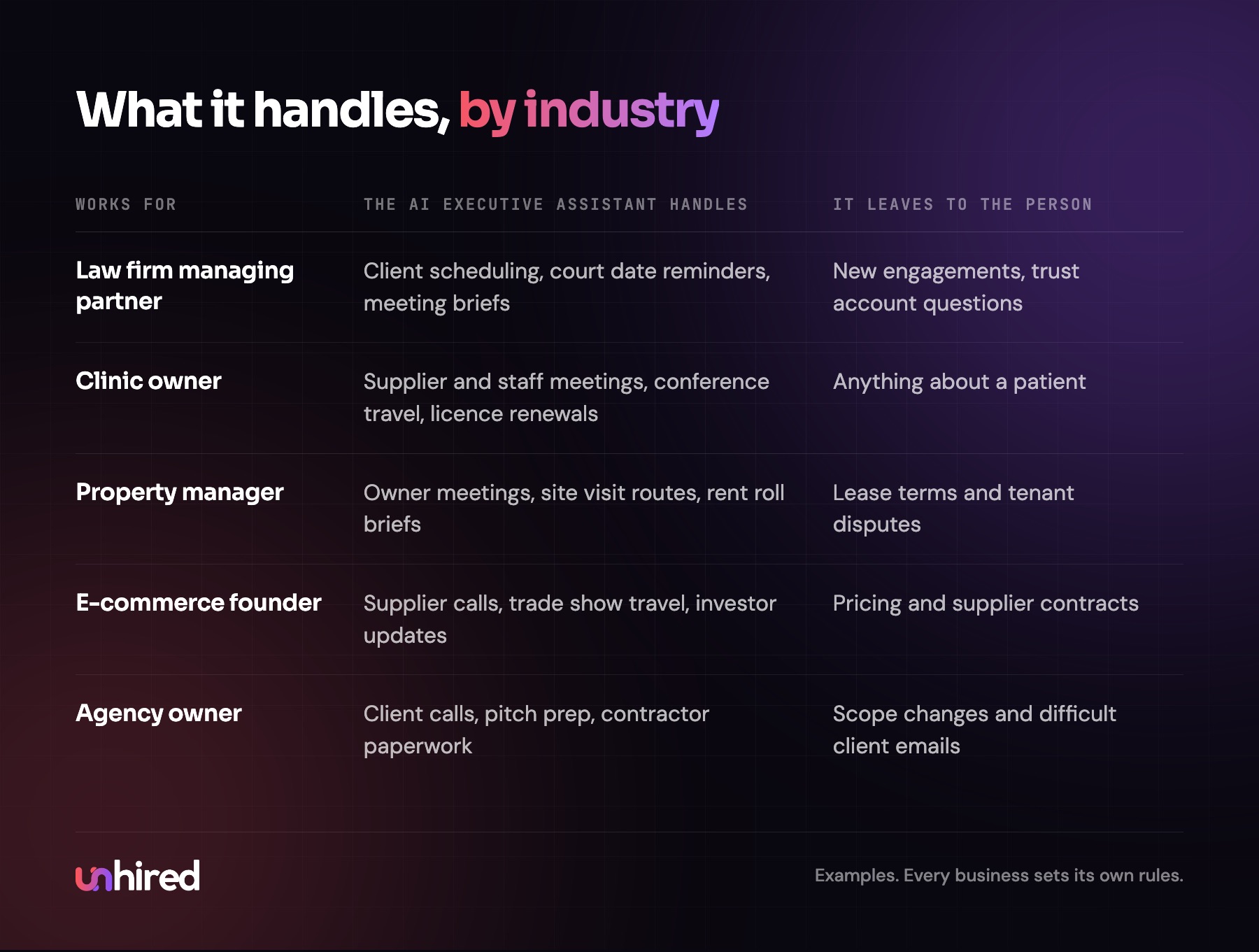
Before each external meeting it writes a one-page brief: who's attending, their role, the last three emails with them, open invoices or tickets from the CRM, and what was agreed last time. A property manager meeting a building owner sees the open maintenance requests and the last rent roll. A lawyer meeting a client sees the matter status and the last bill.
After the meeting, it drafts the follow-up email and adds the action items to whatever task tool the business uses. If the meeting was recorded with the attendees' consent, it works from the transcript.
Admin around the edges
Expense receipts get matched and filed. Contracts get sent for signature and chased. Renewals, licence deadlines and birthdays the owner cares about go on the calendar with a reminder. None of these is big. Together they're a few hours a week that someone senior is spending on clerical work.
What it should always leave to the person
An assistant who writes in your name can do real damage if the limits are vague. These are the lines I'd draw at any business:
- New commitments. It can confirm a meeting the owner already agreed to. It can't accept a new client, agree to a price, take a speaking slot or say yes to anything the owner hasn't said yes to.
- Money above a set limit. Travel within policy is fine. Any payment, deposit or purchase above the limit waits for approval, and it never changes where a payment goes because an email asked it to.
- Confidential and personal matters. Staff issues and messages about health or family go straight to the owner, untouched.
- Sharing documents outside the company. It can send a document the owner has cleared for that person. It doesn't forward the financials because someone asked nicely.
- Anything that reads like the owner's opinion. A difficult email to a partner or an unhappy client gets drafted, not sent.
Requests that look like they come from the owner deserve a special rule. Business email compromise, where a criminal impersonates an executive or a vendor to redirect a payment, is one of the costliest crimes reported each year to the FBI's Internet Crime Complaint Center. An AI Executive Assistant should treat any message asking for a payment, a gift card purchase or a change of bank details as something to confirm with the owner through a channel already on file.
A day on the job
Here's an example day for an AI Executive Assistant working for the managing partner of a small law firm. Three items go to the partner, which is about right.
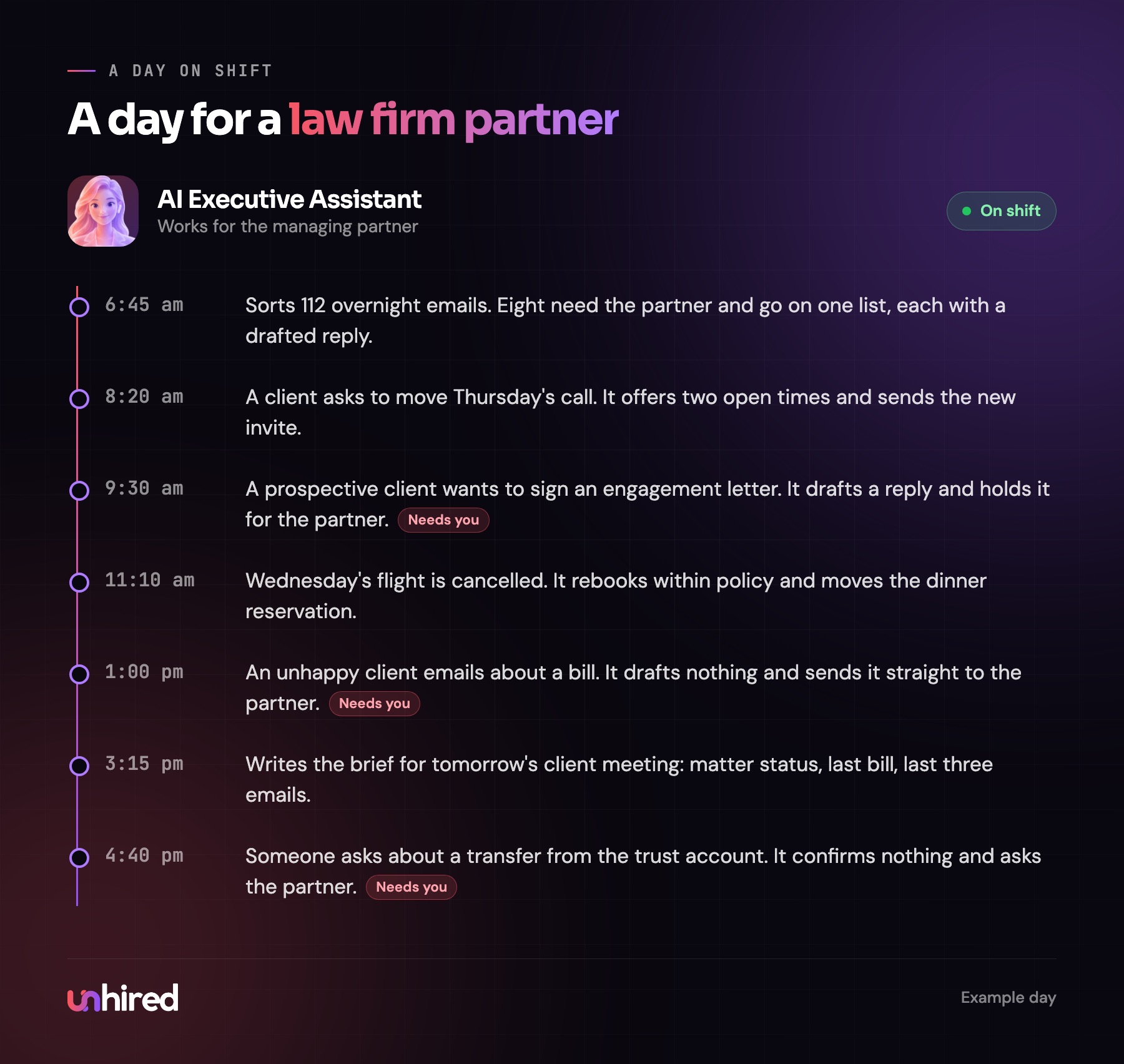
The inbox is sorted before the partner sits down. The rescheduled call and the rebooked flight happen without anyone chasing them. The new engagement, the client complaint and the trust account question all land with the partner, each with a short summary of what's being asked.
What an executive assistant costs
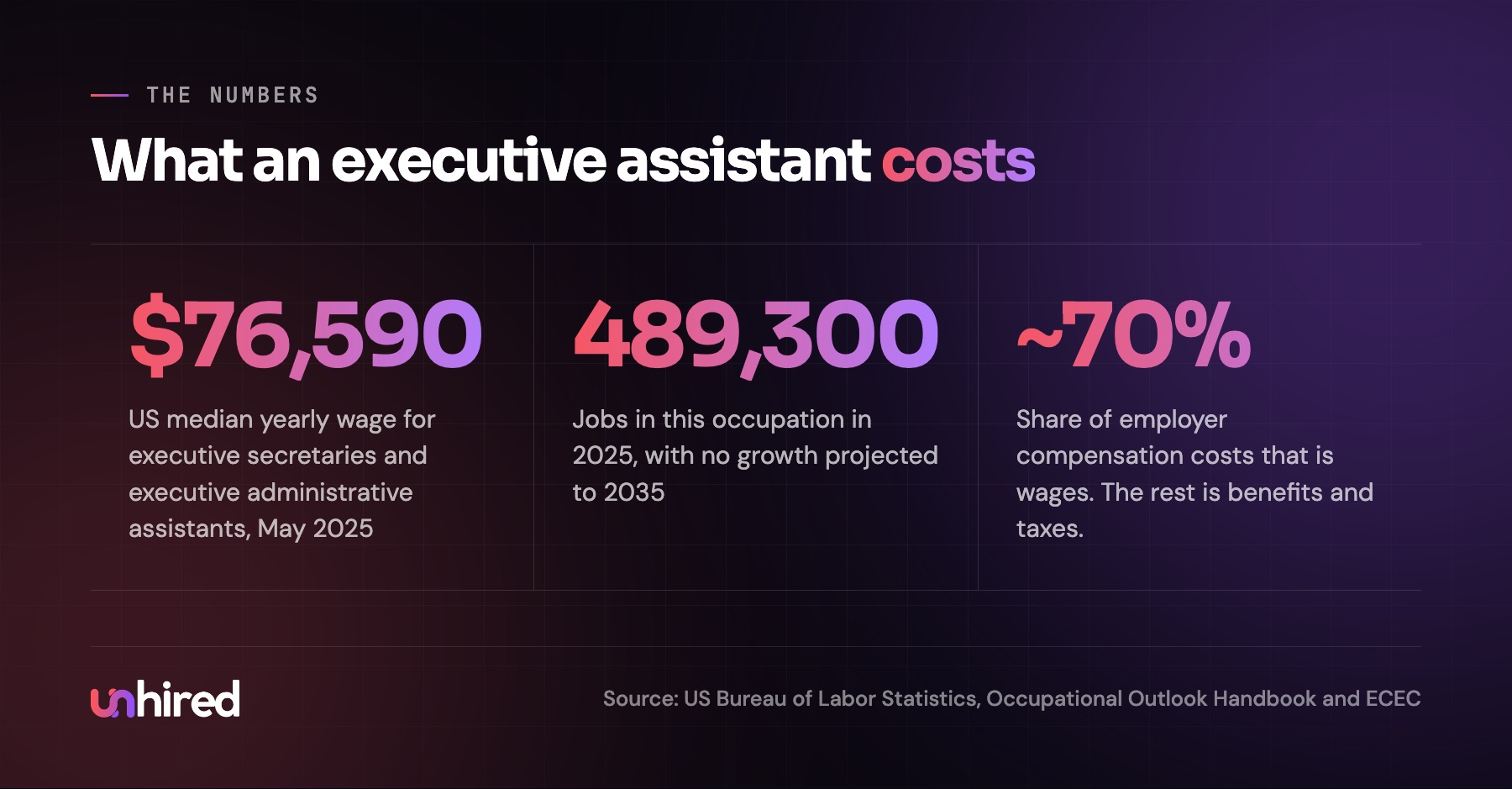
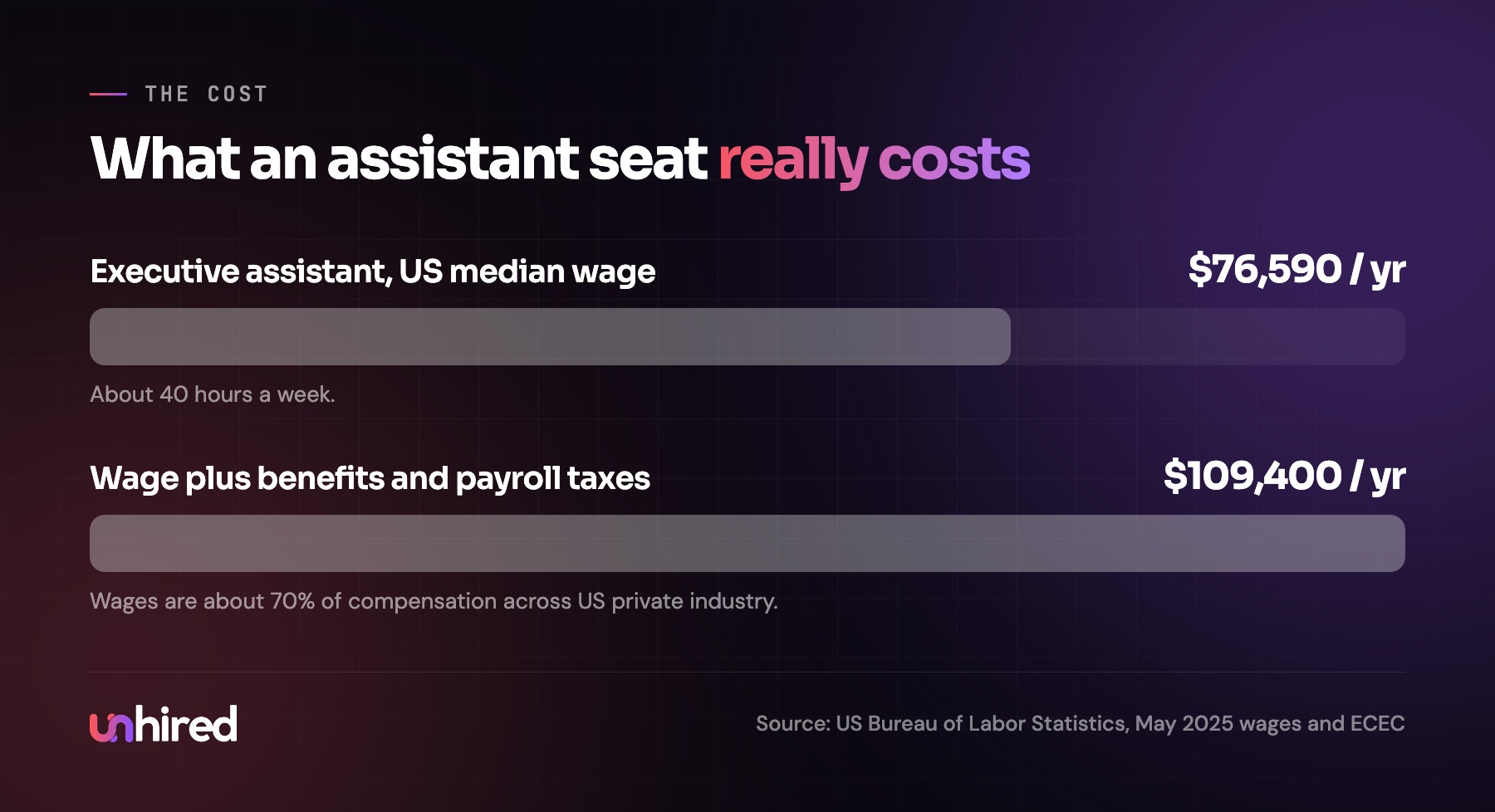
The US Bureau of Labor Statistics puts the median wage for executive secretaries and executive administrative assistants at $76,590 a year as of May 2025. Over a 2,080-hour year, that's about $36.82 an hour. There were about 489,300 of these jobs in 2025, and BLS projects no growth in that number through 2035.
The wage isn't the whole cost. Across US private industry, wages and salaries are about 70% of what employers spend on compensation, according to the BLS Employer Costs for Employee Compensation report. At the median wage, that puts the full cost of the seat closer to $109,400 a year before recruiting and training.
Most owners of small businesses don't compare against that number, because they never hired the assistant. They compare against what they do now, which is usually a part-time virtual assistant or their own evenings. The honest comparison is that cost plus the hours the owner spends on email and scheduling, valued at what the owner's time is worth to the business.
How much you'd pay for an AI Executive Assistant
There are two ways to get one.
Building it yourself. Gmail and Outlook both have assistant features, and AI agent platforms, scheduling tools and travel apps are sold as monthly subscriptions. Software costs are usually modest. The real cost is the time it takes to connect everything, write the rules for what it can send and book, test it on a few weeks of real email, and keep it current as the business changes.
Having it built and maintained. A provider sets it up, connects the accounts, writes the rules with the owner, and keeps it updated, usually for a monthly fee.
The price depends on how many people it supports, how many inboxes and calendars it covers, how much travel there is, how many other systems it reads from (CRM, practice management, accounting), and whether it sends on its own or only drafts. An agency founder who travels twice a year needs much less than a managing partner with three assistants' worth of calendar and a flight every week.
Whatever the quote, set it against the full cost of the seat: about $109,400 a year for a full-time executive assistant at the US median, or whatever your current mix of part-time help and your own time adds up to.
How an AI Executive Assistant is set up
Setup looks like the first month with a new assistant, with the unwritten rules written down.
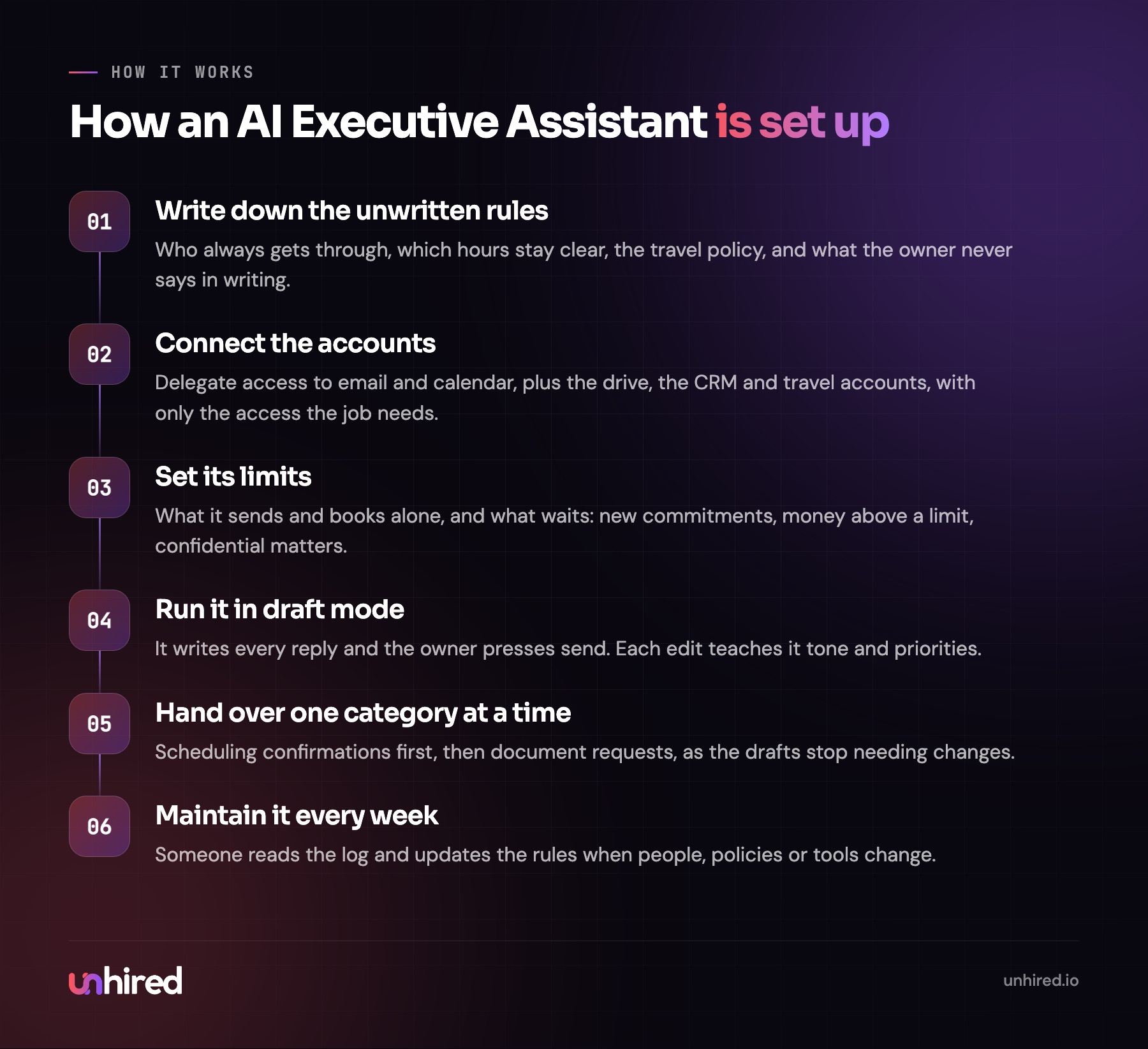
The step I'd never skip is draft mode. For the first few weeks it writes every reply and the owner presses send. Each edit the owner makes is a lesson about tone, about who gets a fast answer and who waits, about what the owner never says in writing. Once the drafts stop needing changes for a category of email, like scheduling confirmations or document requests, that category moves to sending on its own. A lot of setups fail because they start with full sending rights and one bad email to a client kills the owner's trust in it.
After that, someone has to read the log each week and update the rules when the business changes, like a new travel policy or a new person whose emails should always get through.
When it fits
If the owner's day is mostly decisions and conversations, and the support work around them is email, scheduling and logistics, an AI Executive Assistant can hold the seat. If the job is mostly in-person work, like greeting guests, running the office and handling physical mail, you still need a person, and an AI Employee can take the inbox and calendar work off their desk. The AI Receptionist post draws a similar line for the front desk.
To find out where you stand, spend one week labelling every email you handle and every calendar change you make. Use three labels: something a rule could handle, something that needed a short reply anyone could write, and something only you could decide. The first two labels are the job an AI Executive Assistant would own. Some websites offer free assessments that check whether a role can be filled by an AI Employee, which is a quicker way to run the same sort for a whole job.
Wage data: US Bureau of Labor Statistics, Occupational Outlook Handbook, May 2025. The law firm day is an example built from the duties in this post.