
When an owner decides to try an AI Employee, they often send me the job posting they'd use for a person: self-starter, strong communicator, other duties as assigned.
A person can work with that, because they'll fill the gaps by asking around in their first week. An AI Employee works from what's written. "Other duties as assigned" gives it nothing to do, and "strong communicator" doesn't tell it when to email a client and when to call the office manager instead.
I've spent the last four years building AI systems and agents for businesses, and the job description is where most of the real work starts. Writing one well is also the fastest way to find out whether a role is ready for an AI Employee at all.
How it differs from a job posting
A job posting is a sales document. It's written to get the right person to apply, so it leads with the company and the kind of person you want.
An AI Employee is AI that holds one job on a team, with its own logins, a manager and written rules about what it can do alone. Its job description is those rules. It's read every time the AI Employee decides what to do next, and it needs the detail a new hire would pick up from the person training them.
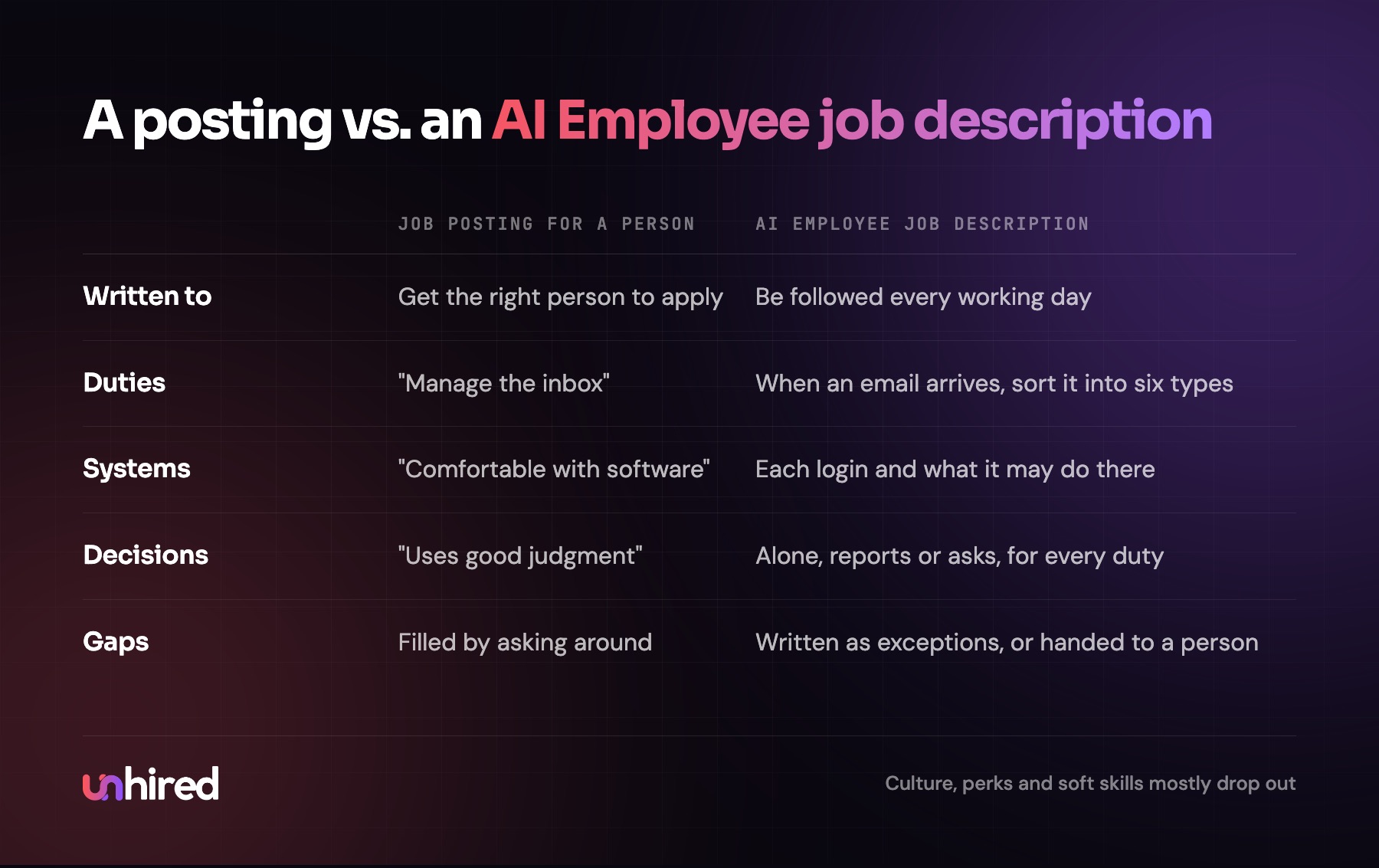
That means the parts that matter in a posting (culture and a friendly tone) mostly drop out. And the parts a posting never covers, like which system to check first or what to do when a document is missing, become most of the page.
The eight parts of an AI Employee job description
I put the same eight parts in every one, in this order. Some take a line. The duties and the exceptions take most of the space.
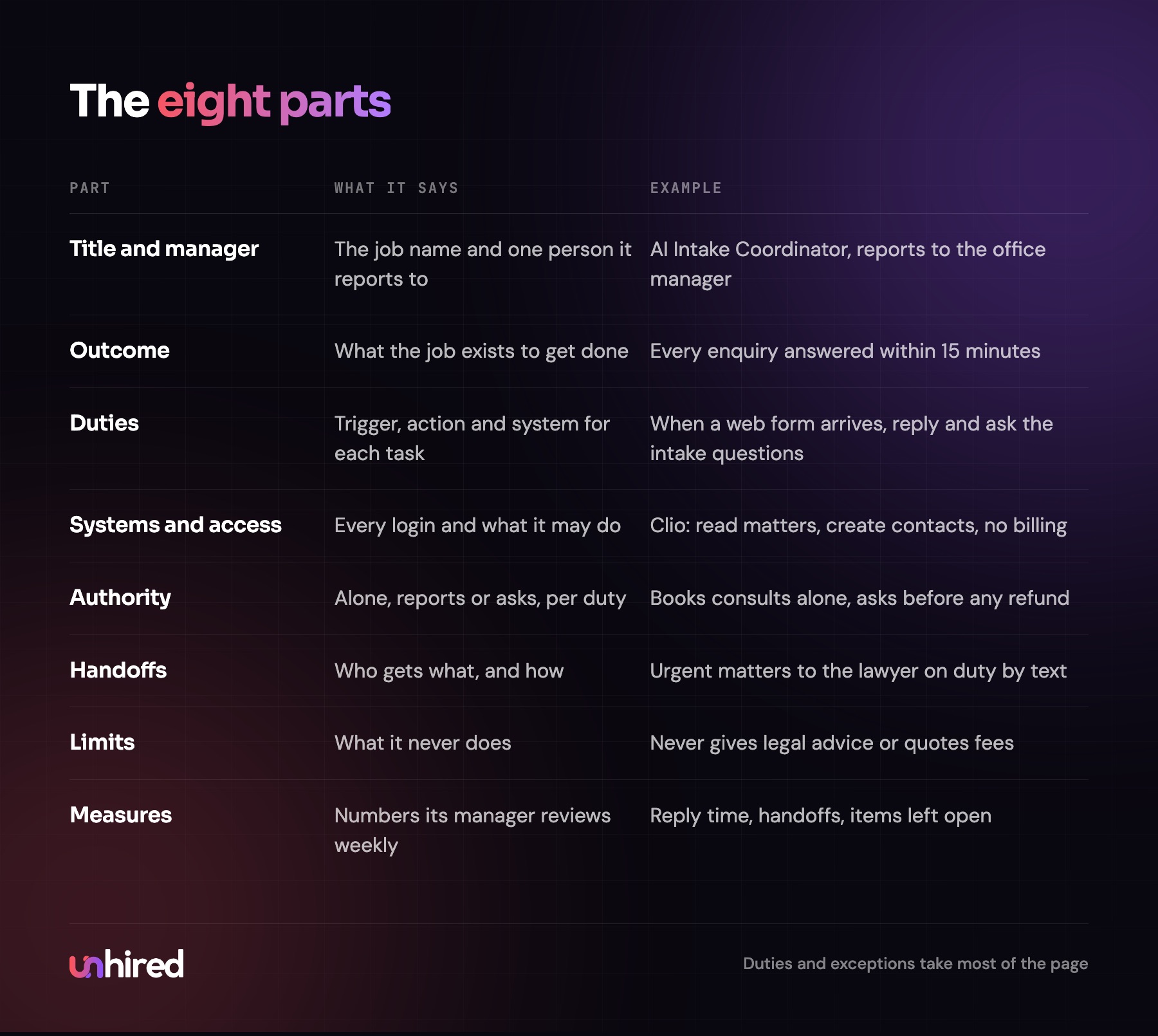
The title and manager come first. A plain job name ("AI Intake Coordinator") and the one person it reports to. One name, not "the team," because someone has to read its log and answer its questions.
Then the outcome, in one sentence: what the job exists to get done. "Every new enquiry gets a reply within 15 minutes during business hours and a booked consult within one business day." The outcome is what the AI Employee falls back on when a situation isn't covered anywhere else.
The duties come next, and they're the biggest part. I'll cover how to word them below.
Systems and access lists every login and what the AI Employee may do inside it. "Clio: read matters, create contacts, no access to billing." Writing this down before anything is built keeps the permissions as narrow as the job, which matters for data security as much as for accuracy.
Authority, handoffs and limits are three separate sections, and owners tend to merge them. Authority says how much it can do alone on each duty. Handoffs say who gets what, and how. Limits are the short list of things it never does, whatever the situation.
The last part is how it's measured. Pick the handful of numbers its manager will look at each week, like reply time and how many items it handed off. I went through which ones are worth tracking in how to measure an AI Employee's performance.
How to write the duties
Every duty should have three pieces: what starts it, what the AI Employee does, and where it does it. I write them as trigger, action and system.
"Manage the inbox" fails that test. It has no trigger, no clear action and no system. Compare it with this: "When an email arrives at info@, sort it into one of six types. Answer types one to four from the policy document. Forward types five and six to Dana with a two-line summary."
The second version is longer, and every word of it can be followed. It also forced someone to decide what the six types are, which most offices have never written down.
A few more rewrites I see often:
- "Handle scheduling" becomes "When a client asks to move an appointment, offer the next three open slots in the booking system and confirm the one they choose by text."
- "Follow up with leads" becomes "When a web form comes in, reply within 15 minutes with the qualifying questions, and put a meeting in Priya's calendar once they're answered."
- "Keep records up to date" becomes "After every call, add a note to the contact in the CRM with the reason for the call and the next step."
If you can't write a duty this way, that's useful to know. It usually means the task depends on judgment that lives in one person's head, and I'd leave it with a person for now. What an AI Employee can't do covers where those lines usually fall.
Authority: alone, reports or asks
Every duty gets one of three levels. Alone means it does the task and logs it. Reports means it does the task and tells its manager. Asks means it prepares everything and waits for a person to say yes.
The rule I use is simple. If a mistake can be undone the same day and doesn't touch money, health or legal matters, it can usually be alone. If it can be undone but a manager would want to know, it reports. If it's hard to undo, or it changes what someone pays or is owed, it asks.
So a property manager's AI Employee might book viewings alone, report every maintenance request it logs, and ask before it approves any repair over a set amount. An online store's might answer order status questions alone and ask before any refund. A law firm's intake coordinator might collect the facts of a new matter alone and hand anything that sounds urgent to a lawyer on duty.
A sample from an accounting firm
Here's a short version for an AI Client Coordinator at a small accounting firm, reporting to the office manager. The outcome: every client's documents are in and complete two weeks before their return is due.
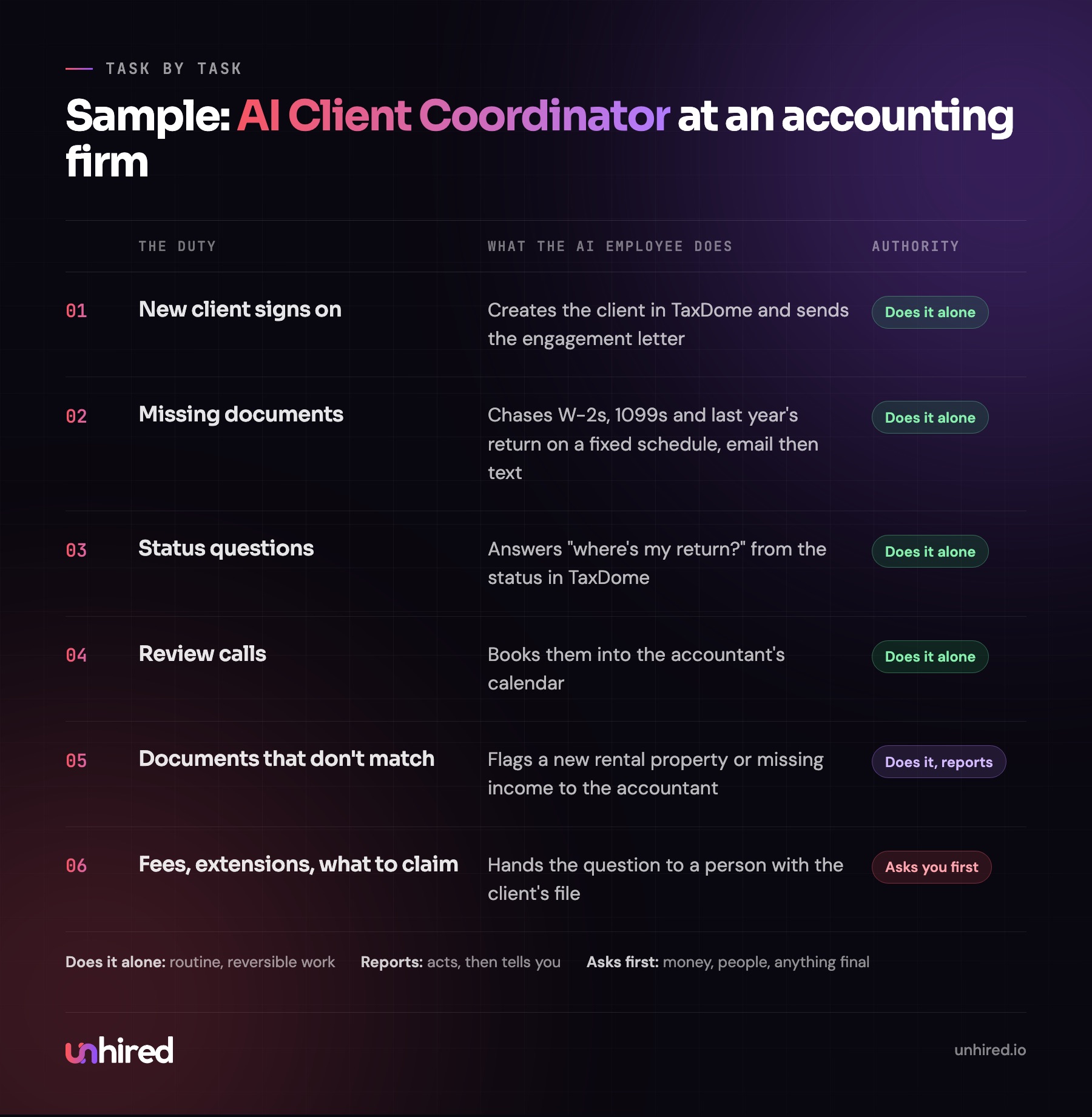
When a new client signs on, it creates them in TaxDome and sends the engagement letter. It chases missing W-2s, 1099s and last year's return on a fixed schedule, by email first and text after the second reminder. It answers "where's my return?" from the status in TaxDome and books review calls into the accountant's calendar. All of that is alone.
When an uploaded document doesn't match the client's organizer, for example a new rental property nobody mentioned, it flags it to the accountant and keeps going. Questions about fees, extensions or what a client can claim go to a person every time, and it never gives tax advice.
That fits on one page. The exceptions (a client who only replies by phone, a spouse filing separately, photos instead of PDFs, a document from the wrong year) take another two or three.
Turning an existing posting into one
If you already have a posting or a job description for the role, start there. It saves time, and the duties list is usually close to right.
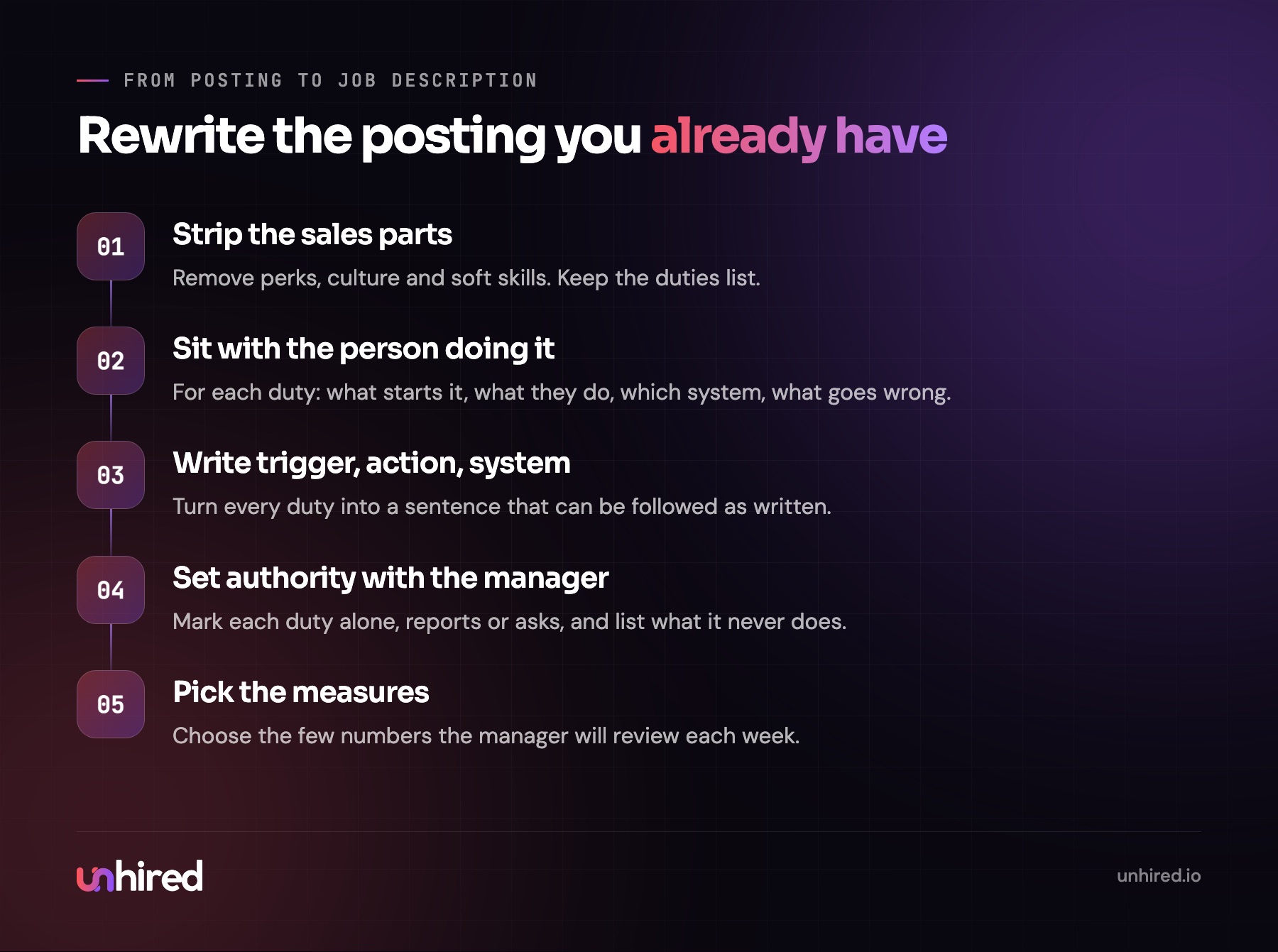
Strip out everything written to attract a person: the perks and the soft skills. Then sit with whoever does the job today and go through the duties one at a time. For each, ask what starts it, what they actually do, which system it happens in, and what goes wrong. The last question is where the exceptions come from.
Then give each duty an authority level with the manager in the room, write the short list of things it never does, and pick the numbers you'll review. If you'd rather have something check the role for you first, some websites offer free assessments that check whether a role can be filled by an AI Employee.
What the job description means for cost
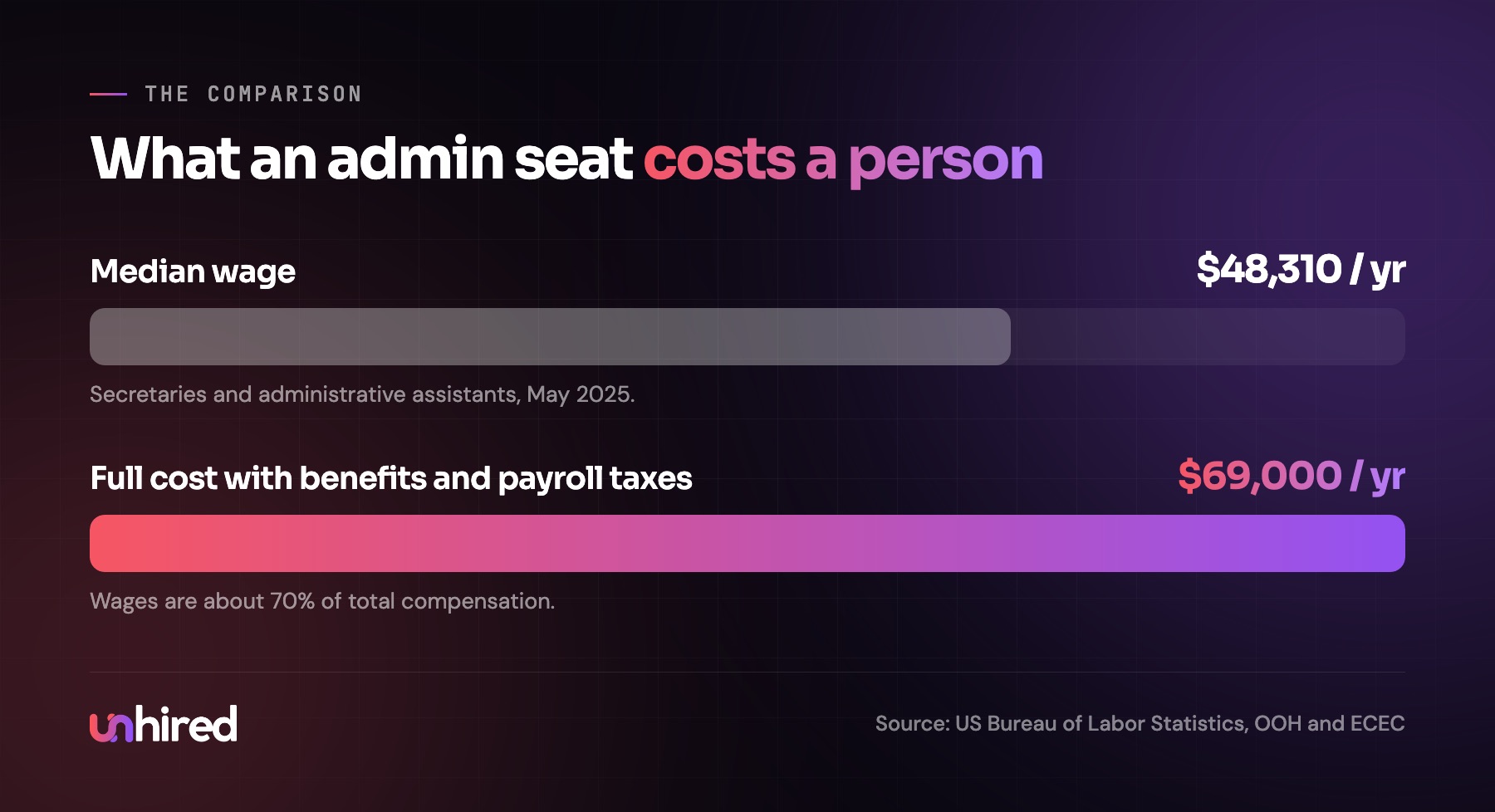
A person in an administrative seat isn't cheap. The US Bureau of Labor Statistics puts the May 2025 median wage for secretaries and administrative assistants at $48,310 a year. Wages are about 70% of total compensation in private industry, according to the BLS Employer Costs for Employee Compensation report, which puts the full cost of that seat near $69,000 before recruiting and training.
AI Employees are usually priced one of two ways. You can assemble one yourself from software, with an AI agent platform plus connections to your email, phone and business systems, and have someone on staff build and maintain it. Or a provider builds and maintains it for a monthly fee.
On both routes, the price follows what's in the job description. Each channel adds cost, and phone costs more than email. Each system on the access list is a connection to build and keep working. Each exception is more setup and more review. A tight description with one channel and three systems prices very differently from "a bit of everything."
That's the other reason to write it before you talk to anyone. Send the same document to every provider and the quotes become comparable, because they're pricing the same job. My longer breakdown is in how much an AI Employee costs.
Keep it current
The job description isn't finished on launch day. In the first month, its manager will find rules that were wrong and questions it keeps bringing back, and each one should turn into a line in the document. Training an AI Employee is mostly this loop.
After that, update it whenever the business changes: a new booking system or a new refund policy. An AI Employee working from last year's rules will follow them exactly.
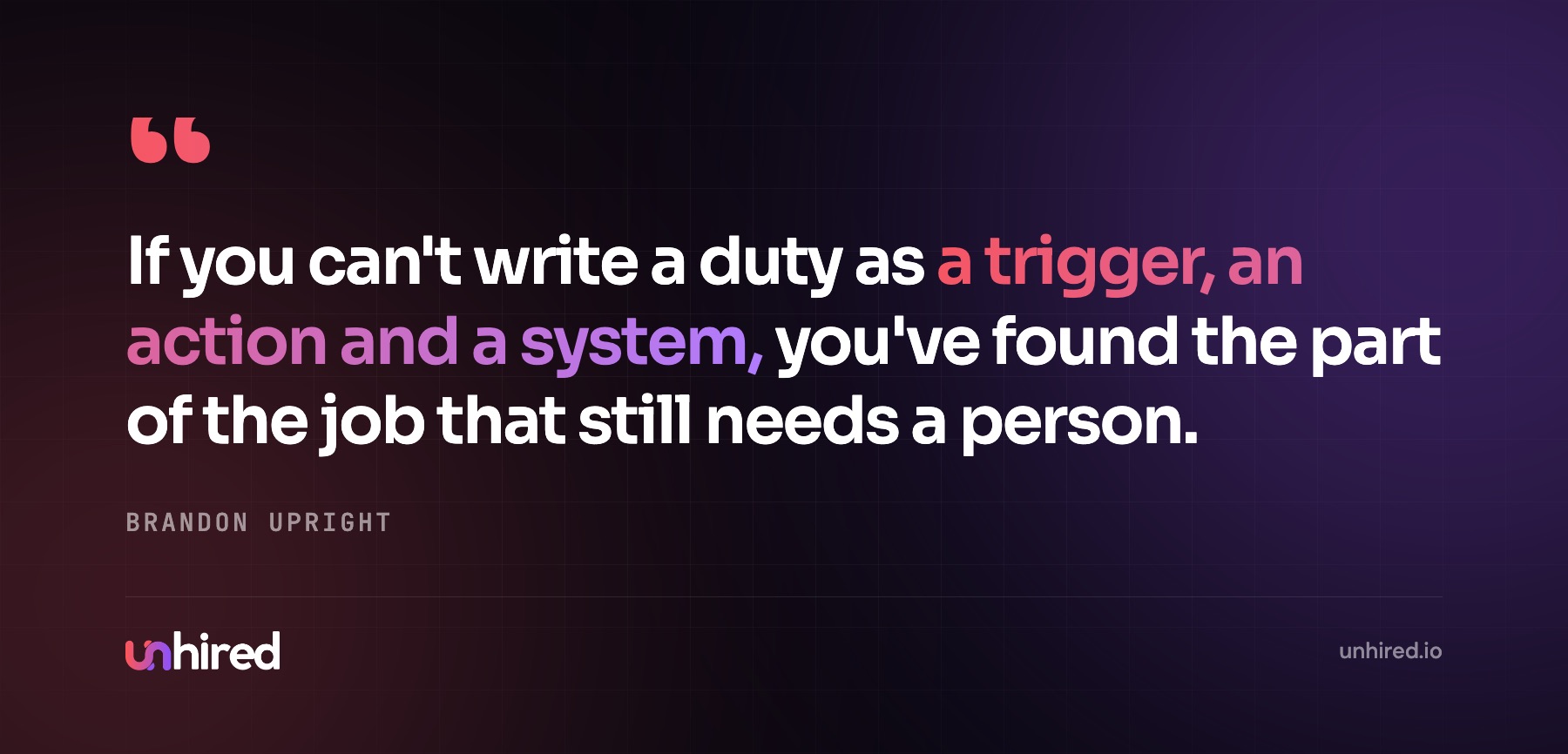
If you want to start this week, take one job posting you already have and rewrite three of its duties as trigger, action and system, with an authority level next to each. If you can't do it for a duty, you've found the part of the job that still needs a person.
Wage data: US Bureau of Labor Statistics, Occupational Outlook Handbook, May 2025 median for secretaries and administrative assistants; the full-cost figure uses the BLS Employer Costs for Employee Compensation share of wages in total compensation. The accounting firm, property manager, store and law firm are examples, not clients.