
A client texts a salon at 9:40 pm asking for a balayage and a trim on Saturday. The salon is closed, the stylists are home, and the booking app only shows a two-hour gap that isn't long enough. By morning she has booked somewhere that answered.
I've spent the last four years building AI systems and agents for businesses, and salons and spas have one of the most rule-heavy calendars I've seen. On one salon's menu, a haircut might be 45 minutes and a full colour two and a half hours, with the stylist free for half an hour while it processes. A new colour client may need a patch test a day or two before. A couples massage needs one room and two therapists at the same time. The person at the desk carries all of that in their head while checking out a client, answering the phone and ringing up shampoo.
That's the work an AI booking assistant is good at. This post covers hair salons, barbershops, nail studios, day spas and med spas. Most of it also applies to lash, brow and waxing studios.
What an AI booking assistant does at a salon or spa
An AI booking assistant is an AI Employee that holds the booking side of the front desk. It reports to someone, usually the salon manager or the owner, and it has logins to the phone line, text, email, Instagram and Facebook messages, and the booking software (Vagaro, Boulevard, Fresha, Mindbody, GlossGenius or whatever the salon runs). It has written rules about what it can do on its own, and every conversation goes into a log the manager can read.
These are the duties that take most of its day.
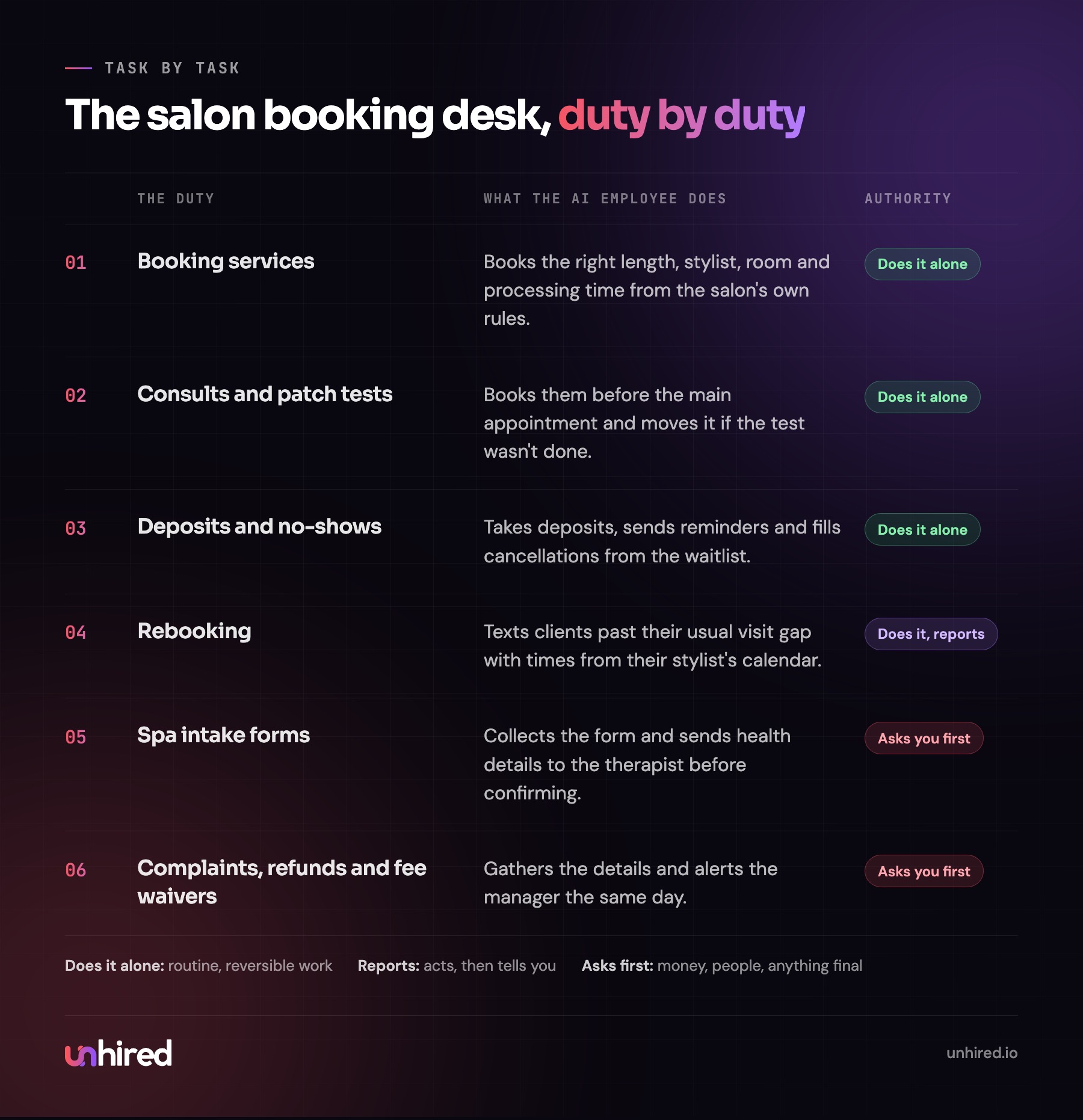
Booking services the way the salon actually runs them
Online booking tools let clients pick a service and a time. They don't know that this stylist only does extensions on Tuesdays, or that a cut can slot into the processing time of someone else's colour. The salon knows, and the AI booking assistant can be given those rules.
It asks the questions a good front-desk person would: is this a first visit, how long is your hair now, when was your last colour, do you want a toner or gloss with it. Then it books the right length with the right stylist. For a spa, it matches the treatment to a room and a therapist, and for a couples booking it holds both therapists and the double room together.
Consultations and patch tests
Plenty of salons won't book a new colour client, or anyone who wants a big change, without a consultation first. Many also want a patch test before a first colour or lash tint. The AI booking assistant books the consult or patch test before the main appointment, explains why, and reminds the client the day before. If the test wasn't done, it moves the main appointment instead of letting it go ahead.
Deposits, cancellations and no-shows
A no-show on a three-hour colour appointment is three hours of one stylist's day with nothing in it. The AI booking assistant takes deposits where the salon requires them, sends reminders, handles "can I move to Friday" replies, and offers freed-up times to clients on a waitlist. It applies the cancellation policy exactly as written. A client asking to waive a fee goes to the manager.
Rebooking
A client who gets colour every six weeks, or a barbershop regular who comes in every three, is the steadiest revenue a salon has. The AI booking assistant can text clients who are past their usual interval with a few times from their stylist's calendar. It can also send the "book your next one" message after checkout, for the clients who said they'd do it later.
Questions, gift cards and after-hours
Most messages to a salon are the same questions: price ranges, how long a service takes, parking, whether a stylist does curly cuts, whether a gift card covers gratuity. The AI booking assistant answers from the salon's own menu and policies, sells and sends digital gift cards, and books at 9:40 pm when the client is ready.
What stays with the stylists, therapists and the desk
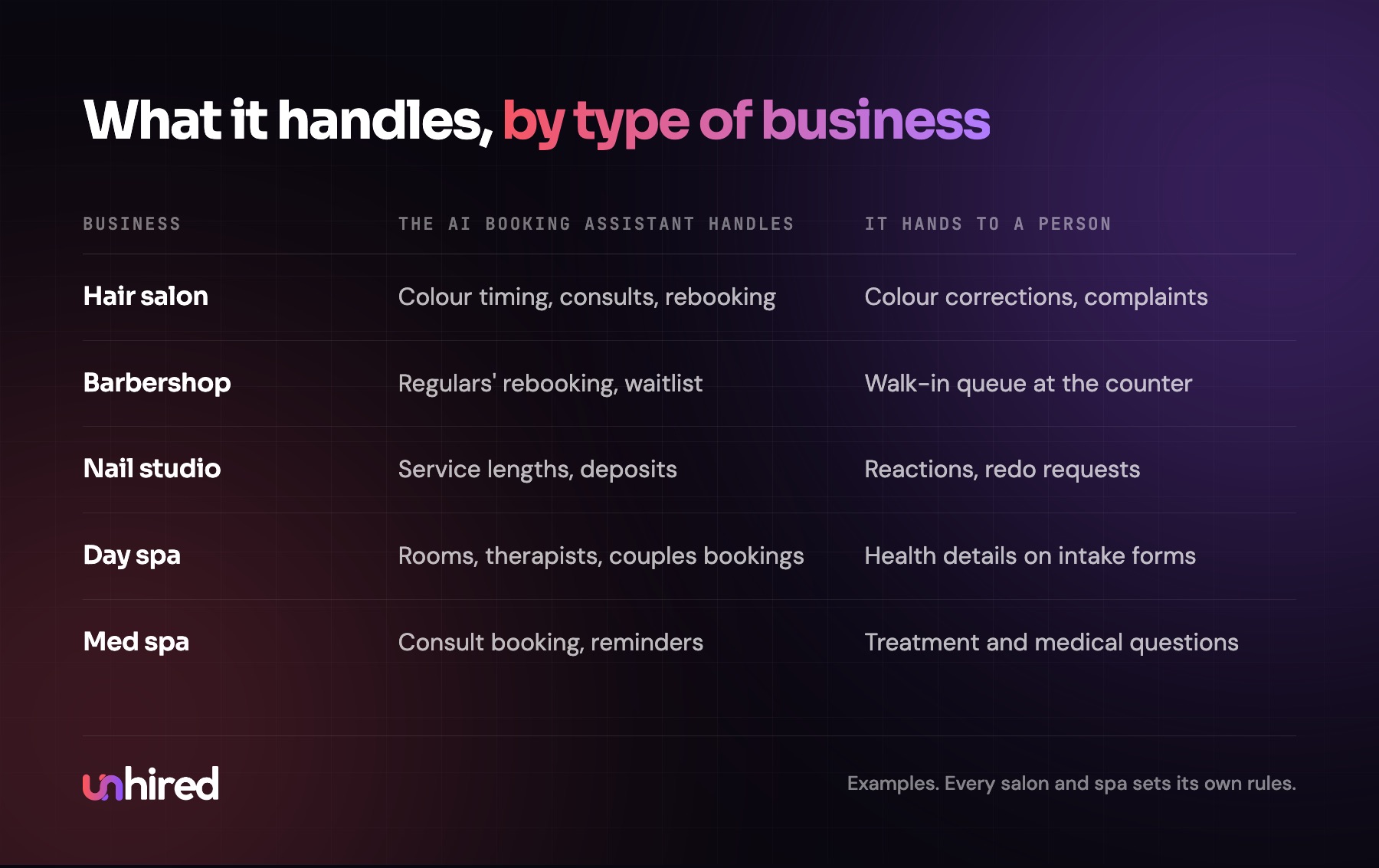
These always go to a person, with a written summary so the client doesn't repeat themselves:
- Colour corrections, big transformations and anything a stylist has to see first. The AI books the consultation and the stylist decides what's possible and what it costs.
- Health details on spa and med spa intake forms. Pregnancy, recent surgery, skin conditions, medications and allergies go to the therapist or provider before the appointment is confirmed. At a med spa, anything about injectables, lasers or other medical treatments goes to the licensed provider.
- Reactions and complaints. A client whose scalp is burning or who hates their colour needs a person that day, and the AI Employee should alert the manager the first time it hears it.
- Refunds, fee waivers and redos. It collects the details. The manager decides.
- Anyone who asks for a person.
The front counter is the other thing to keep. Clients walk in, check in, pay, tip and buy product, and for a lot of them seeing a friendly person at the desk is part of why they come back. I wouldn't put an AI Employee in that seat. I'd take the phone, texts and inbox away from it, so the person there can look after the people in the room.
Clients should also know when they're messaging AI. The post on whether customers should know they're talking to an AI Employee covers how to word it.
A Saturday at a hair salon
Here's an example Saturday at a salon with six stylists. Three items go to a person, and that's normal.
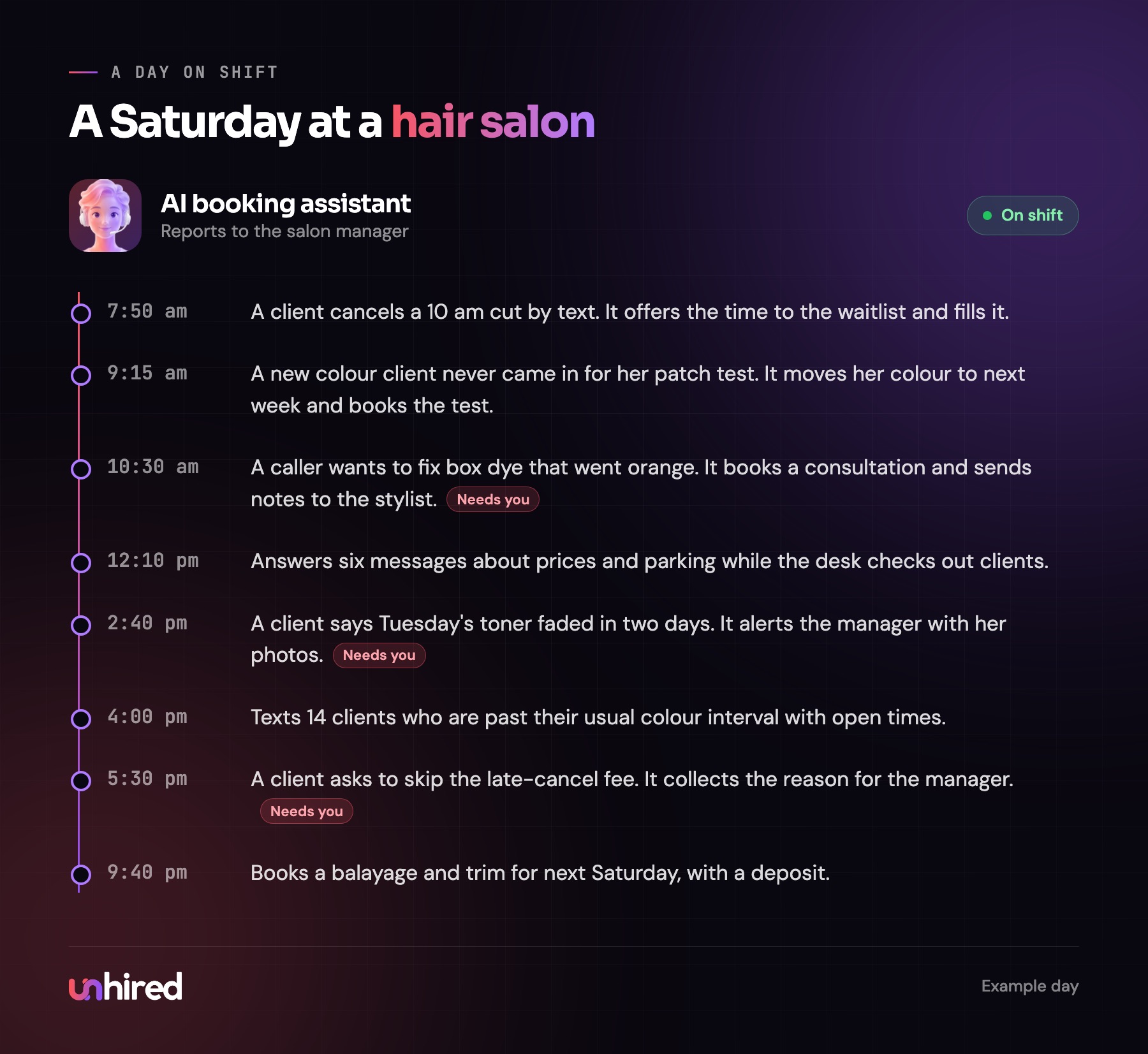
The 7:50 cancellation is filled from the waitlist before the salon opens. The colour client who skipped her patch test gets moved instead of booked into a reaction. The colour correction, the complaint and the fee waiver all reach a person with notes attached, and nobody at the desk answered a single phone call during checkout.
Client information and access
Most salons hold contact details, booking history, card details for deposits and sometimes photos. Spas and med spas also hold health information from intake forms. In the US, a med spa that is a HIPAA covered entity needs a signed business associate agreement with any vendor that handles protected health information. HHS lists the required contract provisions. Other countries have their own privacy laws.
The setting owners get wrong most often is access. An AI booking assistant needs the calendar, the service menu, client contact details and booking history. It should never see full card numbers; deposits should go through the booking software's own payment link. It doesn't need treatment notes or before-and-after photos unless a specific duty calls for them. Ask any provider where message logs are stored, for how long, and who can read them. The post on AI Employee data security has a fuller checklist.
What a salon front-desk hire costs
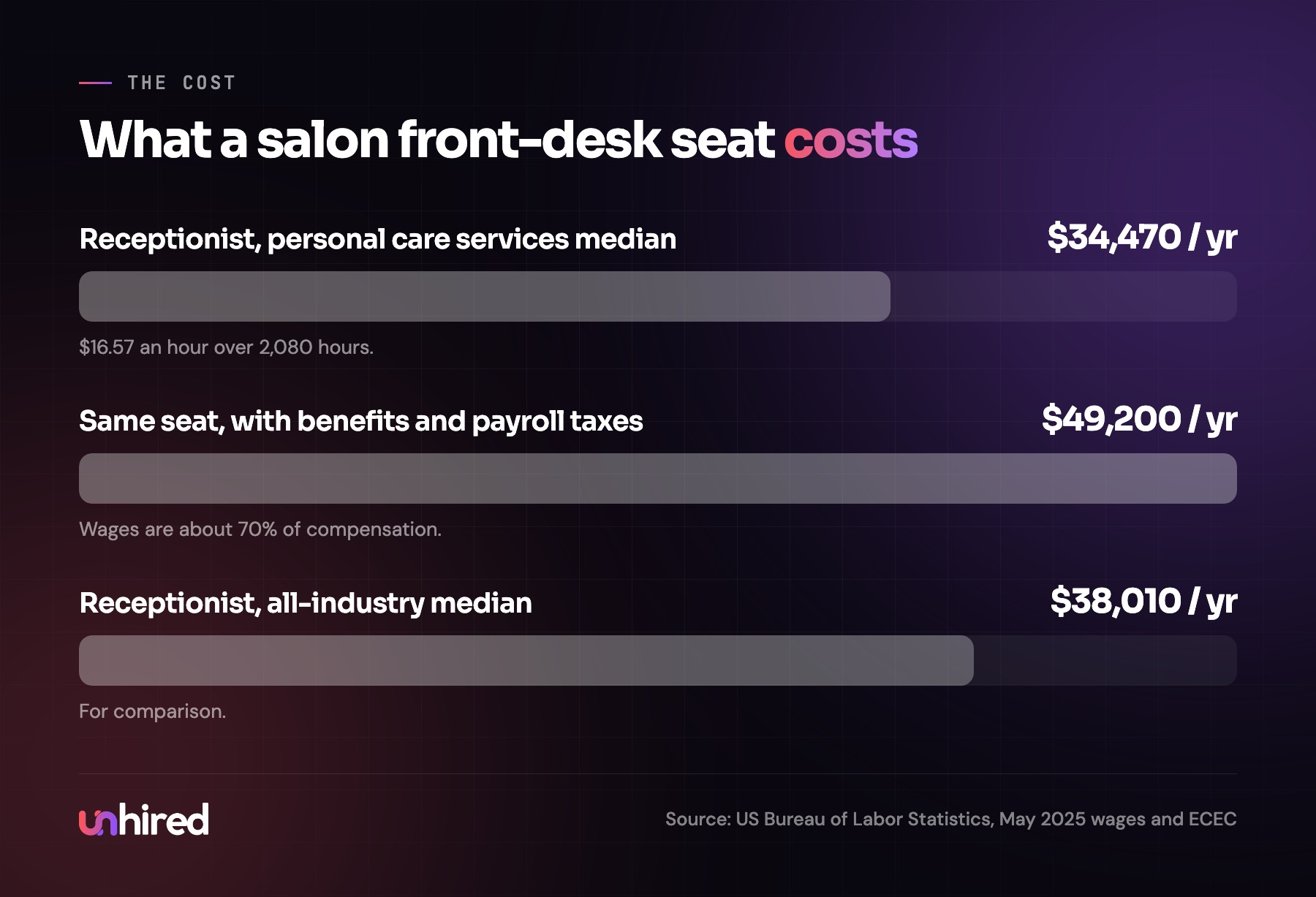
The US Bureau of Labor Statistics puts the median wage for receptionists in personal care services at $16.57 an hour as of May 2025. Over a 2,080-hour year that's about $34,470. Across all industries the receptionist median is $38,010 a year.
Wages are about 70% of what US private employers spend on compensation, according to the BLS Employer Costs for Employee Compensation report. At that ratio, a salon receptionist at the median comes to about $49,200 a year with benefits and payroll taxes. Then there's hiring, training on the booking software, and covering lunches, sick days and Saturdays, which at a small salon often means a stylist running to the phone with gloves on.
How much you'd pay for an AI booking assistant at a salon
AI Employees are usually priced one of two ways.
You can assemble one from software: an AI phone and messaging tool, a connection to your booking system, and a texting service. The subscriptions are the smaller cost. The bigger one is the time someone spends writing every service length, processing time and stylist rule, testing it on real requests and keeping it current.
Or a provider builds and maintains it, usually for a monthly fee. It costs more than the bare software, and writing the rules and reviewing the log becomes someone else's job.
What moves the price: how many channels it covers (phone is usually the most work), whether your booking software has a clean integration, how many stylists, therapists and locations it books for, message volume, languages, and how much maintenance is included.
To compare quotes, put them next to the full cost of the seat, about $49,200 a year at the median, for roughly 40 hours of coverage a week. Clients message salons at night and on Sundays, and those hours aren't in that 40.
How an AI booking assistant is set up at a salon
Setup is mostly the same work as training a new front-desk hire, written down once.
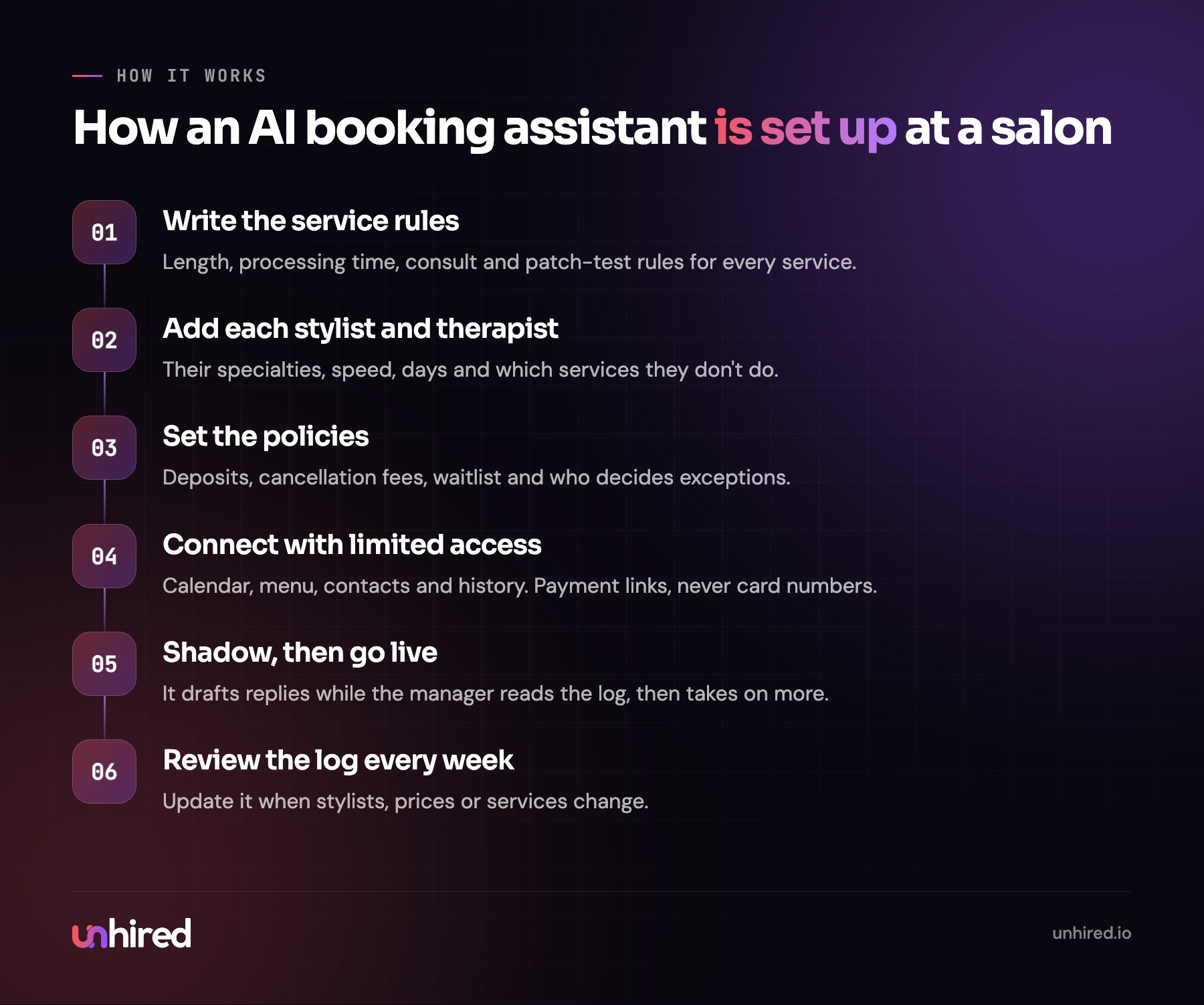
The service rules take longer than owners expect. Every stylist has their own speed, their own specialties and their own days, and the menu has more variations than anyone has written down. Sit with your senior stylists for an afternoon and get it on paper.
Then run a shadow period of a week or two, where it drafts replies and bookings while the manager reads the log. After that, someone still reviews the log weekly. Stylists leave and join, prices change every year, and an AI booking assistant nobody updates keeps quoting last year's menu.
Is your salon's desk a good fit?
Pull two numbers this week. From your booking software, count how many bookings came in online, by text or by phone, and how many messages arrived after closing. Then ask whoever works the desk to tally a busy Saturday: how many calls they answered during checkouts and how many they missed.
If most of the desk's day is phones and messages, an AI booking assistant can take that part of the seat, and the person at the counter gets their attention back for the clients in front of them. If your salon is mostly walk-ins, keep the person and give the AI Employee the after-hours messages and rebooking texts. Some websites offer free assessments that check whether a role like this can be filled by an AI Employee, which is a reasonable next step once you have those two numbers.
The AI scheduling assistant post goes deeper on booking rules, reminders and rescheduling if you want more detail on that side of the job.