
Owners setting up their first customer-facing AI Employee often ask me some version of the same thing: can it just answer the phone as "Sarah from the front desk," with no mention of AI? The worry is that callers will hang up the moment they hear the word.
I've spent the last four years building AI systems and agents for businesses, and my answer to this one doesn't change. Tell customers they're talking to an AI, in the first line, on every channel. Hiding it is the riskier choice, both with customers and with the law, and the cost of saying it is one sentence.
What disclosure means in practice
An AI Employee is AI that holds one job on a team, with its own logins and a person it reports to. When that job faces customers, disclosure is the line where it says what it is. It doesn't need to be a legal notice or a paragraph about technology. It's the same kind of sentence a new receptionist uses to introduce themselves.
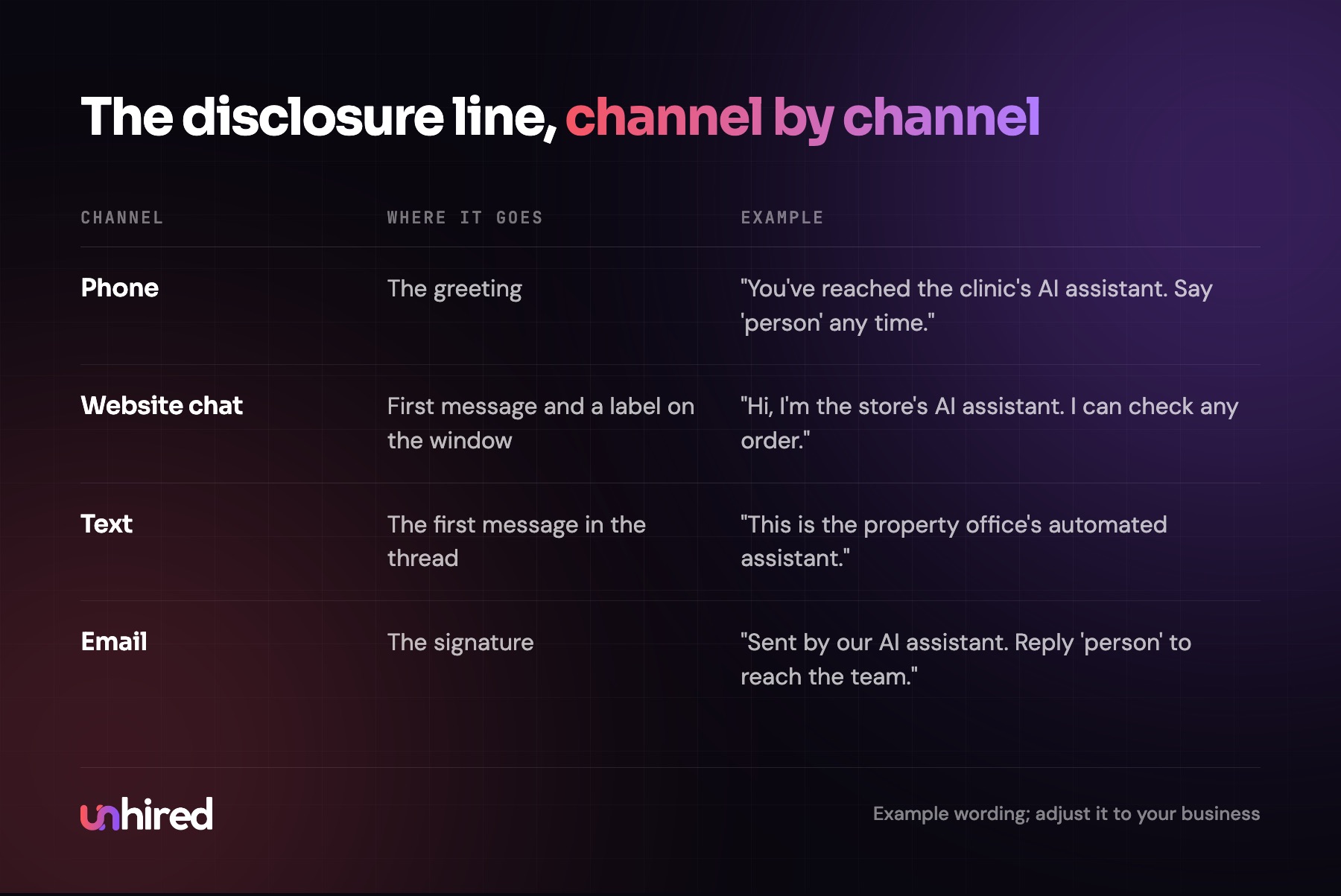
On the phone, it's the greeting: "Hi, you've reached the clinic's AI assistant. I can book or change your appointment, or say 'person' any time to reach the front desk." In a website chat, it's the first message plus a small label on the chat window. In a text thread, the first message names the business and says it's automated. In email, the signature says the reply came from an AI assistant and gives a way to reach a person.
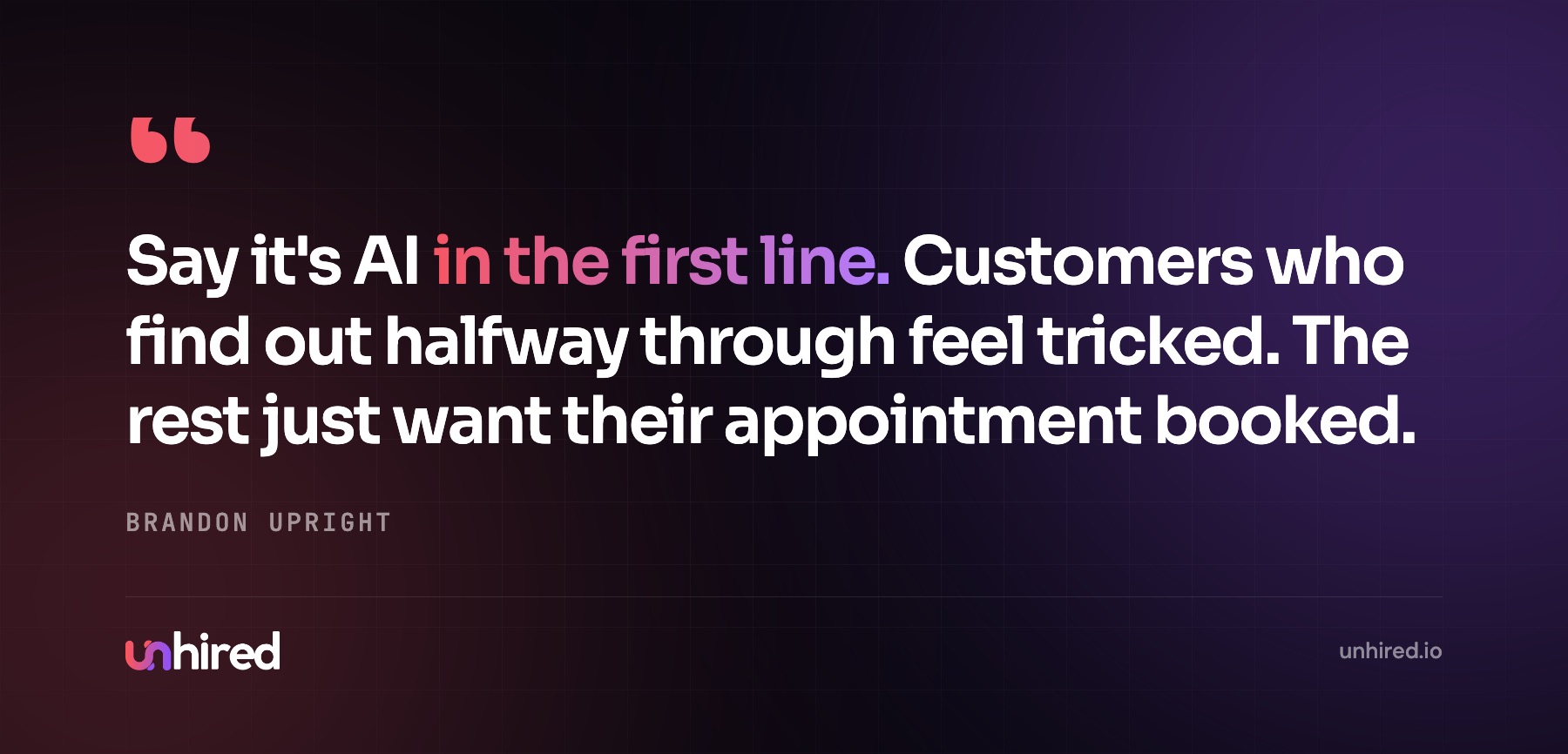
The disclosure goes at the start. Saying it after five minutes of friendly conversation, or only when someone asks "am I talking to a robot?", feels like being caught.
Why I tell owners to always disclose
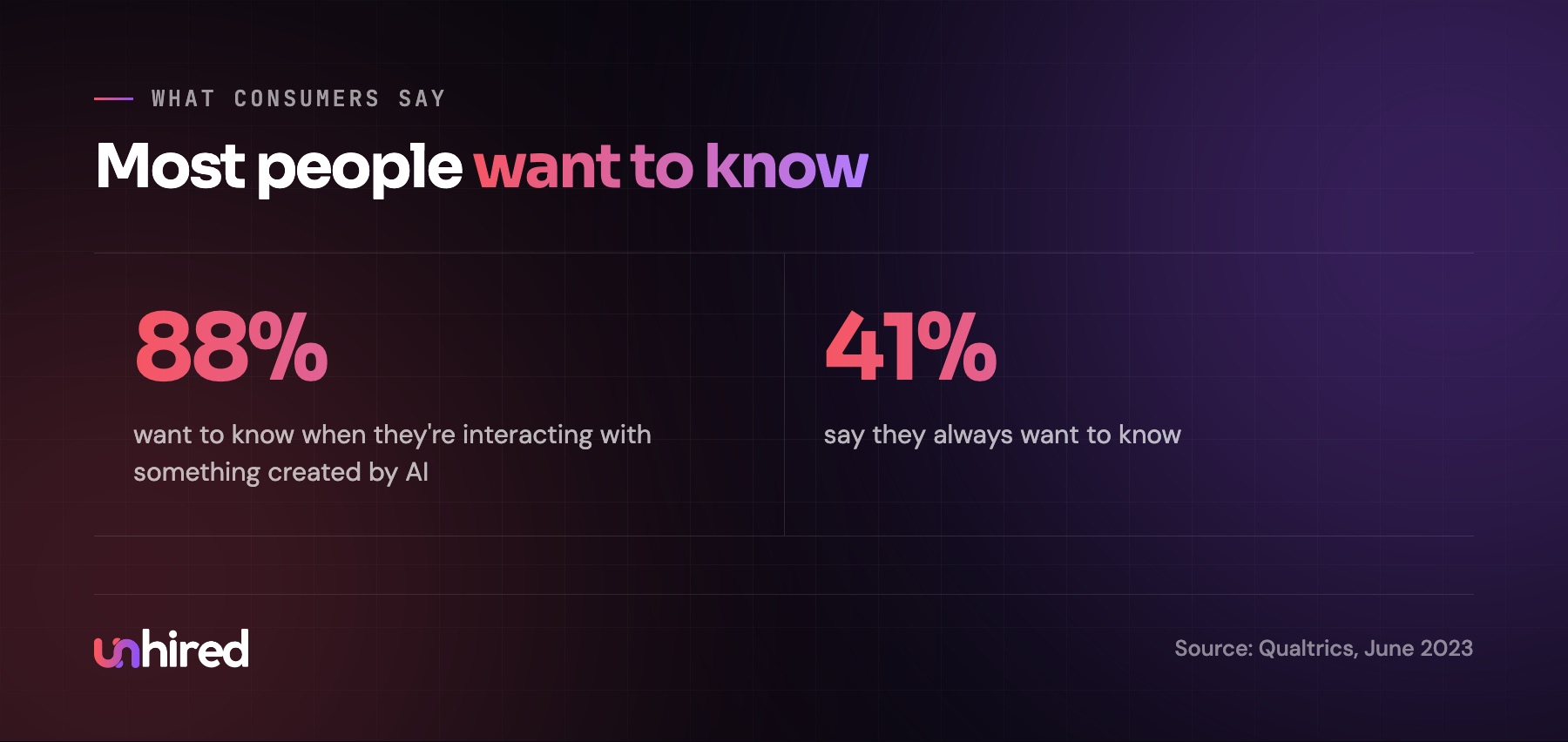
The first reason is that customers want to know. In a 2023 Qualtrics study, 88% of consumers said they want to know when they're interacting with something created by AI, and 41% said they always want to know.
The second reason is that they find out anyway. A caller asks something slightly off script and the answer comes back a little too smooth, or a chat replies at 2:14 am in four seconds. Once a customer suspects they were misled, every answer they got becomes suspect too, including the correct ones. For a law firm doing intake or a clinic booking appointments, that suspicion lands on the business, not on the software.
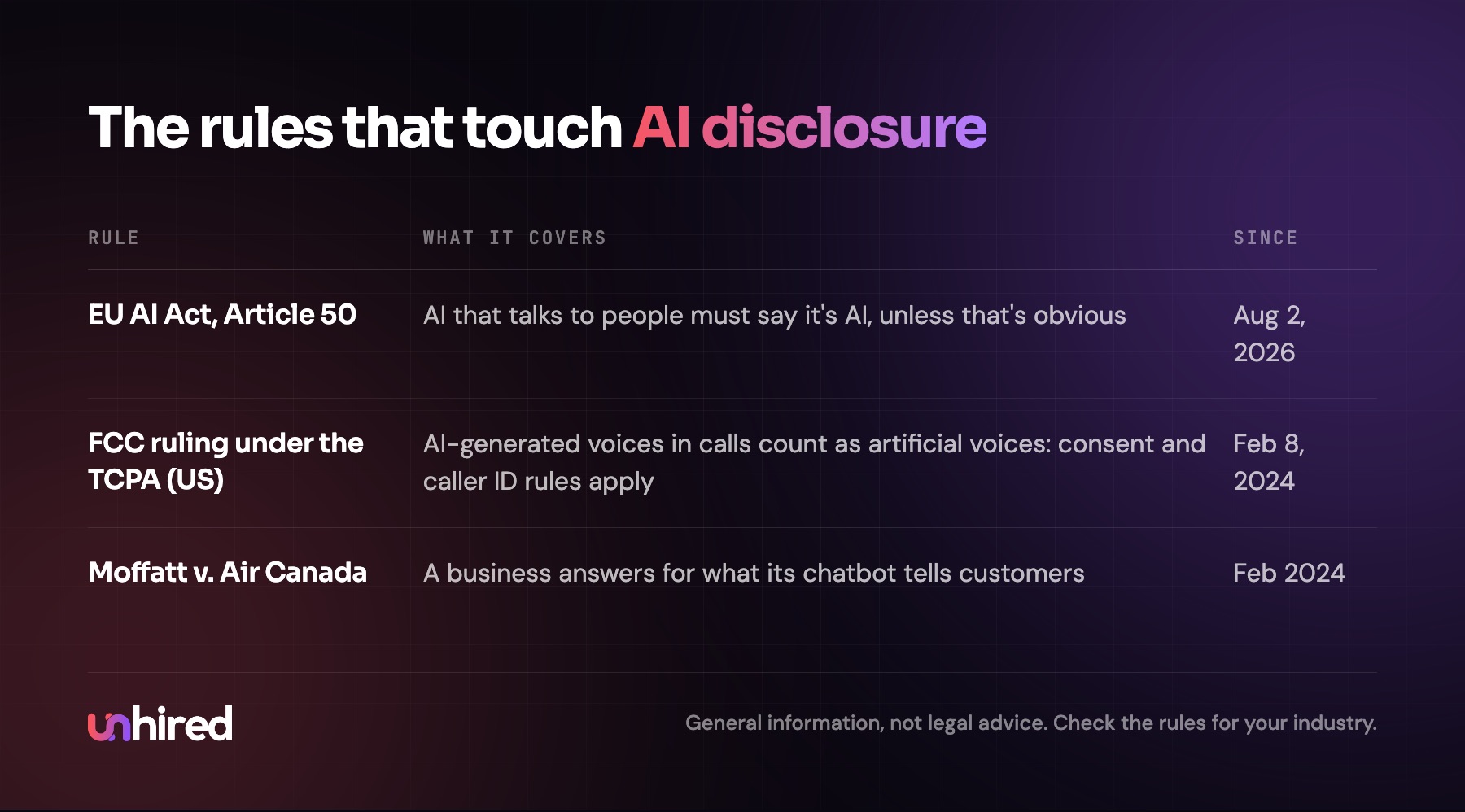
The third reason is that the business answers for what its AI says, whatever it calls itself. In Moffatt v. Air Canada, decided in February 2024, a Canadian civil tribunal held the airline to a bereavement refund policy that its website chatbot had described wrongly. Air Canada argued the chatbot was responsible for its own words, and the tribunal rejected that. Pretending the AI is a person doesn't move responsibility anywhere. It only makes the customer angrier when the mistake comes out.
What the rules say
I'm not a lawyer, and this changes often, so treat what follows as a starting point for a conversation with yours.
The European Union's AI Act has a transparency rule in Article 50. AI systems built to interact directly with people have to tell them they're interacting with AI, unless that's obvious to a reasonably well-informed person. That obligation applies from August 2, 2026. If you serve customers in the EU by chat, phone or email, it applies to your AI Employee now.
In the US, the FCC ruled in February 2024 that AI-generated voices count as "artificial" voices under the Telephone Consumer Protection Act. That matters most for outbound calls: an AI Employee calling customers to confirm appointments or follow up on quotes needs the same prior consent a prerecorded call would, and the call has to identify the business.
Other places are writing their own rules, and some industries have extra ones on top. Health care, legal services, insurance and financial advice all have conduct rules about who can say what to a client. If your AI Employee works in one of those, ask your regulator or professional body what they expect before it goes live.
Does telling people hurt the experience?
Less than owners expect. Most people calling a property manager about a leaking tap, or messaging an online store about a late order, want the problem handled. If the AI Employee logs the request and gives a time that turns out to be true, they're satisfied. The experience goes bad when it can't help and won't let them reach someone who can.
Some customers will ask for a person straight away, and that's fine. An older patient who has called the same dental office for twenty years may simply prefer the receptionist. The fix is a fast, honest path to a human, not hiding what's answering the phone.
There's also a group of customers who prefer the AI. They'd rather text at 11 pm than wait on hold at 9 am, and they like that it doesn't get tired of a third question about parking. Saying what it is lets those people relax and use it.
Names, voices and personality
Giving your AI Employee a name is fine. "Ava" is easier to talk to than "the system." What it can't do is borrow a human identity, like a made-up backstory about how long it's worked there, or answer "yes" when someone asks if it's a real person.
The same applies to voice. A warm, natural voice is good. A cloned voice of a real staff member answering as that person is not, and it's the kind of thing the FCC ruling was aimed at.
Tone should match the business. An accounting firm's AI Employee can be brief and precise. A wellness clinic's can be warmer. A marketing agency's can be a bit more casual. None of that changes the first line.
How the handoff to a person should work
Disclosure promises the customer they can reach a human. The handoff is where that promise is kept or broken, and it's the step I see set up worst.
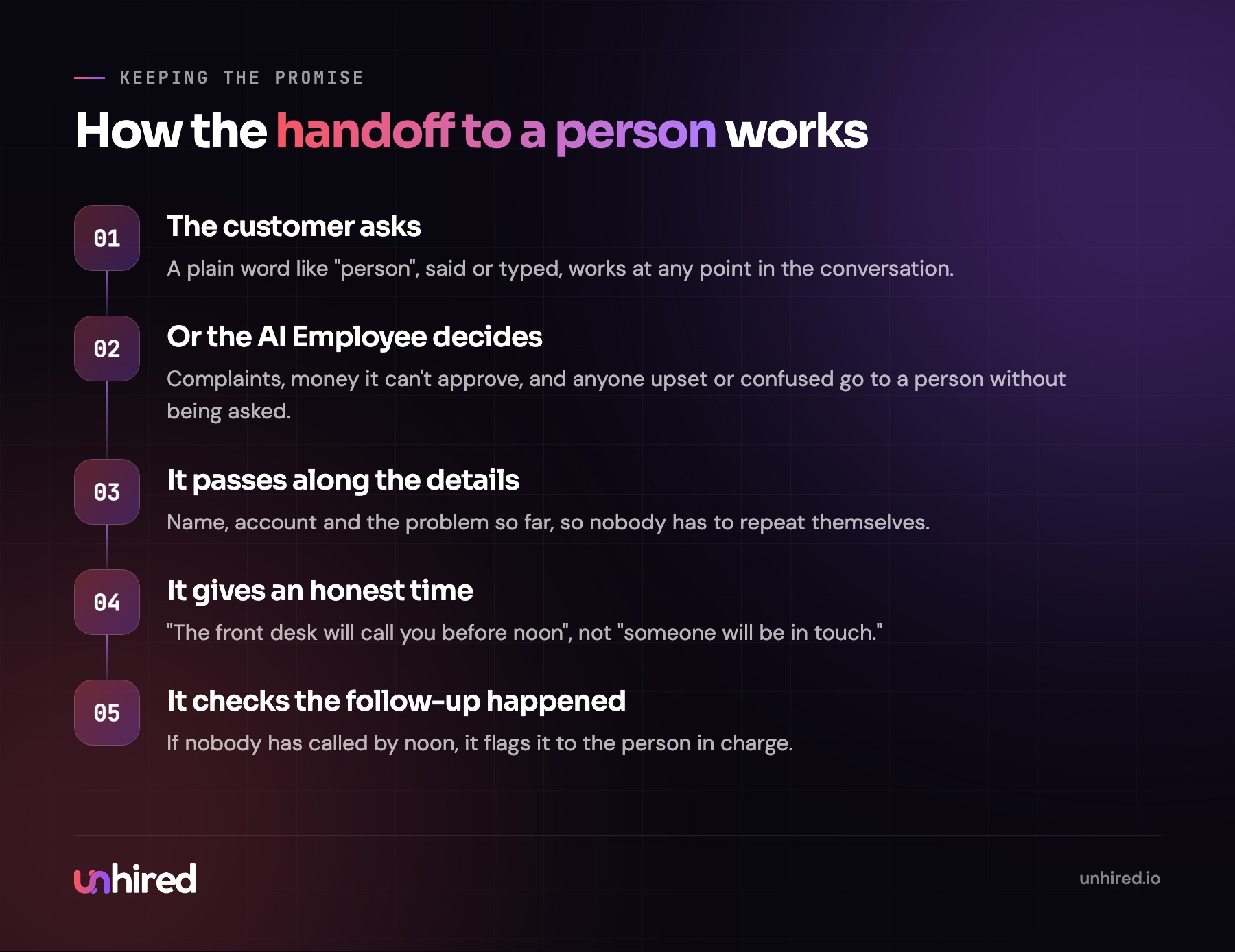
Give customers a plain way to ask, like saying or typing "person." Have the AI Employee pass along everything it already knows, so nobody has to repeat their account number and the whole problem. Tell the customer honestly when they'll hear back: "the front desk will call you before noon" beats a vague "someone will be in touch." Then make sure someone does call before noon, and have the AI Employee check that the follow-up happened.
The rules for when it hands off on its own matter just as much. A complaint, a request it can't verify, anything involving money it isn't allowed to approve, and anyone upset or confused should go to a person without them having to ask. I covered where those lines usually fall in what an AI Employee can't do.
Which roles need the most care
Not every role faces customers. An AI Employee that does data entry or reconciles invoices never talks to anyone outside the team, so disclosure is a note in your staff handbook and that's it.
The roles that need the most thought are the ones where the AI Employee is the first voice a customer hears: a front desk, intake at a law firm, leasing inquiries at a property manager, order support at a store, or a sales rep replying to new leads. If you're working out whether one of your own customer-facing roles fits, some websites offer free assessments that check whether a role can be filled by an AI Employee. I went through the front-desk version in detail in the AI Receptionist breakdown.
Write your disclosure line this week
If you already have an AI tool talking to customers, or you're about to, write one sentence for each channel it uses. Name the business, say it's an AI assistant, and say how to reach a person. Read it out loud and change anything you wouldn't say to a customer at the counter.
Then test the handoff yourself. Call or message as a customer, ask for a person, and time how long it takes to get one and whether you had to repeat anything. If that path works, the disclosure line will almost never be the reason someone has a bad experience.
Sources: Qualtrics, June 21, 2023; EU AI Act, Article 50; FCC declaratory ruling on AI-generated voices, February 8, 2024; Moffatt v. Air Canada, 2024 BCCRT 149. The clinic, law firm, property manager, store and other businesses are examples, not clients. This article is general information, not legal advice.