
A buyer fills out the contact form on a listing at 9:15 on a Sunday night. The listing agent is at a family dinner, sees the notification, and calls back Monday at noon. The buyer answers politely and mentions they saw the house that morning with another agent who replied in ten minutes.
I've spent the last four years building AI systems and agents for businesses, and real estate teams have one of the clearest splits I've seen between the work that needs a licensed person and the work that only needs to get done on time. The selling and negotiating belong to the agents. Around every deal sits a pile of replies, bookings, deadlines and reminders that runs on rules the team already has, and it lands on whoever has a free hour, which on a busy team is nobody.
This post covers what an AI Employee does as an assistant to a real estate team, what it should always hand to an agent, how licensing and fair housing rules shape the setup, and how the cost compares to the hire it would replace.
What the job involves
An AI Employee in this role holds a job the way an unlicensed team assistant would. It reports to the team lead or the broker, has logins to the CRM, the shared calendar, email, the texting line and the transaction management software, and works from a written set of rules about what it does alone and what it brings to an agent. Everything it sends goes into a log someone on the team reads.
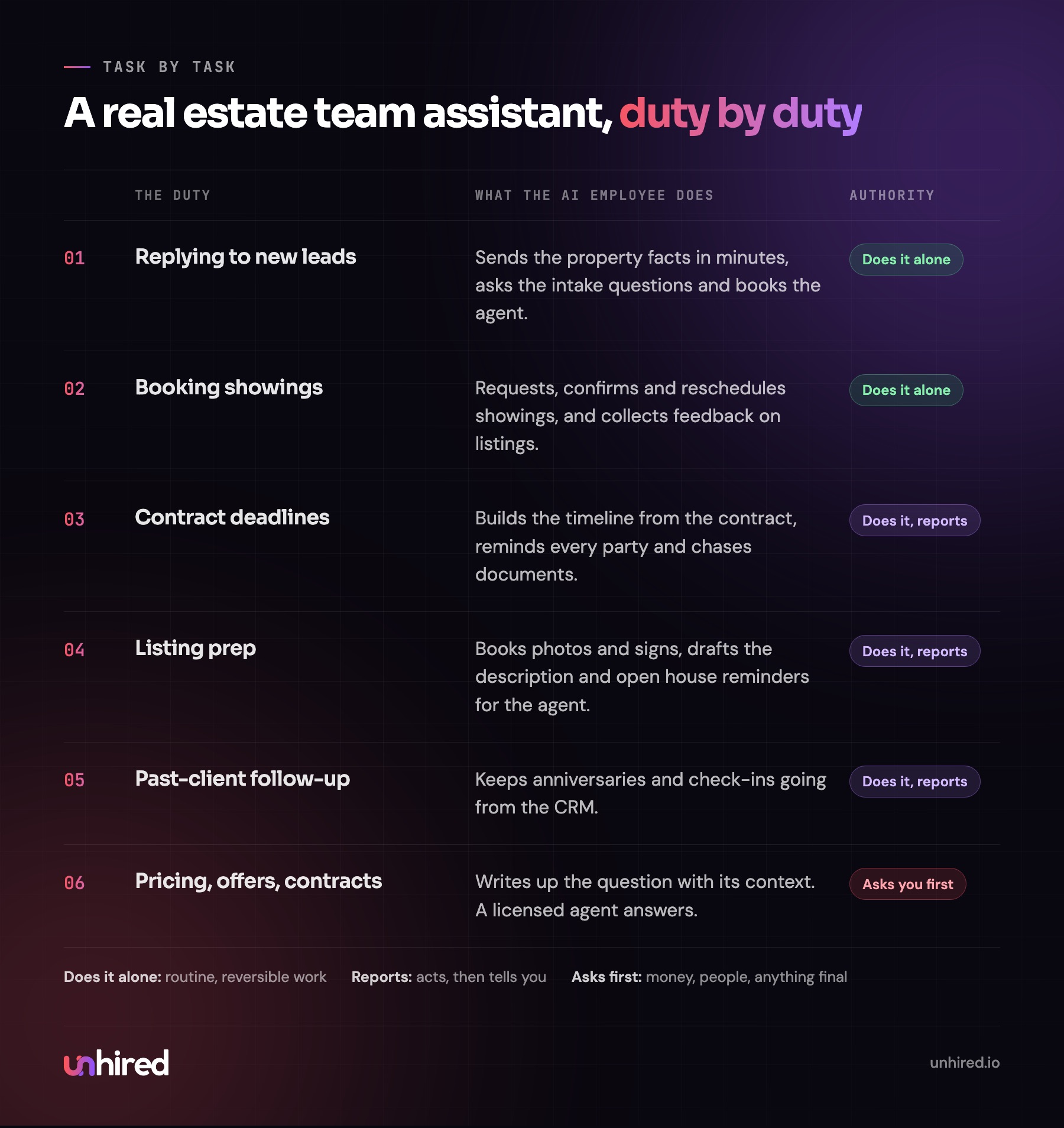
The work splits into five duties.
Replying to new leads
Leads come from listing portals, the team's website, sign calls, open house sign-in sheets and referrals, and they arrive whenever buyers are browsing, which is evenings and weekends. The AI Employee replies within minutes with the facts of the property the lead asked about: price, beds and baths, taxes, HOA fees, showing availability. Then it asks the team's intake questions (timeline, price range, whether they've spoken to a lender, whether they already have an agent) and books a call or showing with the agent on rotation. The qualifying side overlaps with what I covered in the post on the AI Sales Rep.
Booking showings
Showings are a chain of small confirmations: the buyer's availability, the listing agent's or showing service's approval, the lockbox instructions, the route if there are four homes in an afternoon. The AI Employee requests each showing, confirms with the buyer the day before, sends the addresses in order, and moves things when a seller declines a time. On the team's own listings, it sends feedback requests to buyer agents the next morning and puts the answers in a summary for the seller.
Tracking contract deadlines
Once an offer is accepted, the file runs on dates: earnest money due, inspection period, appraisal, financing contingency, final walk-through, closing. A missed date can cost a client their deposit or their deal. The AI Employee builds the timeline from the signed contract, reminds every party ahead of each date, chases the lender, title or escrow and the other agent for documents, and tells the agent on the file the moment something slips. It reads dates off the contract. It never explains what a clause means.
Listing prep and open houses
For a new listing, it books the photographer and the sign install, then drafts the listing description from the agent's notes. Every draft goes to the agent before it's published. On an open house day, it texts each sign-in that evening with the same thank-you and the property details, and books follow-up showings for anyone who asks.
Past clients and long-term leads
Most agents say referrals are their best business and then go a year without contacting a past client, because there is always a closing that needs attention first. The AI Employee keeps the follow-up running from the CRM: a check-in when a lead who said "next spring" reaches spring, or a reply to the past client who texts asking for a plumber recommendation. Drafts that carry the agent's name and opinion go to the agent first.
What stays with a licensed agent
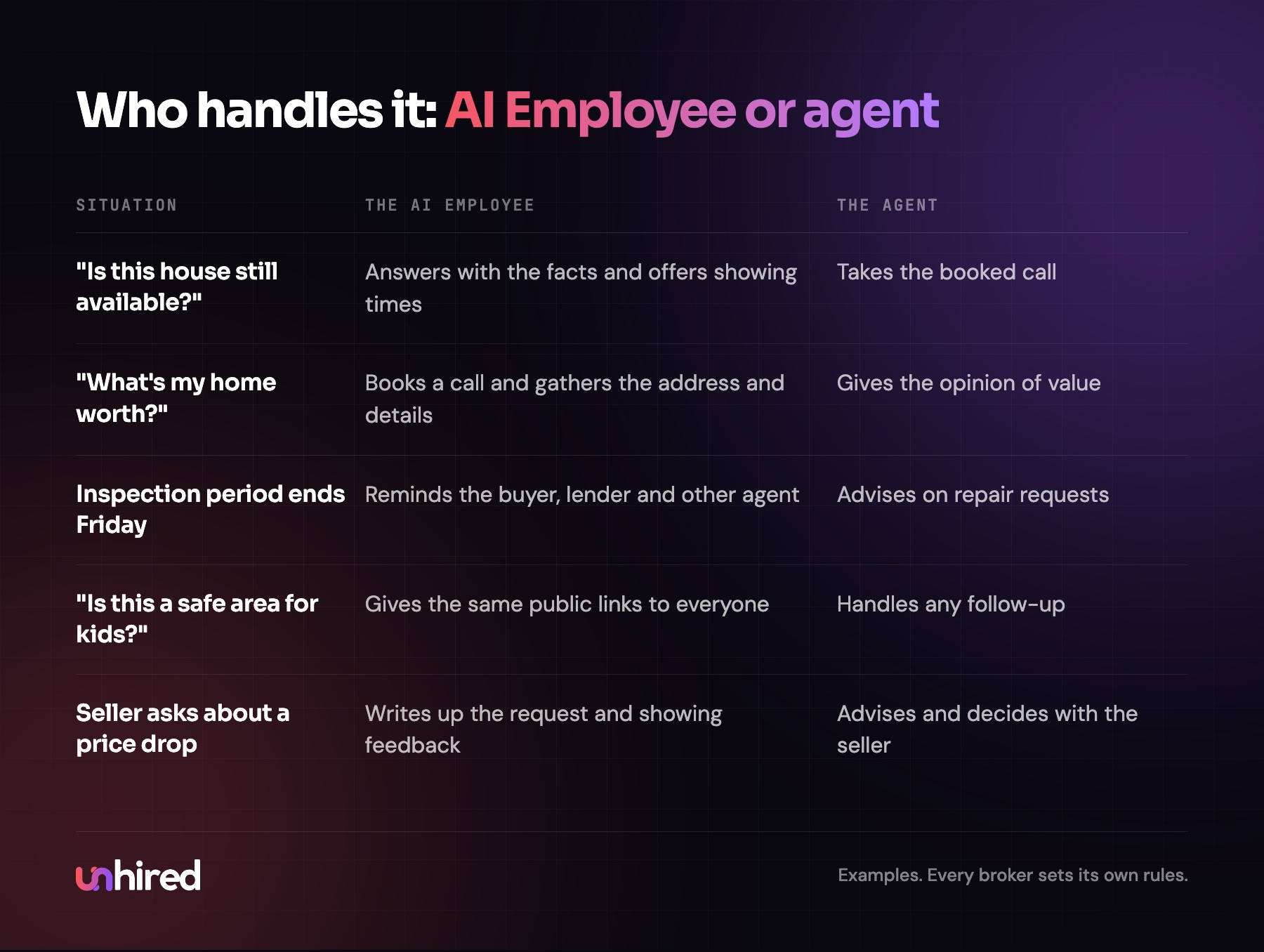
Most places that license real estate agents also limit what an unlicensed assistant can do, and those limits are a good starting point for an AI Employee. I set its rules at least that tight. These go to an agent, with a written summary of the conversation attached:
- Pricing opinions. "What do you think it's worth?" and "should we drop the price?" are the agent's to answer, usually with a comparative market analysis the agent signs off on.
- Offers and negotiation. Writing an offer, presenting it, countering it and talking terms with the other side.
- Contract questions. What a contingency means, whether a client can back out, what happens if the appraisal comes in low.
- Advice about a neighbourhood. Whether an area is safe, good for kids or "a good fit" is a fair housing risk in an agent's mouth and a bigger one in software's.
- Complaints, and anyone upset about a deal.
- Anyone who asks for their agent. That handoff happens on the first request.
Buyers and sellers should also know when they're messaging an AI Employee. The post on whether customers should know they're talking to an AI Employee covers how to word it.
Fair housing applies to every message
In the US, the Fair Housing Act makes it illegal to treat buyers and renters differently because of race, colour, religion, national origin, sex, familial status or disability, and many places add more protected classes. Other countries have their own human rights codes with similar rules. They apply to every message a team sends, whoever or whatever sends it.
For an AI Employee on a real estate team, two parts of that need written rules. The first is steering. It gives every buyer the same facts about a property and never suggests an area based on who the buyer is or what they've said about their family. When someone asks about schools or crime, it gives the same factual answer every time, such as a link to the school district's site or the public crime map, and leaves opinions to the agent.
The second is listing copy. Phrases like "perfect for a young family" or "walking distance to the church" have caused trouble in ads for decades. The AI Employee drafts descriptions that talk about the property (square footage, the renovated kitchen, the fenced yard), runs them against a list of phrases the broker has banned, and still sends every draft to the agent before it goes live.
A Saturday on shift
Here's an example Saturday for an AI assistant on a team of four agents with two listings and six buyers under contract. Three items go to an agent, and that's what a healthy log looks like.
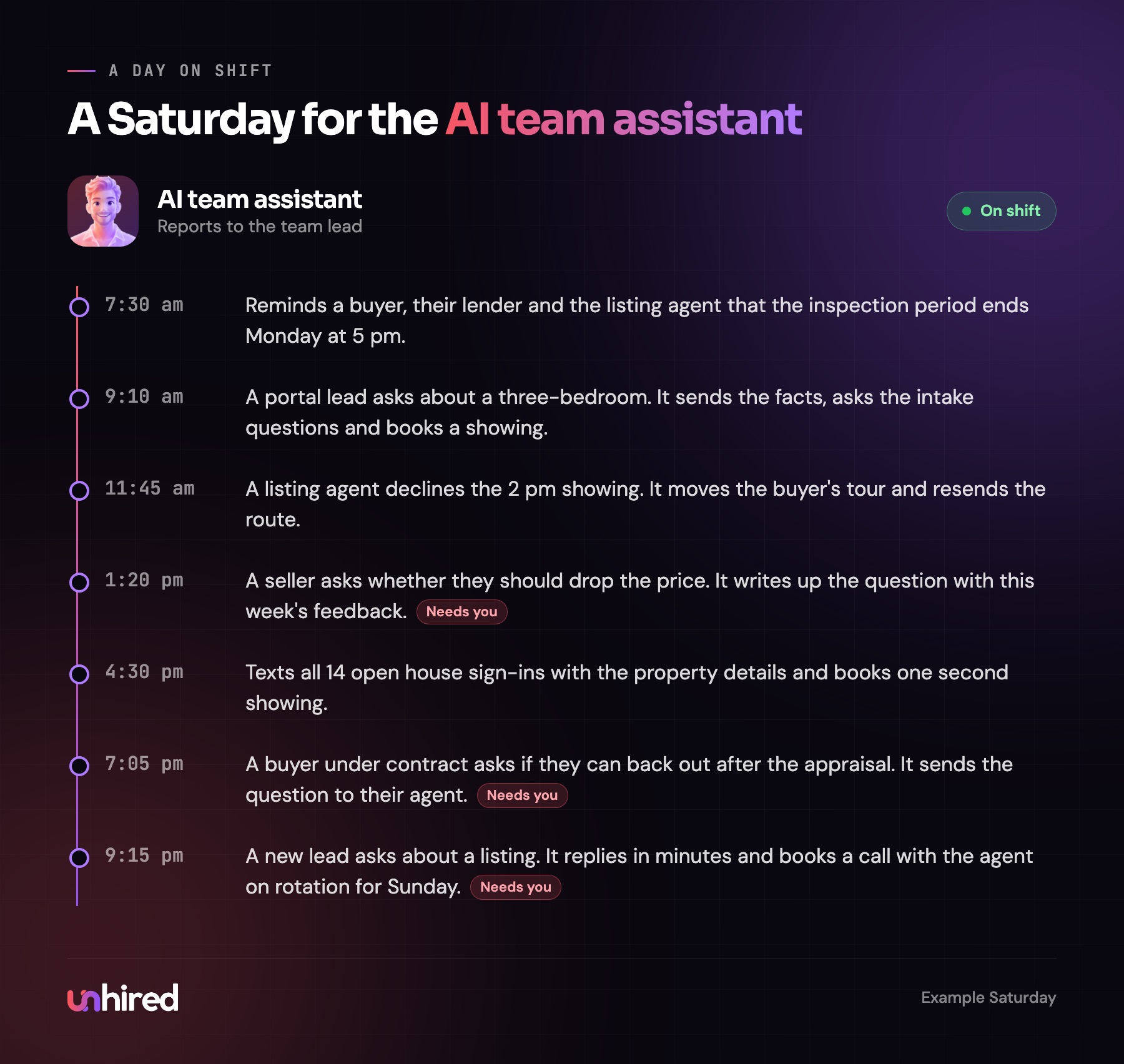
The inspection reminder goes out before anyone thinks to check the calendar. The open house sign-ins all hear back the same evening, and the one who wants a second look is booked before Sunday. The seller asking about a price drop and the buyer asking whether they can get out of the contract both reach their agent with the full conversation written up, and the AI Employee doesn't guess at either answer.
What the seat costs a person
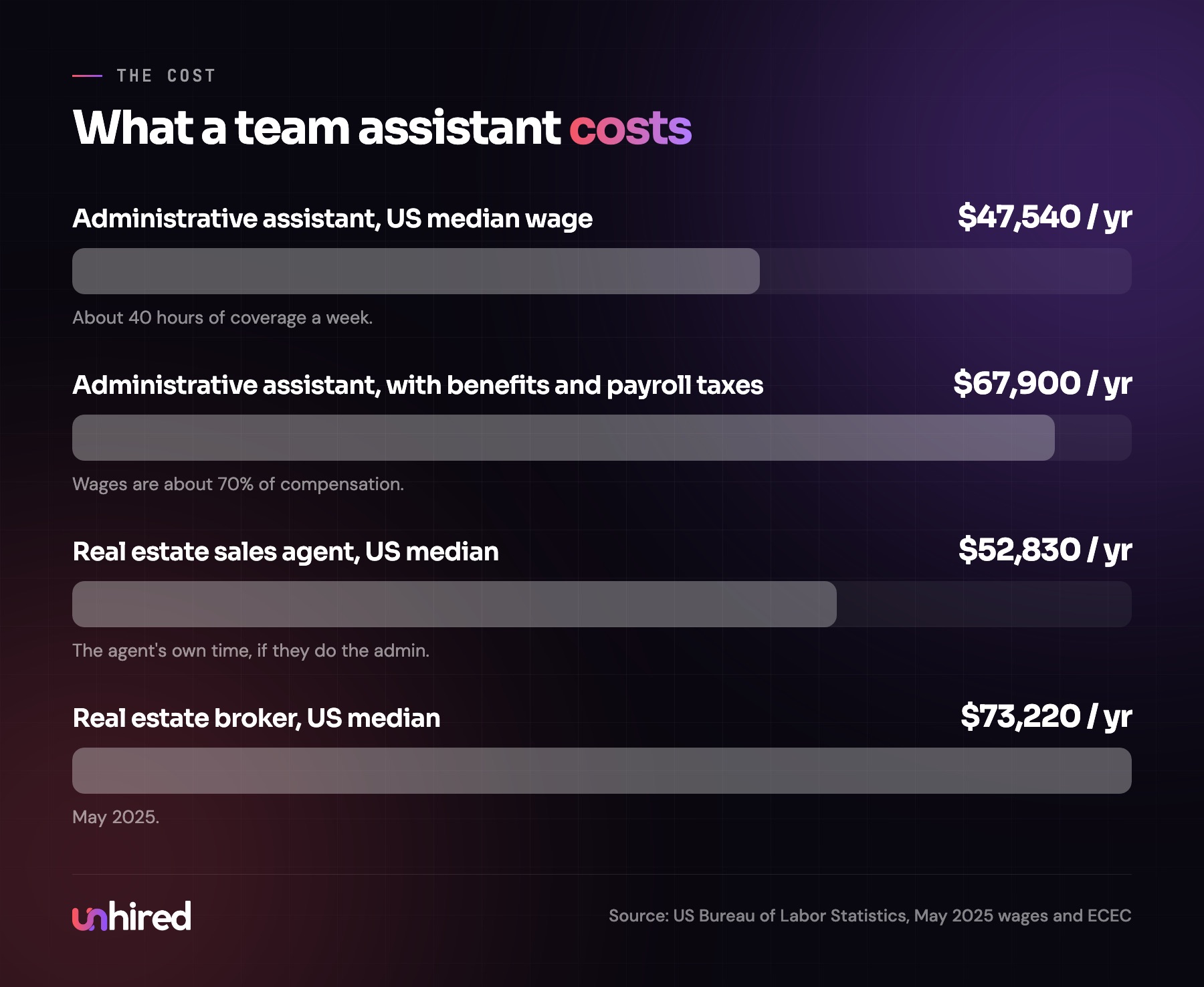
On most teams, this work is done by an administrative assistant or transaction coordinator, or by the agents themselves in the evenings. The US Bureau of Labor Statistics puts the median wage for secretaries and administrative assistants, except legal, medical and executive, at $47,540 a year as of May 2025.
Wages are only part of the cost. Across US private industry, wages and salaries are 70% of what employers spend on compensation, according to the BLS Employer Costs for Employee Compensation report, which puts that assistant at about $67,900. Then add hiring and training on the CRM, plus the evenings and weekends the job keeps asking for.
When the agents do the admin themselves, the cost is their time. The BLS lists the median for real estate sales agents at $52,830 and for brokers at $73,220 (May 2025), and notes that both often work evenings and weekends to fit clients' schedules. Every hour an agent spends rescheduling showings is an hour not spent with a client.
How much you'd pay for an AI assistant for real estate agents
You can assemble one from software: an AI messaging and phone tool, a connection to your CRM, calendar access, and a texting service. The subscriptions are the smaller cost. The larger one is someone's time writing the intake questions, the showing rules, the deadline timeline and the handoff rules, checking all of it against fair housing and your broker's policies, and keeping it current.
Or a provider builds and maintains it, usually for a monthly fee. You pay more than the bare software, and someone else handles setup and the weekly log reviews.
The price moves with the number of agents and lead sources, how many deals are open at once, whether your CRM and transaction software have clean integrations, how many channels it covers, and how much ongoing maintenance is included. A solo agent with a few deals a quarter needs much less than a team running a dozen files at once.
To compare quotes, set them against the full cost of the seat: about $67,900 a year for an assistant at the US median with benefits and payroll taxes, covering roughly 40 hours a week, while most leads arrive outside those hours.
How an AI assistant for a real estate team is set up
Setup looks a lot like training a new team assistant, with the broker's rules written down first.
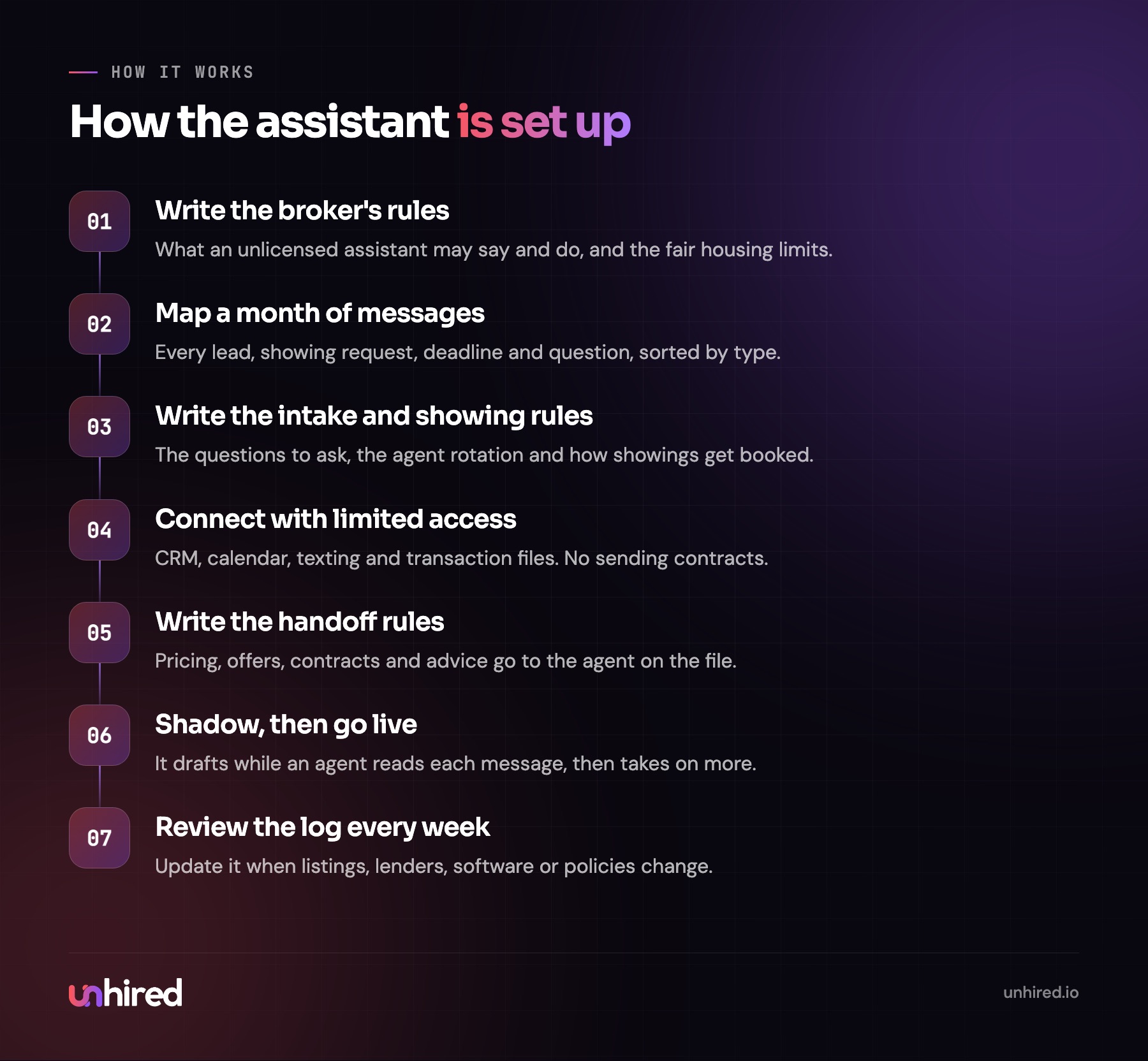
The handoff rules take the most thought. Every team has a sense of where the assistant stops and the agent starts, and most have never written it down, which is how assistants end up answering pricing questions they shouldn't. Writing those rules is worth doing even without an AI Employee.
For the first two weeks, the AI Employee drafts replies and reminders while an agent reads each one before it goes out. It takes on more once the drafts are right. After that, someone still reads the log every week, because listings change every week, and a team that switches CRMs or lenders needs the AI Employee updated the same week.
Is your team a good fit?
If you're a solo agent with a handful of deals a year and most of your business comes from people who call your cell, the AI Employee has less to do, and those calls should stay with you anyway.
If your leads arrive at night, showings take a dozen texts to set up, and you've had a deadline slip because everyone was at closings, the assistant seat is a strong candidate for an AI Employee, with the agents keeping the pricing, offers, contracts and advice.
To check your own team, pull the last 30 days of messages and tasks. Note the time each one arrived and whether it needed a licensed opinion or only an answer, a booking or a reminder. Sort them into what an AI Employee could own, what it could do with an agent checking, and what needs an agent. Some websites offer free assessments that check whether a role like this can be filled by an AI Employee, which is a useful next step once you have that month in front of you.