
A prospective client fills in the contact form on a marketing agency's website at 8:50 on a Thursday night. They want help with a product launch in six weeks and they've filled in the same form on three other agency sites. One agency replies at 9:02 with two questions about the budget and a choice of times on Friday morning. The other three reply on Monday.
The agency that replied first gets the call, and usually the work. Harvard Business Review published research on this back in 2011, The Short Life of Online Sales Leads, and the pattern hasn't changed since: most companies take far too long to answer a lead.
That first reply, and everything between it and a booked meeting, is the job an AI Sales Rep is built for. Below is what it does, where it hands over to a person, and what the job costs next to hiring a rep.
What an AI Sales Rep is
An AI Sales Rep is an AI Employee that holds the front half of the sales job. It has logins to the CRM, the inbox, the calendar and whatever the business sells from, a written playbook for who counts as a good lead, and a salesperson or owner it reports to. Every message it sends and every change it makes to the CRM goes into a log.
I've spent the last four years building AI systems and agents for businesses, and sales is where I see owners expect the wrong thing. They picture a robot that cold-calls strangers and closes deals. The part that pays off is much less dramatic. In most small and medium businesses the leads already come in, from the website, ads, referrals and phone messages, and they leak out because nobody answers fast enough, asks the right questions or follows up past the second try.
An AI Sales Rep fixes the leak. The person who closes keeps closing.
What it does, duty by duty
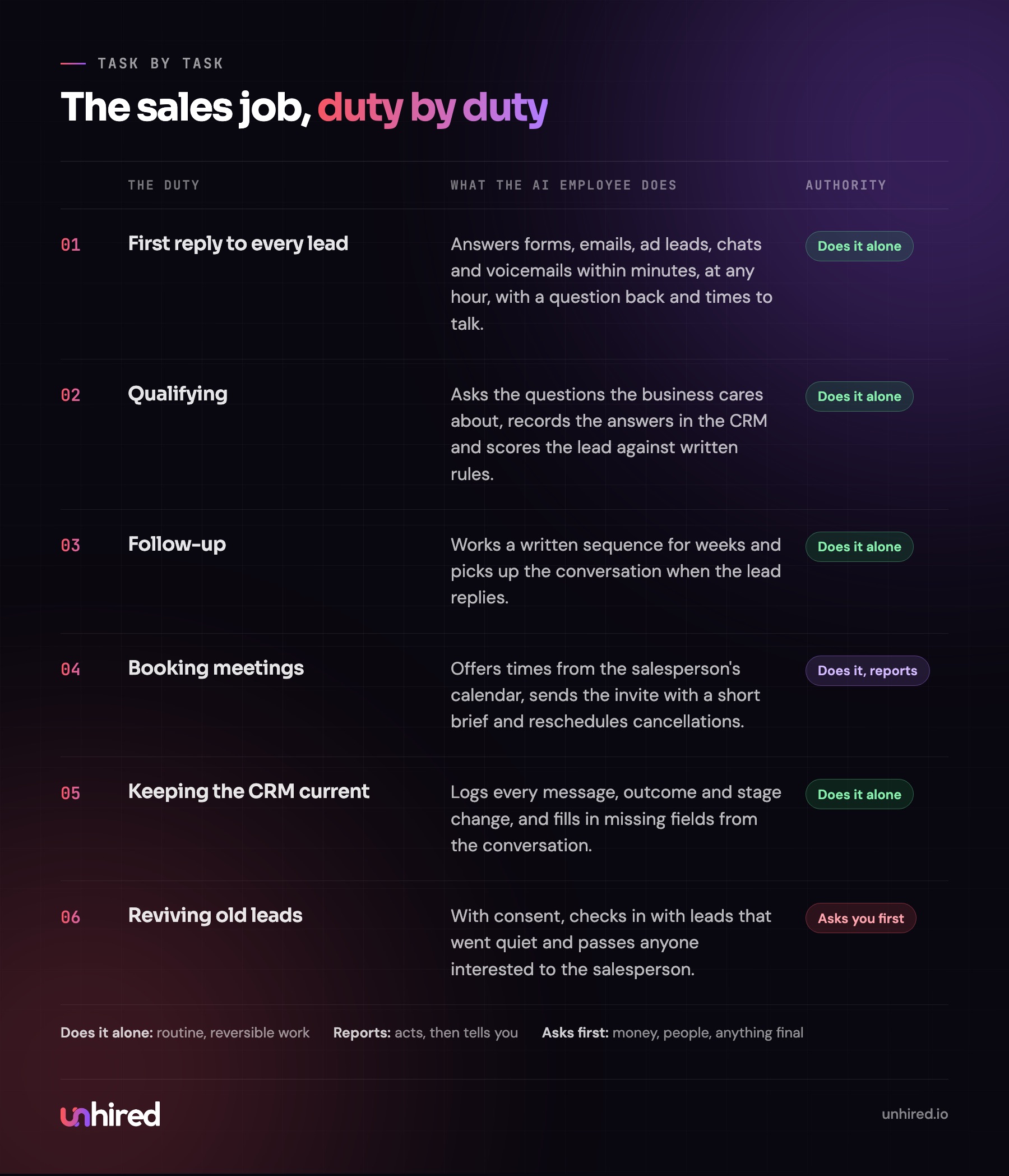
I'd split the job into six duties, each with the authority I'd give it on day one.
First reply to every new lead
Web forms, emails to the sales inbox, ad leads from Facebook and Google, chat messages and voicemails all get a reply within a few minutes, at any hour. A good first reply answers what the lead asked, asks one or two questions back and offers a time to talk. "Thanks for reaching out, someone will be in touch" does none of that.
Qualifying
Every business has its own version of a good lead. A law firm cares about the type of matter and whether there's a conflict with an existing client. A software company wants team size and the tools they use now. At a cosmetic clinic it's the treatment and the budget. The AI Sales Rep asks those questions in conversation, records the answers in the CRM and scores the lead against rules someone at the business wrote down.
Follow-up
This is the duty that gets dropped most. A busy owner or salesperson sends one follow-up, maybe two, and moves on. The AI Employee follows a written sequence for weeks: a useful answer on day two, a case study or a price guide on day five, a check-in on day 12, a last message on day 30. When the lead replies, it picks up the conversation where it left off.
Booking meetings
Once a lead qualifies, it offers times from the salesperson's real calendar, books the call or the site visit, sends the invite with a short brief attached and sends a reminder the day before. If the lead cancels, it offers new times instead of letting the meeting disappear.
Keeping the CRM current
Every call outcome, email and stage change gets logged. Salespeople hate this part, and an out-of-date CRM is why an owner can't say how many deals are open without calling a meeting. The AI Employee updates it as it goes and fills in missing fields from the conversation.
Reviving old leads
Most businesses have hundreds of leads in the CRM that went quiet six or 18 months ago. With the right consent, the AI Sales Rep works through them in small batches, asks whether the need is still there, and passes anyone who answers yes back to the salesperson.
What it looks like in different businesses
The duties are the same everywhere. The playbook changes.
A wholesale distributor's AI Sales Rep answers quote requests from new trade accounts, checks the products they want against the catalogue and books a call with the account manager for anything above a set order size. At an insurance brokerage, it collects the details a broker needs before quoting, such as the renewal date and current carrier, and books the review. A property management company uses it for owners asking about management services, and it sends the fee schedule and books a walk-through. At a digital agency, it qualifies on budget and timeline and books discovery calls with the founder, who still runs every one.
What should always go to a person
These are the lines I'd draw at any business:
- Pricing outside the published rates. Discounts, custom quotes and payment terms go to a person, and the AI Employee prepares the numbers and the history.
- Contract terms. Anything a lawyer or the owner would want to read before it's sent stays with them.
- Large or strategic deals. Above a set value, or from a named list of target accounts, the AI Sales Rep books the meeting and steps back.
- Unhappy existing clients. A complaint that arrives in the sales inbox goes to whoever owns the account, untouched.
- Anyone who asks for a person. The lead gets one, quickly, with the conversation so far attached.
Two more rules sit underneath all of it. The AI Sales Rep says it's an AI when it introduces itself, and it only contacts people who reached out first or who gave consent. Anti-spam laws in most countries put limits on commercial email and texts to people who haven't opted in, and a sales tool that ignores them puts the whole business at risk.
A day on the job
Here's an example day for an AI Sales Rep at an IT services company that sells support contracts to offices and clinics. Two items go to the sales manager.
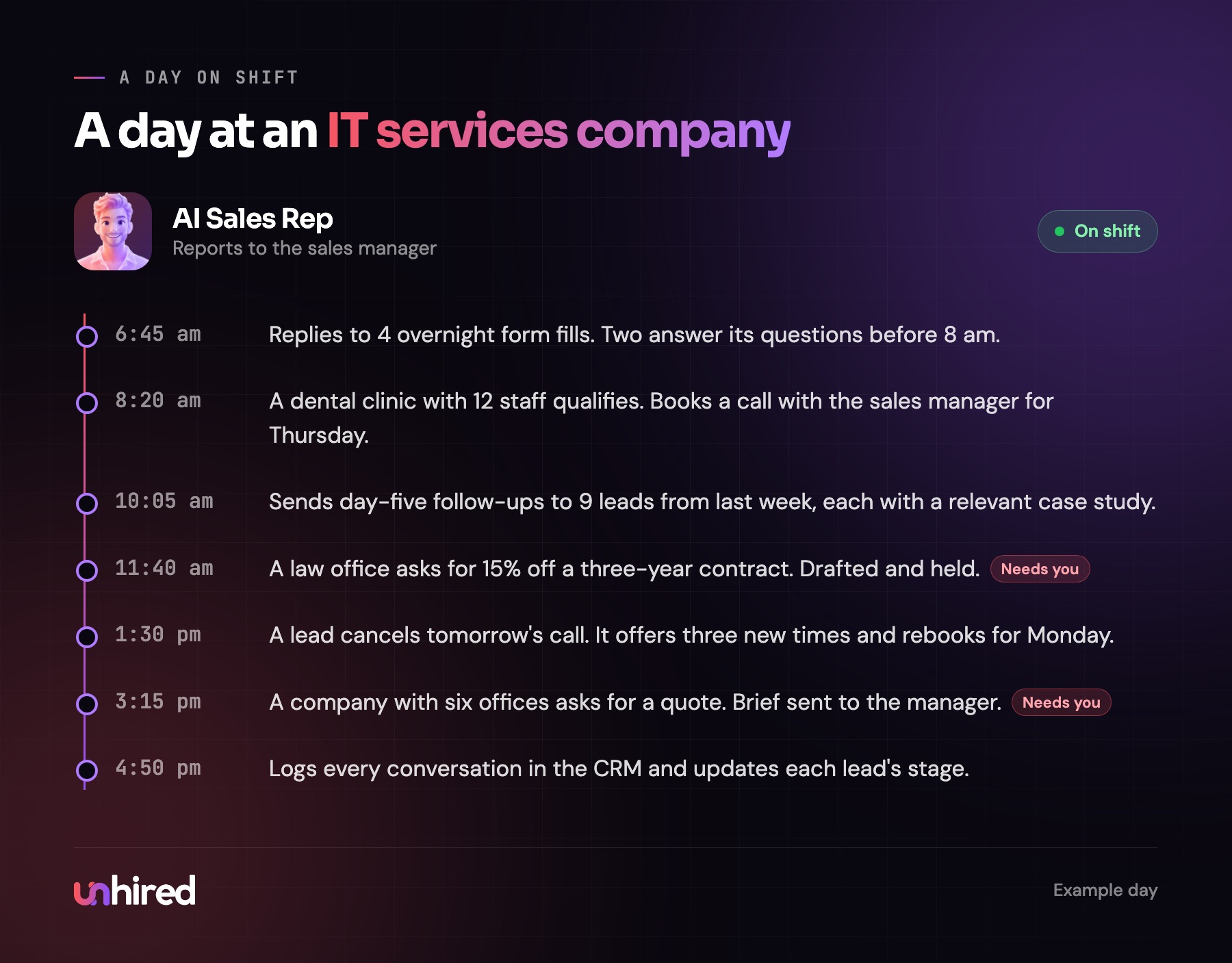
The overnight form fills are answered before anyone is in. Two meetings land on the sales manager's calendar with a one-page brief each. The request for a discount on a three-year contract and the large multi-site lead both go to the manager with everything needed to decide.
What a sales representative costs
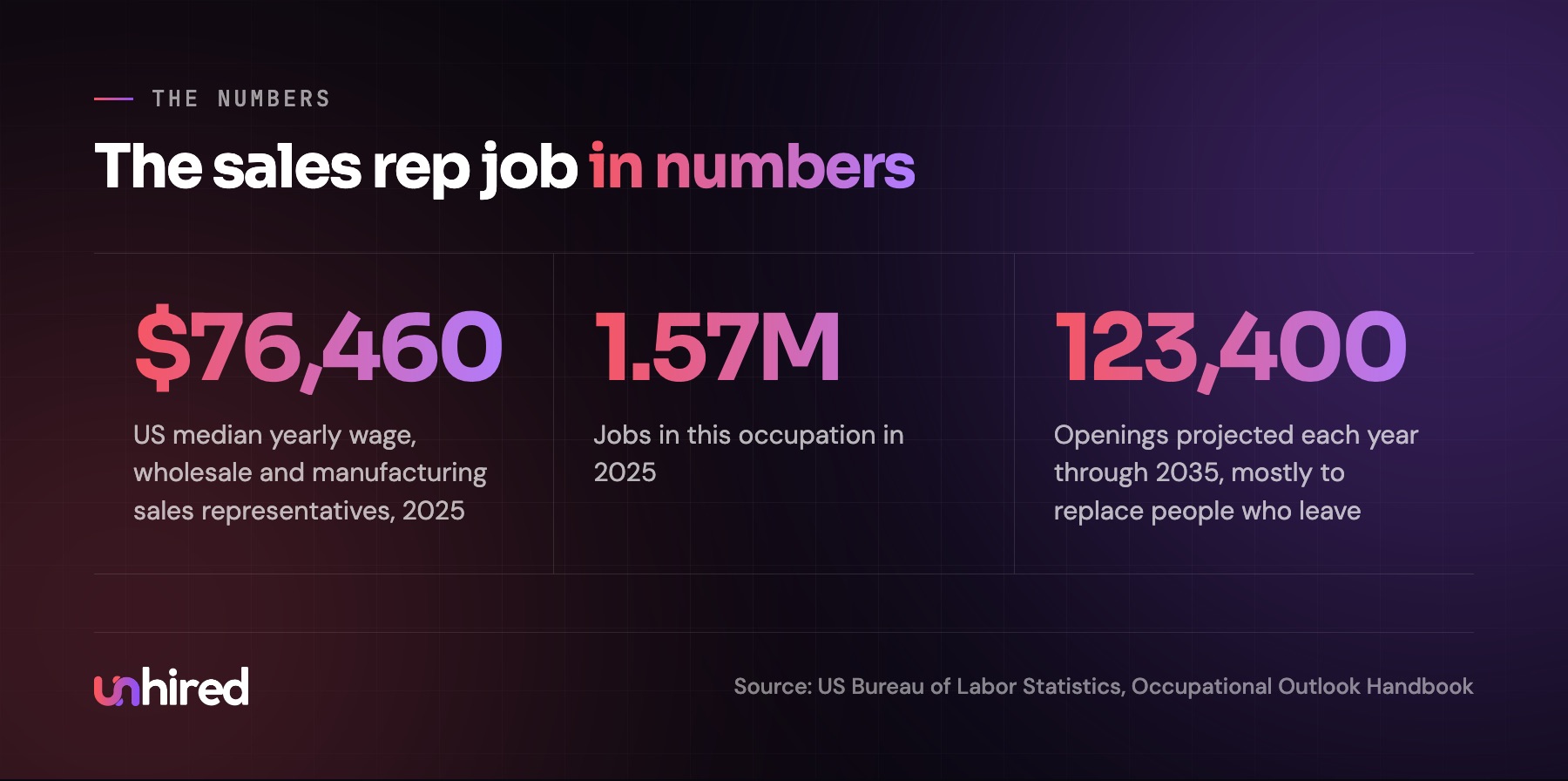
The US Bureau of Labor Statistics puts the median wage for wholesale and manufacturing sales representatives at $76,460 a year in 2025, or $36.76 an hour. Reps selling technical and scientific products earn more, with a median of $104,920. BLS counts about 1.57 million of these jobs and projects about 123,400 openings a year through 2035, mostly to replace people who leave.
The wage is a base. Many sales roles add commission or bonuses on top, and across US private industry wages and salaries are about 70% of what employers spend on compensation, according to the BLS Employer Costs for Employee Compensation report. At the median wage, that puts the full cost of one rep closer to $109,000 a year before commission, recruiting and the months a new rep spends learning the product.
How much you'd pay for an AI Sales Rep
There are two ways to get one.
Building it yourself. Most CRMs now sell AI add-ons for email drafting and lead scoring, and AI agent platforms can connect to the inbox, the calendar and the CRM. The software is the smaller cost. The bigger one is the time to write the playbook, connect everything, test it against real leads and keep it current when prices or the sales process change.
Having it built and maintained. A provider sets it up, connects the systems, writes the playbook with the business and keeps it updated, usually for a monthly fee.
What drives the price is lead volume, the number of channels (form, email, text, chat, phone), how many systems it connects to, and how much it's allowed to do on its own. A clinic with 60 new enquiries a month needs much less than a distributor answering hundreds of quote requests across several product lines.
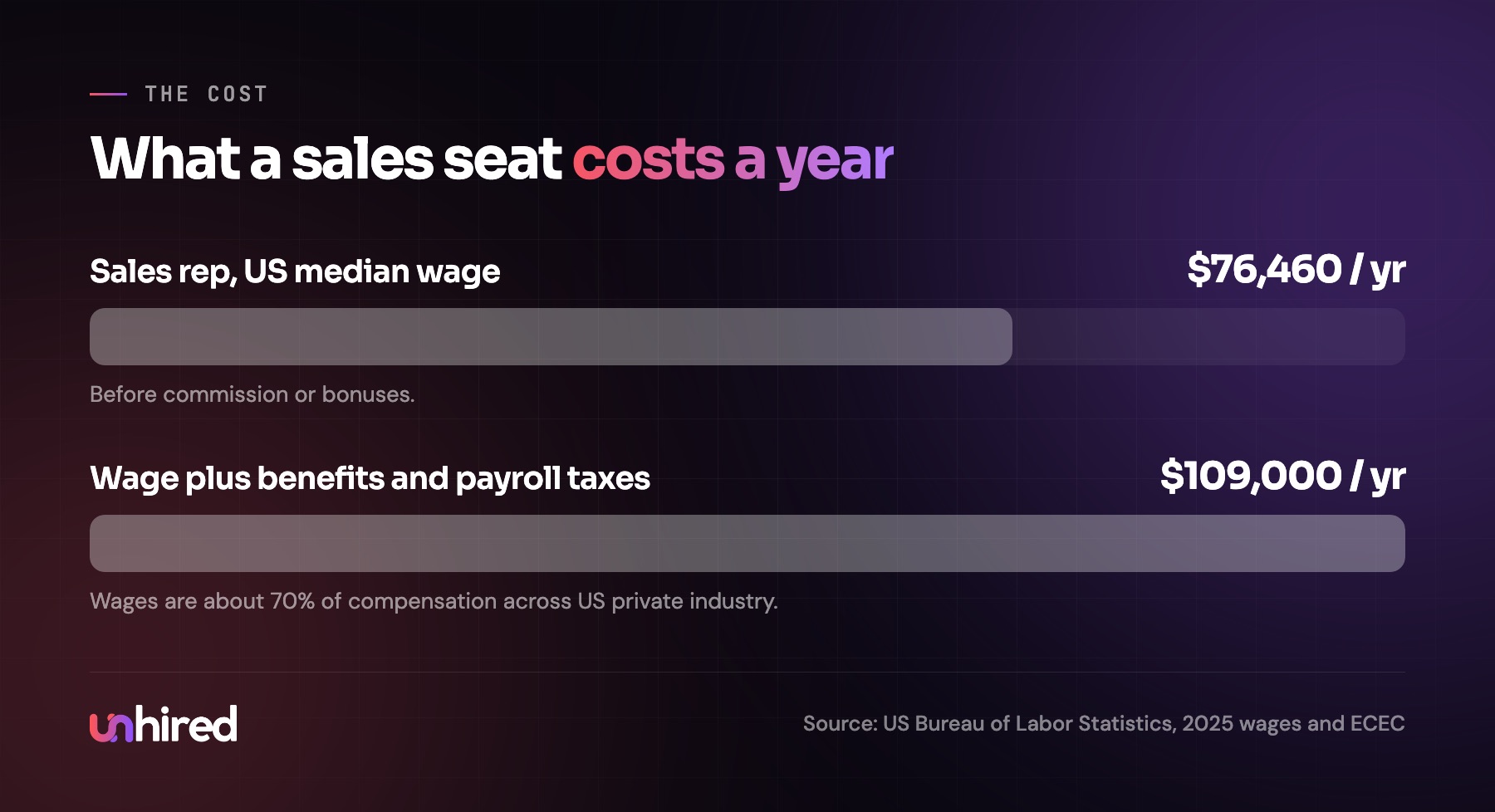
When comparing quotes, line them up against the full cost of the seat (about $109,000 a year for one rep at the US median, before commission), and remember that a person covers about 40 of the 168 hours in a week, while plenty of leads arrive in the other 128.
How an AI Sales Rep is set up
Setup starts with the leads you already have, including the ones you lost.
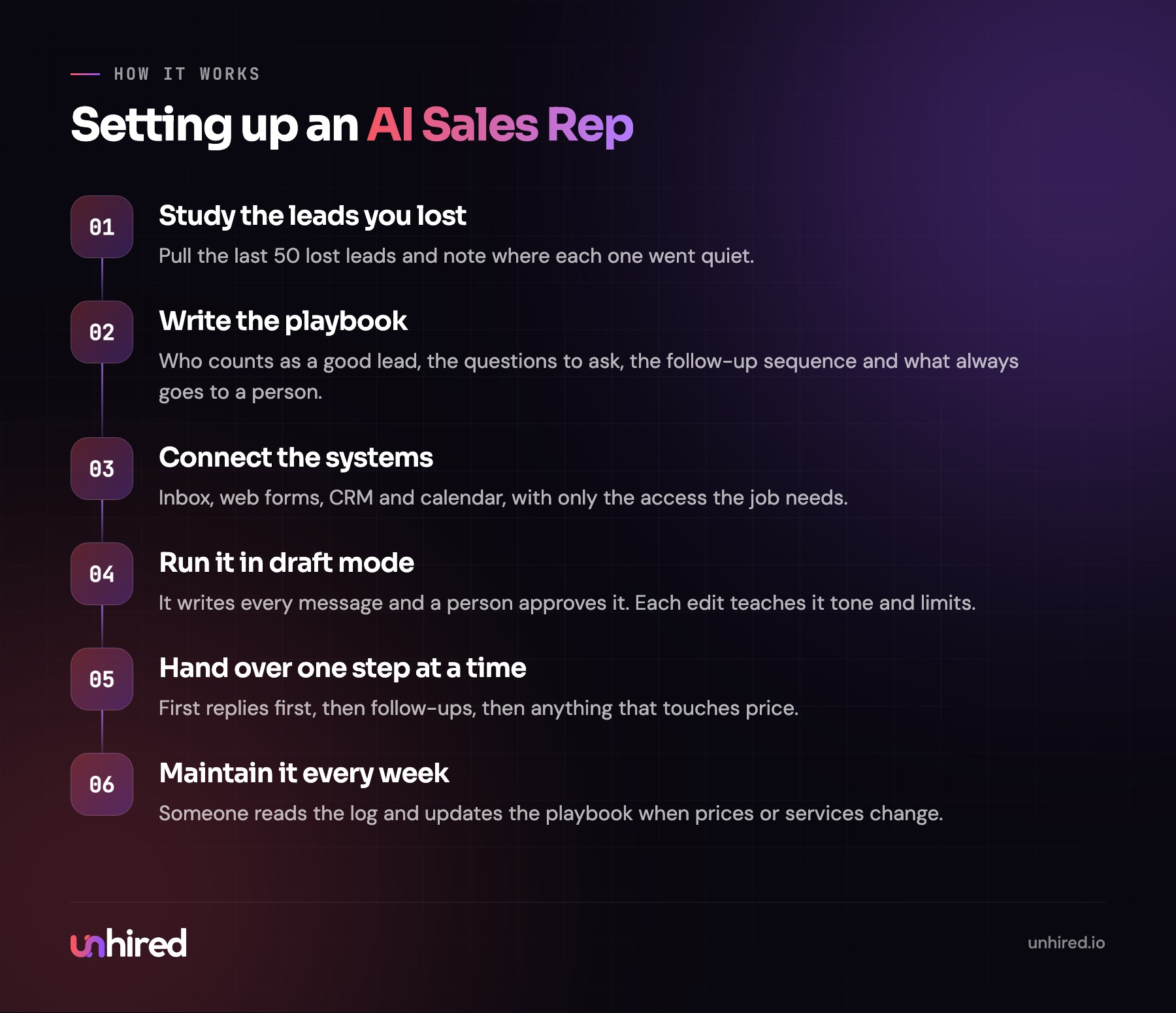
The step I'd never skip is draft mode. For the first two weeks it writes every message and a person approves it before it goes. Each edit teaches it the tone and the promises it shouldn't make. Once first replies stop needing edits, those go out on their own. Follow-ups come next, and anything involving price comes last.
After launch, someone has to read the log every week. Prices change and new services launch, and the playbook has to keep up.
Where it fits and where it doesn't
If your leads come in on their own and the problem is speed and follow-up, an AI Sales Rep can hold that part of the job, and your salesperson or owner spends their time in meetings. If your sales are a few large deals a year built on relationships and long negotiations, keep a person in charge of every conversation and give the AI Employee the CRM updates, the meeting prep and the reminders. The AI Receptionist post covers the phone side, and the AI Customer Support employee post covers what happens after the sale.
To see where you stand, pull your last 50 lost leads from the CRM or the inbox and write down where each one went quiet: no first reply for a day or more, no follow-up after the first, a meeting that was never booked, or a real decision against you. The first three are the job an AI Sales Rep would own. Some websites offer free assessments that check whether a role can be filled by an AI Employee, which runs the same sort on the whole job.
Wage data: US Bureau of Labor Statistics, Occupational Outlook Handbook, 2025. The IT services day is an example built from the duties in this post.