
At 10:40 on a Saturday night, a tenant texts the office line: "No hot water in 4B." The property manager who covers that building is asleep, the office reopens Monday, and by then the same tenant has sent two more messages and left a one-star review that mentions the company by name.
I've spent the last four years building AI systems and agents for businesses, and property management is one of the heaviest workloads I've looked at per person. One manager often covers a few hundred units, and nearly everything in the job arrives as a message from a tenant, an owner, a vendor or a prospect. The work is coordination. It happens inside one or two software systems, and most of it follows rules the company already has, even if nobody has written them down.
This post covers what an AI Employee does as a property management assistant, what it should always hand to a person, the fair housing rules that shape how it's set up, and how the cost compares to the hire it would replace.
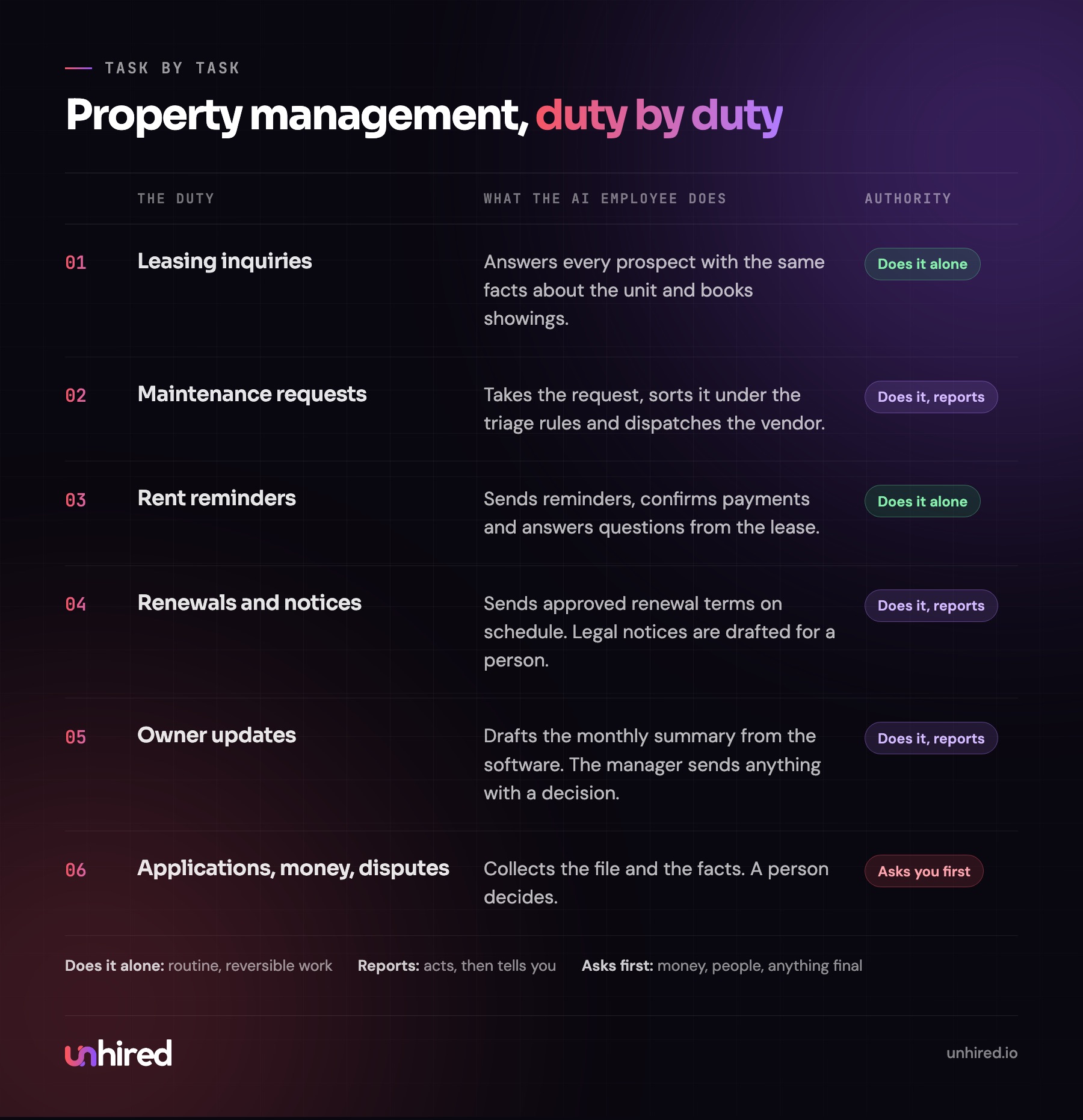
What the job involves
A property management office, whether it runs single-family rentals, apartment buildings, condo associations or small commercial space, has the same handful of recurring jobs. Someone answers prospects and shows units. Someone takes maintenance requests and gets a vendor out. Someone chases rent and sends renewals. Someone keeps owners informed. At a small company that's one or two people, and the same people also handle move-outs, inspections, and the surprise at 10:40 pm.
An AI Employee in this role holds the job the way a person would. It has a manager (usually the senior property manager or the broker of record), logins to the property management software, the phone line, email and texting, and a written set of rules about what it can do on its own. Every message and every action goes into a log someone at the company reads. The front-desk part of the job overlaps with what I covered in the post on the AI Receptionist. Property management adds five duties of its own.
Leasing inquiries and showings
Prospects message from listing sites, the company's website and the phone, and the ones who get an answer within minutes are the ones who show up. The AI Employee answers every inquiry with the facts of the unit: rent, deposit, availability date, pet policy, parking, what's included in the rent. It gives the same answers to everyone, which matters for the fair housing section below. It books showings into the leasing calendar, sends the address and lockbox or meeting instructions, confirms the day before, and follows up with anyone who went quiet after a showing.
Maintenance requests
This is where after-hours work piles up. The AI Employee takes the request by text, call or portal, asks the questions a good coordinator asks (which unit, what's happening, since when, is anyone in danger, is water running), and sorts it under the company's rules. A dripping faucet gets logged and scheduled with the plumber during business hours. A burst pipe gets the shutoff instructions the company wrote, then the on-call plumber, then the manager's phone rings. It tells the tenant what happens next, sends the work order to the vendor, and checks back when the vendor marks it done.
Rent reminders and payment questions
Rent comes in on a schedule, and so do the questions around it: where to pay, whether a payment posted, what the late fee is, how to set up autopay. The AI Employee sends reminders before the due date, confirms payments when they post in the software, and answers the questions from the lease and the company's policies. When a payment is late, it sends the first notice on the day the company's rules say to, and nothing more aggressive than that without a person.
Renewals and notices
Leases end on dates the software already knows. The AI Employee sends renewal offers at the right lead time (90 days out is common, but the company sets it), with the terms the manager has approved for that unit, and tracks who has responded. It sends move-out instructions, schedules inspections and reminds tenants about forwarding addresses. Any notice with legal weight, like a notice to vacate or a lease violation, is drafted for a person to send.
Owner updates
Owners want to know their units are rented, their rent is collected and their repairs are handled, and most property managers are too busy doing those things to say so. The AI Employee drafts a monthly summary for each owner from the software: occupancy, rent collected, open work orders, upcoming lease ends. It also answers routine owner questions like "did the HVAC repair get done?" from the work order log. The manager reads and sends anything with a decision in it.
What it should always hand to a person
Housing is where people live, and a property manager's mistakes land on someone's home. These are the situations I'd always route to a named person, with a written summary attached:
- Application decisions. It can collect a complete application and order the reports the company already uses. Who gets the unit is decided by a person, under written criteria.
- Anything that changes money. Late fee waivers, rent concessions, payment plans, security deposit deductions and vendor invoices above a set amount all wait for approval.
- Legal notices. Notices to vacate, lease violation letters and anything that could end up in front of a judge are drafted by the AI Employee and sent by a person who has read them.
- Disputes between tenants. Noise complaints, parking fights and anything involving a neighbour get logged with both sides' accounts and go to the manager.
- Emergencies. Gas smells, fires, floods and anyone describing a threat get the company's emergency instructions, the on-call vendor where it applies, and a person alerted right away.
- Anyone who asks for a person. That handoff happens on the first request.
Tenants should also know they're messaging an AI Employee. The post on whether customers should know they're talking to an AI Employee covers how to word it.
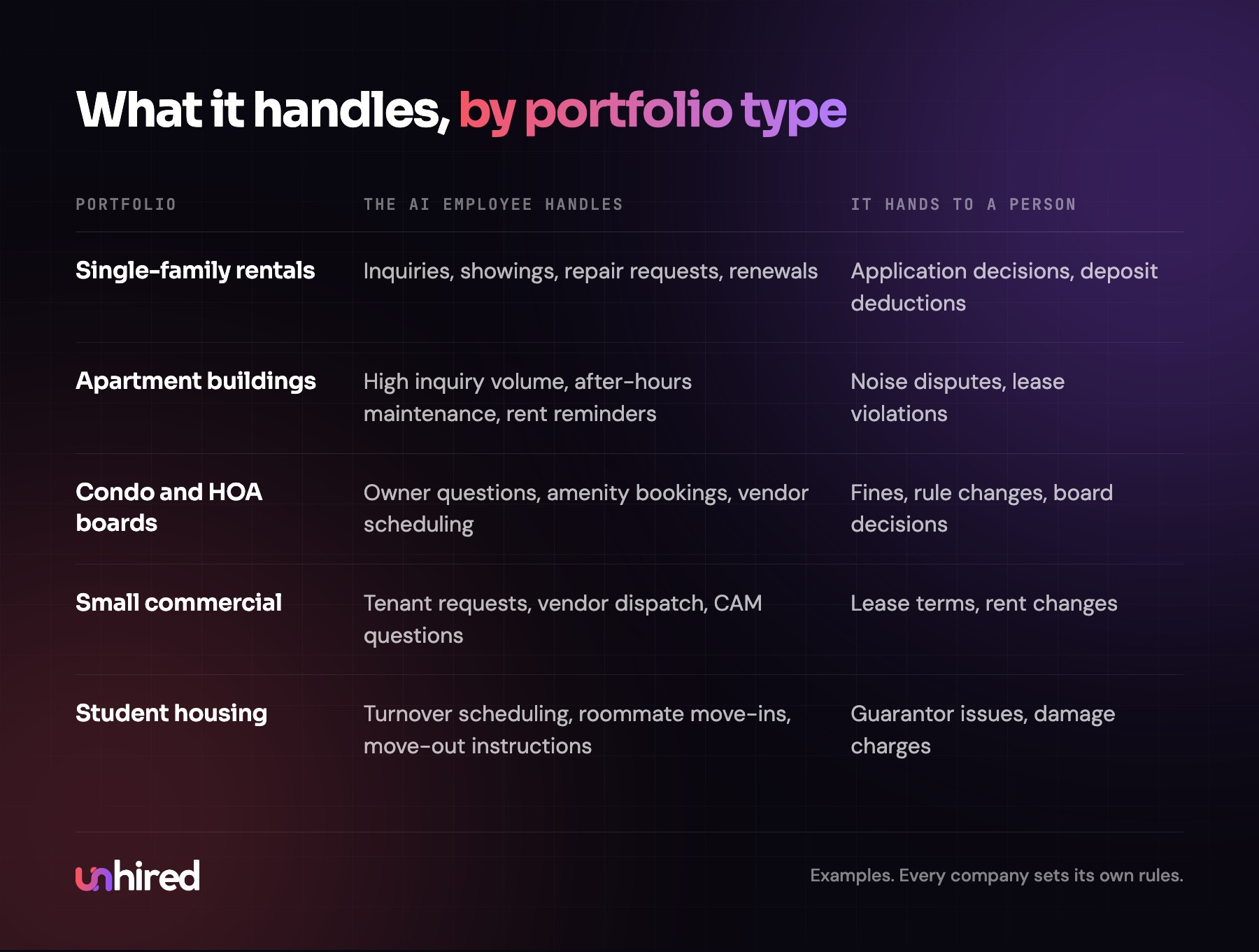
Fair housing shapes the whole setup
In the US, the Fair Housing Act makes it illegal to treat prospects and tenants differently because of race, colour, religion, national origin, sex, familial status or disability, and many states and cities add more protected classes. Other countries have their own human rights codes with similar rules. Those laws apply to every message a housing provider sends, whether a person or software sends it.
That shapes the rules an AI Employee in this job runs on. It gives every inquiry the same facts about a unit, in the same order, and never steers anyone toward or away from a building. It doesn't ask about family size, where someone is from or whether they have a disability, and if a prospect volunteers that information, it doesn't act on it. When someone asks for an accommodation, like a reserved parking space or a service animal in a no-pets building, the request goes to the manager, because those requests have legal weight and need a considered answer.
Screening is where I'd keep the tightest limits. An AI Employee can confirm an application is complete and order the reports the company already uses, and that's all. It never scores, ranks or recommends applicants. The decision belongs to a person applying written criteria the same way every time, and the log should show that's what happened.
A weekend on shift
Here's an example of a Saturday for an AI property management assistant at a company managing a few hundred residential units. Three items go to a person, and that's how a good log reads.
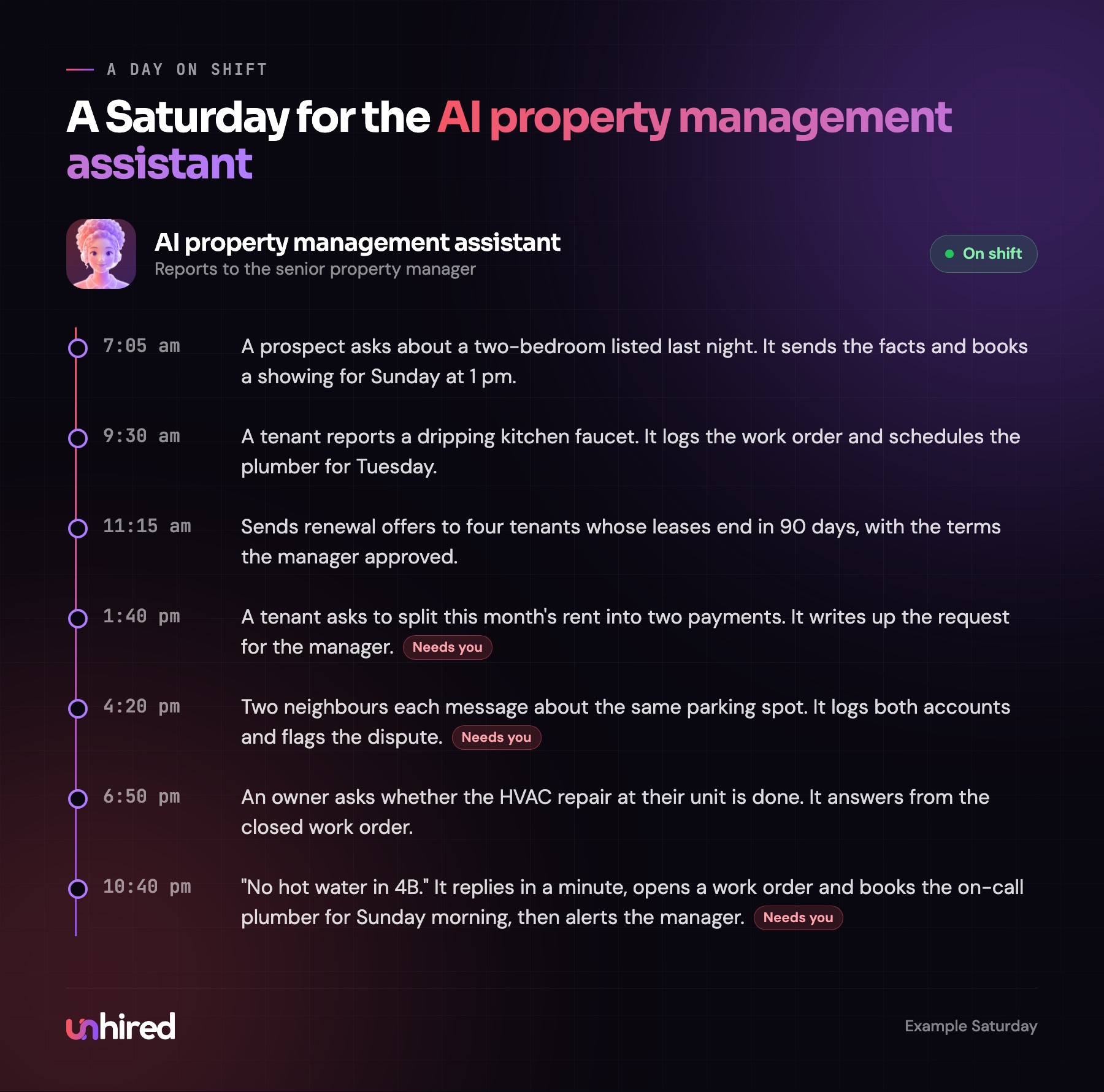
The 10:40 pm hot water text gets a reply in under a minute, a work order and a plumber booked for Sunday morning, so Monday starts with a fixed water heater instead of a review. The prospect who inquired at 7 am has a showing booked before the office would have opened. The tenant asking for a payment plan and the two neighbours arguing about a parking spot both reach the manager Monday morning with the whole story written up.
What the seat costs a person
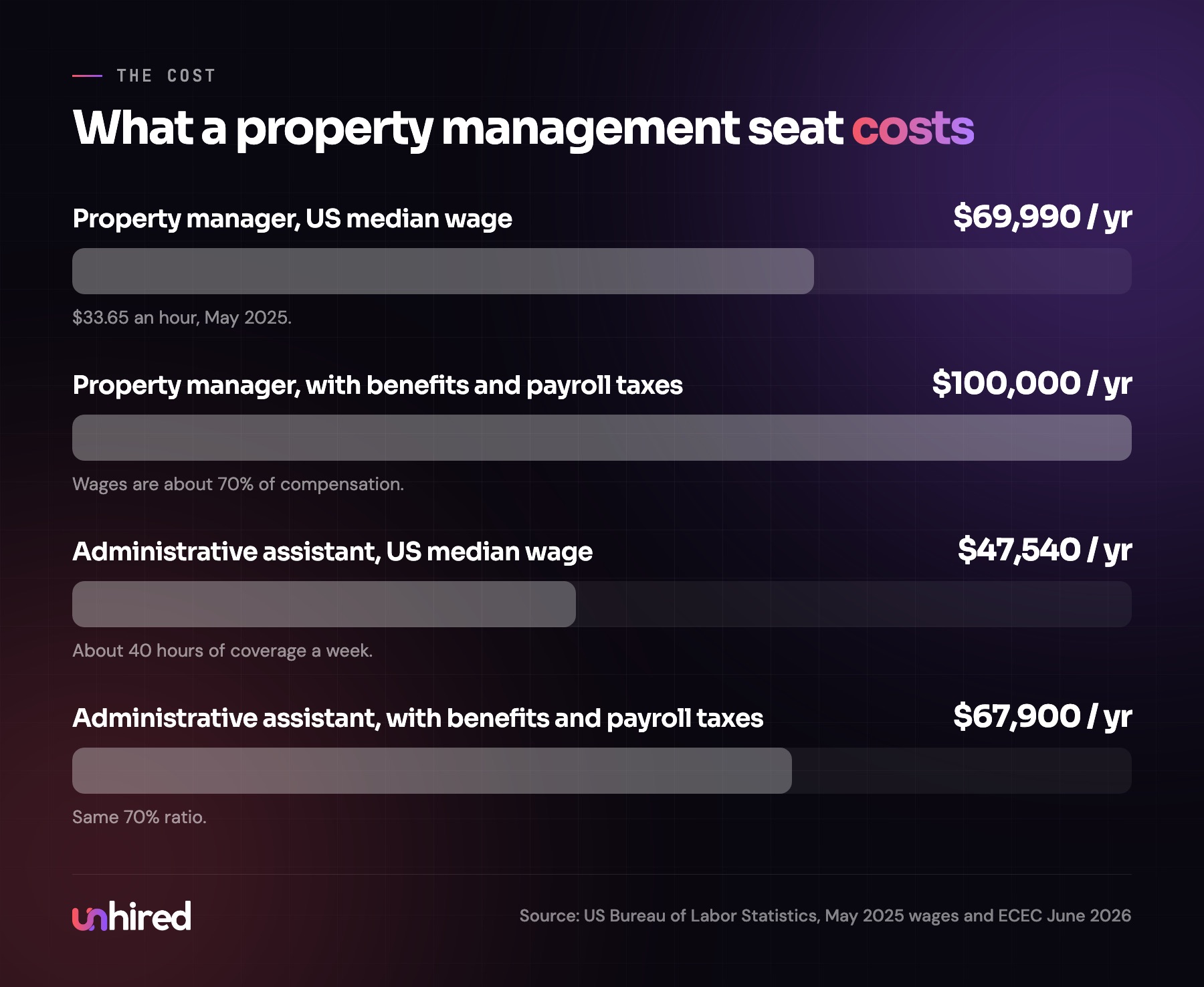
The US Bureau of Labor Statistics puts the median wage for property, real estate and community association managers at $69,990 a year ($33.65 an hour) as of May 2025, and $64,290 in the real estate industry specifically. Many companies put an administrative assistant or leasing coordinator on the inbox instead; the BLS median for secretaries and administrative assistants, except legal, medical and executive, was $47,540 in May 2025.
Wages are only part of it. Across US private industry, wages and salaries are 70% of what employers spend on compensation, according to the BLS Employer Costs for Employee Compensation report for June 2026. Then add the job posting, interviews, training on the software, and coverage for sick days, vacation and the weekends nobody wants.
How much you'd pay for an AI property management assistant
You can assemble one from software: an AI phone and messaging tool, a connection to your property management system, and a texting and email service. The subscriptions are the smaller cost. The bigger one is a person's time mapping every request type, writing the maintenance triage rules and the handoff rules, checking the setup against fair housing law, testing it and keeping it current.
Or a provider builds and maintains it, usually for a monthly fee. You pay more than the bare software, and someone else handles setup, updates and the weekly log reviews.
The price moves with the number of units and properties, how many channels it covers (phone, text, email, portal), whether your property management software has a clean integration, how many vendors it dispatches, languages, and how much maintenance is included.
To compare quotes, set them against the full cost of the seat. A property manager at the US median costs $69,990 in pay and about $100,000 once benefits and payroll taxes are counted at the BLS ratio. An administrative assistant at the median comes to about $67,900. Each covers roughly 40 hours a week, and the hot water goes out on Saturday night.
How an AI property management assistant is set up
Setup looks a lot like training a new coordinator, with the fair housing review added at the start.
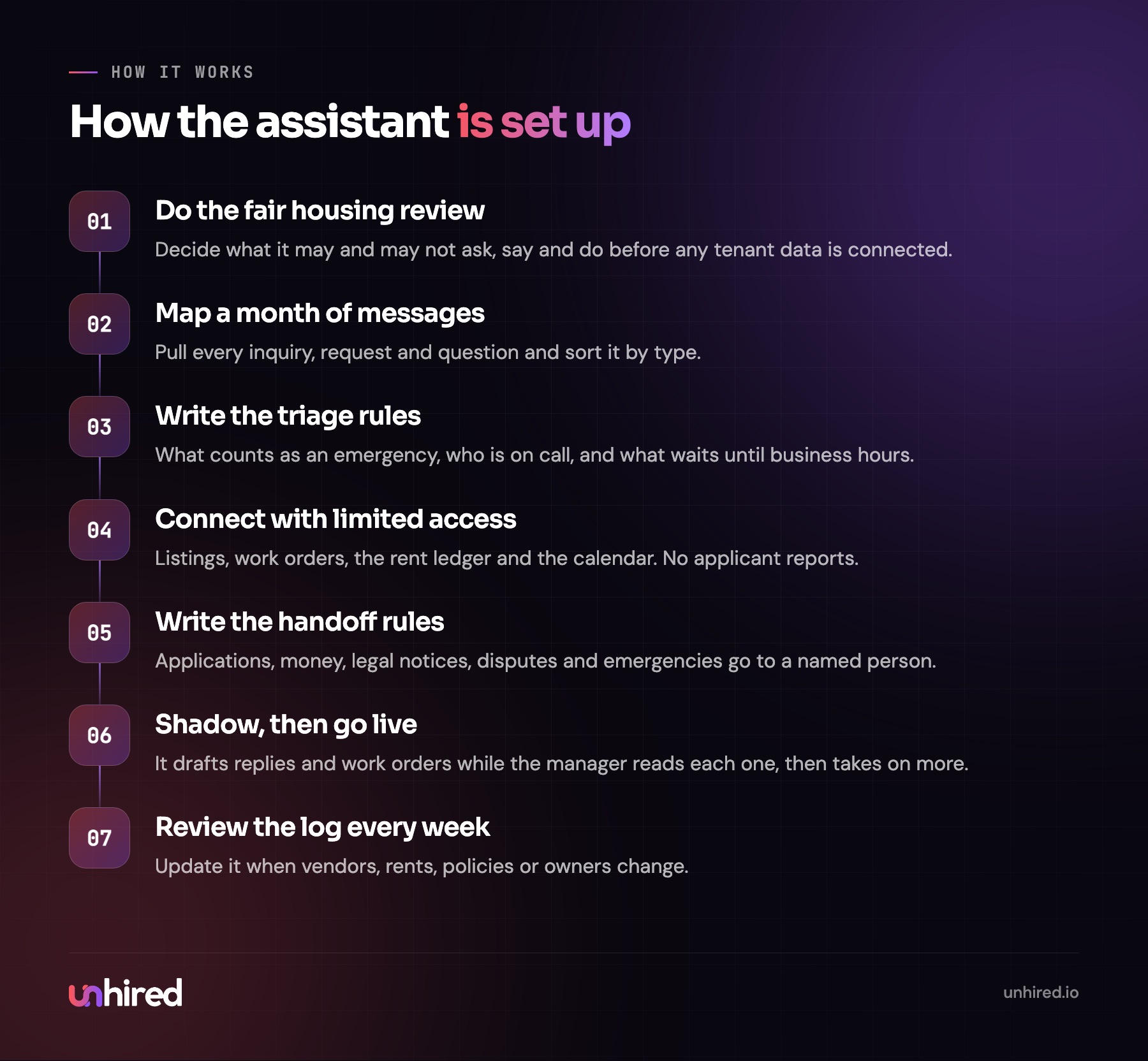
The triage rules are the part that takes real thought. Every company has a sense of what's an emergency and what waits until Tuesday, and almost none have written it down. Writing it down is most of the work, and it's worth doing even if you never hire an AI Employee, because your human staff are making those calls differently from each other right now.
The shadow period decides whether it works. For the first two weeks, the AI Employee drafts replies and work orders while the manager reads every one before it goes out. It takes on more once the drafts are right. After that, someone still reads the log weekly, because vendors change and owners change their minds about pet policies, and an assistant nobody updates keeps quoting last year's terms.
Is your portfolio a good fit?
If most of your tenants are long-term, repairs are rare and owners call you because they like talking to you, the AI Employee has less to do, and the relationship calls should stay with you anyway.
If your inbox fills with the same leasing questions, maintenance requests arrive at all hours, and renewals get sent late because someone was busy with a flood, this role is a strong candidate for an AI Employee, with your team handling the applications, the money, the legal notices and the disputes.
To check your own company, pull the last month of messages. For each one, note how it came in, when, what it was about (leasing, maintenance, rent, renewal, owner, other) and whether it needed a decision or just an answer. Then sort them into three groups: what an AI Employee could own, what it could do with a person checking, and what needs your team. Some websites offer free assessments that check whether a role like this can be filled by an AI Employee, which is a useful next step once you have that month in front of you.