
At 5:50 am a warehouse client texts the staffing agency's on-call phone: one of the forklift operators booked for the 6 am shift isn't there. Overnight, 42 people applied to a posting for a medical office receptionist. Three candidates who interviewed with a client last Tuesday still haven't heard anything, and one of them has another offer.
I've spent the last four years building AI systems and agents for businesses, and recruiting agencies run on a kind of work AI handles well: moving a lot of people through the same steps, quickly, without dropping anyone. The judgment in recruiting is real, and it sits in a few places. Who to submit to a client, how to read someone's career history, what to say when an offer is negotiated, how to keep a client who's unhappy with a placement. Around that is a large layer of screening questions, calendar invites, reminders, reference requests, paperwork and status updates.
This post covers what an AI Employee does at a recruiting or staffing agency, what it should always leave to the recruiters, what hiring law means for automated screening, and how the cost compares to the hire.
What the coordination side of recruiting involves
A small agency might place permanent hires for accounting firms and tech companies, run temporary staff for warehouses and clinics, or both. The same coordination work sits around the recruiting in all of them. Someone takes the job order from the client. Someone posts it, reads the applications, asks the screening questions and books interviews. Someone chases references, collects tax forms and certifications, confirms start dates and answers "did I get it?" A temp desk adds shift fills and timesheets every single week.
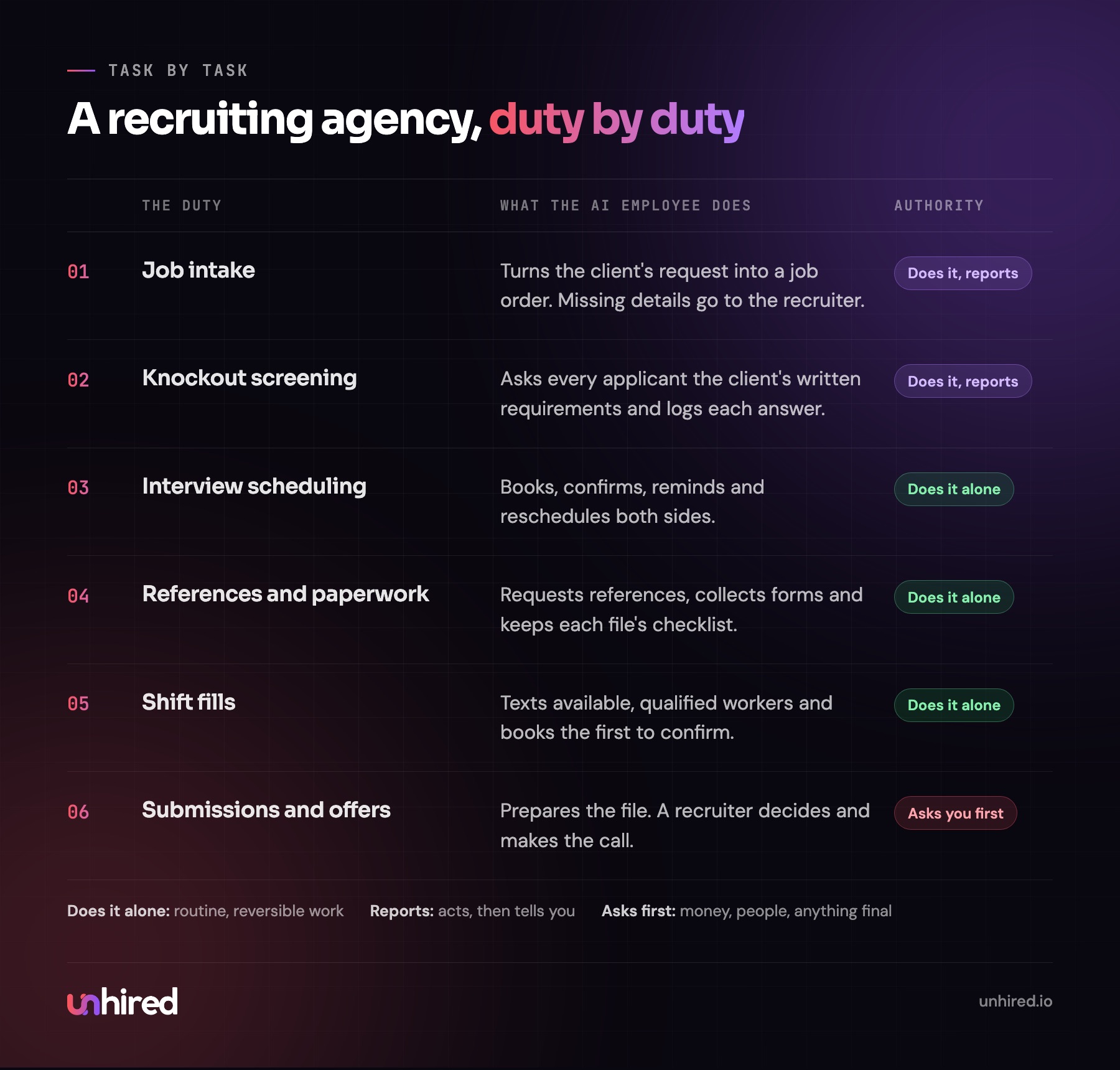
An AI Employee in this role holds that job the way a recruiting coordinator would. It reports to the agency owner or the lead recruiter, has its own logins to the applicant tracking system (Bullhorn, JobAdder, Recruit CRM or whatever the agency runs), email, a texting line and the calendars, and it works under written rules about what it can do on its own. Everything it does goes onto the candidate's record. At an agency, the work splits into five parts.
Job intake
When a client sends a new opening, the AI Employee turns the email or call notes into a job order in the ATS: title, pay range, schedule, location type, must-have requirements and the nice-to-haves. Anything missing, like a pay range or whether the role is remote, goes back to the recruiter as a question for the client before the job is posted.
Screening applicants
This is where the most hours go, and where the rules matter most. The AI Employee asks every applicant the same knockout questions the client set: do you hold the required license, can you work nights, are you able to commute to an on-site role. Applicants who meet them get a short structured screen and an interview slot. Applicants who don't meet an objective requirement get a polite reply and a note on their record saying which one. Anything that needs judgment about experience or fit goes to a recruiter with the answers attached.
Interview scheduling
Booking a three-person panel at a client while the candidate works a day job is a lot of back and forth. The AI Employee offers times from the client's calendar, confirms, sends the video link or address, reminds both sides the day before and reschedules when someone cancels. The general version of this job is in the post on the AI scheduling assistant.
References, paperwork and follow-up
It sends reference requests and chases them, collects tax forms, direct deposit details, certifications and background check consent, and keeps a checklist for each placement until the file is complete. The onboarding side looks a lot like the duties in the AI HR Administrator breakdown. It also tells every candidate where they stand after each step, which is the thing candidates complain about most and the thing busy recruiters drop first.
Shift fills and timesheets
On a temp desk, the 5:50 am no-show text gets an answer in minutes. The AI Employee texts the qualified workers marked available and books the first one who confirms. The client hears who's coming before the shift is ten minutes late. On Friday it chases missing timesheets and flags any hours that don't match the schedule before payroll runs.
What it should always hand to a recruiter
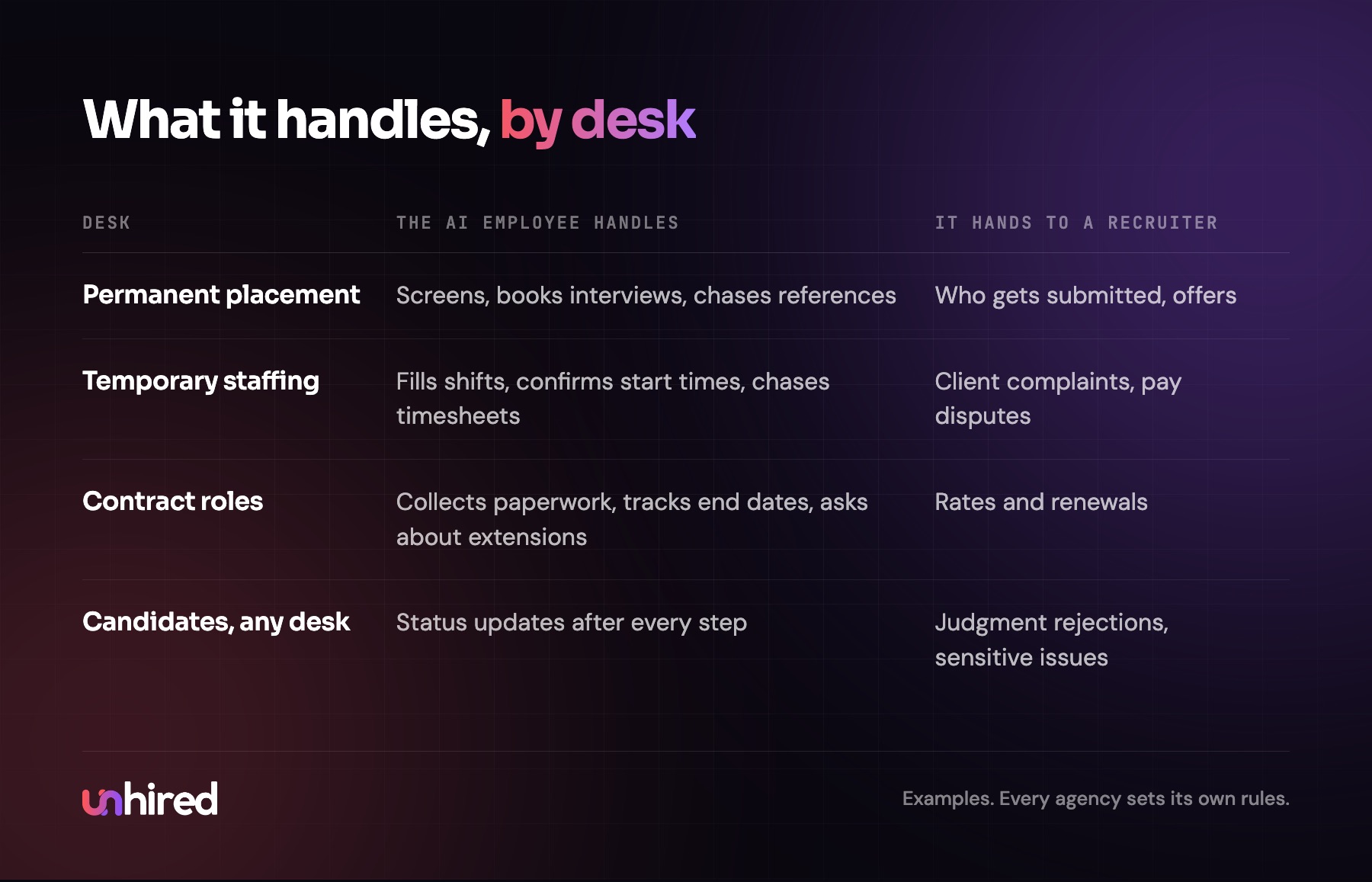
Recruiting is a relationship business on both sides, and the moments that decide whether a client or a candidate comes back belong to a person. These are the situations I'd always route to a named recruiter, with the context written up:
- Who gets submitted. The AI Employee can rank applicants against the written requirements, but a recruiter decides who goes in front of the client.
- Rejections that need judgment. "Not enough experience" or "not the right fit" is a call about a person, and it should be made and owned by one.
- Offers and pay. Negotiating salary, bill rates or a counteroffer stays with the recruiter.
- Client complaints and placement problems. A client unhappy with a temp, or a hire who quits in week two, needs a phone call.
- Anything sensitive. A flagged background check, a request for an accommodation, a candidate who mentions a health or family situation.
- Anyone who asks for a person. That handoff happens on the first request.
Candidates should know when they're messaging an AI Employee. I covered how to word that in the post on whether customers should know they're talking to an AI Employee.
What hiring law means for automated screening
Anti-discrimination law applies to a hiring decision whether a recruiter, a spreadsheet or an AI Employee made it. If a screening rule screens out people of a protected group and isn't tied to the job, the agency and the client can both be on the hook. Some jurisdictions have gone further and now require employers to tell candidates when an automated tool is used in screening, or to have those tools audited for bias, so check the rules wherever your clients hire.
The setup rules I'd follow for any agency:
- Every knockout question is written down, comes from the client's actual requirements and is the same for every applicant.
- The AI Employee never screens on anything that isn't job-related: no guessing at age from graduation years, no filtering on gaps in employment, no reading into names or addresses.
- Every rejection is logged with the specific requirement that wasn't met, so a recruiter can review a sample each week.
- It has its own login, the narrowest permissions the job needs, and candidate data only goes to AI vendors whose terms say it isn't used to train their models. The post on AI Employee data security covers the general version.
A Monday at a staffing agency
Here's an example Monday for an AI Employee at a small agency running both a permanent desk and a temp desk. Three items go to a recruiter, which is what a good log looks like.
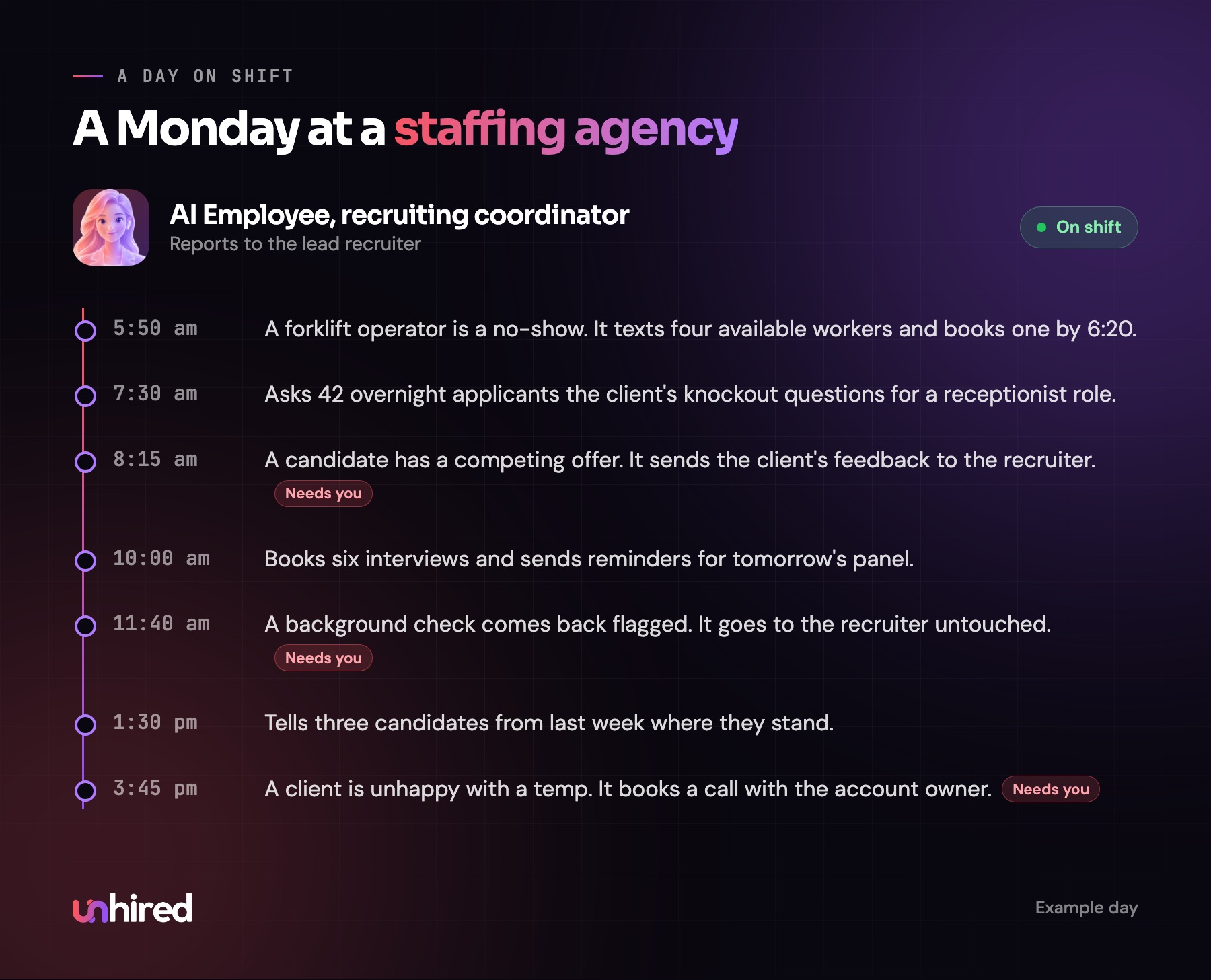
The warehouse has its forklift operator by 6:20 am, and the recruiter hears about it after it's solved. The candidate with a competing offer reaches the recruiter with the client's interview feedback already attached, so the call that decides the placement happens that morning instead of Thursday.
What the seat costs a person
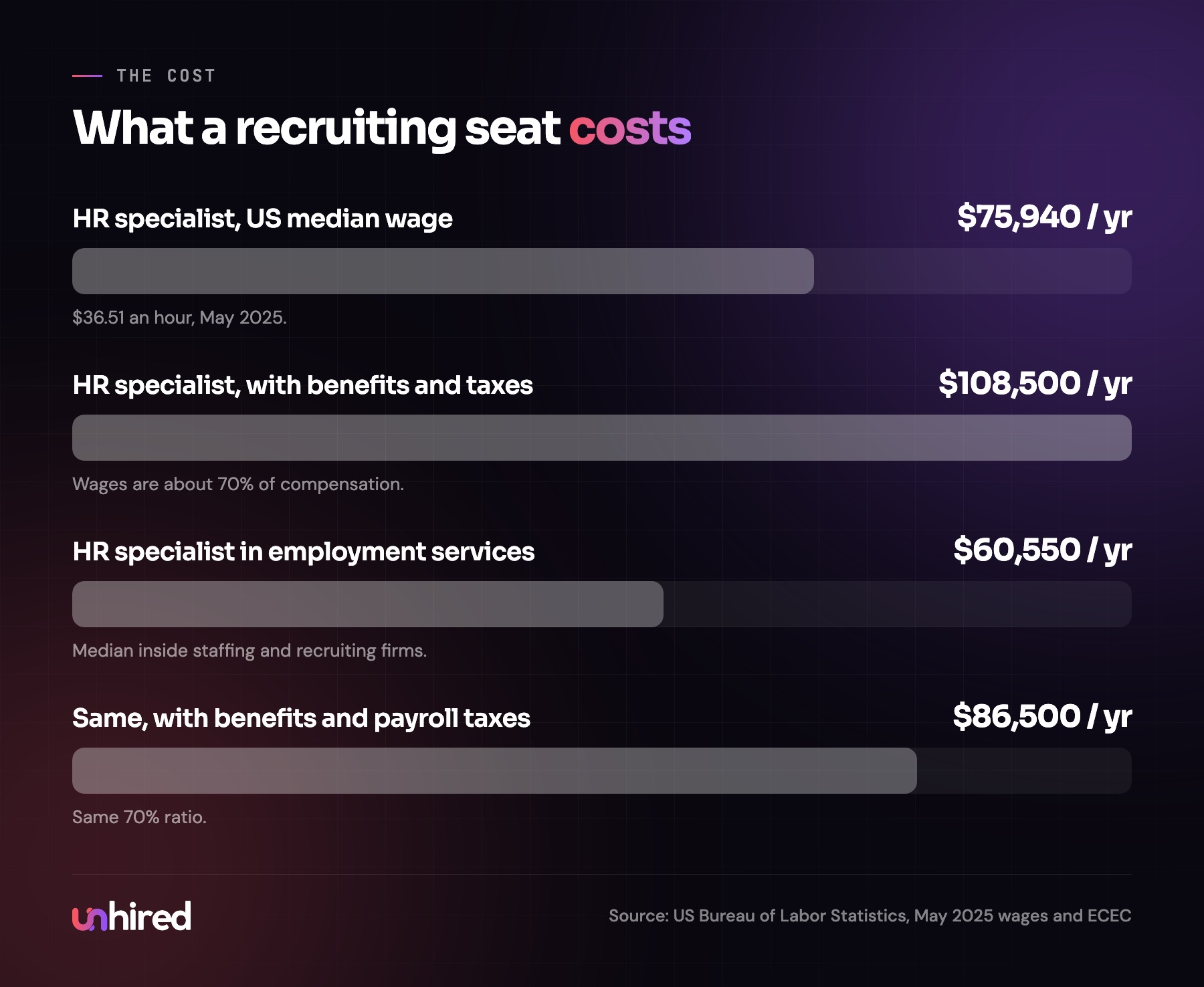
The US Bureau of Labor Statistics groups recruiters with human resources specialists, and puts the median wage at $75,940 a year ($36.51 an hour) as of May 2025. Inside employment services, the industry that covers recruiting and staffing agencies, the median was $60,550.
Wages are only part of it. Across US private industry, wages and salaries are 70% of what employers spend on compensation, according to the BLS Employer Costs for Employee Compensation report. Agencies also pay for job board subscriptions, ATS seats and the months it takes a new coordinator to learn the clients.
How much you'd pay for an AI recruiting assistant
You can assemble one from software: an AI agent platform, a connection to your ATS, a texting service and calendar access. The subscriptions are the smaller cost. The bigger one is someone's time writing the screening rules for each client, the message templates and the handoff rules, testing it on real applicants and keeping it current as clients and roles change.
Or a provider builds and maintains it, usually for a monthly fee. You pay more than the bare software, and someone else handles the setup, the updates and the log reviews.
The price moves with how many applicants and placements come through each month, whether your ATS has a clean integration, how many clients have their own screening rules, whether there's a temp desk with shift fills and timesheets, and how much maintenance is included. A boutique firm placing a few accountants a month needs much less than a temp agency filling hundreds of shifts a week.
To compare quotes, set them against the full cost of the seat. A coordinator at the employment services median costs $60,550 in pay and about $86,500 once benefits and payroll taxes are counted at the BLS ratio. At the overall HR specialist median it's closer to $108,500. Either covers roughly 40 hours a week, and shift no-shows happen at 5:50 am.
How an AI Employee is set up at an agency
Setup looks a lot like onboarding a new coordinator, with the screening rules written first.
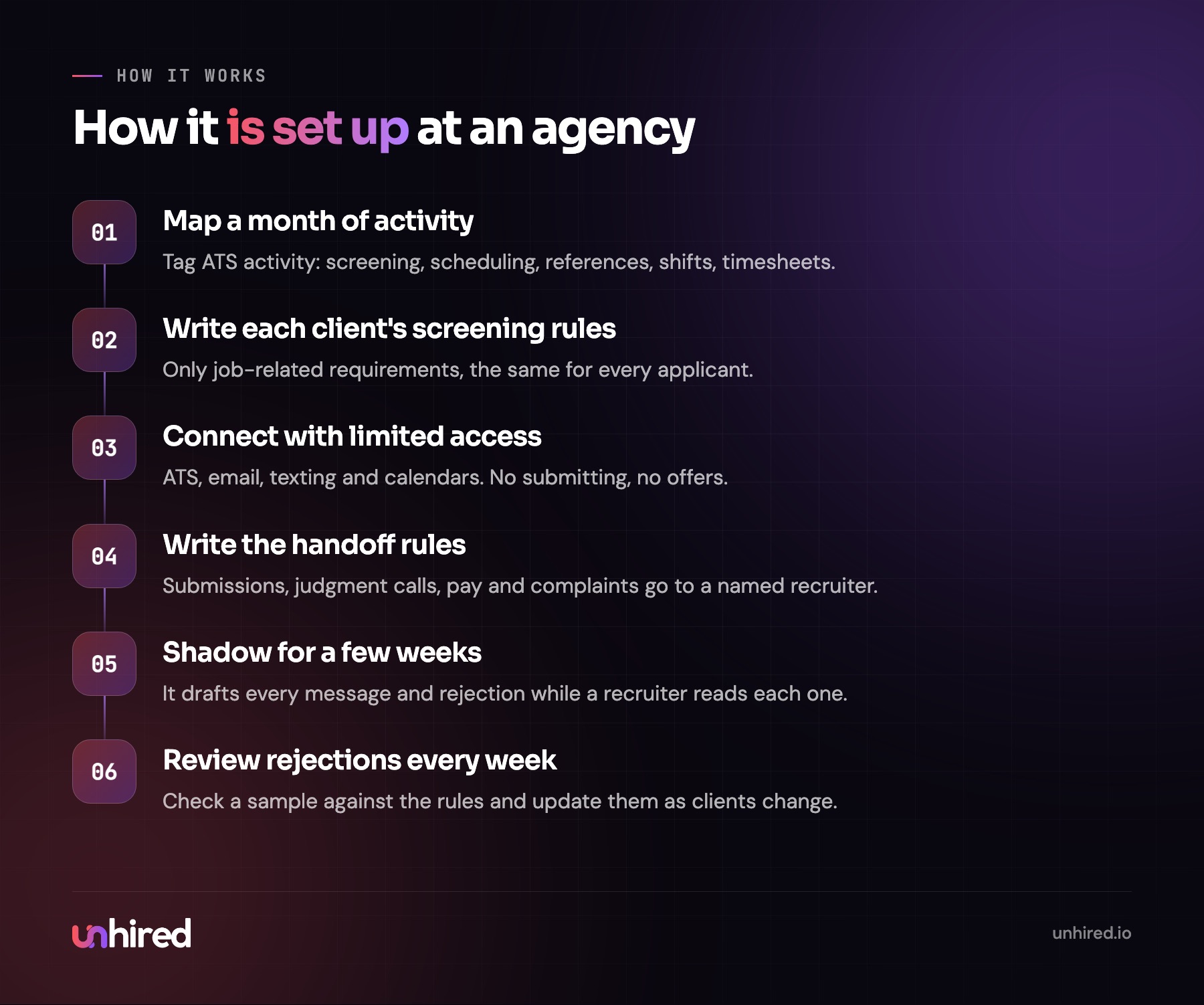
The screening rules take the most thought. Every recruiter carries each client's real requirements in their head, including the ones the client said on a call and never put in the job description. Writing them down helps even without an AI Employee, because it's the record you'd want if anyone ever asked why an applicant was turned away.
For the first few weeks, the AI Employee drafts every candidate message and every rejection, and a recruiter reads each one before it goes out. It takes on more once the drafts are right. After that, someone still reviews a sample of rejections every week.
Is your agency a good fit?
If you run a small executive search practice with a handful of searches a year, most of your work is the judgment and the relationships, and an AI Employee has less to do.
If your recruiters spend their days booking interviews, chasing references and answering status texts, or your temp desk fills shifts by phone at dawn, the coordinator seat is a strong candidate for an AI Employee, with the recruiters keeping every submission, offer and client call. Some websites offer free assessments that check whether a role like this can be filled by an AI Employee.
To check your own agency, pull last month's activity from your ATS and tag each item: screening, scheduling, reference, paperwork, status update, shift fill, timesheet, submission, offer. Then mark the ones that needed a recruiter's judgment. If most of the list is scheduling and chasing, start by writing down the screening rules for your three biggest clients, since that document decides how fast the next 42 applicants hear back.