
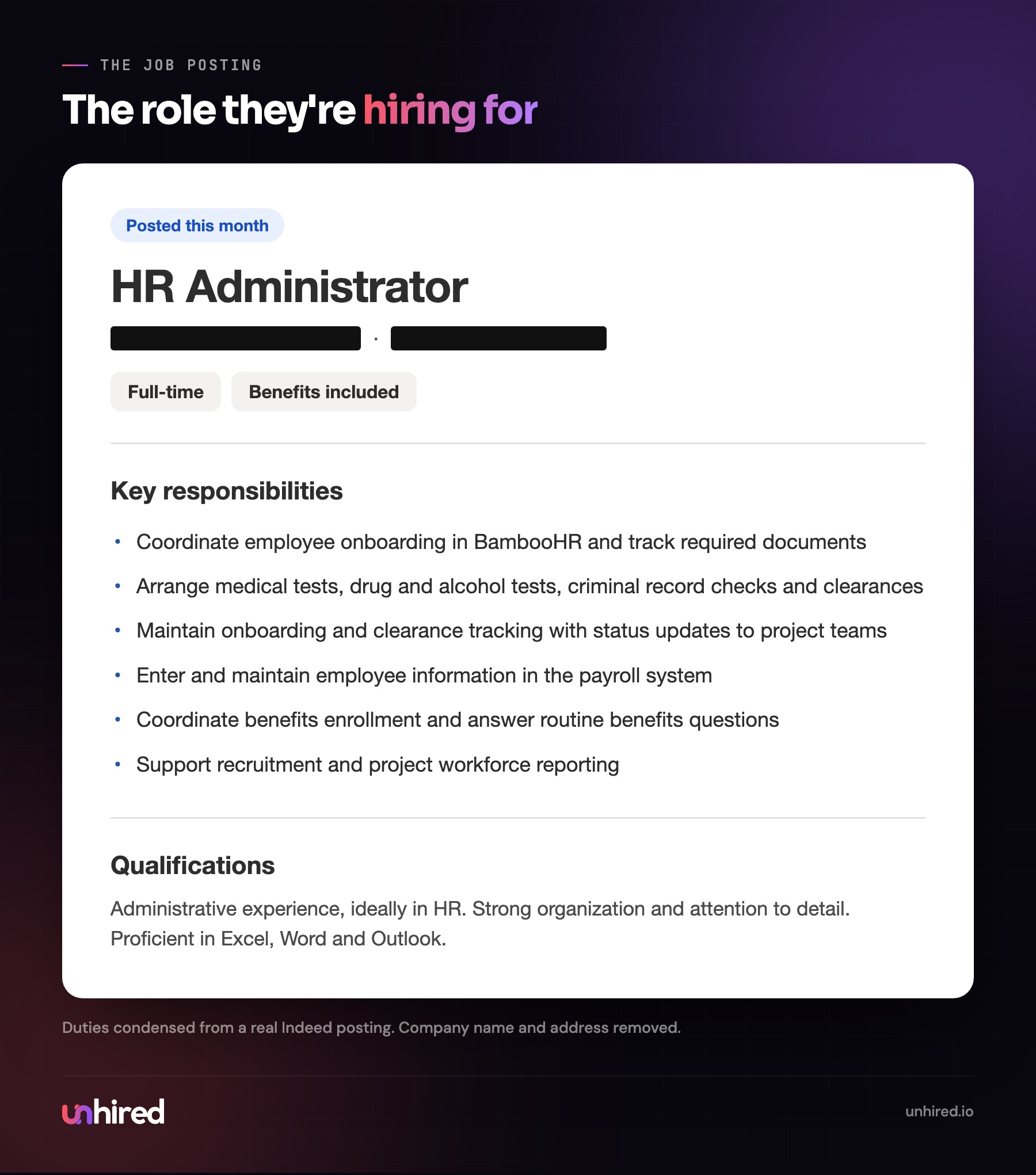
A construction company posted a job for an HR Administrator this month. Full-time, benefits included, reporting into a busy HR team that onboards crews for several project sites at once.
I read every posting the same way now. I go down the list of duties and sort each one: could an AI Employee own this, or does it need a person? This posting has six duties, and all six are paperwork moving between BambooHR, the payroll system, a testing clinic and the people running each site.
So I worked out what the AI version of this hire would look like: what it would do in each duty, a normal day on the job, how it would be set up, and what it would cost next to the wage.
What I mean by an AI Employee
An AI Employee is AI built to hold one specific job on a team. This one would have a title (HR Administrator), a boss (the HR manager), logins to the systems the job runs on, and a written set of rules about what it can do on its own and what it has to bring to a person. Everything it does goes into a log the HR manager can read.
That last part is what separates it from a chatbot on a website. A chatbot answers when someone asks. This would work the job all day, the way the person in the seat would.
If you want the longer explanation, I wrote it up here: What is an AI Employee?
The posting, duty by duty
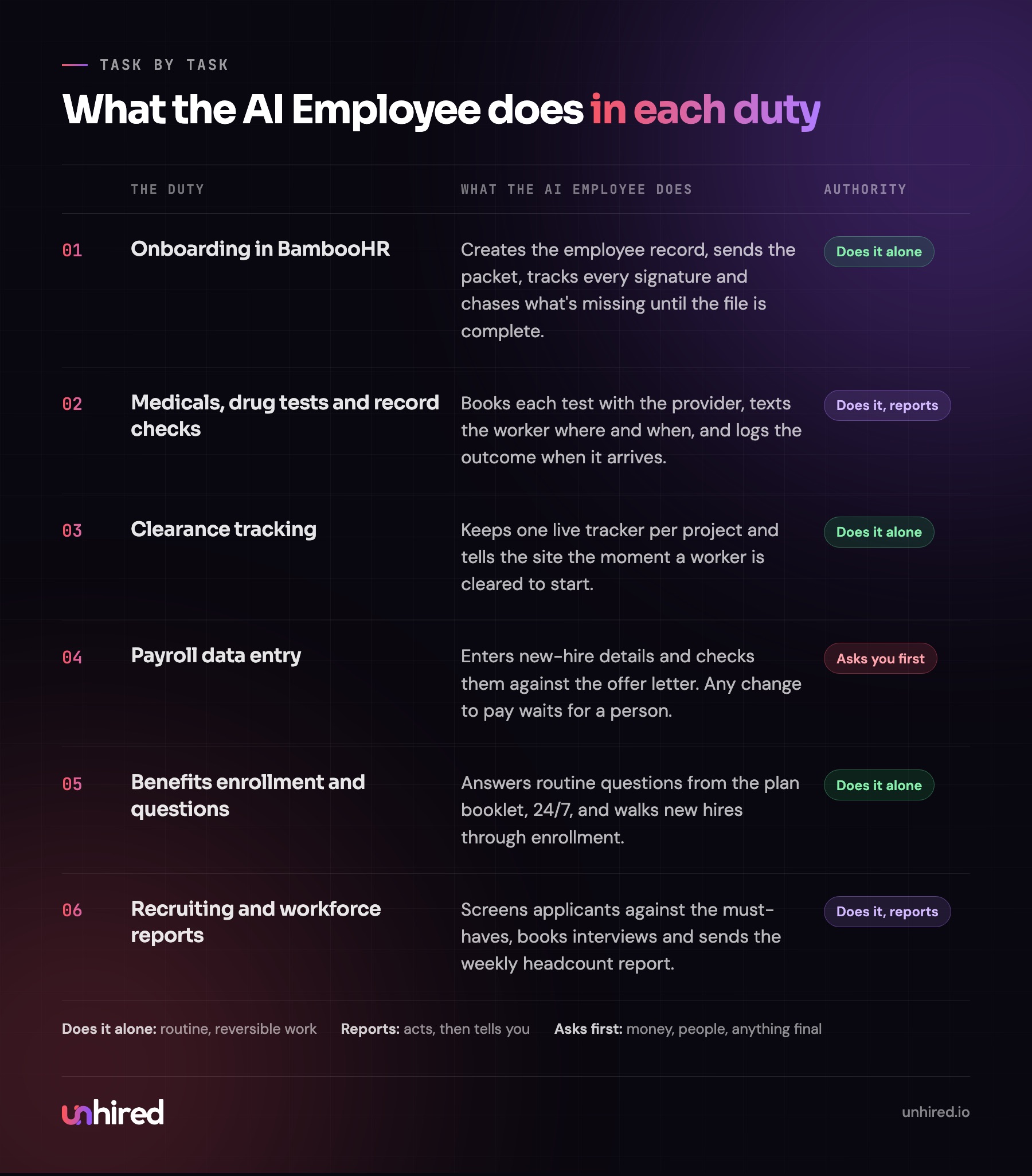
I'd split the six duties like this. The authority column matters as much as the middle one, because an AI Employee that knows when to stop is the only kind worth hiring.
1. Onboarding in BambooHR
Every new hire on a construction crew needs the same pile of paper: an employee record, a signed offer letter, a TD1, banking details for direct deposit, emergency contacts, policy sign-offs, and usually copies of their safety tickets. Collecting it is easy. Getting the last two forms out of a labourer who's already on site is the part that eats an HR Administrator's week.
The AI Employee would create the record as soon as a hire is confirmed, send the packet, and then follow up by text on a schedule until the file is complete. It would do all of that on its own, since none of it is hard to undo and every message is logged.
2. Medicals, drug and alcohol tests, and record checks
Nobody steps onto a site until they're cleared, so a slow booking costs the project a worker for every day it sits. The AI Employee would book each test with the provider, text the worker the clinic address and time, and send a reminder the day before.
Results are where it stops. A clean result gets logged and the tracker updates. A flagged result goes straight to the HR manager, and the AI Employee does nothing else with it.
3. Clearance tracking for the project teams
Right now, a superintendent who wants to know if a new worker can start Monday probably calls the office and waits while someone checks a spreadsheet. The AI Employee would keep a live tracker for each project and message the site the moment someone is cleared. The superintendent hears before they think to ask.
4. Payroll data entry
Typing the same details from BambooHR into payroll is where small, expensive mistakes come from, like a transposed bank number or last year's pay rate. The AI Employee would enter each record and compare it to the signed offer letter before saving anything.
Anything that changes what someone gets paid waits for a person to approve it. That rule shouldn't bend for any business.
5. Benefits enrollment and questions
Questions like "is physio covered for my spouse?" come in at 9 pm as often as 9 am, and each one pulls the HR Administrator off something else. The AI Employee would answer routine questions from the plan booklet at any hour and walk new hires through enrollment. A claim dispute or a medical situation goes to a person.
6. Recruiting and workforce reports
It would post openings, screen applicants for the tickets and availability the job needs, and book interviews into the hiring manager's calendar. People still decide who gets hired. Every Friday it would also send the headcount by project, pending clearances and open roles, which today someone probably builds by hand.
A normal Monday
Here's a realistic day for this AI HR Administrator. Two items on it go to the HR manager, and that's how it's supposed to work.
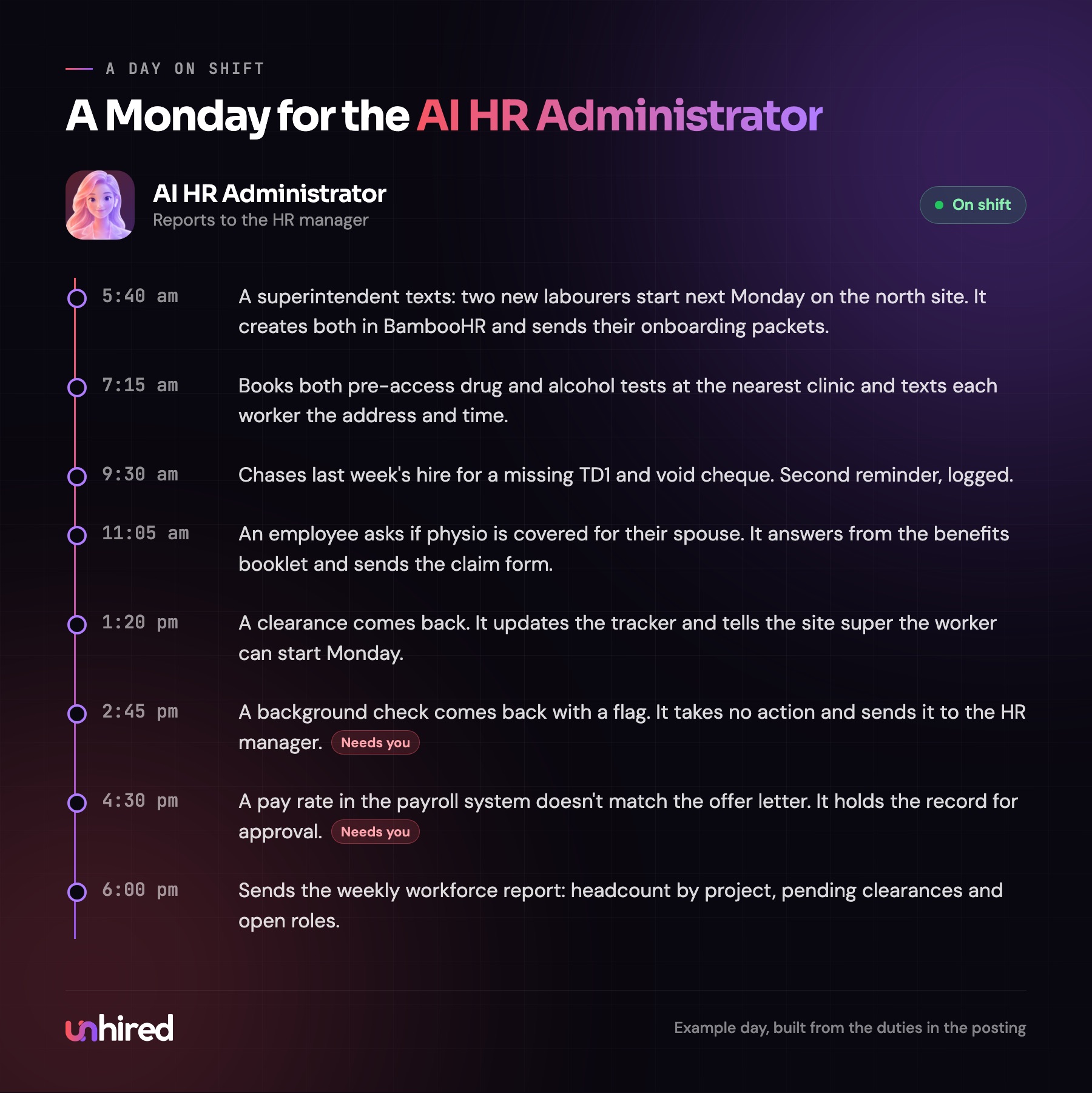
The 5:40 am text from a superintendent gets handled before anyone is in the office. The missing TD1 gets its second reminder on schedule, without anyone having to remember it. And the flagged background check and the pay rate that doesn't match the offer letter both land on the HR manager's desk with everything needed to decide.
How an AI HR Administrator is set up
Most of the work in setting up an AI Employee is the same work as training a new hire. Someone has to learn how this company actually does onboarding and clearances, including the steps nobody ever wrote down, and turn that into instructions.
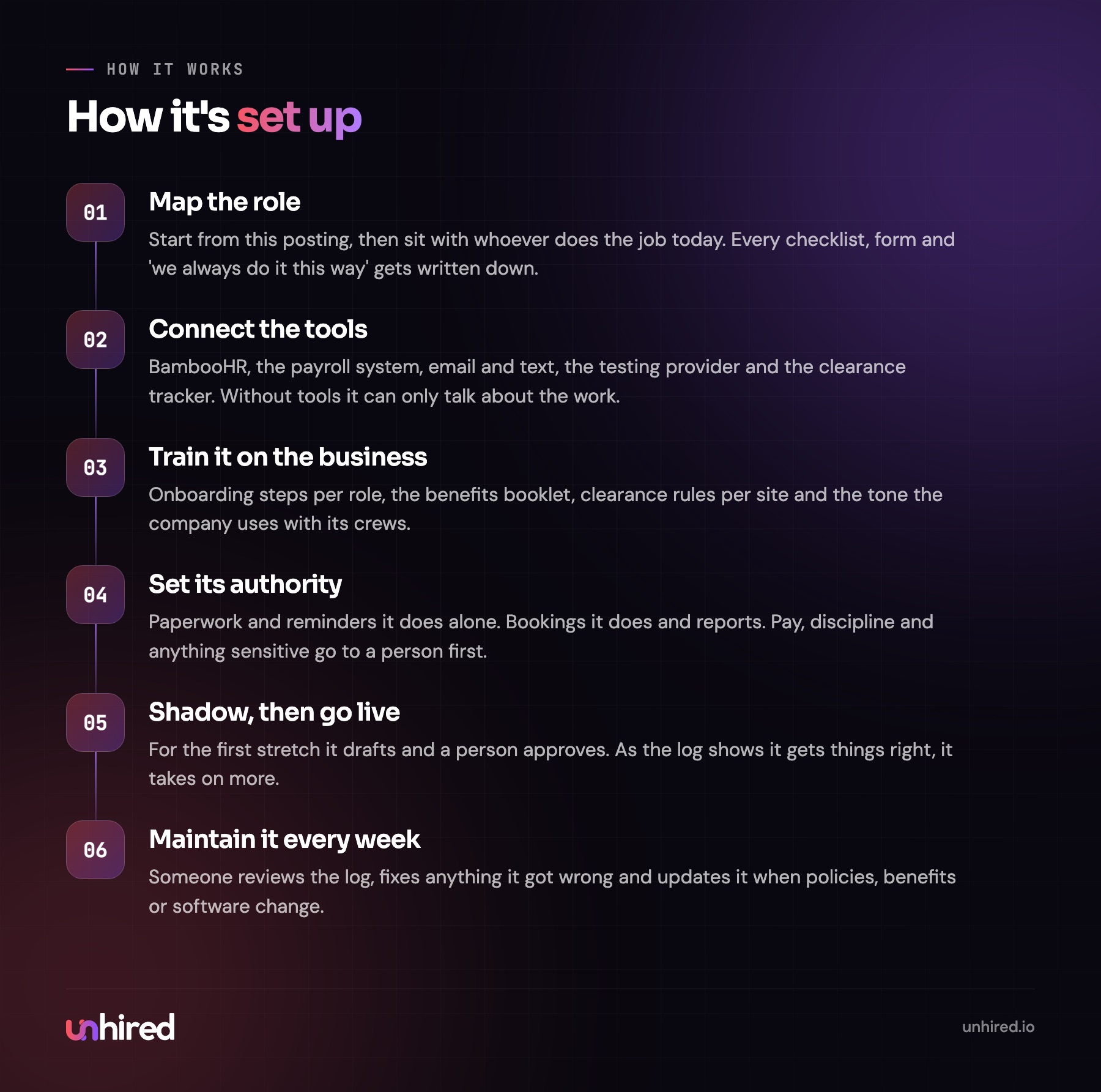
The last step is the one people skip. This company will switch benefits providers, open a site with different clearance rules, or change payroll software, and an AI Employee nobody updates slowly drifts out of date. Whoever builds it, the company needs to know who reviews its log and keeps it current.
What the seat costs a person
The Government of Canada's Job Bank puts the national median wage for this occupation at $33.33 an hour (NOC 12101, 2023-2024 data). Over a 2,080-hour year that's about $69,326.
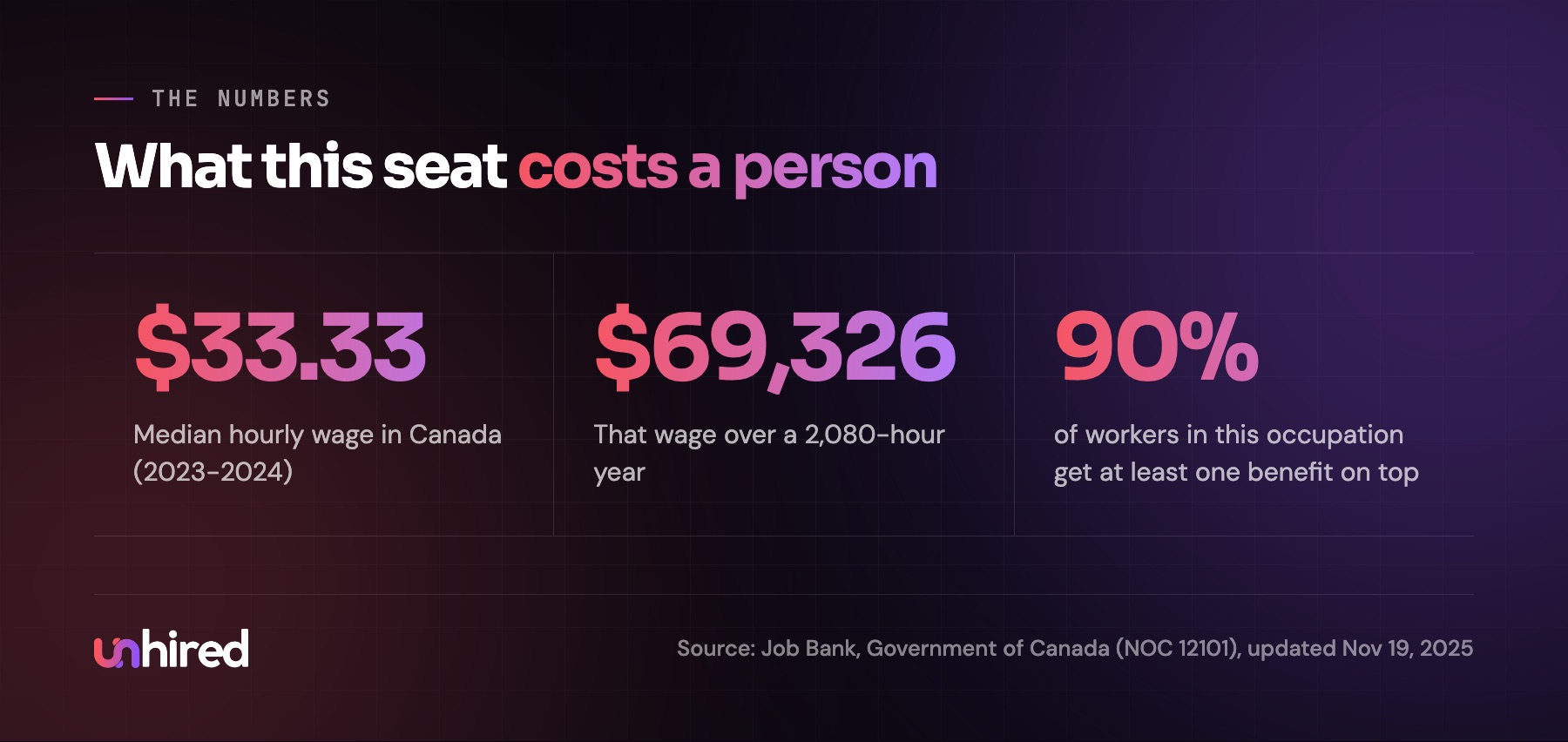
The wage is only part of it. Across Canada, 90% of workers in this occupation get at least one benefit on top of their pay, and the employer also covers payroll taxes, recruiting, training, vacation coverage, and a second round of hiring if the first person leaves.
How much you'd pay for an AI HR Administrator
There are two ways to get one. A company can assemble it from software subscriptions (an AI agent platform plus connections to BambooHR, payroll and a texting tool) and have someone on staff design, test and maintain it. Or it can have a provider build and maintain it, which is usually a monthly fee.
The price depends on how many systems it has to connect to, how many hires and questions it handles in a month, and how much ongoing maintenance is included. A company onboarding a few people a quarter needs much less than one running crews across several sites.
Whatever the quote, compare it with the full cost of the seat: about $69,326 in wages for this role, plus benefits, payroll taxes and the cost of hiring, for roughly 40 hours of coverage a week.
Would I tell this company to skip the hire?
Not necessarily. They're hiring because the seat is empty, so no one's job is on the line here.
If the HR manager is buried in onboarding paperwork and the company keeps adding crews, the AI Employee fills the seat in days and works the same early mornings the sites do. If they'd rather have a person, the duty breakdown is still useful: hand the chasing and the data entry to an AI Employee, and the person they hire spends their days on hiring decisions and the conversations with crews that actually need someone in the room.
The same exercise works for any job you're about to post: go down the duties one at a time and ask whether each is coordination between systems or a judgment call that needs a person. Some websites offer free assessments that run this check on a job description for you.
Wage data: Job Bank, Government of Canada, updated November 19, 2025. The posting is real; the company name and address have been removed. The Monday schedule is an example built from the duties in the posting.