
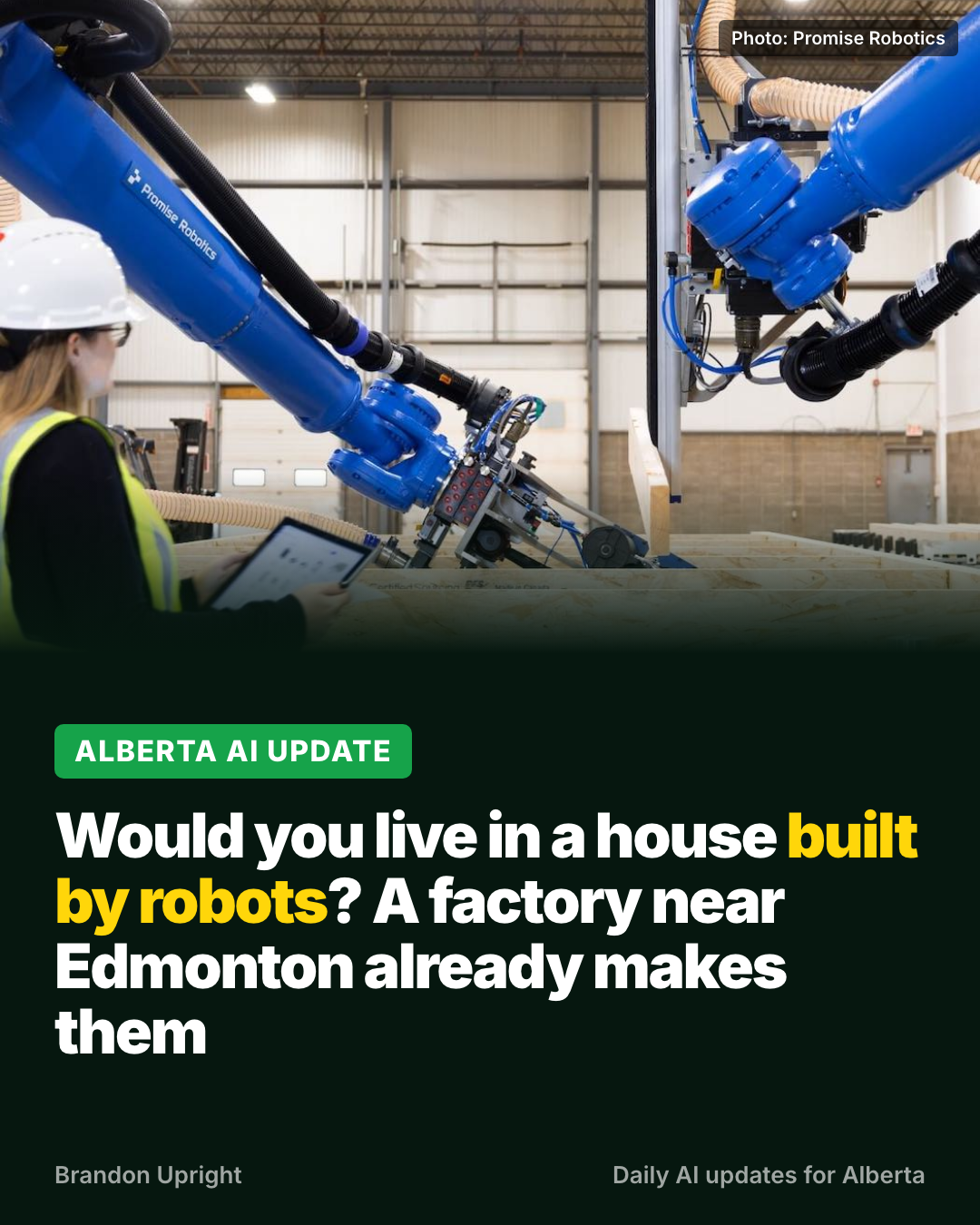
If you have tried to get a house built in Alberta lately, you know the wait usually comes down to people: framers, carpenters and crews who are booked months out. A company with factories in Nisku and Calgary is betting that robots can take some of that load.
What Promise Robotics does
Promise Robotics uses AI software and robots to build structural parts of homes in a factory. A builder sends in the house plans it already uses. The software breaks the design into pieces and turns them into instructions for the robots, which build the components. Those are trucked to the site, where human crews assemble them.
Builders don't buy a factory or learn to run one. They pay for what gets produced. The company calls this "factory-as-a-service."
The news
BetaKit reported on November 17 that the company closed a $40 million Series B round, meaning a later-stage investment from venture investors. It was led by White Star Capital, with Horizons Ventures, Radical Ventures and PSP Investments, which manages pensions for federal public servants.
According to Calgary Tech Journal, Promise signed a multi-year deal in October with D.R. Horton, the largest homebuilder in the United States by volume, covering more than 1,250 homes. It has more than 2,500 housing units under contract across three markets, and its first US factory, in Phoenix, is scheduled to open in 2027.
BetaKit, citing The Globe and Mail, says the company plans to grow from 85 to more than 100 employees. Its co-founders include CEO Ramtin Attar and chief innovation officer Reza Nasseri of Landmark Homes.
Why it matters here
Canada has pledged to build 500,000 homes a year. BetaKit notes the Canadian Housing Research Network puts the real pace closer to 200,000. The gap is not only money and permits. There aren't enough skilled tradespeople to build that many homes the old way.
"Homebuilding can't scale on trade labour alone," Attar said in the company's announcement.
What I'd keep in mind
The company has not published a figure for how much faster or cheaper its homes are, so I wouldn't assume your next house costs less because of it. What it is selling builders is capacity: more homes from the same crew.
I also don't read this as robots replacing tradespeople. The parts still get assembled, wired, plumbed and finished by people on site. The factory takes the repetitive cutting and nailing, which is the work that is hardest to hire for.
Most AI news is about software on a screen. This is one of the clearest Alberta examples of AI running machines that build physical things, and it is happening just outside Edmonton.