
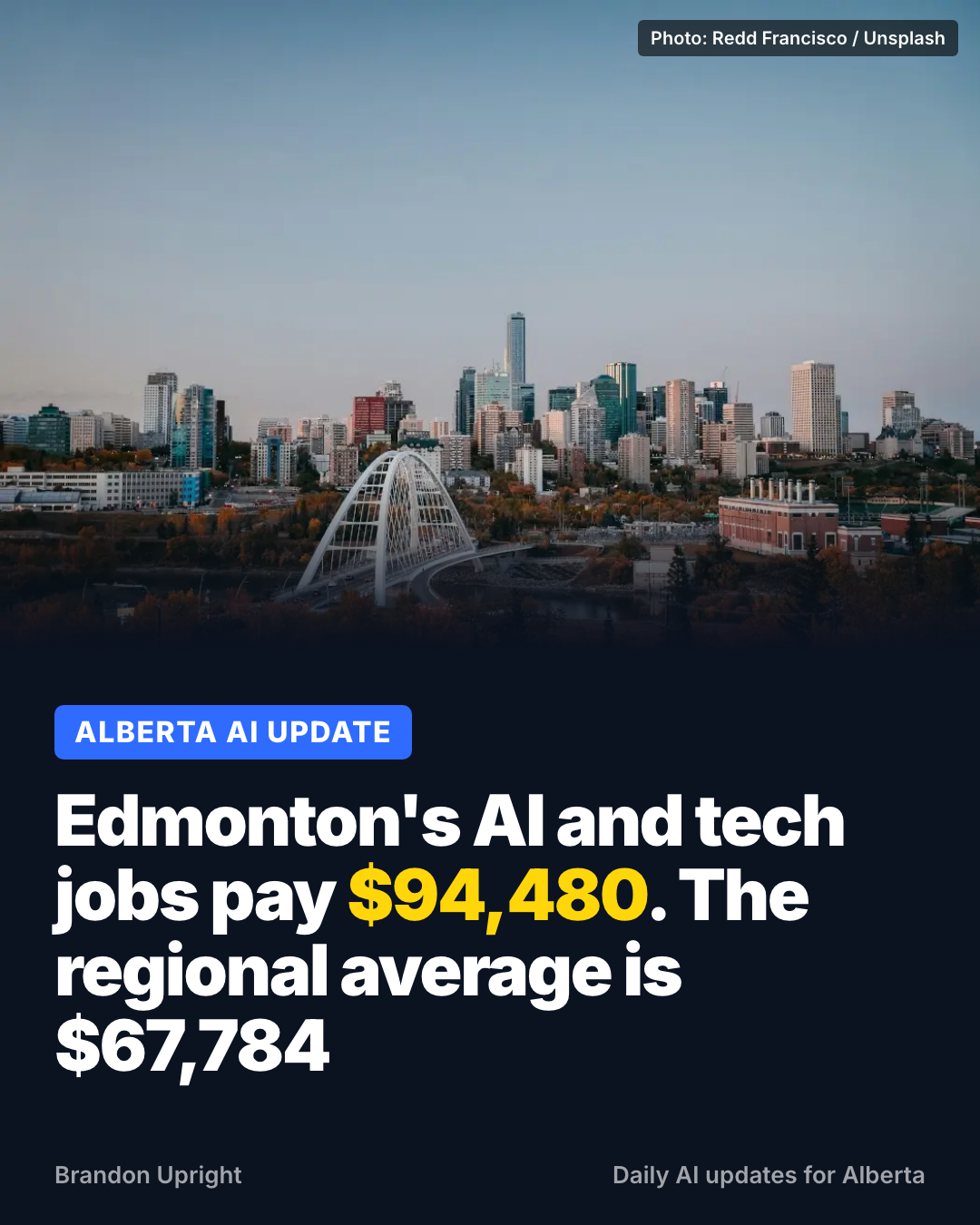
If you have ever wondered whether a tech job is worth retraining for in Edmonton, the Edmonton Chamber of Commerce just put a number on it.
What the report found
The Chamber presented its State of the Economy report at a luncheon at the Westin Edmonton on November 18, as Taproot Edmonton reported. It looks at three newer parts of the regional economy together: AI and technology, defence and aerospace, and life sciences.
- Jobs in those three grew 21% from 2019 to 2025.
- Their contribution to the region's real GDP grew nearly 37%.
- Both are about triple the pace of the region's other main industries.
- The average wage in them is $94,480, about $27,000 above the regional average of $67,784.
The report describes these as high-skill, high-earning jobs, not entry-level ones.
The catch
They are still small. Together they make up about 2% of jobs and 2% of the region's economy, or roughly 1 in every 50 jobs.
And the report is blunt about how Edmonton compares. In each of the three, job growth trailed both Alberta and Canada. It says the region has been "a passenger on a national trend rather than its driver." Edmonton wages in AI and in defence are lower than Calgary's. BetaKit reported that the region has less than half the concentration of these industries that the rest of Canada has, and that senior roles and head offices are still mostly elsewhere.
For contrast, oil and gas is 14.4% of the region's economy from about 3% of its jobs.
What the Chamber wants
The report lists five asks: one long-term economic development strategy, predictable policy, land and infrastructure ready before companies need it, keep hiring new graduates, and "brag more about Edmonton's strengths."
Heather Thomson, the Chamber's vice-president of economy and engagement, said the region has the core institutions already, such as Amii and the University of Alberta. "This is what we can't fumble," she said.
What it means if you're thinking about it
Not every job in these fields is a coding job. AI and tech companies hire salespeople, project managers, trainers and support staff, and the pay gap tends to follow them. If you work in an office today and you are good with the software you already use, learning how AI tools fit into that work is the most practical first step I know of. It costs a few evenings, and the report puts the pay gap at about $27,000 a year.