
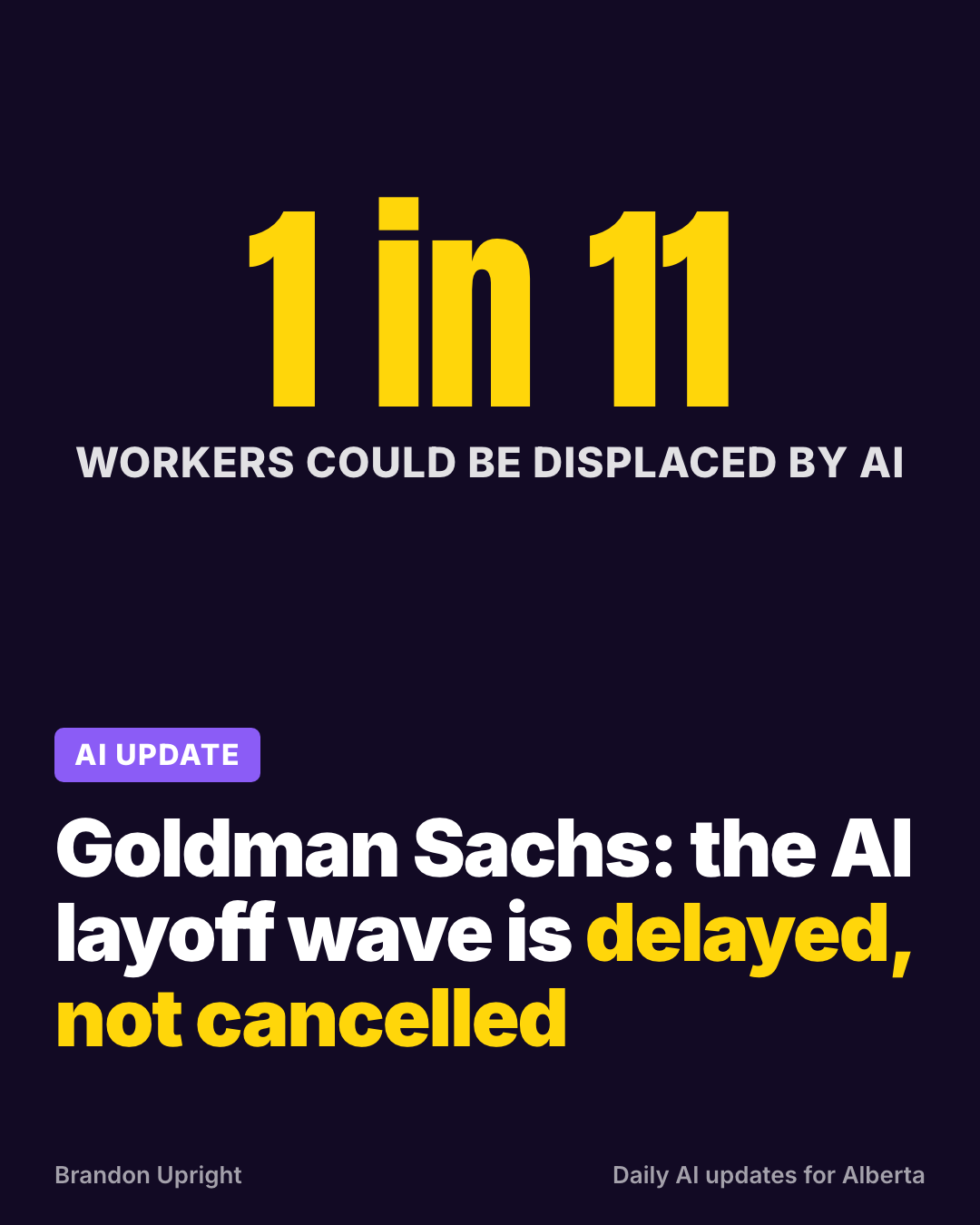
At the start of this year, plenty of people expected AI to set off a wave of layoffs. It didn't happen. Goldman Sachs now says the wave is late, not gone.
What Goldman said
Fortune reported on November 16 that Goldman's 2027 US economic outlook found the layoff rate "remained historically low" this year. The bank expects that pattern, which it describes as low hiring and low firing, to last about one more year, "before AI displacement begins to have a larger impact in subsequent years."
Goldman isn't forecasting a recession. It sees US economic growth of 2.4% in 2027.
In October, Goldman economist Joseph Briggs estimated that up to 9% of workers could be displaced during the move to AI, roughly 1 in 11. He also said job losses from automation tend to stay limited while the economy is healthy and speed up during a slowdown.
Who is already feeling it
The people feeling it first aren't being laid off. They're not being hired.
Researchers at the Stanford Digital Economy Lab found that employment of 22- to 25-year-olds in the jobs most exposed to AI was about 19% below where it would otherwise be, up from 15% a year earlier. They wrote that they don't see widespread job losses across the economy, and that the change is coming mainly through companies hiring fewer young workers.
Fortune's article names routine jobs such as clerks, secretaries and machine operators as the kind that have historically shrunk in steps during recessions.
The other side
Not everyone agrees the wave is coming. Princeton's Arvind Narayanan, co-author of the book AI Snake Oil, has pushed back on predictions that most white-collar work disappears, while still calling AI "very useful for every knowledge worker." Some predictions have been far more extreme than Goldman's. Fortune notes that Anthropic CEO Dario Amodei said in May 2025 that AI could wipe out half of entry-level office jobs.
What it means here
These are US numbers. Canada doesn't move in lockstep with the US, but our job market tends to follow theirs, and the same software is sold on both sides of the border.
The way I read it, most people have a window. If Goldman is right, the next year looks a lot like this one. That is a good time to learn which parts of your own job AI does well and which parts it doesn't, while nobody is forcing the question.
If you're a parent of someone in their early twenties, the Stanford finding is the one I'd pay attention to. The entry-level roles that used to teach people a trade or an office are where hiring is slowing first. Skills that pair a field with the ability to use AI tools well are the safer bet.