
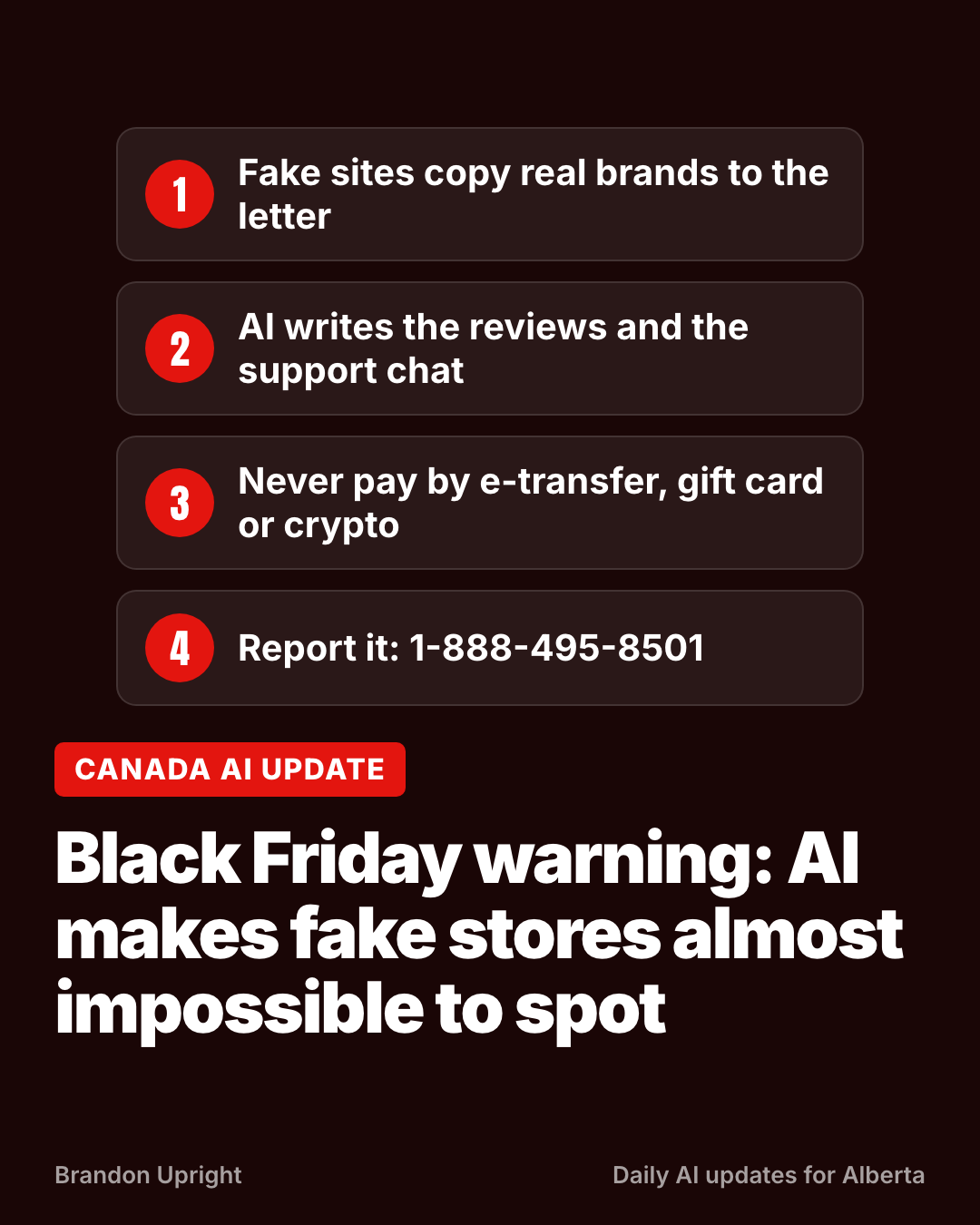
Black Friday is November 27. If you're shopping online this week, the fake stores you'll run into look better than they did a year ago, and AI is the reason.
What has changed
In October, the Canadian Centre for Cyber Security updated its guide to shopping online safely. It says scammers can use AI to create convincing websites, ads, product descriptions, reviews and customer service conversations, and that this makes scams harder to detect.
Benoit Dupont, who directs the Research Chair in Cybercrime Prevention at the University of Montreal, told The Canadian Press that fraudsters often start by building sites that copy a real brand's look exactly. "AI makes their site more credible," he said. He added that the deals are pushed through social media ads and influencers, real or generated by AI.
The Cyber Centre also says a professional look, a padlock icon and a familiar brand name do not prove a site is real. Spelling mistakes and clumsy design used to give fakes away. You can't count on that now.
The numbers
The Canadian Press reported that Canadians had reported $535 million in fraud losses from the start of the year to September 30. Last year's total was $705 million. Fewer than 10% of fraud cases are reported to the Canadian Anti-Fraud Centre, so the real losses are higher.
A Leger survey done in February found about 35% of Canadians have been victims of an online scam, such as phishing or a fake website.
What still gives a fake away
- A price that is far below everywhere else, with a countdown clock telling you to hurry.
- No phone number or real address, and vague return or refund policies.
- A request to pay by e-transfer, gift card or cryptocurrency.
- A follow-up text or email about a delivery problem, a customs fee or a refund you didn't ask for.
- A web address that is one character off, like a zero in place of the letter o.
Dupont's advice is simple: take your time, double-check, and talk it over with someone before you hand over a card number. Searching the store's name with the word "scam" takes ten seconds.
AI shopping assistants
If you use a chatbot to find deals, the Cyber Centre makes a point worth remembering. It says AI tools cannot reliably tell whether a seller or an offer is trustworthy the way a person can. A recommendation from a chatbot is not a safety check.
If you get caught
Call your credit card company right away and ask to reverse the charge. Dupont said refunds are more common for this kind of fraud than for investment or romance scams. Change your passwords if you made an account. Then report it to the Canadian Anti-Fraud Centre at reportcyberandfraud.canada.ca or 1-888-495-8501, even if you didn't lose money. Reports are how fake sites get taken down.