
At 8:40 on a Monday, the office manager at a dental clinic opens one screen before her email. Four items are waiting for her approval: two patients asking to move appointments to times outside the usual rules, an insurance question the AI Employee wasn't sure about, and a reply to a patient who sounded upset. She approves three, rewrites one, and closes the screen at 8:52.
That's what managing an AI Employee looks like most days once it's settled. Twelve minutes, done before the phones get busy.
The first two weeks look very different, and that's the part owners tend to underestimate. I've spent four years building AI systems and agents for businesses, and the question of who looks after the thing comes up in nearly every conversation. It should. An AI Employee without a manager drifts. Its documents go stale, and the work it hands back to people piles up unanswered.
Who manages an AI Employee
The right manager is the person who would have managed a human in the same seat. At a clinic, that's the office manager. At a law firm, usually the senior paralegal or the lawyer whose files the intake work feeds. At an online store, the operations lead. At a marketing agency, the account director whose clients it emails.
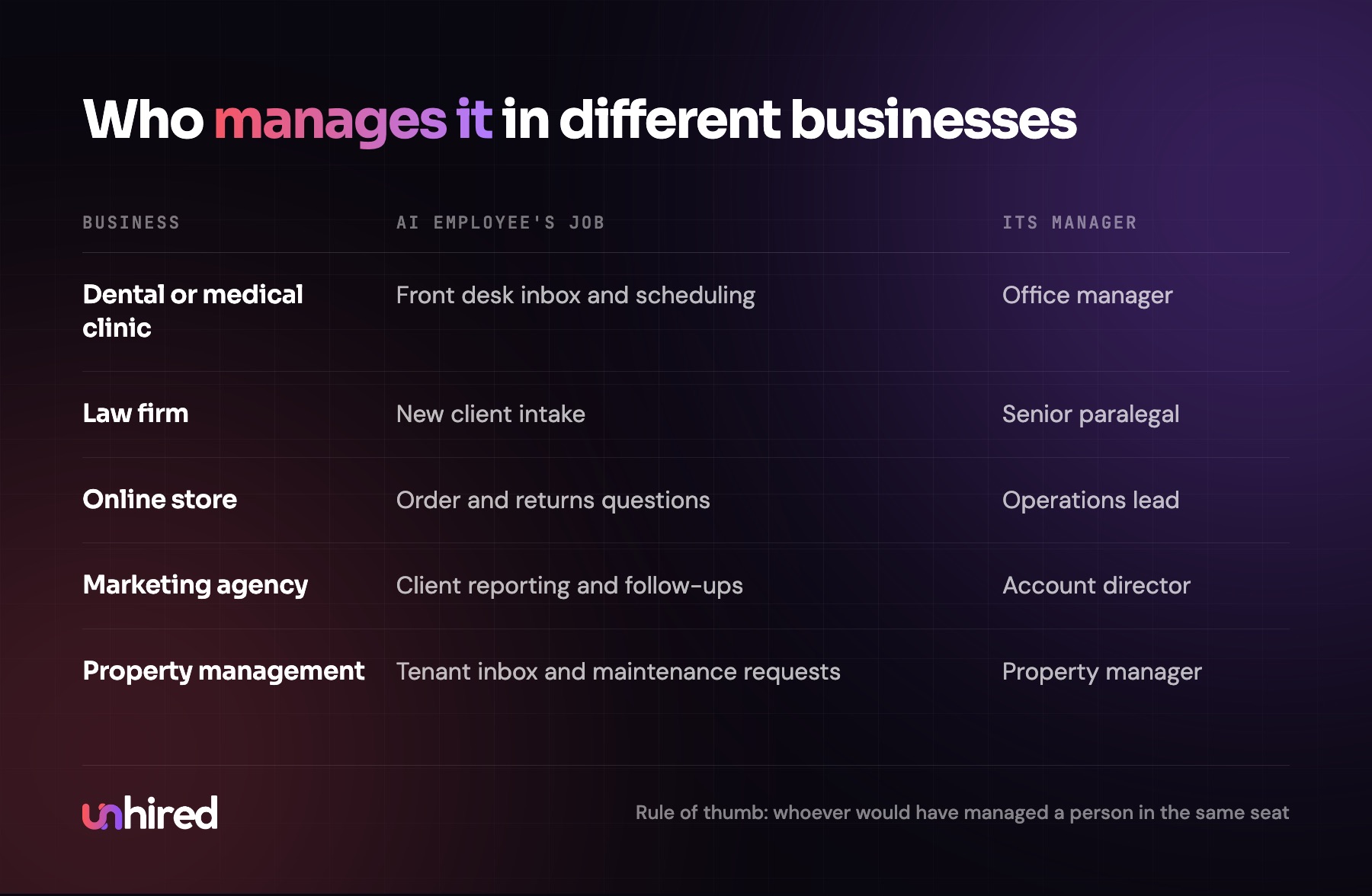
I'd steer away from handing it to IT, even when IT set it up. Managing the role means deciding whether a refund should have gone out or whether a reply to a client sounded right. That's judgment about the work, and it belongs with whoever owns the work. IT can stay involved for logins and connections to other software.
Two other things matter. The manager needs the authority to change the AI Employee's rules without asking permission each time, the same way they could tell a new hire "from now on, check with me before you do that." And there should be one manager. When the office manager and two dentists all leave instructions, the AI Employee gets three versions of the same rule, and nobody knows which change caused the problem on Thursday. Name a backup for vacations, but one person owns it.
What managing one involves
The job has five parts. None of them is technical.
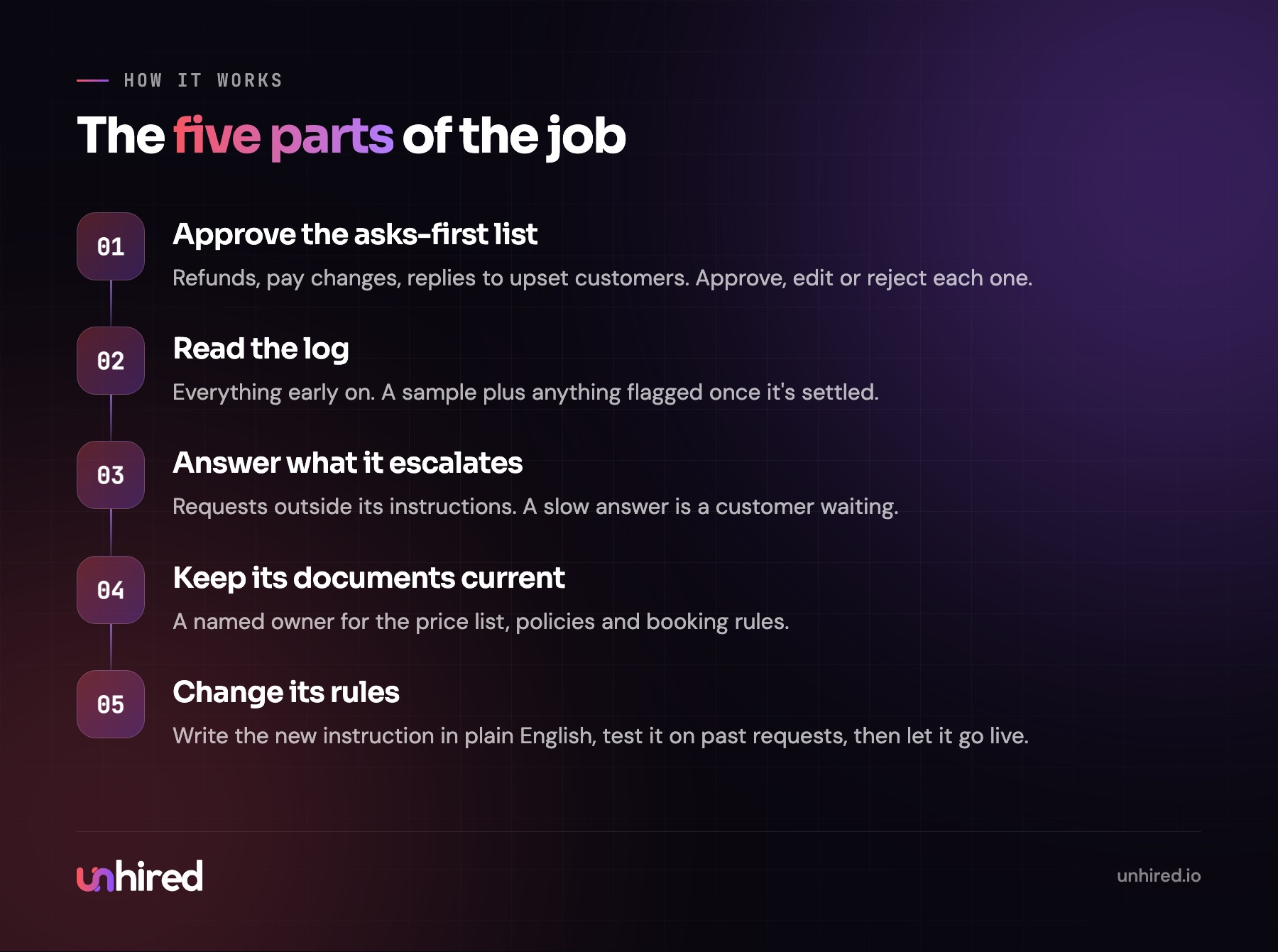
The biggest part early on is approving the asks-first list. Every AI Employee should have a written list of things it must check with a person before doing, like refunds, anything that changes someone's pay, or a reply to an angry customer. The manager sees these in a queue and approves, edits or rejects each one.
Next is reading the log. Every message it sent, every record it changed and the reason it gave. At first the manager should skim all of it. Later, a sample plus anything flagged. I covered what to look for in how to measure an AI Employee's performance.
Third, answering what it escalates. A good AI Employee hands back anything outside its instructions: a request it doesn't understand, a question its documents don't cover. Someone has to answer those, and a slow answer is a customer waiting.
Fourth, keeping its documents current. Think of the price list or the cancellation policy PDF. When one changes and nobody updates the copy the AI Employee reads, it keeps giving last month's answer. I'd put a name next to every document it uses.
Last, changing its rules. When the manager sees the same correction twice, they write a new instruction in plain English, test it against past requests, and let it go live. If a provider maintains the AI Employee, this step is usually theirs, with the manager saying what needs to change.
How much of their week it takes
These are the hours I'd plan for. They come from my own experience setting these up, not from a study, and a busy role with lots of approvals will sit at the high end.
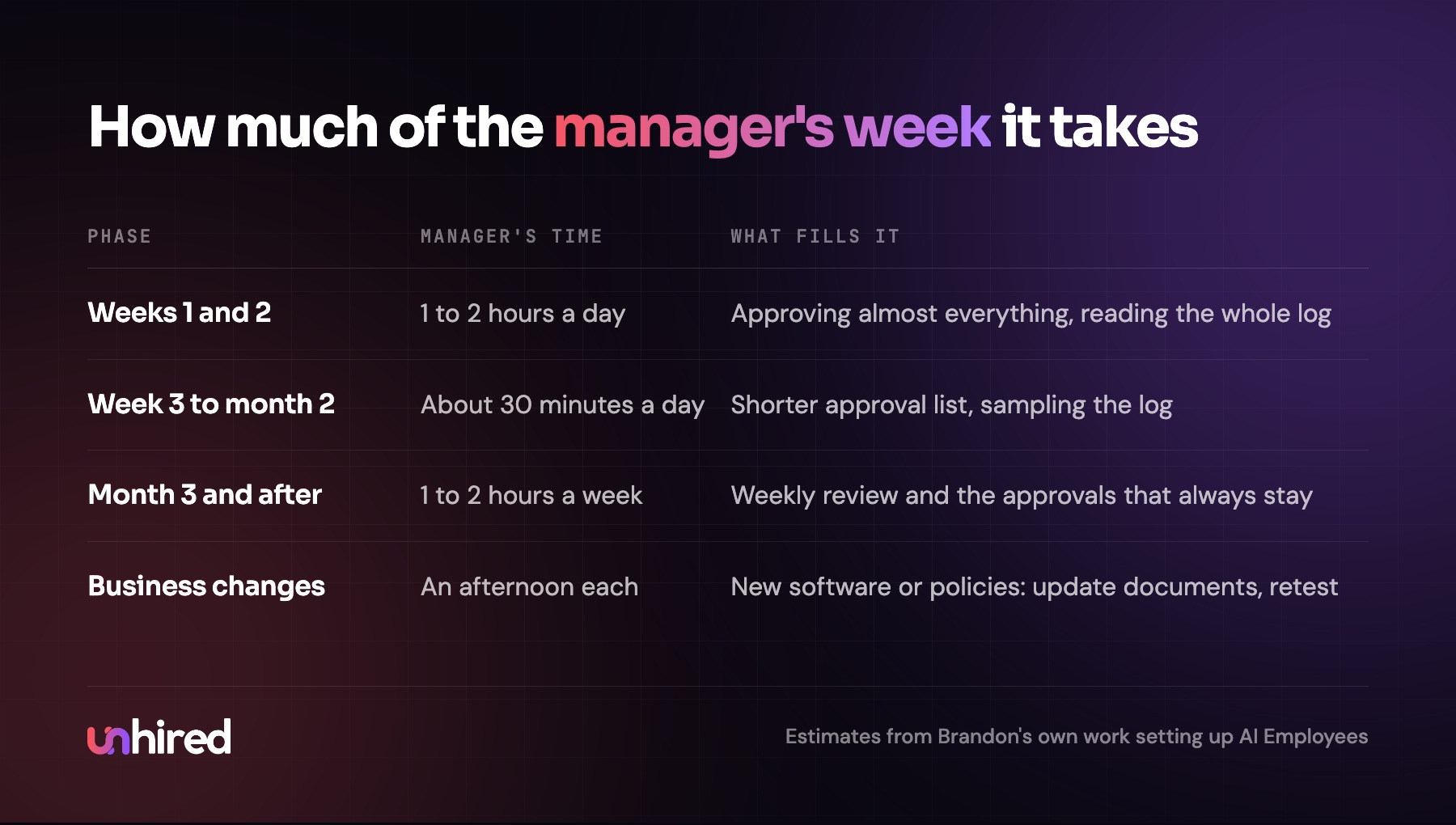
In the first two weeks, plan for one to two hours a day. Almost everything customer-facing should be on the asks-first list, the manager reads the whole log, and they're finding all the things nobody wrote down, like the dentist who never books new patients on Fridays.
From week three through the end of the second month, it drops to about 30 minutes a day. The asks-first list gets shorter as the log shows which duties it handles well, and the manager moves from reading everything to sampling.
From the third month on, one to two hours a week is typical. Most of that is the weekly review and the handful of approvals that should always stay with a person.
Changes in the business add time in the weeks they happen. Switching booking software or bringing in a new returns policy means an afternoon of updating documents and testing the AI Employee against the new rules. I go through that kind of retraining in how to train an AI Employee.
A normal week once it's settled
Take the manager of an AI Employee handling the inbox and scheduling at a property management company, three months in. Their week runs like this.
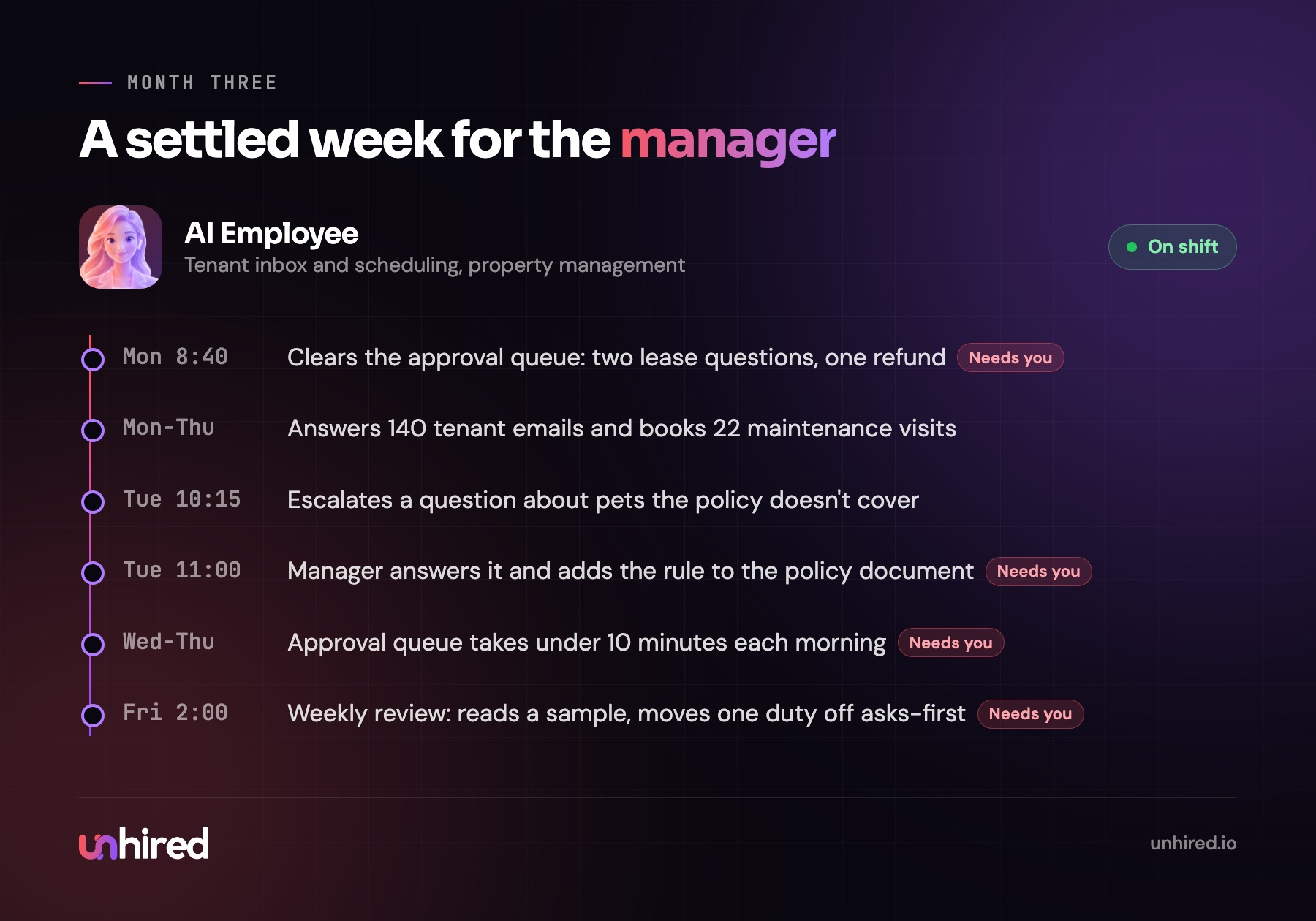
Most of the week, the manager's part is a few minutes clearing the approval queue in the morning. The bigger block is Friday's review, where they read a sample of the week's conversations, check the numbers, and decide whether anything moves on or off the asks-first list.
What makes it take longer
When a manager tells me it's eating far more of their week than the numbers above, it's nearly always one of four causes.
A long asks-first list that never shrinks is the most common. If every email still needs approval in month three, the manager is doing the job with extra steps. Review the list every two weeks and move duties off it once the log shows a clean run.
Messy documents come next. If the answers live in three versions of a policy and somebody's memory, the AI Employee keeps escalating, and the manager keeps answering the same questions. An afternoon cleaning up the documents saves hours later.
More than one boss is the third. Conflicting instructions create mistakes, and tracing them takes time.
Last, no fixed review time. When the log only gets read "when there's a moment," problems build up for weeks and then take a whole day to untangle. A standing 30 minutes on Friday works better than good intentions.
Managing an AI Employee next to managing a person
A person in the same seat takes management time too: training in the first months, weekly one-on-ones, and the whole hiring process again if they leave. What changes with an AI Employee is the shape of the work. There are no conversations about motivation or schedules, and far more reading of what it did. Some managers find that easier. Others find it tedious, and that's worth knowing before you pick who owns it.
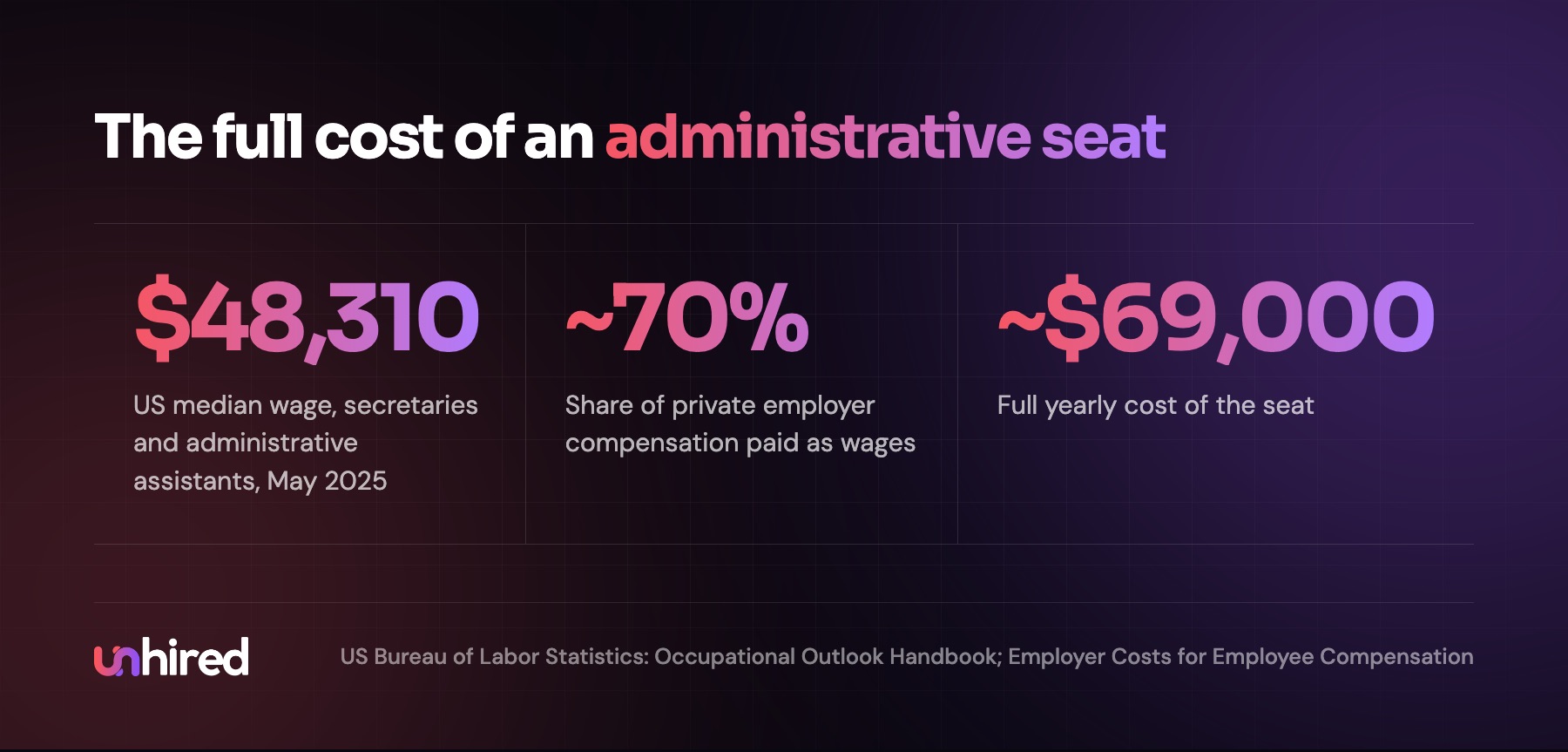
For a sense of the seat itself, the US median wage for secretaries and administrative assistants was $48,310 a year in May 2025, or $23.23 an hour (Bureau of Labor Statistics). Wages are about 70% of what private employers spend on compensation (BLS Employer Costs for Employee Compensation), so the full cost of that seat is closer to $69,000 a year.
How the manager's time affects what an AI Employee costs
There are two usual ways to get one. A business can assemble it from software subscriptions and have someone on staff build, test and maintain it. Or a provider builds and maintains it for a monthly fee.
Who does what changes the manager's week. Built in-house, the manager or a colleague also writes the instruction changes, runs the tests and fixes broken connections when software updates. With a provider, those parts usually move to them, and the manager keeps the approvals, the log review and the escalations. Those three never leave the business, because they're decisions about your customers.
What drives a provider's price is mostly how many systems it connects to, how much volume it handles, and how much of the maintenance and testing is included. When you compare quotes, ask each one exactly which of the five parts of the job above stay with your manager.
Before you start, put it on someone's calendar
If you're still deciding whether a role fits at all, some websites offer free assessments that check whether a role can be filled by an AI Employee and which duties should stay with a person.
Once you've picked the role, write down four things: who manages it, who covers when they're away, how fast approvals get answered, and when the weekly review happens. Then book the time. Put one to two hours a day on the manager's calendar for the first two weeks and a standing Friday block after that. If you can't find that time on anyone's calendar, start with a smaller role. The time won't appear on its own once it's live.
Wage data: US Bureau of Labor Statistics, Occupational Outlook Handbook, secretaries and administrative assistants, May 2025 median; the full-cost figure uses the BLS Employer Costs for Employee Compensation share of wages in total compensation. Manager hours are estimates from my own work. The examples in this article are illustrative.