
At 7:40 on a Monday morning, a dental office already has three voicemails from the weekend, a hygiene patient who texted "can't make it today," and a new patient trying to book online who doesn't know which insurance details to bring. The front desk opens at 8. By 8:15, both lines are ringing and someone is standing at the counter waiting to pay.
I've spent the last four years building AI systems and agents for businesses, and clinic front desks are one of the clearest fits I know. The work is high volume, rule-based and tied to one system, the practice management software. It is also full of moments where a person has to step in, which is why the setup matters so much.
This post covers what an AI Receptionist does at a dental office or medical clinic, what it should always pass to your team, the privacy work that comes first, and what it costs next to a hire.
What an AI Receptionist does at a clinic
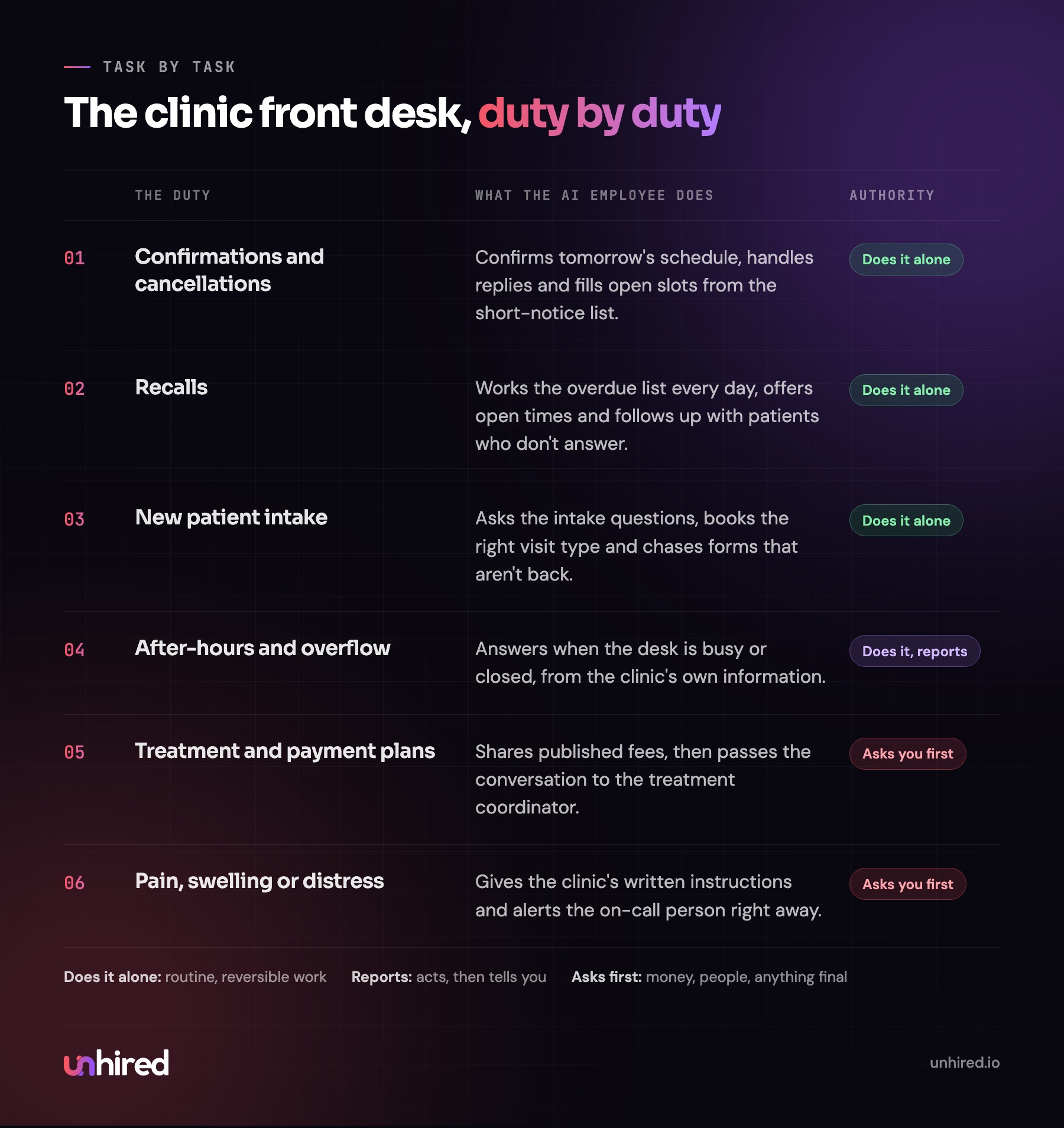
An AI Receptionist is an AI Employee that holds the front-desk job. It has a manager (usually the office manager), logins to the phone line, the text and email tools and the scheduling system, and written rules about what it can do on its own. Every call and message it handles goes into a log the office manager can read.
The general version of the job is covered in the post on the AI Receptionist. At a clinic, four duties take most of the hours.
Confirmations and the morning cancellations
Every appointment on tomorrow's schedule needs a confirmation, and every "I can't make it" reply needs a new time. The AI Receptionist sends the confirmations the afternoon before, handles the replies, and moves people into new slots under your rules. When a 9 am hygiene slot opens at 7:40, it goes down the short-notice list and offers the time to patients who said they could come in on short notice.
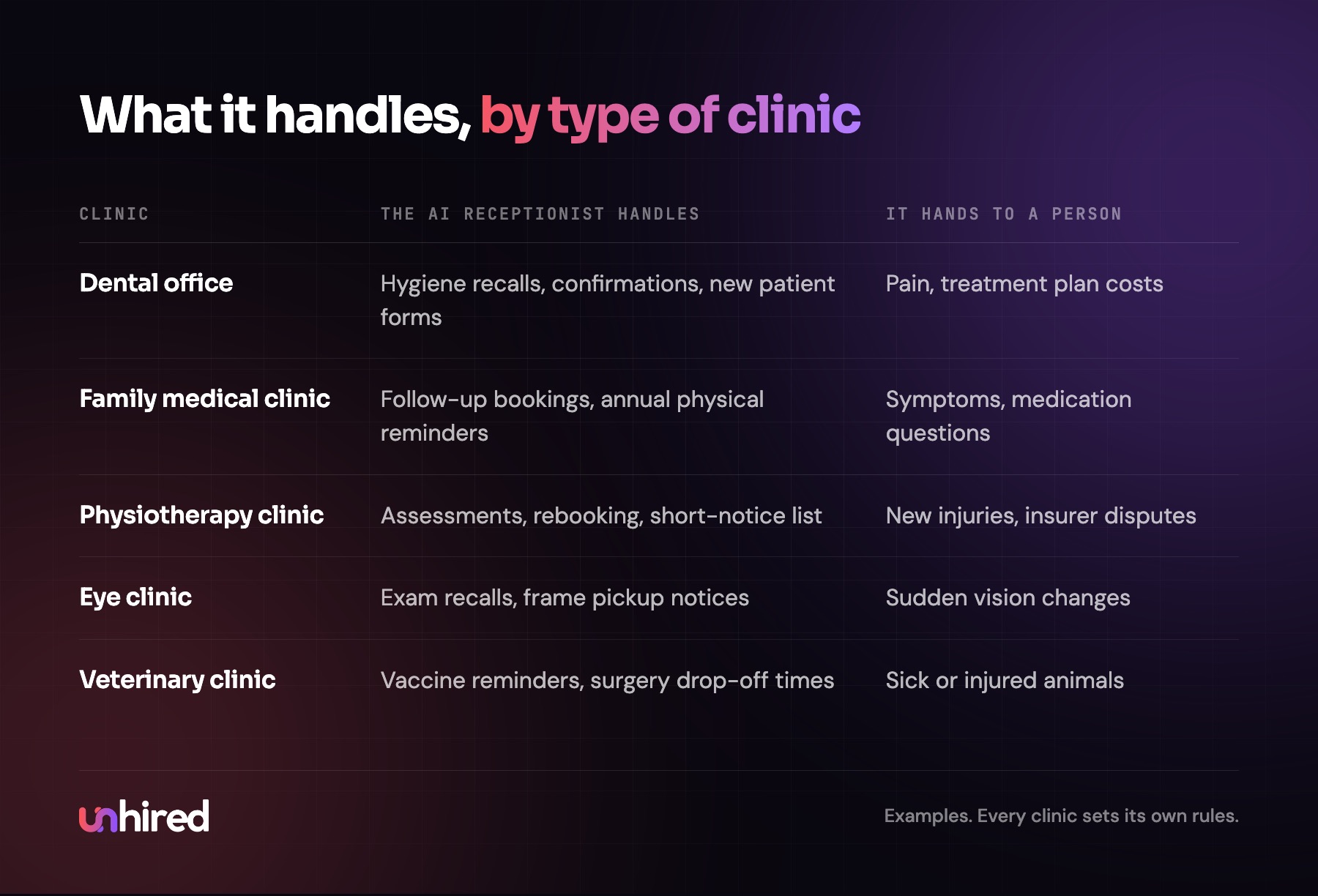
The rules are the part a clinic has to write down. A crown prep might need 90 minutes with a specific dentist. A new patient exam might only go in the morning. A physiotherapy clinic might want assessments with the senior physio only. The AI Receptionist follows those rules every time, which is more than most busy front desks manage at 8:15 on a Monday.
Recalls
Most dental offices have a list of patients who are overdue for their cleaning, and most front desks never get to the bottom of it. Working the recall list is the first thing to slip when the phones get busy.
An AI Receptionist works the list every day. It texts or emails each overdue patient with a couple of open times, books whoever answers, and follows up on a schedule with the ones who don't. A family practice clinic can use the same approach for annual physicals or follow-ups the doctor asked for.
New patient intake
A new patient call has a fixed set of questions: name, date of birth, contact details, reason for the visit, insurance carrier and member ID, referring provider, and whether they have X-rays from another office. The AI Receptionist asks those questions, books the right appointment type, sends the intake and consent forms, and reminds the patient two days before if the forms aren't back.
It can also request records from the previous office if you want it to, with the patient's signed release attached.
After-hours and overflow calls
When both front-desk staff are on the phone, or it's 6:30 pm, calls go to the AI Receptionist instead of voicemail. It books, reschedules and answers questions from your own information: hours, parking, which insurance plans you work with, what to bring to a first visit.
After-hours calls are also where the emergency rules matter most, which is the next section.
What it should always hand to a person
Clinics need a shorter leash than most businesses. These are the calls I'd always route to a person, with a written summary attached:
- Anyone in pain, bleeding, swelling or distress. The AI Receptionist gives the instructions the clinic has written (the after-hours line, the on-call dentist, or call 911 for anything that sounds life-threatening) and alerts the on-call person right away. It doesn't decide how serious it is.
- Clinical questions. "Is this normal after an extraction?" and "can I take ibuprofen with my prescription?" go to a clinician. The AI Receptionist books the earliest appropriate visit or a call back.
- Treatment plans and payment plans. It can share published fees and explain which documents to bring. Conversations about a multi-visit treatment plan, financing or what insurance will cover belong with the treatment coordinator.
- Insurance disputes and billing errors. It collects the details and passes them to whoever handles billing.
- Upset patients, or anyone who asks for a person. That handoff should happen on the first request.
Patients should also know who they're talking to. A good setup says it's an AI assistant for the clinic at the start of the call. The article on whether customers should know they're talking to an AI Employee goes into how to word that.
Patient privacy comes first
A dental office or clinic is handling health information, so the privacy work happens before anything is connected.
In the US, a vendor that creates, receives, keeps or sends protected health information for a clinic is a business associate under HIPAA. The clinic needs a signed business associate agreement that sets out what the vendor may do with the information and how it protects it. The HHS Office for Civil Rights lists the required contract provisions. Other countries have their own health privacy laws with similar ideas: written agreements, limited access, and knowing where the data lives.
The questions I'd ask any provider, or answer for yourself if you build it:
- Will you sign a business associate agreement, or the equivalent where you are?
- Where are call recordings, transcripts and text logs stored, and for how long?
- Can the AI Receptionist be limited to scheduling and contact details, with no access to clinical notes?
- Who on the provider's side can see patient conversations?
- What happens to the data if the clinic stops using the service?
Limiting access is the one owners skip. An AI Receptionist that books appointments needs the schedule, contact details and insurance fields. It doesn't need charts or X-rays, so it shouldn't have them.
A day at a dental office
Here's an example day for an AI Receptionist at a two-dentist practice. Three items go to a person, and that's how it should look.
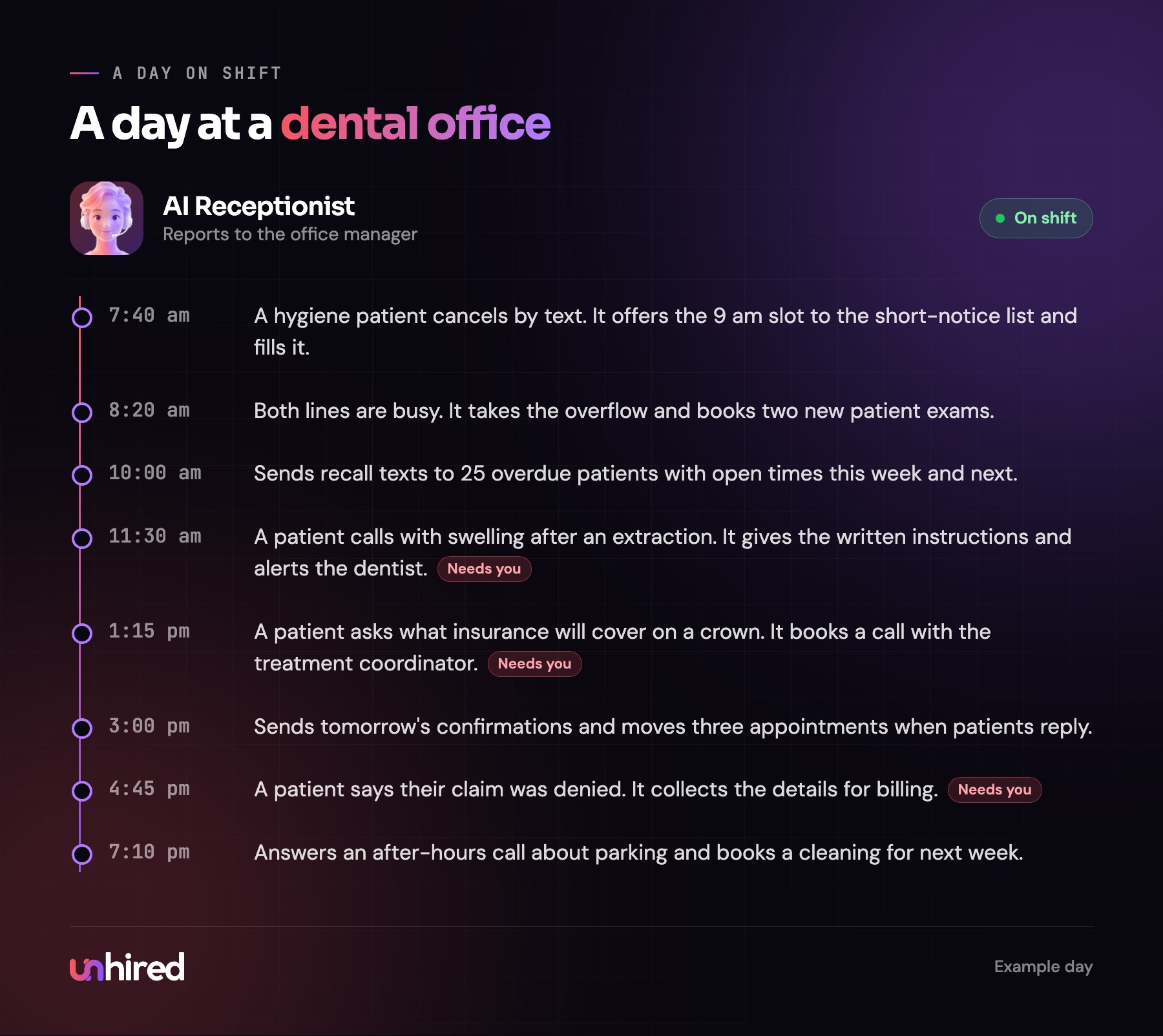
The 7:40 am cancellation fills before the office opens. The recall texts go out while the front desk is checking patients in. The patient with swelling, the treatment plan question and the insurance problem all reach a person with notes attached, so nobody has to ask the patient to repeat themselves.
What a clinic front-desk hire costs
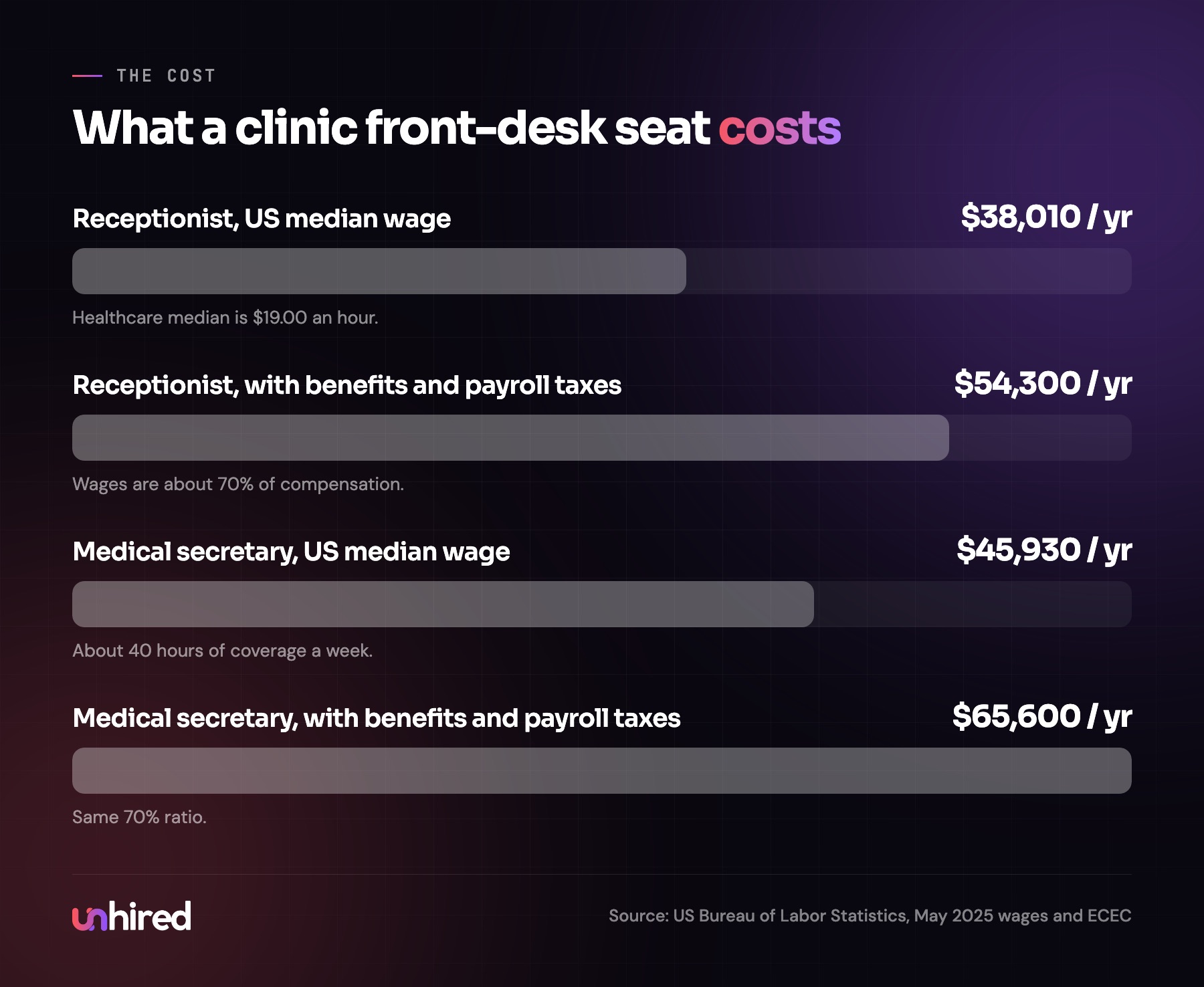
The US Bureau of Labor Statistics puts the median wage for receptionists at $38,010 a year as of May 2025. In healthcare and social assistance, the median is $19.00 an hour. Clinics that hire a medical secretary or administrative assistant for the front desk pay more: the BLS median for medical secretaries and administrative assistants was $45,930 in May 2025.
Wages are only part of the cost. Across US private industry, wages and salaries are about 70% of what employers spend on compensation, according to the BLS Employer Costs for Employee Compensation report. Benefits and payroll taxes make up the rest. On top of that come the job ad, interviews, training on the practice software, and covering lunch breaks, sick days and vacation.
How much you'd pay for an AI Receptionist at a clinic
There are two ways to get one.
You can assemble it yourself from software: an AI phone and chat tool, a connection to your practice management system, and a texting service. The subscriptions are the smaller cost. The bigger one is the time someone spends mapping the call types, writing the booking rules, testing it, handling the privacy paperwork and keeping it current.
Or a provider builds and maintains it, usually for a monthly fee. You pay more than the bare software, and someone else handles the setup, the updates and the log reviews.
The price moves with a few things: how many channels it covers (phone, text, email, web chat), whether your practice management system has a clean integration, call volume, how many locations and providers it schedules for, languages, and how much maintenance is included.
To compare quotes, set them against the full cost of the seat. A receptionist at the US median wage costs $38,010 a year in pay and about $54,300 once benefits and payroll taxes are counted at the BLS ratio. A medical secretary at the median comes to about $65,600. Each covers about 40 hours a week; the phone rings for more than that.
How an AI Receptionist is set up at a clinic
Setup looks a lot like training a new front-desk hire, with privacy steps added at the start.
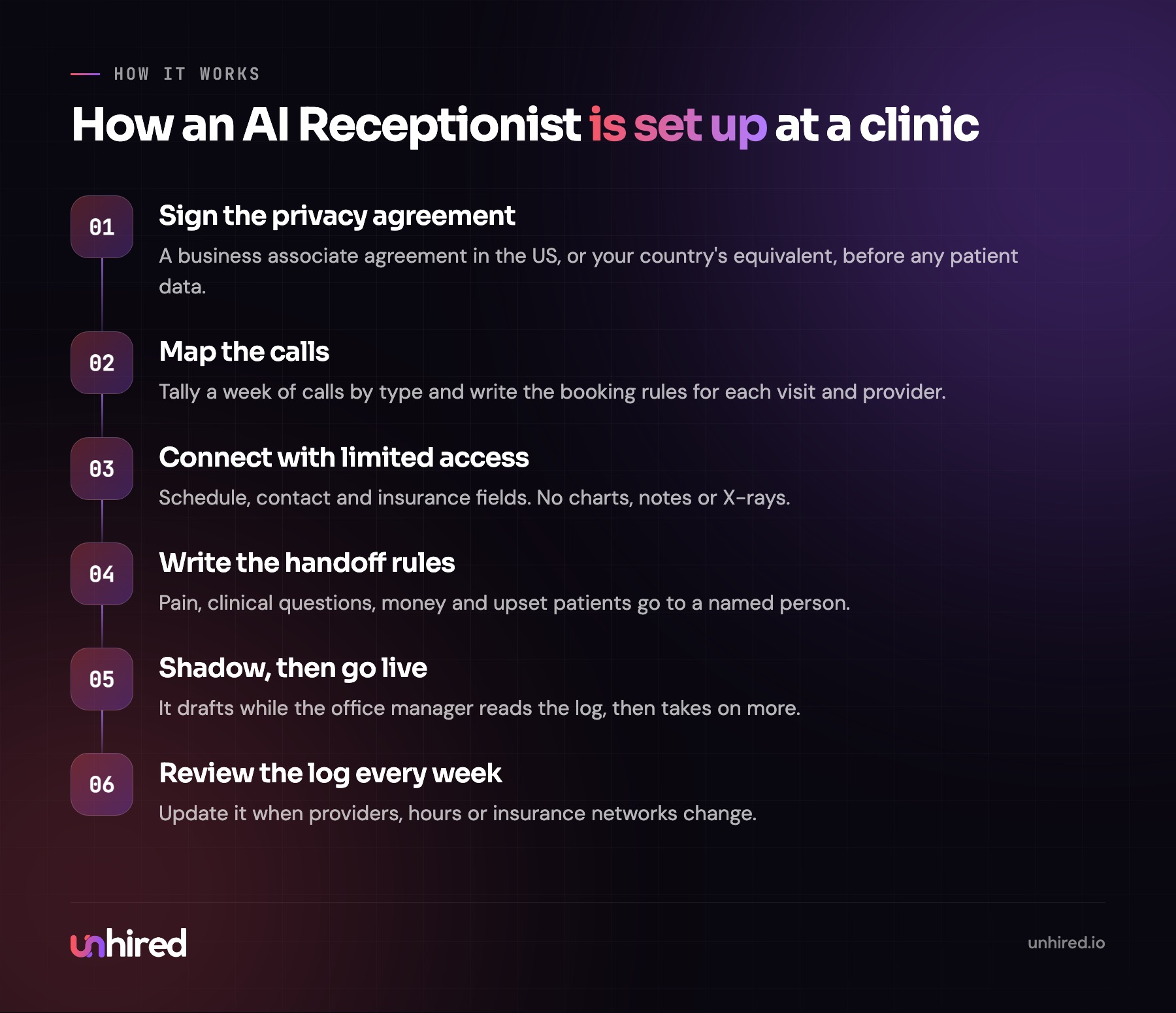
The step that decides whether it works is the shadow period. For the first week or two, the AI Receptionist drafts confirmations and bookings while the office manager reads the log, and it only takes on more once it's getting them right. After that, someone still reviews the log every week. Clinics add providers, change hours for the holidays and switch insurance networks, and an AI Receptionist nobody updates starts booking last quarter's schedule.
Is your front desk a good fit?
Some front desks are mostly in-person. If your team spends most of the day checking patients in, taking payments at the counter and calming nervous patients in the waiting room, you still need a person there. An AI Receptionist can take the phones, texts and recall list off their plate, which is often what makes the job manageable again.
If most of the desk's day is phones, confirmations and scheduling, an AI Receptionist can hold most of the seat, with a person handling the counter and the handoffs.
To check your own office, track one ordinary week. Have the front desk tally every call and message by type: confirmation, reschedule, recall, new patient, insurance question, clinical question, emergency. Then sort each type into three groups: what an AI Employee could own, what it could do with a person checking, and what needs someone at the desk. Some websites offer free assessments that check whether a role like this can be filled by an AI Employee, which is a reasonable next step once you have the tally.