
Ask whoever runs marketing at a small business where their Monday went. A lot of the time the answer is logins. Google Analytics, Meta Ads Manager, Google Ads, Mailchimp and the CRM each hold one piece of last week's numbers, and somebody has to copy them into a spreadsheet before the owner asks how the campaign did. Then a scheduled Instagram post failed over the weekend, and twelve people filled in the contact form on Thursday and Friday with no record of who called them back.
None of that is the creative part of marketing. It's the scheduling, reporting and follow-up that keep the creative part working, and in small teams it eats the week. That half of the job is what an AI marketing assistant is for. This post covers what one does, what it should hand to a person, how it's set up and what it costs next to a hire.
What an AI marketing assistant is
It's an AI Employee that holds one seat: the marketing operations work. It has a manager, usually the owner or the marketing lead. It has logins to the marketing accounts, and it works from written rules about what it can publish alone and what needs approval. Every post it schedules and every lead it follows up goes into a log.
It doesn't decide who your customer is or where the budget goes. Those calls need someone who knows the business and can be held to them. The AI marketing assistant takes the plan that person makes and runs it every day without dropping pieces.
A lot of marketing tools already have AI features: a caption writer in the scheduler, subject line suggestions in the email platform. They help with one task inside one tool. The assistant works across all of them, the way a marketing coordinator moves between tabs all day.
The duties, one by one
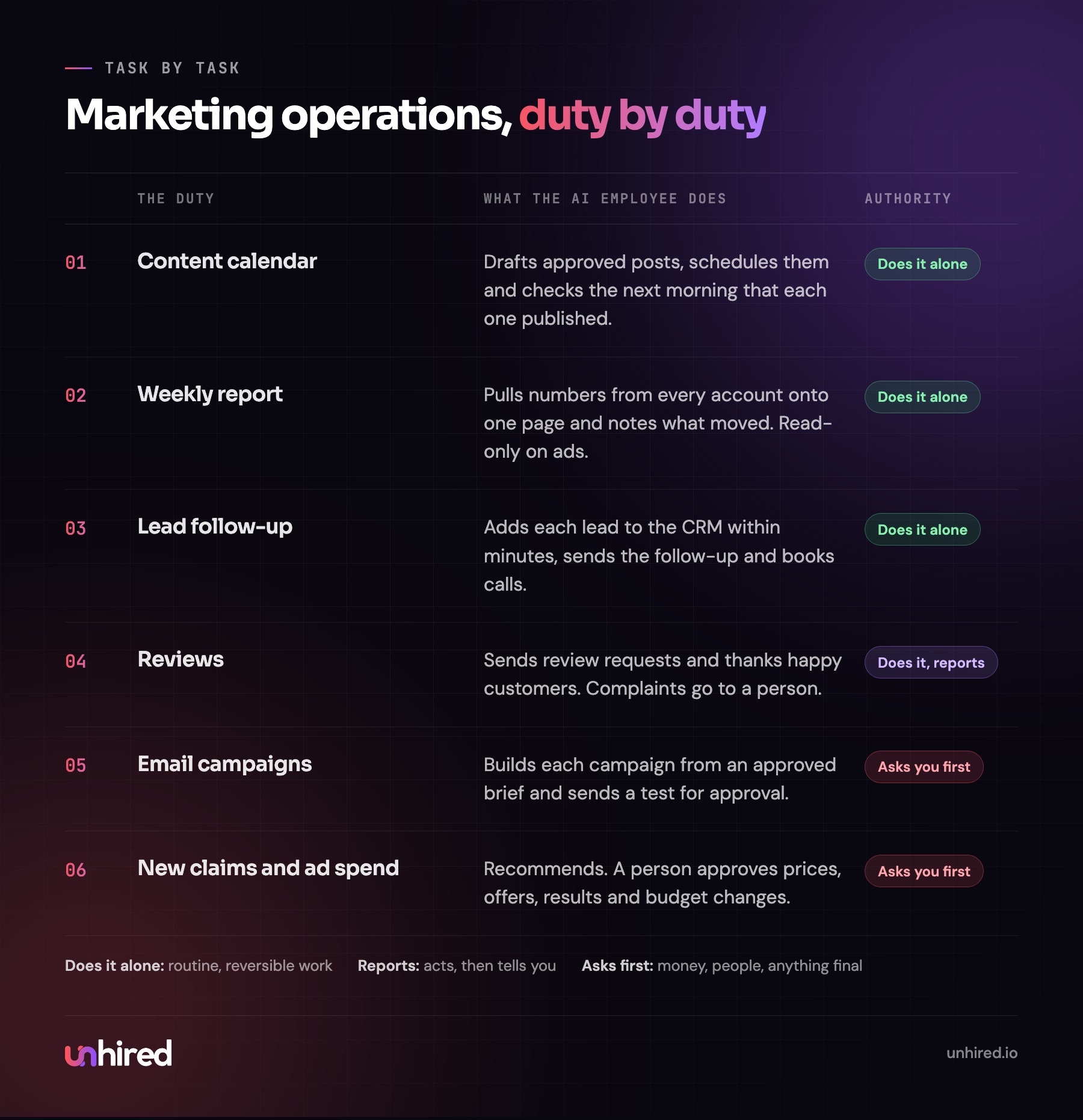
I'd split the seat into six duties, each with the authority level I'd give it.
The content calendar
A dental clinic plans a month of posts: a hygienist introduction, a reminder about unused insurance benefits before year end, two patient tips. A law firm plans a monthly newsletter and a post when a partner speaks at an event. An online store plans around product drops and holidays.
Once the plan is approved, the AI marketing assistant drafts each post in the company's wording, sizes the images for each platform, schedules them in Buffer, Hootsuite or Meta Business Suite, and checks the next morning that each one actually published. A post that failed gets fixed and rescheduled the same day instead of noticed a week later.
The weekly report
This is the duty I'd hand over first, because it's pure collection. Every Monday it pulls the numbers from each account, puts them on one page in the same order every week, and writes three or four lines on what moved: which email had the highest click rate, which ad's cost per lead jumped, which page sent the most form fills.
It only reads the ad accounts. It can point out that a campaign's cost per lead doubled. It can't pause the campaign or move the budget.
Lead follow-up
Form fills, webinar sign-ups, people who downloaded a price list, a stack of business cards from a trade show. Marketing generates these and then they sit, because nobody owns the gap between the form and the salesperson.
The AI marketing assistant adds each lead to the CRM within minutes, sends the follow-up email you wrote for that source, and books a call on the right calendar if the lead asks for one. A lead that matches your rules for a good fit goes to a person the same day. If you want a deeper look at what happens after the hand-off, my AI sales rep post covers that seat.
Reviews
After a visit, a closed matter or a delivered order, it sends a review request through whatever system you use. When a review comes in, it thanks a happy customer with a short reply in your wording. A complaint goes to a person with the customer's history attached. A public reply to an angry customer is part of your reputation, and I'd never let software write the final version.
Email campaigns
From an approved brief, it builds the campaign in Mailchimp or Klaviyo, picks the list segment you defined, sends a test to the manager and schedules it once someone approves. It also cleans up after: bounced addresses removed, unsubscribes honoured, replies forwarded to the right inbox.
Housekeeping
Tracking links on every campaign, so the report knows where leads came from. Opening hours that match on the website and Google Business Profile. Broken links on the landing pages. It's dull work, and when it slips the report stops being accurate.
What it should hand to a person
Marketing is public, so the list of things I'd keep with a person is specific.
- Strategy and budget. Who you're selling to, what you say about yourself, and how much goes into ads.
- Any new claim. Prices, discounts, results, credentials and comparisons with competitors get approved by a person before they go out. Clinics, law firms, financial advisors and insurance agencies have advertising rules from their regulators, and someone who knows them should read anything new.
- Ad spend. The assistant reads the ad accounts and recommends. A person changes the budget.
- Complaints, in public or in private.
- Anything that reacts to news. A scheduled post can look careless on the wrong day, so the person who runs marketing should be able to pause the calendar with one message.
Email has rules too. Anti-spam laws generally require consent and a working unsubscribe link, and they differ by country. The assistant should only email lists you've confirmed it's allowed to email.
A week of marketing operations
Here's an example week for an AI marketing assistant at a 20-person physiotherapy clinic. Three items go to a person, and that's how it should look.
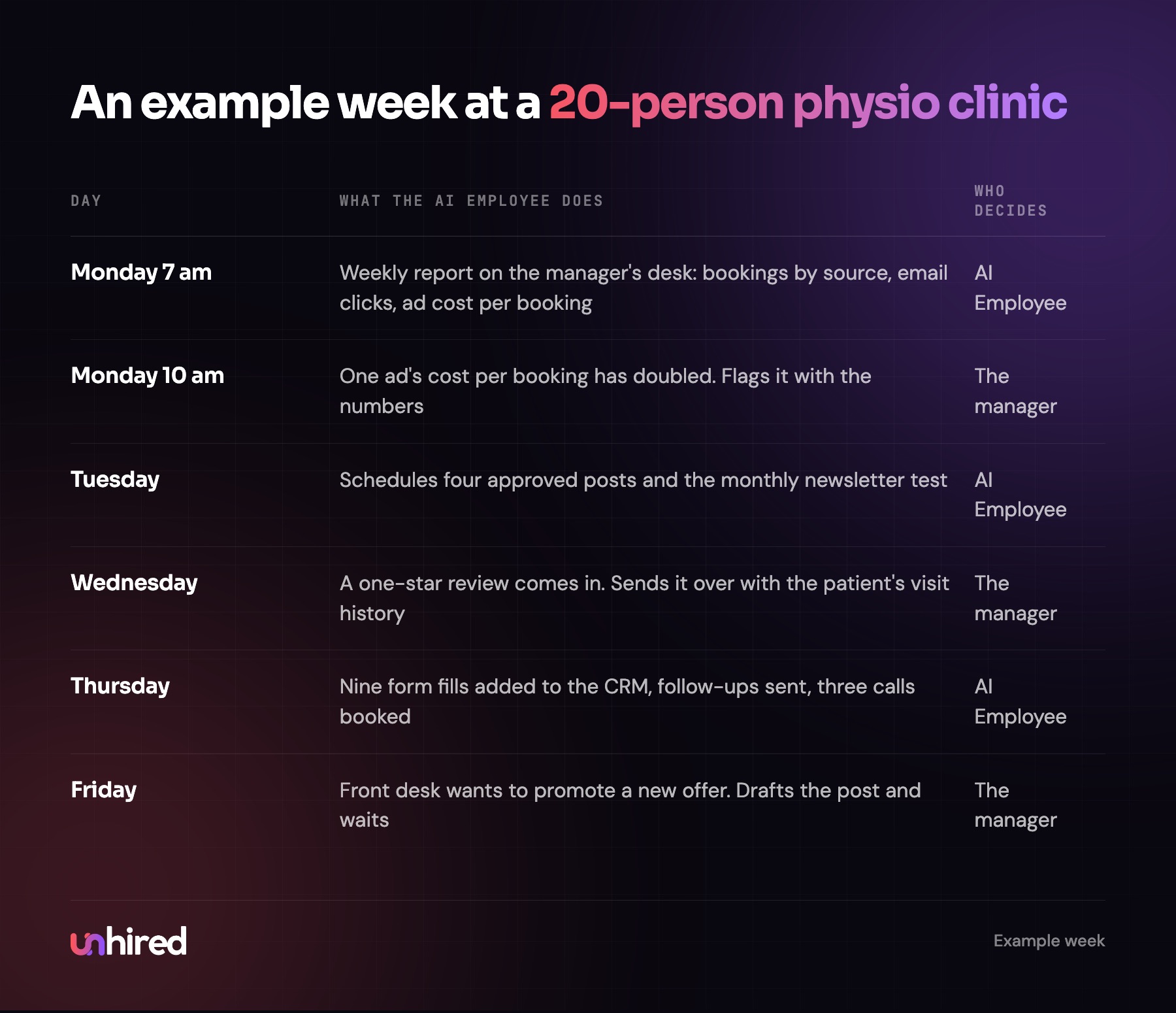
The report is waiting before the clinic manager's first coffee on Monday. The Thursday form fills are in the CRM with follow-ups already sent. The one-star review, the ad that's costing twice as much per booking and the new offer the front desk wants to promote all land with the manager, each with what's needed to decide.
What a marketing hire costs
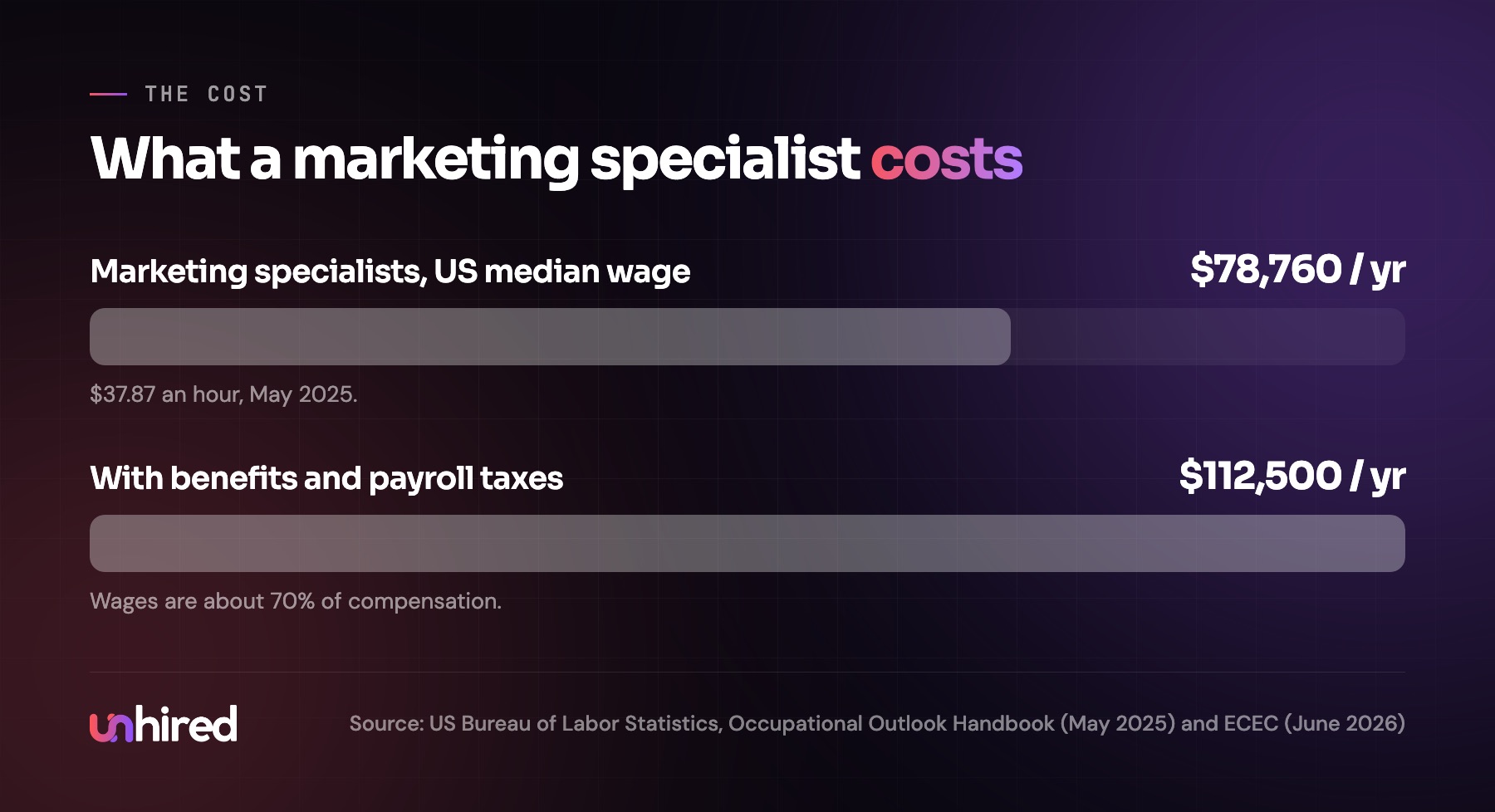
The US Bureau of Labor Statistics groups most marketing coordinators and specialists under market research analysts and marketing specialists. The median wage for that group was $78,760 a year, or $37.87 an hour, in May 2025, with employment projected to grow 7 percent from 2025 to 2035.
Wages are about 70% of what private employers spend on compensation, according to the BLS Employer Costs for Employee Compensation report for June 2026. At the specialist median, that puts the full cost near $112,500 a year before recruiting and training.
Plenty of small businesses never make that hire. The owner posts when there's time and the office manager sends the newsletter. That mix has a cost too, and it mostly shows up as leads that never got a reply.
How much you'd pay for an AI marketing assistant
There are two ways to get one.
Building it yourself. Schedulers, email platforms and CRMs all sell automation and AI features by monthly subscription, and AI agent platforms can connect them. The software is the small part. Someone has to connect the accounts, write the rules, test the follow-ups on real leads and keep it current when a tool changes.
Having it built and maintained. A provider connects your accounts, learns your wording and your approval rules, and keeps it updated, usually for a monthly fee.
The price depends mostly on how many channels it works and how many leads come in a month. A firm that posts twice a week and sends one newsletter needs much less than a store running five channels and daily email.
When you compare quotes, ask who approves posts in the first month, who updates the rules when you change tools, and whether it can touch ad budgets (the answer should be no). Then set the number against the full cost of the seat, about $112,500 a year at the US median, or against the hours your owner and office manager put into marketing now.
How an AI marketing assistant is set up
Most of the setup is writing down how the business already does marketing.
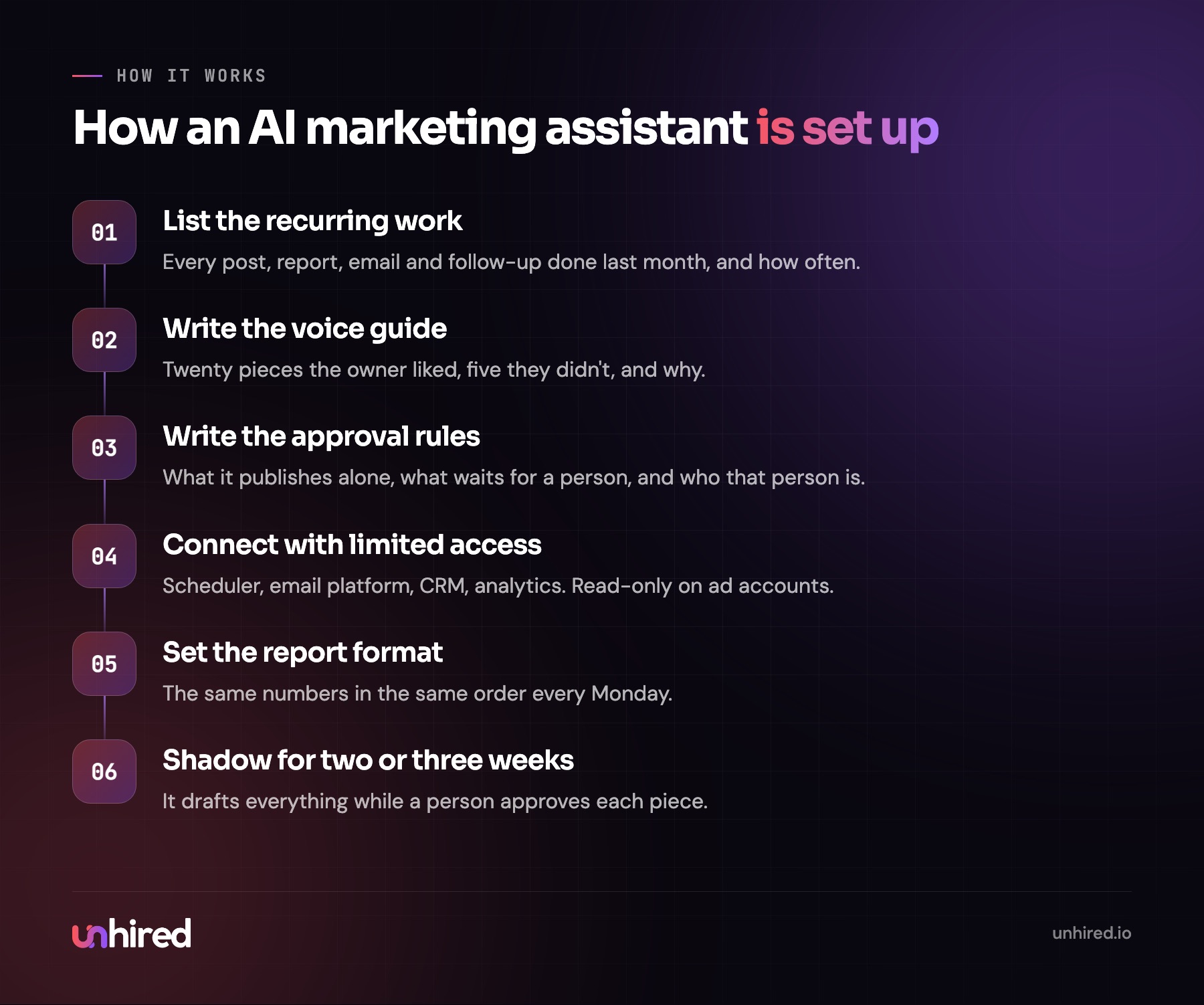
The voice guide takes longest. I'd collect twenty posts and emails the owner liked, and five they didn't, and write down why. Then I'd run it in shadow mode for two or three weeks: it drafts every post, email and reply, a person approves each one, and it only publishes alone once the drafts stop needing edits.
When a person should own marketing
If your marketing is the product, like a design studio or a restaurant built around its look, keep a person in the seat. The same goes for a business that wins most of its work through relationships and events. An AI Employee can still run the reporting and follow-up underneath.
If your marketing is a steady plan of posts, emails and ads that someone keeps falling behind on, the seat is mostly schedule and collection, and an AI marketing assistant can hold it. Some websites offer free assessments that check whether a role can be filled by an AI Employee.
Before you decide, write down every marketing task done last month and mark each one. Put an S beside anything done the same way every time and an N beside anything that needed a new idea or a judgment call. The S tasks are the work an AI marketing assistant would own, and the N tasks are the job worth giving your best person.
Wage data: US Bureau of Labor Statistics, Occupational Outlook Handbook (May 2025) and Employer Costs for Employee Compensation (June 2026). The physiotherapy clinic week is an example.