
At 7:15 on a Tuesday evening, someone who was rear-ended on the drive home calls a personal injury firm. The office closed at 5:30, so the call goes to voicemail. They hang up and call the next firm in their search results, which picks up.
I've spent the last four years building AI systems and agents for businesses, and law firm intake is one of the cleaner fits I've seen. The questions are mostly the same for every caller in a practice area, the work lives in one or two systems, and the line between what staff can say and what only a lawyer can say is already written into the profession's rules. That line is what makes the setup work.
This post covers what an AI Employee does in legal intake, what it should always hand to a lawyer, the confidentiality rules that come before anything is connected, and how the cost compares to an intake hire.
What legal intake involves
Intake is everything between a stranger's first call and a signed engagement letter. At a firm without a dedicated intake team, it's usually split between a receptionist, a legal assistant and whichever lawyer is free.
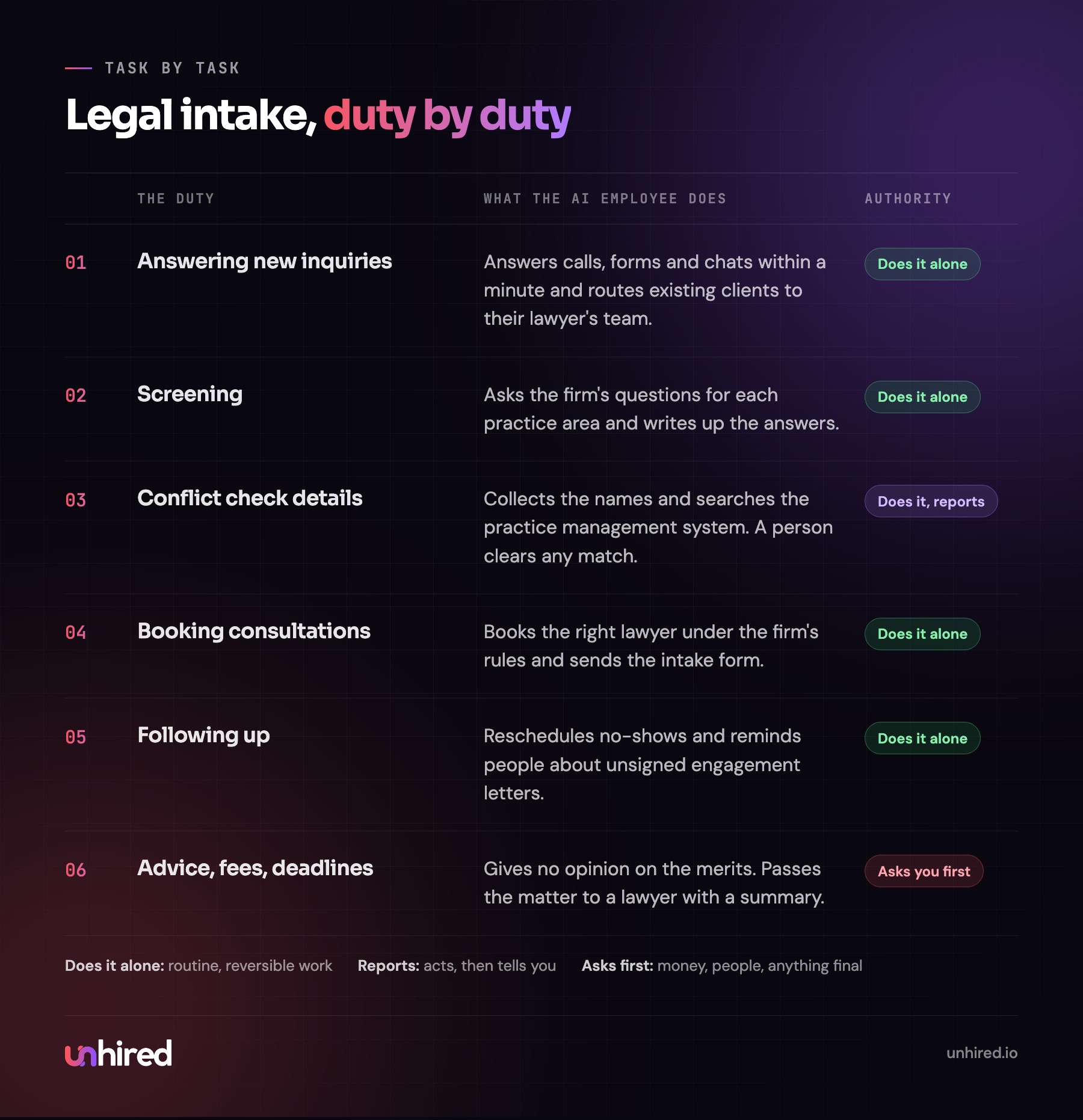
An AI Employee doing intake holds that job the way a person would. It has a manager (often the office manager or the managing partner), logins to the phone line, email, web forms and the practice management system, and a written set of rules about what it can do on its own. Every conversation goes into a log someone at the firm reads. The front-desk side of the job is covered in the post on the AI Receptionist. Intake adds five duties.
Answering new inquiries
Calls, web forms, chat and emails all come in at different hours. The AI Employee answers each one within a minute, says it's an AI assistant for the firm, and asks what the caller needs help with. Existing clients calling about their file get routed to their lawyer's assistant. New inquiries move to screening.
Screening against the firm's criteria
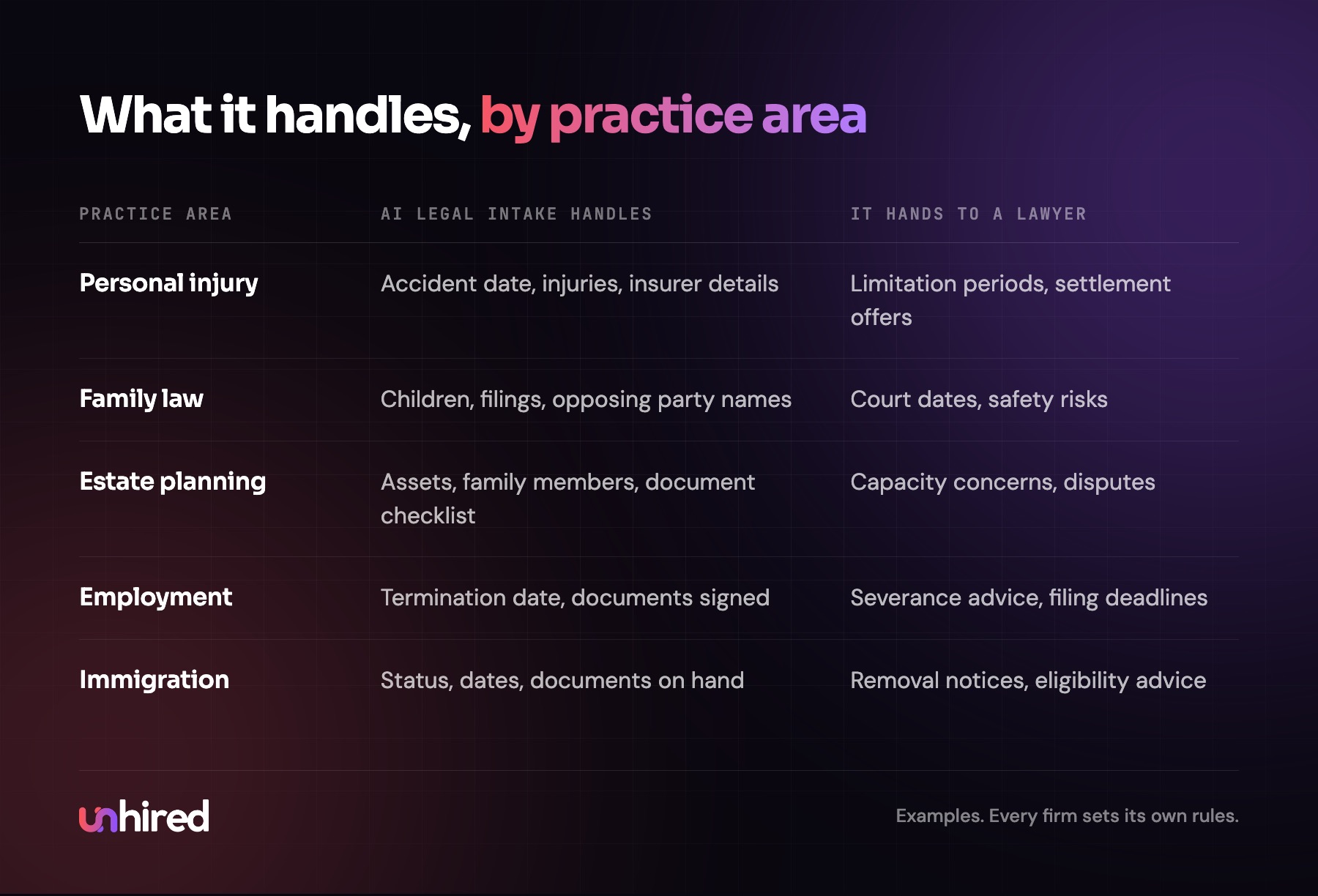
Every practice area has its own screening questions. A personal injury firm asks for the date of the accident, whether there were injuries, and whether insurance is involved. A family law firm asks about children, whether there's a court date, and whether anything has been filed. An employment firm asks for the termination date and whether the caller signed anything on the way out.
The AI Employee asks the firm's questions in the firm's order and writes up the answers. If the matter is clearly outside what the firm handles, it says so politely and gives the referral list the firm has written for that situation.
Gathering conflict check details
Before anyone at the firm discusses the facts, the firm needs to know it doesn't already represent the other side. The AI Employee collects the names a conflict check needs (the caller, the opposing party, related companies, a spouse or business partner) and searches the practice management system for matches.
A clean search gets noted on the intake record. A match, a near match, or a name it can't rule out goes to the person who clears conflicts. The AI Employee only collects and searches; it never clears a conflict.
Booking consultations
Once the screening is done and nothing is flagged, it books the consultation with the right lawyer under the firm's rules: which lawyers take which matter types, how long a consultation runs, whether it's paid or free, and whether it's in person or by video. It sends the confirmation, the intake form and a list of documents to bring.
Following up
This is where firms lose the most work. Someone books a consultation and doesn't show. A client gets an engagement letter and never signs it. A caller says "let me think about it." The AI Employee follows up on a schedule the firm sets, reschedules no-shows and reminds people about unsigned letters, and stops when the person says they've hired someone else.
What it should always hand to a lawyer
Law has a sharper line than most businesses, because only a lawyer can give legal advice. These are the conversations I'd always route to a lawyer or a named staff member, with a written summary attached:
- Legal advice of any kind. "Do I have a case?", "should I sign this?" and "what happens if I miss the hearing?" all get the same answer: a lawyer will review it, and here's the earliest consultation. The AI Employee doesn't give opinions on the merits, even when the answer seems obvious.
- The conflict decision. It gathers the names and runs the search. A person clears it.
- Whether the firm takes the matter, and what it charges. It can explain the published consultation fee. Fee agreements, retainers, contingency terms and declining a matter belong with a lawyer, who also decides whether a non-engagement letter goes out.
- Anything with a deadline. If a caller mentions a court date next week, a limitation period, or papers they were served, the intake goes to a lawyer the same day, flagged as urgent.
- Safety risks. In family law especially, a caller may describe violence or threats. The AI Employee gives the instructions the firm has written, including emergency numbers, and alerts a person right away.
- Anyone who asks for a person. That handoff happens on the first request.
People should also know who they're talking to. The article on whether customers should know they're talking to an AI Employee goes into how to word that.
Confidentiality comes first
A prospective client tells the firm things they'd never post publicly, and in most places that information is protected even if the firm never takes the case. In the ABA Model Rules, the duties to prospective clients are set out in Rule 1.18. So the privacy and ethics work happens before anything is connected.
The American Bar Association's Formal Opinion 512, issued in July 2024, applies the existing rules to AI tools: lawyers have to understand the tool well enough to use it competently, protect client information, supervise the work, and be honest with clients about how their matter is handled. Bars in other jurisdictions have their own guidance, and a firm should read its own before connecting anything.
The questions I'd ask any provider, or answer for yourself if you build it:
- Is information from calls and forms used to train anyone's AI model? It shouldn't be.
- Where are recordings, transcripts and intake records stored, and for how long?
- Can the AI Employee be limited to the intake records and the conflict search, with no access to open client files?
- Who on the provider's side can read intake conversations?
- What happens to the data if the firm stops using the service?
Limiting access is the step firms skip. Intake needs the contact database, the conflict search and the calendar. It doesn't need anyone's case file, so it shouldn't be able to open one. The post on how AI Employees handle data security covers access permissions in more detail.
An evening of intake
Here's an example of the after-hours shift at a small firm with family law and personal injury practices. Three of the items go to a person, and that's what a good log looks like.
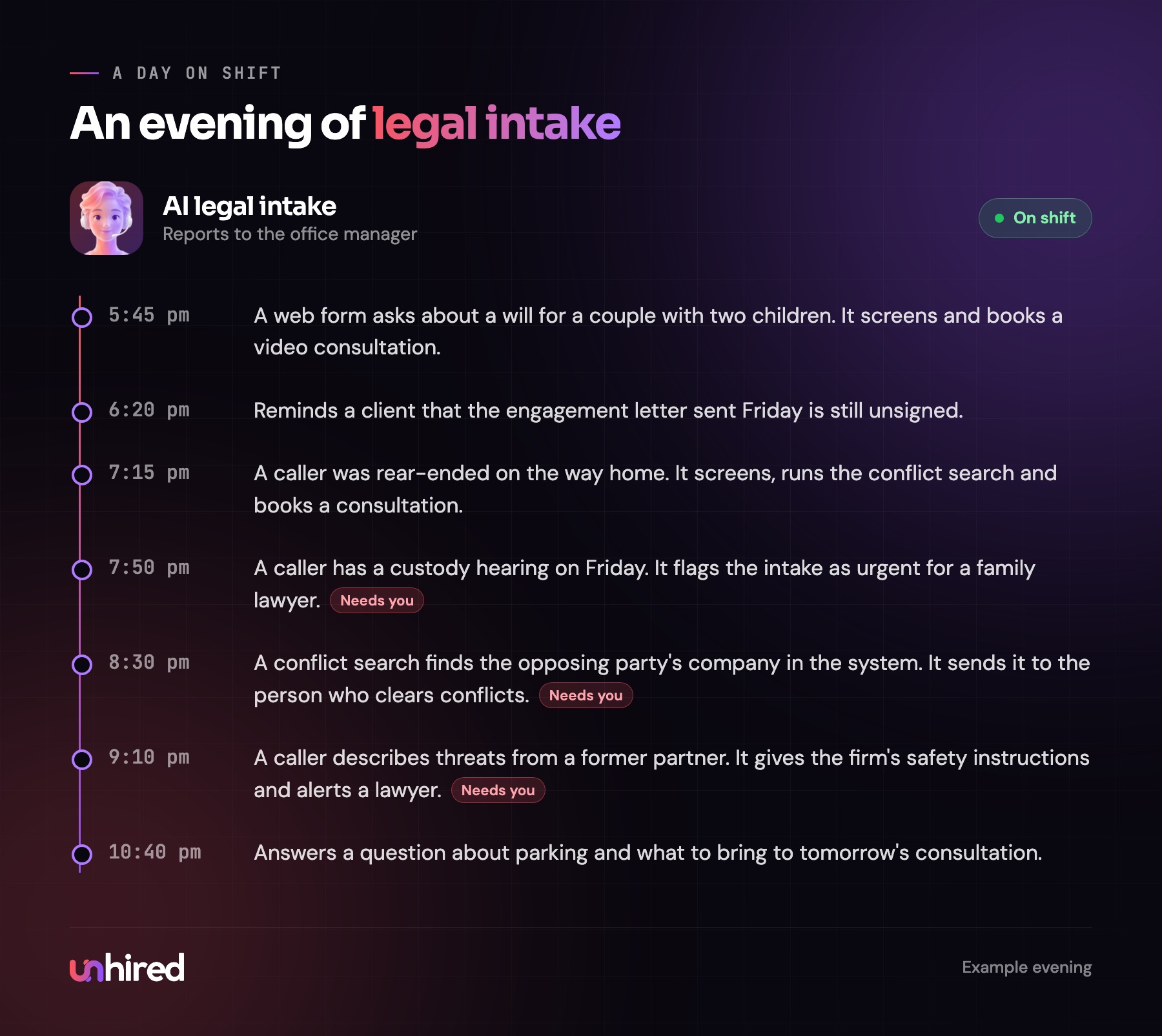
The 7:15 pm car accident call gets screened and booked while the office is dark. The caller with a court date on Friday and the caller describing threats both reach a lawyer that night, with notes, so nobody has to ask them to repeat the story.
What an intake hire costs
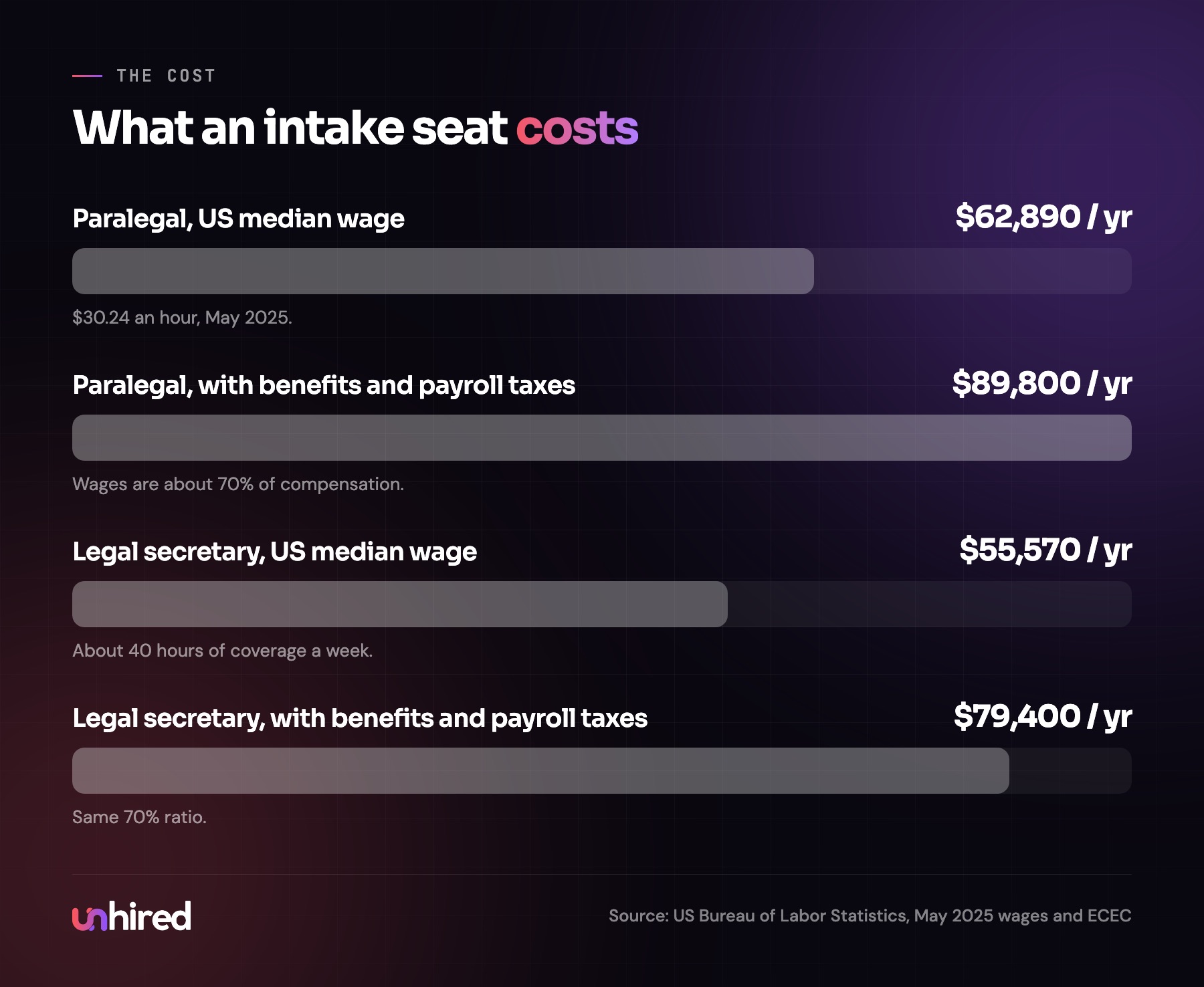
The US Bureau of Labor Statistics puts the median wage for paralegals and legal assistants at $62,890 a year ($30.24 an hour) as of May 2025, and $61,770 in legal services. Many smaller firms put a legal secretary or legal administrative assistant on intake instead; the BLS median for legal secretaries and administrative assistants was $55,570 in May 2025.
Wages are only part of it. Across US private industry, wages and salaries are about 70% of what employers spend on compensation, according to the BLS Employer Costs for Employee Compensation report. Add the job posting, interviews, training on the practice management system, and coverage for lunch, sick days and vacation.
How much you'd pay for AI legal intake
You can assemble it yourself from software: an AI phone and chat tool, a connection to your practice management system, and a texting and email service. The subscriptions are the smaller cost. The bigger one is a person's time mapping every inquiry type, writing the screening questions and handoff rules, working through the ethics review, testing it, and keeping it current.
Or a provider builds and maintains it, usually for a monthly fee. You pay more than the bare software, and someone else handles setup, updates and the log reviews.
The price moves with the number of practice areas (each has its own screening script), how many channels it covers, whether your practice management system has a clean integration, inquiry volume, languages, and how much maintenance is included.
To compare quotes, set them against the full cost of the seat. A paralegal at the US median costs $62,890 in pay and about $89,800 once benefits and payroll taxes are counted at the BLS ratio. A legal secretary at the median comes to about $79,400. Each covers roughly 40 hours a week, and inquiries come in at all hours.
How AI legal intake is set up
Setup looks a lot like training a new intake coordinator, with the ethics review added at the start.
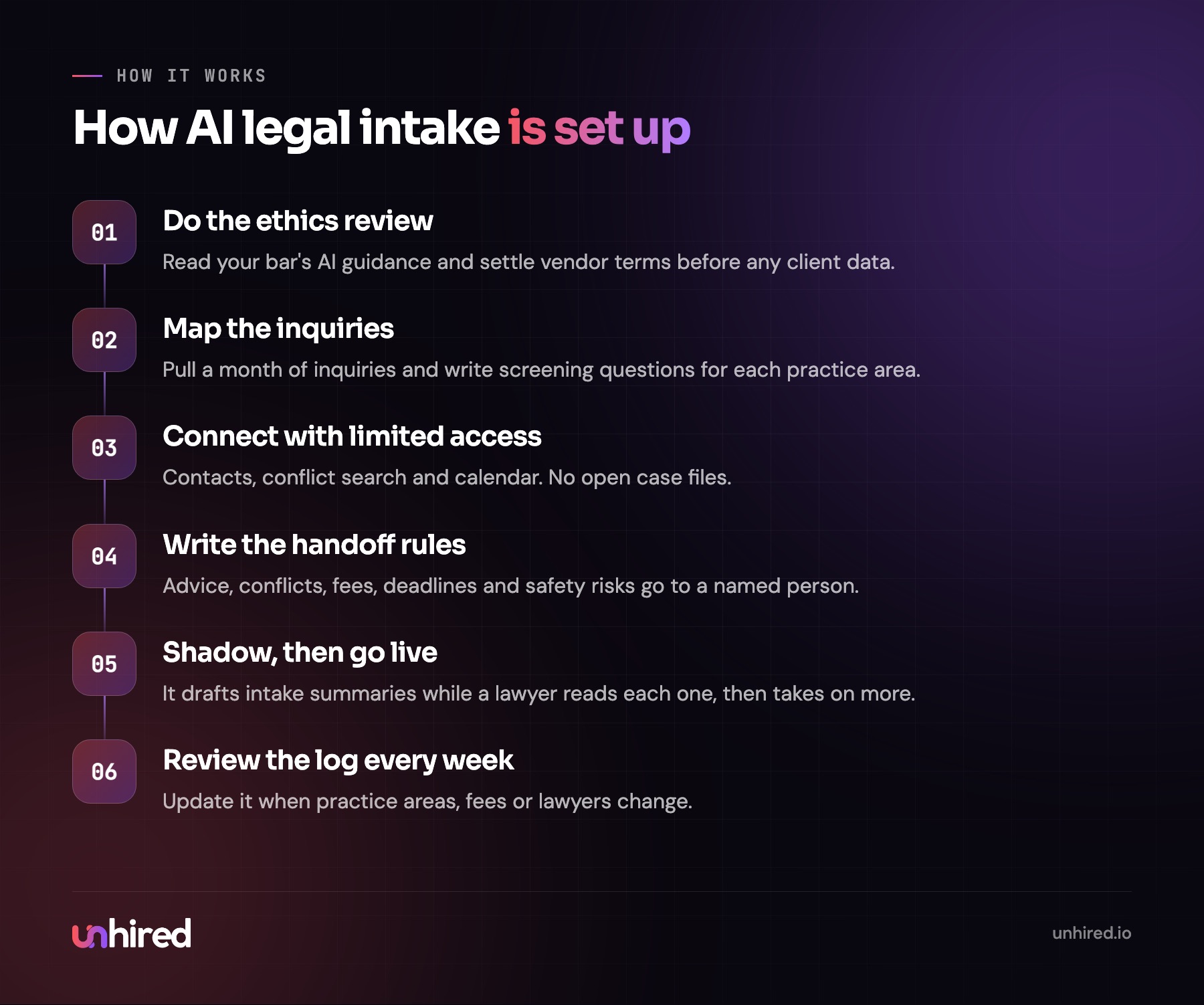
The shadow period decides whether it works. For the first week or two, the AI Employee drafts intake summaries and proposed bookings while a lawyer or the office manager reads every one. It takes on more once the summaries are right. After that, someone still reads the log weekly, because firms add practice areas, change consultation fees and hire new lawyers, and an intake script nobody updates keeps booking the wrong people.
Is your firm's intake a good fit?
Some firms get most new matters through referrals from other lawyers and long-time clients, and those first conversations are relationship calls a partner should take. An AI Employee can still handle the scheduling and follow-up around them.
If most new matters start as calls and web forms from people you've never met, and the same questions get asked every time, intake is a strong candidate for an AI Employee, with lawyers handling the advice, the conflicts and the decision to take the case.
To check your own firm, pull the last month of inquiries. For each one, note how it came in, when, the practice area, whether it was answered live, and whether it became a client. Then sort the intake steps into three groups: what an AI Employee could own, what it could do with a person checking, and what needs a lawyer. Some websites offer free assessments that check whether a role like this can be filled by an AI Employee, which is a useful next step once you have that month in front of you.