
On a Monday morning at an independent agency, the queue usually looks the same. A contractor needs a certificate of insurance naming a property owner as additional insured before a crew can start Thursday. A client bought a car on Saturday and wants it added. Two claims came in over the weekend by voicemail. A commercial renewal is 60 days out and the client still hasn't sent updated payroll figures.
I've spent the last four years building AI systems and agents for businesses, and insurance agencies have one of the cleanest lines I've seen between work that needs a license and the work around it. Advising on coverage, quoting and binding need a licensed agent. Around that sits a layer of certificates, questionnaires, data entry, reminders and status updates that eats most of an account manager's day.
This post covers what an AI Employee does at an insurance agency or brokerage, what it should always leave to the licensed agents, what to check with your carriers first, and how the cost compares to the hire it would replace.
What the service side of an agency involves
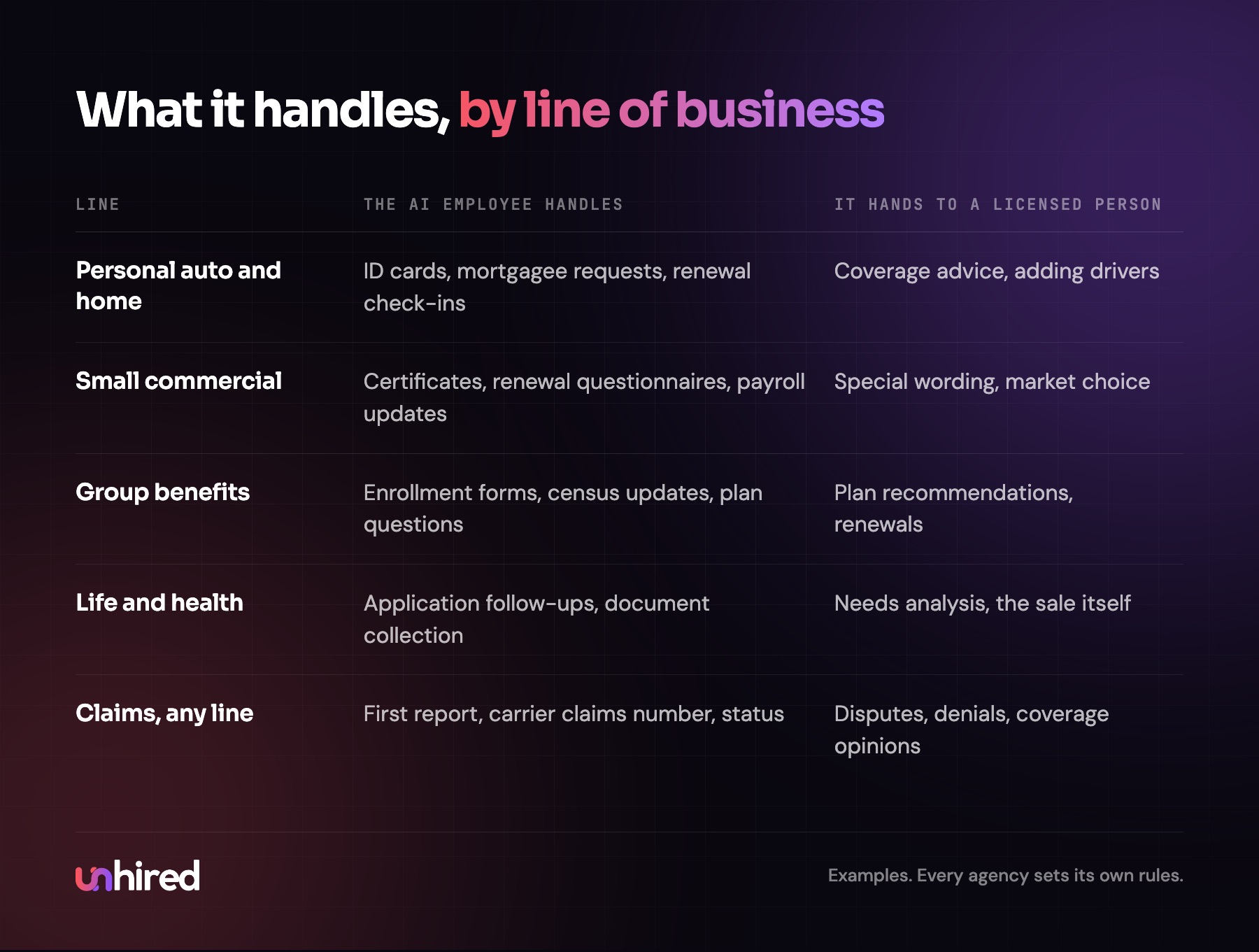
Whether the agency writes personal auto and home, small commercial packages, group benefits or life and health, the same service work sits around the selling. Someone issues certificates. Someone sends renewal questionnaires and chases the answers. Someone enters quote information into the rater, processes routine changes, answers billing questions and takes claim reports. At a ten-person agency, that's usually two or three customer service reps and account managers, with producers picking up whatever lands on them.
An AI Employee in this role holds that job the way a person would. It reports to the agency principal or the service manager, has logins to the agency management system (Applied Epic, AMS360, HawkSoft or whatever the agency runs), email, the phone line and the comparative rater, and works under written rules about what it can do on its own. Everything it does goes into the activity log on the client's file. The general version of this job is covered in the post on the AI Customer Support Employee. At an agency, it breaks down like this.
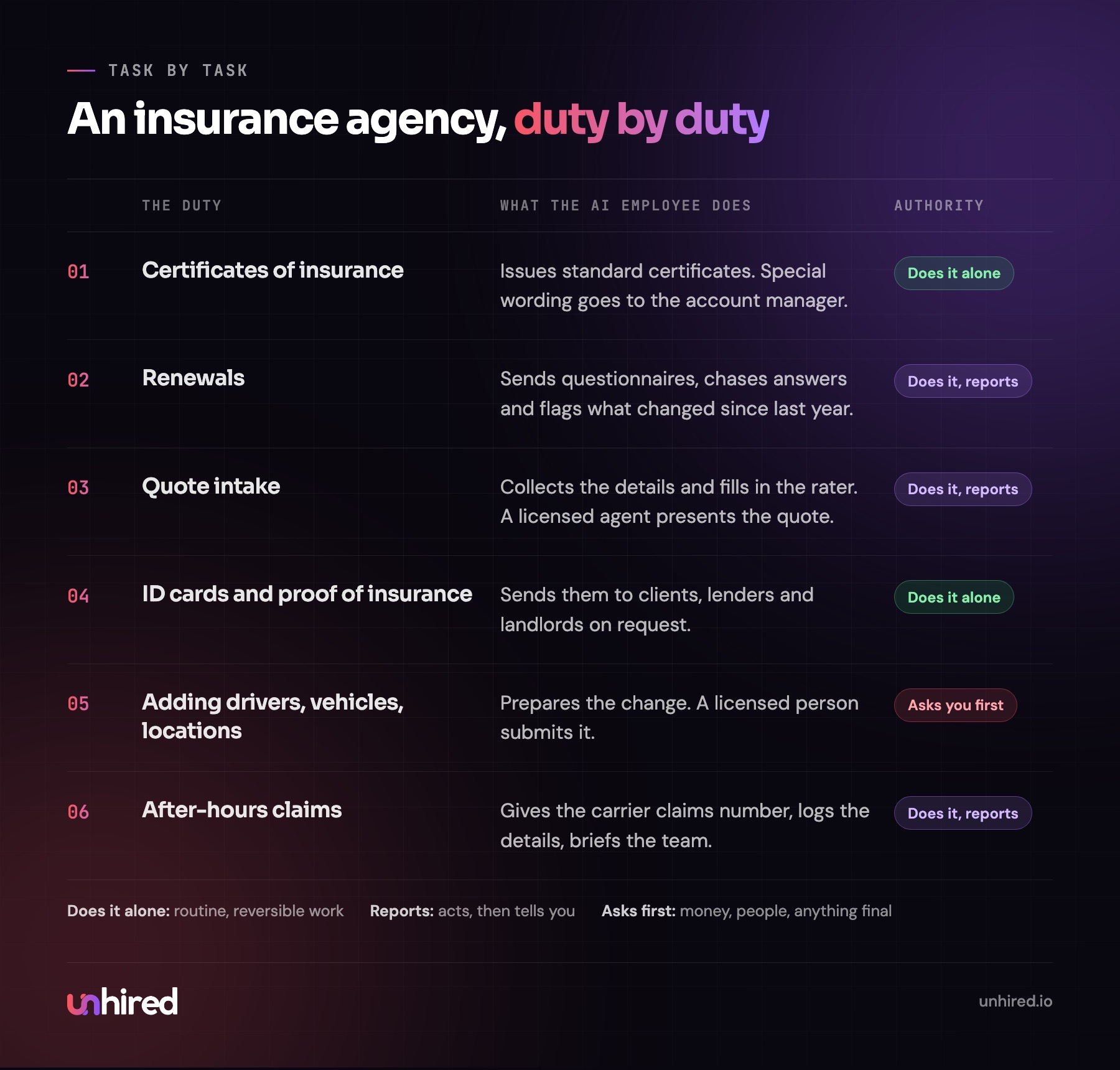
Certificates of insurance
For a commercial book, this is the biggest single service task. A standard certificate for a holder who just needs proof of coverage is a few minutes of work in the management system, and the AI Employee can issue it on its own and email it to the holder. A request to add someone as additional insured, add waiver of subrogation or change wording is different, because the certificate can only reflect what the policy says. Those go to the account manager, with the policy form and the contract language attached.
Renewals
At 90 days out, the AI Employee sends each commercial client the renewal questionnaire (payroll, revenue, vehicle schedule, property values, new locations) and follows up until it comes back. It compares the answers to last year's and flags the changes that matter, like a new vehicle or a jump in payroll. For personal lines, it sends a renewal summary and asks whether anything changed in the household. The account manager decides which markets to approach and what to recommend.
Quote intake
A new prospect calls about a business owner's policy or a home and auto bundle. The AI Employee collects the information the carriers ask for, enters it into the rater and pulls prior declarations pages if the prospect sends them. It never quotes a price on its own. A licensed agent reviews the comparison and presents it.
Routine policy service
ID cards, proof of insurance for a mortgage company or a landlord, address changes and payment method changes can all be handled on its own. Adding a driver, a vehicle or a location changes coverage, so the AI Employee takes the details, prepares the change request and sends it to a licensed person to submit.
After-hours claims and billing
A client who hits a deer at 11 pm gets the carrier's claims number, and the AI Employee logs what happened and tells the account manager in the morning. It doesn't comment on whether something is covered. On billing, it explains direct bill versus agency bill and watches for pending cancellation notices, which are the most urgent item in any agency's mail, because a client who misses one can end up uninsured.
What it should always hand to a licensed agent
Selling, soliciting and negotiating insurance require a producer license, and every word an agency puts in front of a client is a potential errors and omissions claim. These are the situations I'd always route to a named person, with the context written up:
- "Am I covered?" Any coverage question about a specific loss or a specific situation goes to the account manager. A wrong answer here is the classic E&O claim.
- Recommendations. Limits, deductibles, which carrier, whether to add an umbrella. Those are advice.
- Binding and anything that changes coverage. The AI Employee prepares the change, and a licensed person submits it.
- Claim disputes and denials. It can report a claim and pass along status, but a client unhappy with an adjuster talks to a person.
- Cancellations a client asks for. Someone should call before a policy goes away.
- Upset clients and anyone who asks for a person. That handoff happens on the first request.
Clients should know when they're writing to an AI Employee. I covered how to word that in the post on whether customers should know they're talking to an AI Employee.
What to check with your carriers first
Agencies sit between their clients and the carriers they're appointed with, so the setup has more than one set of rules. In December 2023 the National Association of Insurance Commissioners adopted a model bulletin on insurers' use of AI, and state regulators have been adopting versions of it since (NAIC adoption map). It asks insurers to keep a written program for their AI systems and holds them responsible for AI used by third parties they work with. Agencies are among those third parties, so expect carriers to start asking.
Before connecting anything, I'd read three things. First, the agency agreements, for anything on automated access or data handling. Second, the terms of use for each carrier portal, since some don't allow automated logins and the AI Employee may have to work through the management system's download instead. Third, the state insurance data security rules the agency already follows, which cover client data no matter who or what touches it.
The access rules I wouldn't bend: its own login, the narrowest permissions the job needs, no ability to bind or cancel, client data only with AI vendors whose terms say it isn't used to train their models, and every action logged. The post on AI Employee data security covers the general version.
A Monday at an agency
Here's an example Monday for an AI Employee at a small agency with a mix of personal and commercial clients. Three items go to a licensed person, which is what a good log looks like.
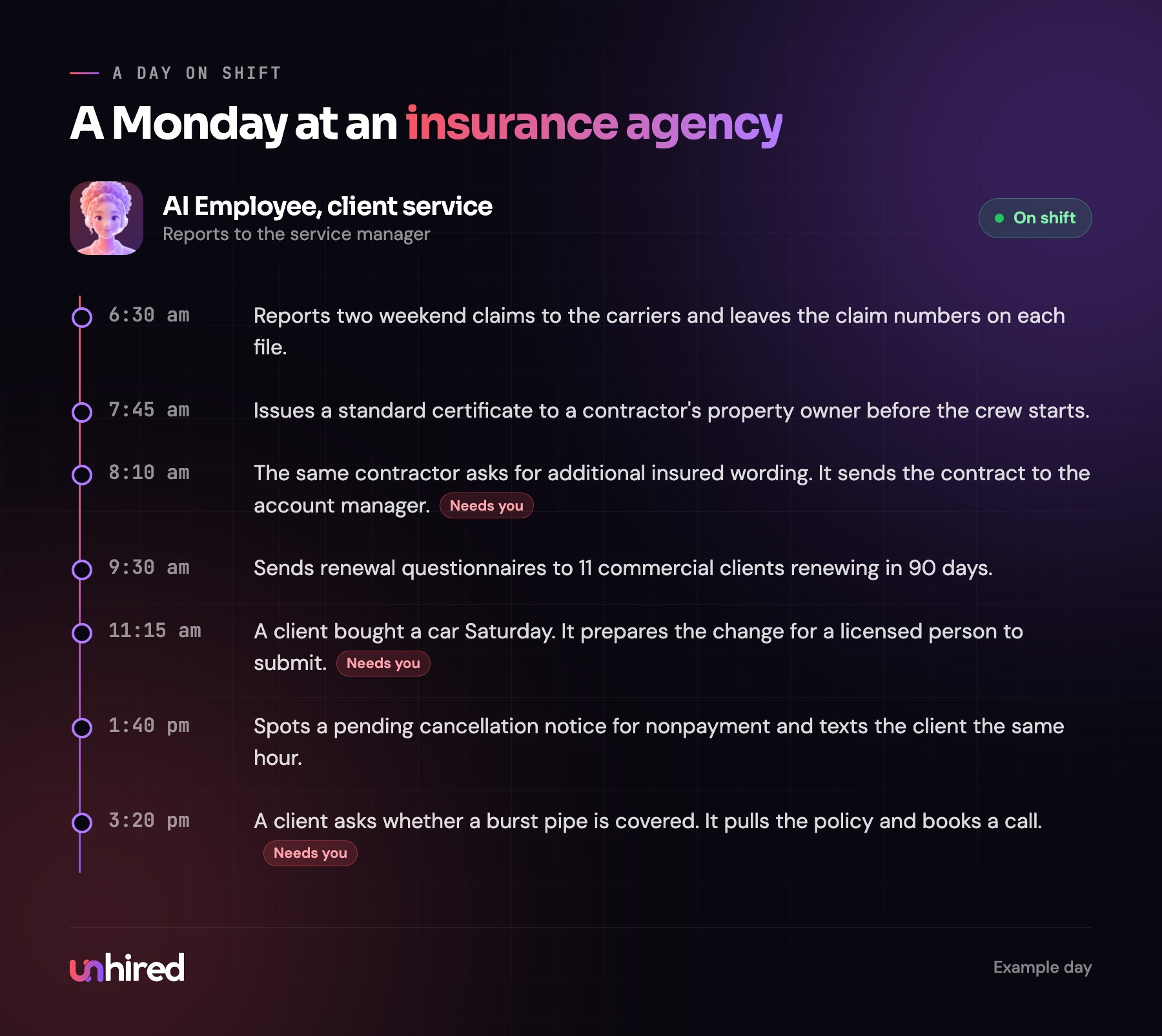
The contractor gets the standard certificate before 8 am, and the request for additional insured wording reaches the account manager with the contract attached instead of sitting in a shared inbox. The weekend claims were already reported to the carriers, so the account manager starts the week with claim numbers instead of voicemails.
What the seat costs a person
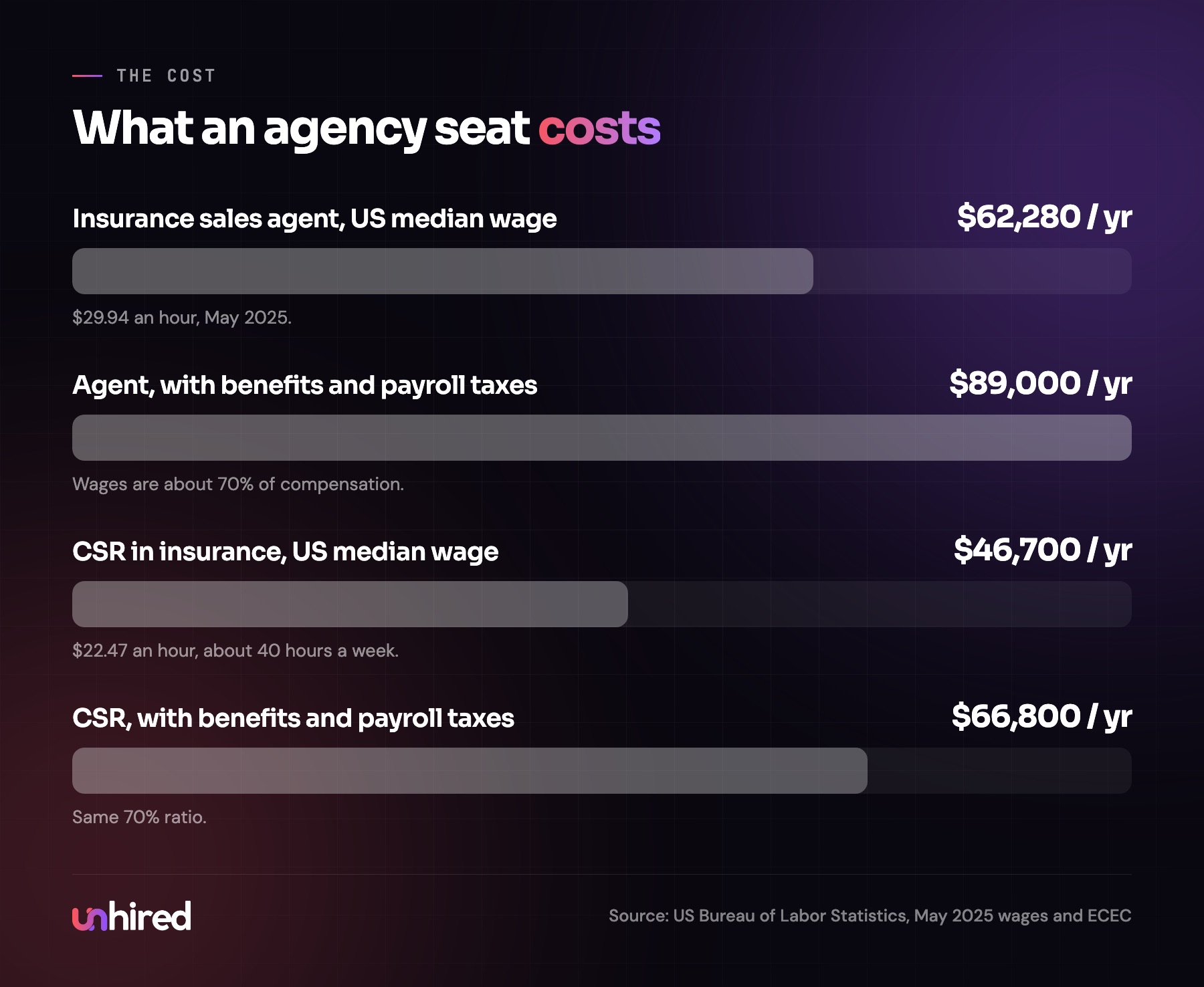
The US Bureau of Labor Statistics puts the median wage for insurance sales agents at $62,280 a year ($29.94 an hour) as of May 2025. Many agencies put a customer service representative on the service work. The BLS median for customer service representatives working in insurance carriers and related activities was $22.47 an hour in May 2025, about $46,700 over a 2,080-hour year.
Wages are only part of it. Across US private industry, wages and salaries are 70% of what employers spend on compensation, according to the BLS Employer Costs for Employee Compensation report. Agencies also pay for licensing, continuing education and appointments with each carrier, and a new CSR takes months to learn the carriers and the book.
How much you'd pay for an AI Employee at an insurance agency
You can assemble one from software: an AI agent platform, a connection to your management system, a phone and texting service and access to your rater. The subscriptions are the smaller cost. The bigger one is someone's time writing the certificate rules, the renewal questionnaires and the handoff rules, testing it on real files and keeping it current when carriers change forms or appetite.
Or a provider builds and maintains it, usually for a monthly fee. You pay more than the bare software, and someone else handles the setup, the updates and the log reviews.
The price moves with the size of the book, how many certificates and service requests come in each month, whether your management system has a clean integration, how many carrier portals it has to work with, and how much maintenance is included. A personal lines agency with simple policies needs less than a commercial brokerage with hundreds of certificate holders.
To compare quotes, set them against the full cost of the seat. An agent at the US median costs $62,280 in pay and about $89,000 once benefits and payroll taxes are counted at the BLS ratio. A CSR at the insurance industry median comes to about $66,800. Either covers roughly 40 hours a week, and claims don't wait for office hours.
How an AI Employee is set up at an agency
Setup looks a lot like onboarding a new CSR, with the carrier review at the start.
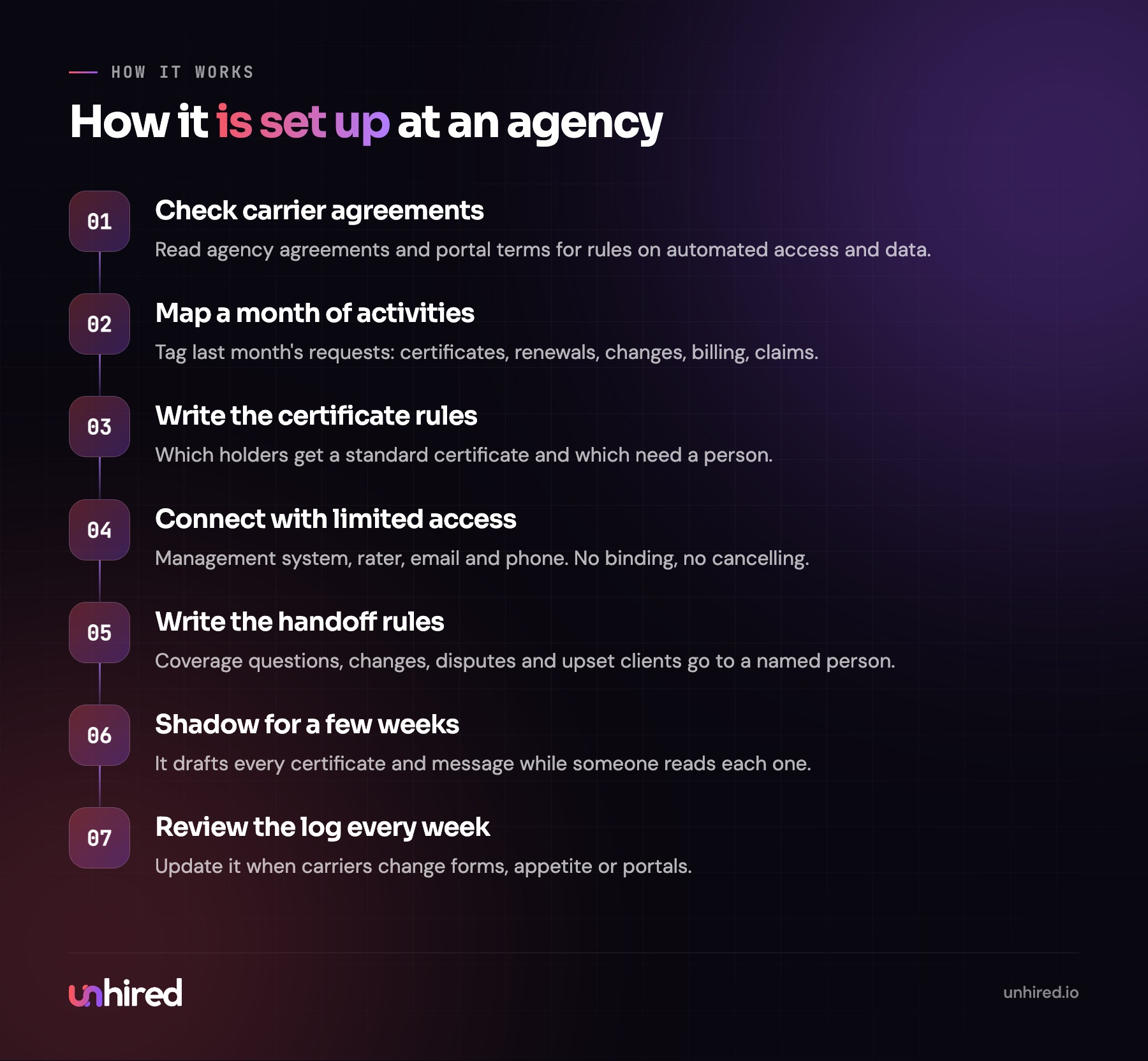
The certificate rules take the most thought. Every account manager knows which holders get a standard certificate and which contracts need special wording, and very few agencies have written it down. Writing it down helps even without an AI Employee, because it's usually the reason one account manager's certificates go out the same day and another's take three.
For the first few weeks, the AI Employee drafts every certificate and every client message, and someone reads each one before it goes out. It takes on more once the drafts are right. After that, someone still reads the log weekly, because carriers change forms and a rule written last year can be wrong this year.
Is your agency a good fit?
If your agency writes mostly personal lines for long-standing clients who call their agent directly, the AI Employee has less to do, and those relationships are probably why clients stay.
If your CSRs spend their days on certificates, renewal chasing and ID cards, and producers handle service calls when they should be quoting, the service seat is a strong candidate for an AI Employee, with the licensed agents keeping every coverage conversation. Some websites offer free assessments that check whether a role like this can be filled by an AI Employee.
To check your own agency, export last month's activities from your management system and tag each one: certificate, renewal, quote intake, policy change, billing, claim, coverage question. Then mark the ones that needed a licensed person's judgment. If most of the list is certificates and paperwork, start by writing down your certificate rules, since that document is what decides how fast the next Thursday deadline gets met.