
In the second week of March, a lot of the email at an accounting firm says some version of the same two things: "Did you get my documents?" and "When will my return be done?" Each one takes a staff accountant two minutes to answer, and each one pulls them out of a return they were halfway through.
I've spent the last four years building AI systems and agents for businesses, and accounting firms have one of the clearest splits I've seen between work that needs a credential and the work around it. Returns, adjusting entries and advice need an accountant. Around them sits a layer of chasing, sorting, reminders and status updates that any careful person could do, and at a small firm that coordination often eats a full seat during busy season.
This post covers what an AI Employee does at an accounting or bookkeeping firm, what it should always leave to the accountants, the data security rules that shape the setup, and how the cost compares to the hire it would replace.
What the job involves
Whether the firm does individual tax returns, monthly bookkeeping for small businesses, payroll, or audits and reviews for larger clients, the same support work sits around the accounting. Someone onboards new clients. Someone collects documents and chases the missing ones. Someone tracks every deadline for every client. Someone answers "where is it?" and someone follows up on unpaid invoices. At a firm of five people, that's usually the partners' assistant plus whichever accountant is least buried that day.
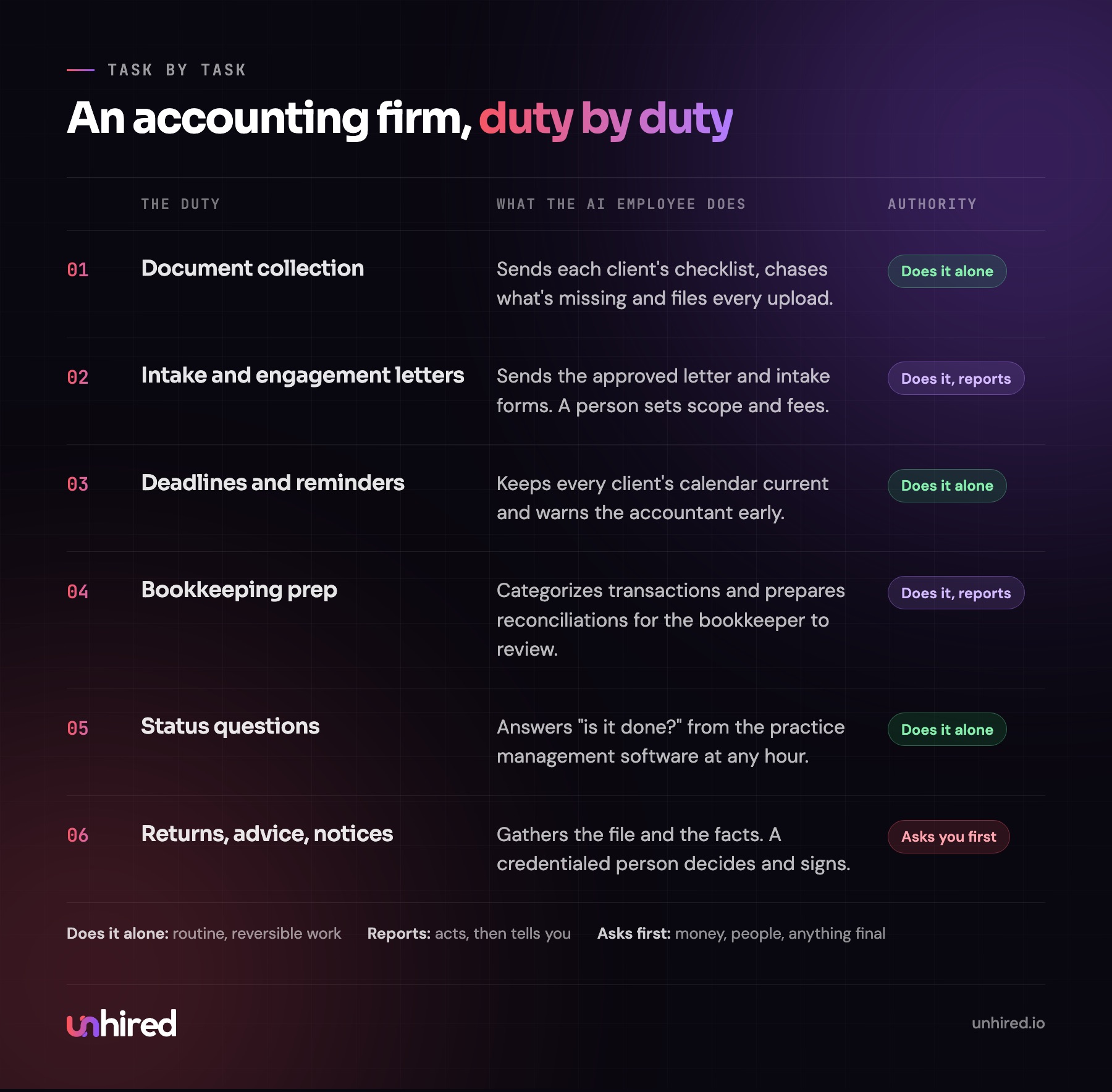
An AI Employee in this role holds that job the way a person would. It reports to a partner or the office manager, has logins to the practice management software, the client portal, email and the firm's calendar, and works under written rules about what it can do on its own. Everything it does goes into a log the firm reads. If you run the books for clients more than you do tax, the post on the AI Bookkeeper goes deeper on the transaction side. The firm-wide duties break down like this.
Collecting and chasing documents
This is the biggest single job in tax season. The AI Employee sends each client a checklist built from last year's file (the same W-2s, 1099s, mortgage statement and charitable receipts, plus anything new they mentioned), then follows up on a schedule until the list is complete. When documents arrive, it checks that each one is readable, belongs to the right client and the right year, and files it in the right folder. A 1099 from a brokerage that appeared last year and is missing this year gets flagged, because that's the document clients forget most.
Client intake and engagement letters
A new client needs an intake questionnaire, an engagement letter, identity checks the firm requires, and access to the portal. The AI Employee sends all of it, answers questions about the process, and chases signatures. It uses the engagement letter template the partners approved. Scope and fees are set by a person before the letter goes out.
Deadlines and reminders
Every client carries a calendar: quarterly estimated payments, payroll filings, sales tax returns, extension dates, the annual return. The AI Employee keeps that calendar current in the practice management software, reminds clients of what they owe and when, and tells the assigned accountant when a deadline is close and the work hasn't started. A missed deadline usually comes with a penalty, so this is the duty I'd set up first.
Bookkeeping prep
For monthly bookkeeping clients, it pulls bank and card feeds into the accounting software, categorizes transactions using the client's history and the firm's rules, matches receipts, and prepares the reconciliation. Anything it isn't sure about goes into a list of questions for the client or the bookkeeper. The bookkeeper reviews and closes the month. The AI Employee never posts an adjusting entry.
Status questions and client updates
"Is my return done?" gets answered from the practice management software in a minute, at any hour. So do "did you get my documents?" and "what's my portal password reset link?" During busy season it can also send each client a short weekly status note, so fewer of them write in at all.
Billing follow-up
It sends invoices when the work is marked complete, reminds clients about unpaid ones on the schedule the firm sets, and answers questions about what an invoice covers from the engagement letter. A request to reduce a bill or set up a payment plan goes to a partner.
What it should always hand to a person
An accounting firm's name and credentials are on everything it signs. These are the situations I'd always route to a named person, with the context written up:
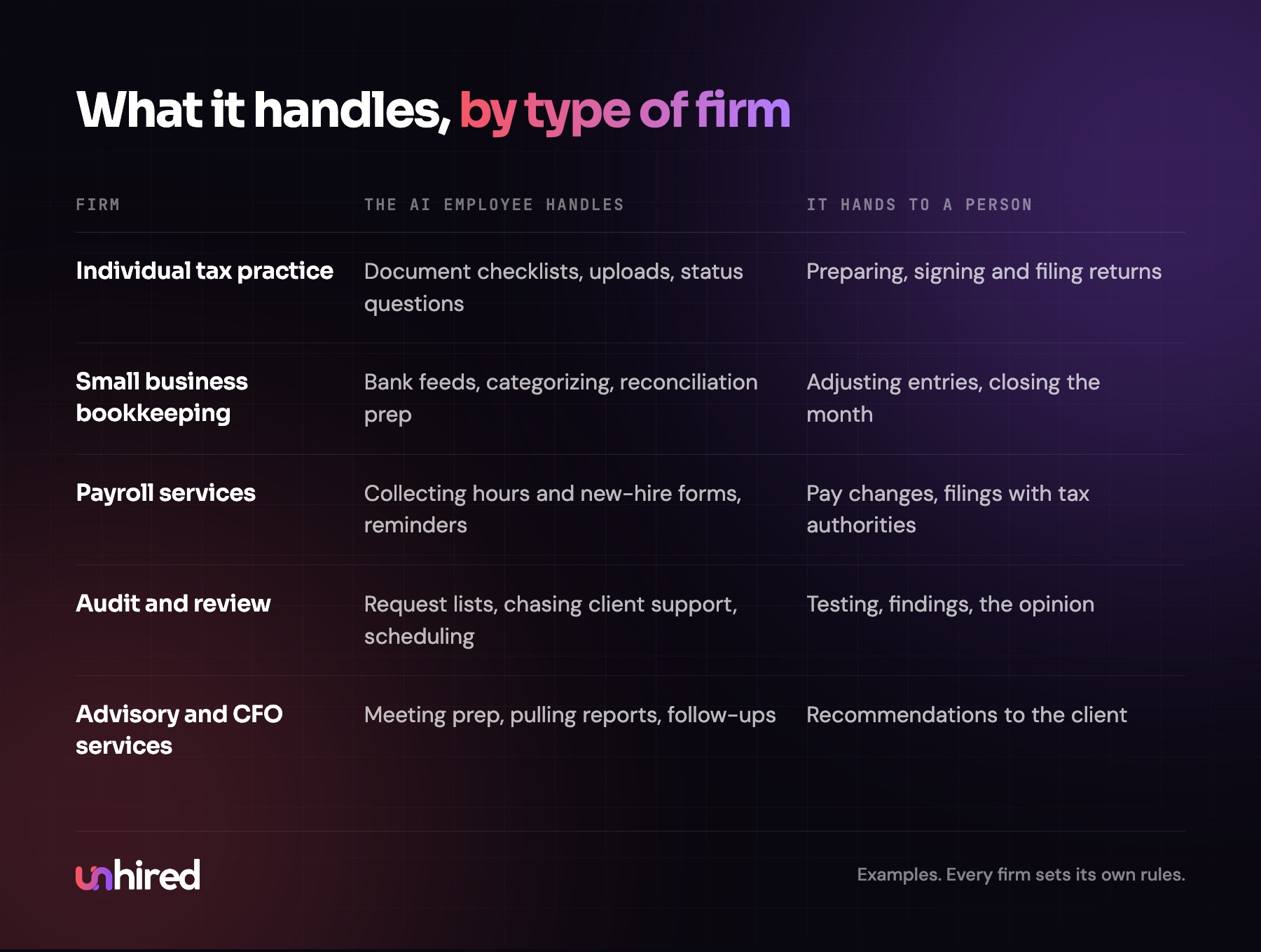
- Anything that signs or files. Returns, financial statements, audit opinions and filings with tax authorities are prepared and signed by the credentialed person responsible for them.
- Advice. "Should I set up an S corp?" or "can I deduct my home office?" is a judgment about one client's situation, and it goes to an accountant. The AI Employee can book the call.
- Changes to a client's numbers. Adjusting entries, reclassifications on a closed period and amended returns are decided by an accountant.
- Notices from a tax authority. An IRS or state letter gets logged, scanned into the file and sent to the assigned accountant the same day. The AI Employee doesn't reply to it.
- Fees and scope. Discounts, write-offs, payment plans and anything outside the engagement letter go to a partner.
- Upset clients and anyone who asks for a person. That handoff happens on the first request.
Clients should also know when they're writing to an AI Employee. I covered how to word that in the post on whether customers should know they're talking to an AI Employee.
Client data and the security rules
Accounting firms hold Social Security numbers, bank details and full financial histories, so the setup starts with security. In the US, tax preparers count as financial institutions under the FTC Safeguards Rule, which requires a written information security plan. The IRS explains what that plan needs in Publication 4557, Safeguarding Taxpayer Data. An AI Employee is one more user and one more vendor that plan has to cover.
In practice that means a few rules I wouldn't bend. It gets its own login with the narrowest access the job needs: the portal, the practice management software and read access to the accounting files of the clients it works on, with no ability to e-file or move money. Client documents only go to AI vendors whose terms say how the data is stored and that it isn't used to train their models. Multi-factor authentication stays on, and every action goes into a log the firm reviews. The post on AI Employee data security covers the general version of this in more detail.
A day in tax season
Here's an example of a Tuesday in March for an AI Employee at a small firm doing individual and small business returns. Three items go to a person, which is what a good log looks like.
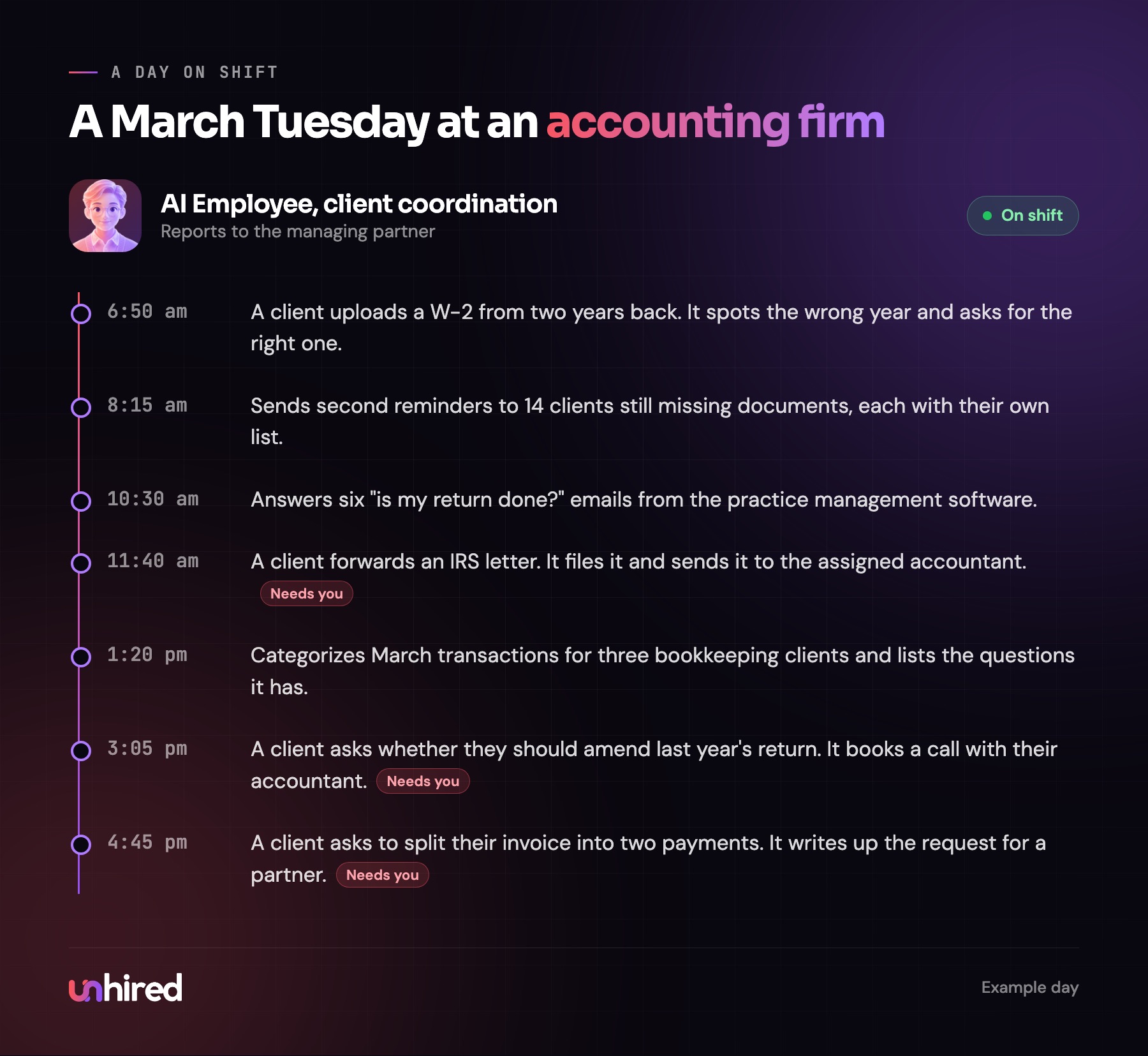
The client who uploaded the wrong year's W-2 at 6:50 am hears about it before anyone is in the office, so the right one arrives by lunch instead of next week. The six "is it done yet?" emails never reach an accountant. The IRS letter, the client asking whether to amend last year and the request to split an invoice all land with the right person, with the file attached.
What the seat costs a person
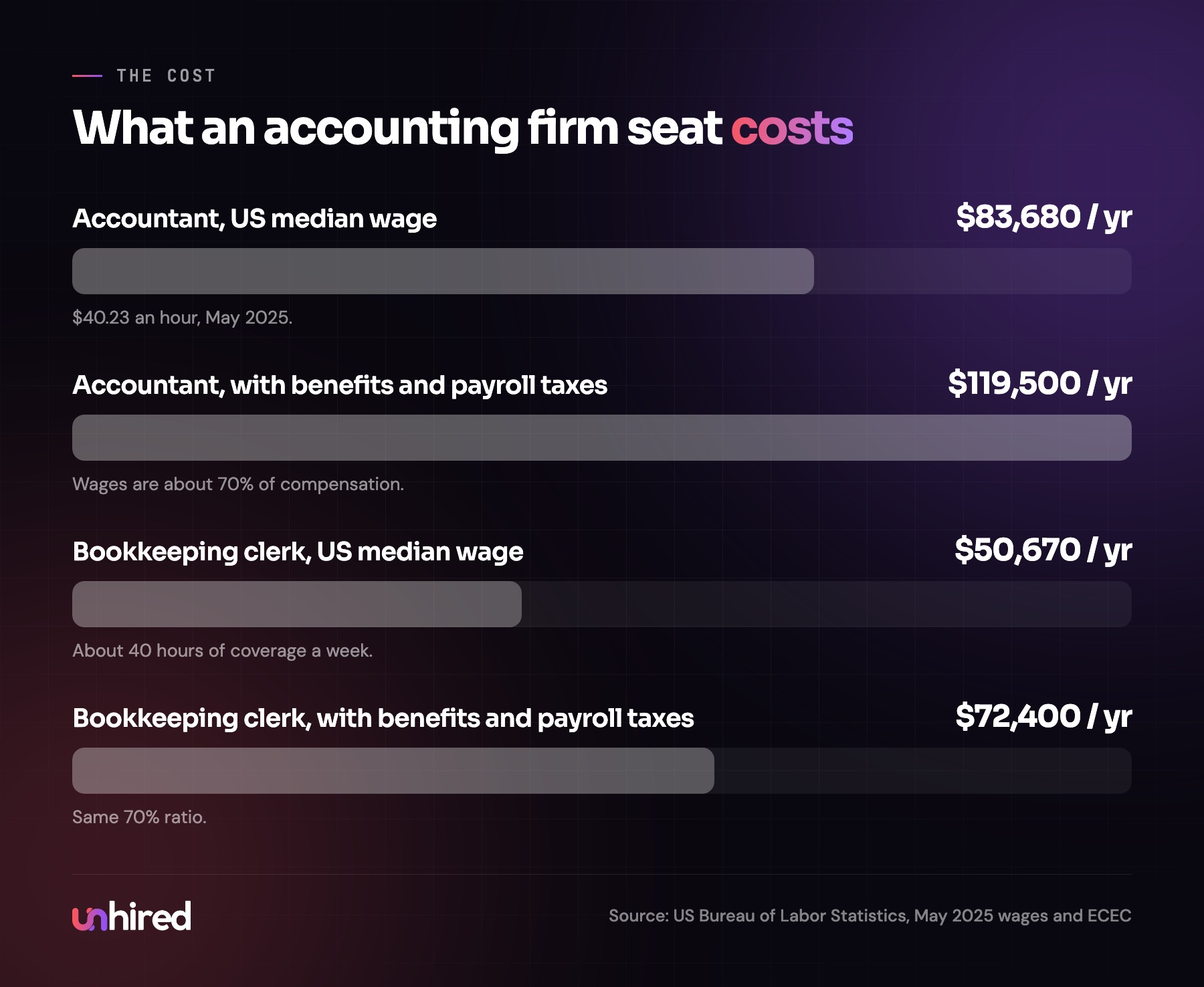
The US Bureau of Labor Statistics puts the median wage for accountants and auditors at $83,680 a year ($40.23 an hour) as of May 2025. Many firms put a bookkeeper or an administrative assistant on the coordination work instead. The BLS median for bookkeeping, accounting and auditing clerks was $50,670 in May 2025, and for secretaries and administrative assistants, except legal, medical and executive, it was $47,540.
Wages are only part of it. Across US private industry, wages and salaries are 70% of what employers spend on compensation, according to the BLS Employer Costs for Employee Compensation report. Firms also pay to recruit and train, and many bring in seasonal help from January to April.
How much you'd pay for an AI Employee at an accounting firm
You can assemble one from software: an AI agent platform, connections to your practice management system, client portal and accounting software, and an email and texting service. The subscriptions are the smaller cost. The bigger one is someone's time writing the document checklists, the deadline rules and the handoff rules, checking the setup against your security plan, testing it on real client files and keeping it current every season.
Or a provider builds and maintains it, usually for a monthly fee. You pay more than the bare software, and someone else handles the setup, the updates when tax forms change, and the log reviews.
The price moves with the number of clients, how many systems it connects to, whether your practice management software has a clean integration, how much bookkeeping it does versus coordination, and how much maintenance is included.
To compare quotes, set them against the full cost of the seat. An accountant at the US median costs $83,680 in pay and about $119,500 once benefits and payroll taxes are counted at the BLS ratio. A bookkeeping clerk at the median comes to about $72,400. Either covers roughly 40 hours a week, and March has more hours in it than that.
How an AI Employee is set up at an accounting firm
Setup looks a lot like onboarding a new admin before busy season, with the security review at the start.
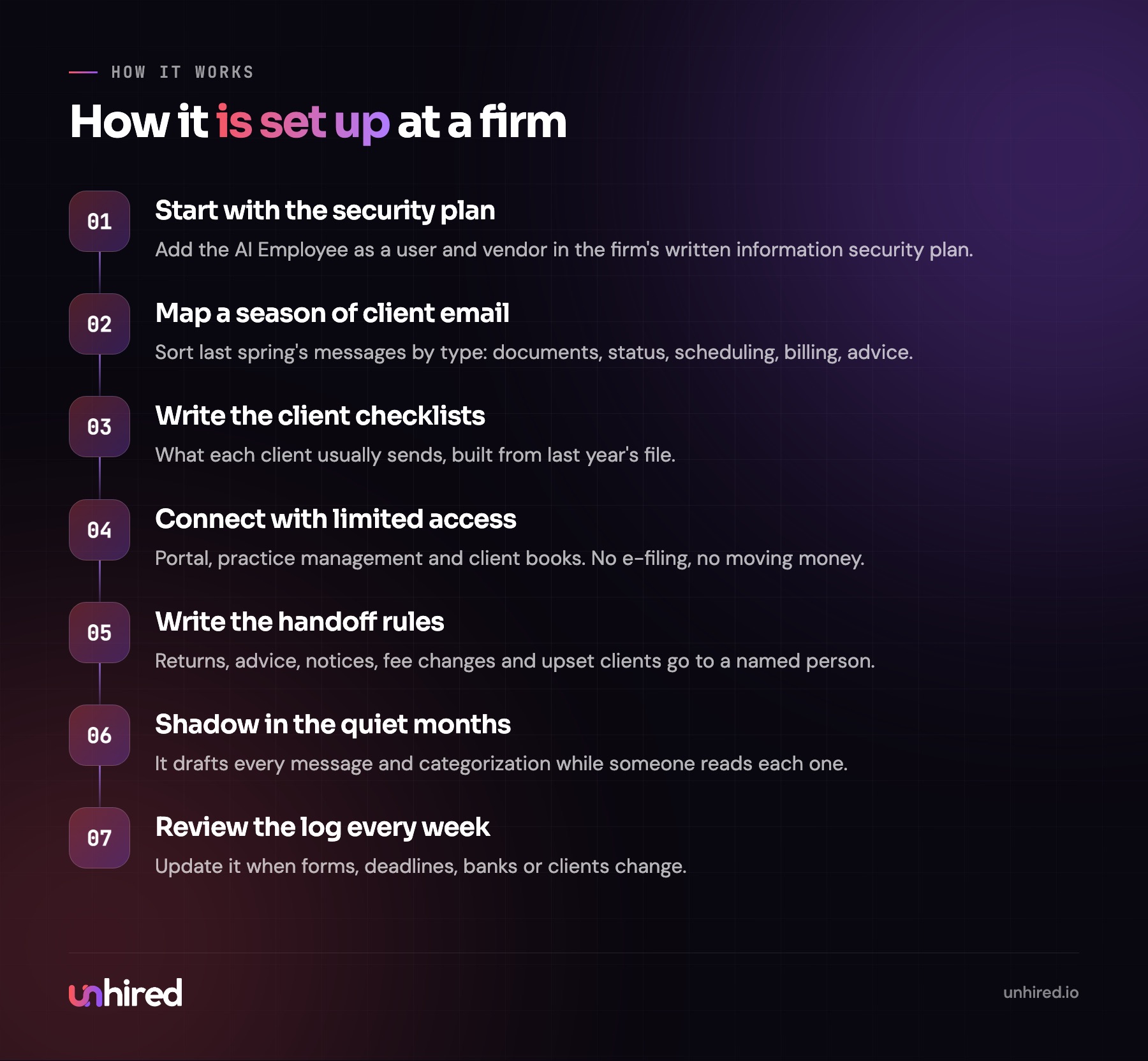
The document checklists are the part that takes real thought. Every accountant has a mental list of what each client usually sends, and very few firms have written it down per client. Writing it down is most of the work, and it's worth doing even without an AI Employee, because it's the reason one accountant's clients get chased on time and another's don't.
The shadow period decides whether it works. Run it in the quieter months, not in March. For the first few weeks, the AI Employee drafts every client message and every categorization, and someone reads each one before it goes out. It takes on more once the drafts are right. After that, someone still reads the log weekly, because tax forms and client banks change, and a rule written last year can be wrong this year.
Is your firm a good fit?
If you have a small book of long-standing clients who drop everything off in one envelope and call you directly, the AI Employee has less to do, and those relationships are probably why clients stay.
If your inbox fills with the same document and status questions every spring, deadlines get tracked in someone's head, and your accountants spend their evenings sorting uploads instead of preparing returns, the coordination seat is a strong candidate for an AI Employee, with your accountants keeping everything that needs a signature.
To check your own firm, pull every client email from last March. Tag each one by type (documents, status, scheduling, billing, advice, other) and note whether it needed an accountant's judgment or just an answer from the file. Some websites offer free assessments that check whether a role like this can be filled by an AI Employee, which is a useful next step once you have that month sorted. Then do the checklist exercise for your top twenty clients before January, because that list is what decides how much of next March you spend answering "did you get my documents?"