
A receptionist seat in the US costs about $54,300 a year once benefits and payroll taxes are added to the $38,010 median wage. If an AI Employee takes on 60% of that job, the work it does is worth about $32,600 a year. That number, minus the time your own staff spend looking after it, is the most its first year can cost and still pay for itself.
That's the calculation I'd make before asking anyone for a price. I've spent four years building AI systems and agents for businesses, and the owners who end up happy with an AI Employee are nearly always the ones who wrote down a break-even number first. The ones who end up disappointed usually took a vendor's ROI slide at face value, built on someone else's volume and someone else's wage.
Where the return on an AI Employee comes from
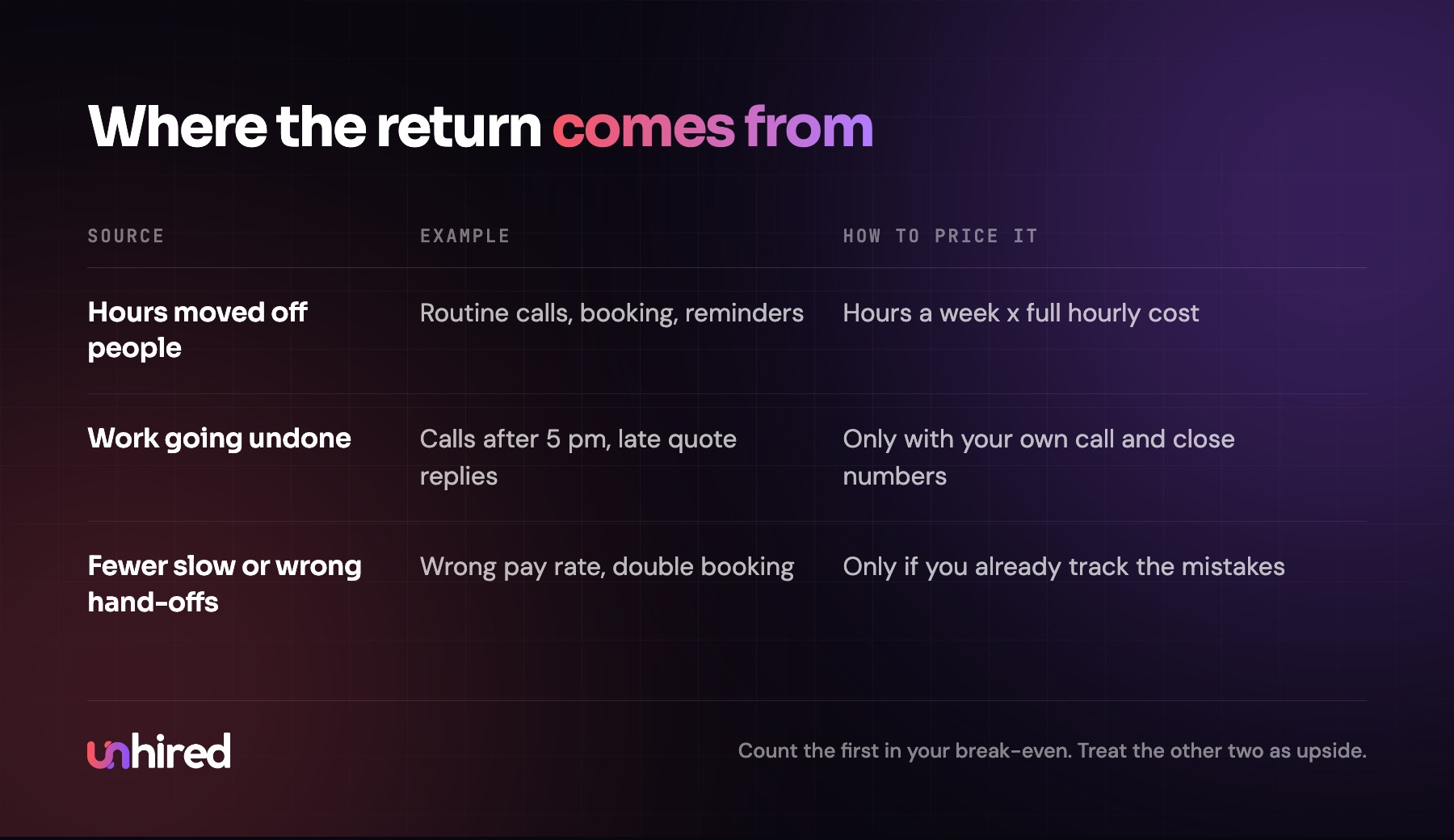
The value shows up in three places. Most businesses only count the first, and some get most of their return from the other two.
Hours of work moved off people
This is the easiest one to price. List the duties the AI Employee would own, estimate the hours each takes a person in a normal week, and multiply by that person's full hourly cost. If the AI Employee is filling an empty seat, the value is the share of the seat's full cost it covers. If it takes work off people you already have, count those hours only if you know what they'll do with them instead. Freed time that turns into longer lunches isn't a return.
Work that was going undone
Every business has work nobody gets to: calls that ring out after 5 pm, quote requests answered two days late, unpaid invoices nobody chases until the end of the month. A law firm missing evening intake calls, an e-commerce store answering order questions the next morning, a property manager whose maintenance requests sit over the weekend. Harvard Business Review's piece on the short life of online sales leads found that most companies are far too slow to answer a lead, and the slow ones lose them.
This value is real but harder to price, so I'd only count it with your own numbers. If you know roughly how many calls go to voicemail each week and what share of answered calls become customers, you can estimate it. If you don't know, leave it out of the break-even and treat it as upside.
Fewer slow or wrong hand-offs
The third is the cost of mistakes and delays: a pay rate typed wrong, a booking that double-books a room, a refund approved twice. An AI Employee that checks each record against the source before saving it cuts some of these. I'd only count this one if you already track the mistakes and know what they cost you. Otherwise it's a guess, and guesses are how ROI estimates go wrong.
The costs to count in the first year
An ROI is only as honest as its cost side, and this is where the slides fall short. For the first year, I'd write down five numbers.
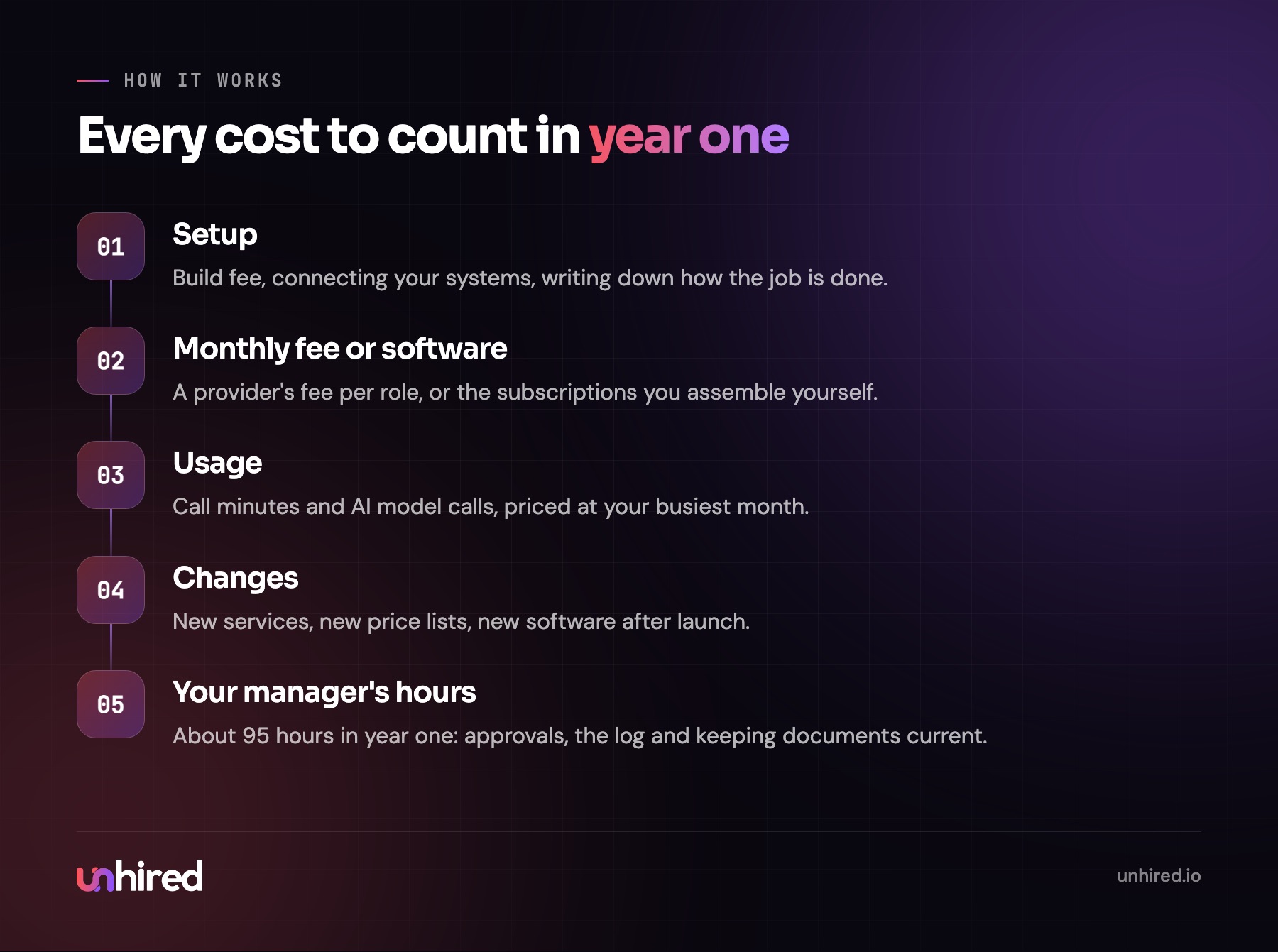
Setup is the first: any build fee, the cost of connecting your booking system, CRM or helpdesk, and the time spent writing down how the job is done. Then the monthly fee to a provider, or the software subscriptions if you assemble it yourself. Third is usage, like phone minutes and AI model calls, priced at your real volume in your busiest month and not your average one. Fourth, changes after launch: a new service, a new price list, new software.
The last is your own staff's time, and it's the one almost every estimate leaves out. Someone has to approve what the AI Employee holds for a person, read its log and keep its documents current. In my post on managing AI Employees I put that at one to two hours a day for the first two weeks, about 30 minutes a day through the second month, and one to two hours a week after that.
Added up over a year, that's roughly 15 hours in the first two weeks, another 15 through the end of month two, and about 65 over the rest of the year. Call it 95 hours of a manager's time in year one.
How to calculate AI Employee ROI
The arithmetic is simple once the inputs are honest.
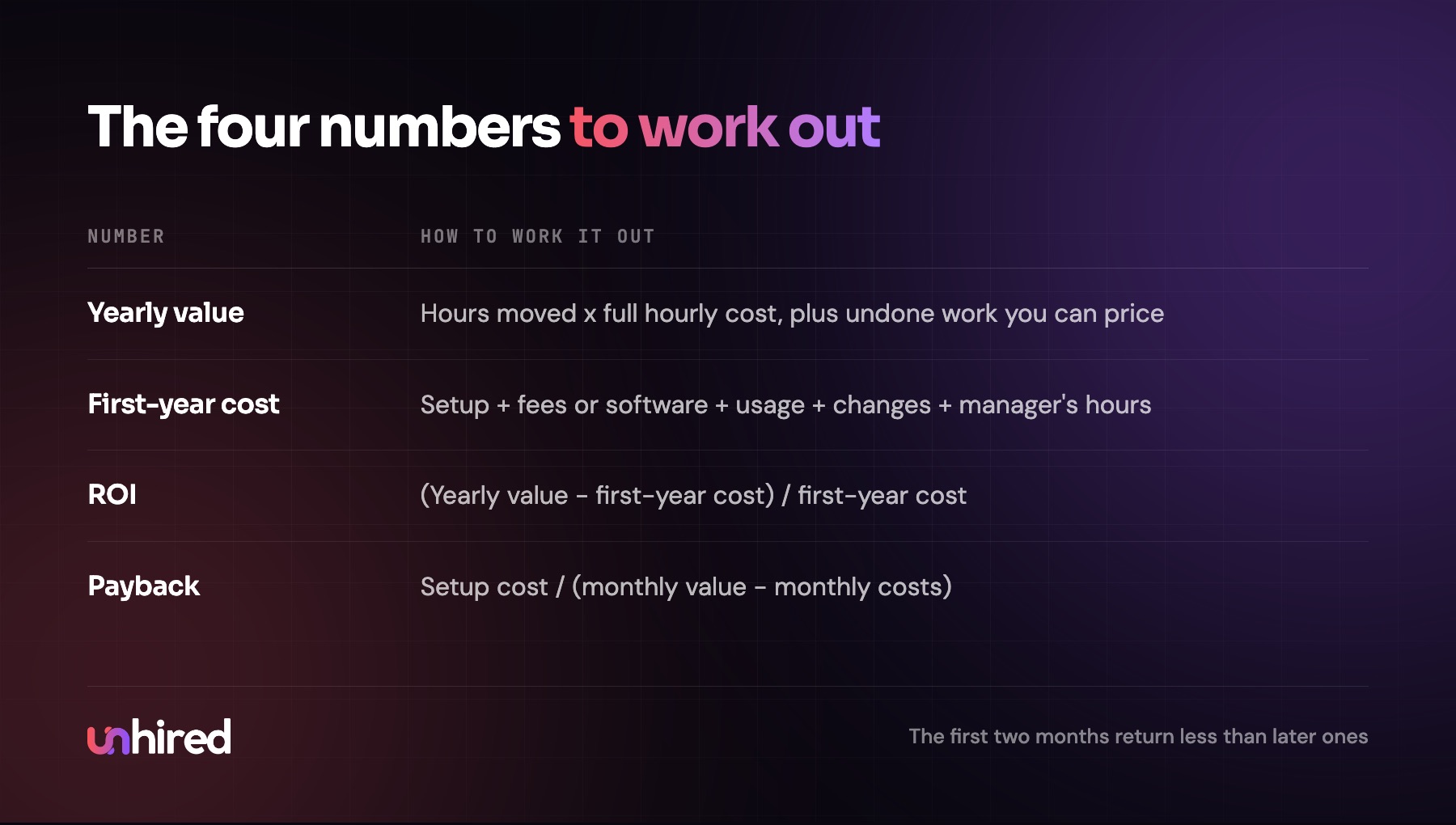
Yearly value is the hours moved, priced at full cost, plus any undone work you can price from your own numbers. First-year cost is the five items above. ROI is the value minus the cost, divided by the cost. A result of 1.0 means the year returned its cost twice over: once to break even, once more as gain.
The payback period tells you how long you wait. Take the monthly value, subtract the monthly costs (fee or software, usage and the manager's hours), and divide the setup cost by what's left. If the answer is longer than a year, I'd look hard at whether the role is the right first one.
One thing to watch: the first two months return less than the rest. The AI Employee runs with more of its work held for approval, and the manager spends far more time on it. A payback worked out from month six numbers will look shorter than the one you actually get.
A worked example: the break-even for a receptionist seat
Here's the break-even for a front desk at a clinic, an accounting firm or a property management office. The wage figures are sourced. The 60% share of the job is an assumption for the example, the kind of number you'd get from going down your own duty list.
The US median wage for receptionists was $38,010 in May 2025. Across private industry, wages are about 70% of what employers spend on compensation (BLS Employer Costs for Employee Compensation), so the seat costs about $54,300 a year, or roughly $26 an hour over 2,080 hours.
Say the duty list shows 60% of the job is answering routine calls, booking, rescheduling and sending reminders, all work an AI Employee can own. That share is worth about $32,600 a year.
Now the manager's time. If the office manager's seat costs about what an administrative assistant's does, $48,310 in wages and about $69,000 in full cost, their hour is worth around $33. Ninety-five hours in year one comes to about $3,200.
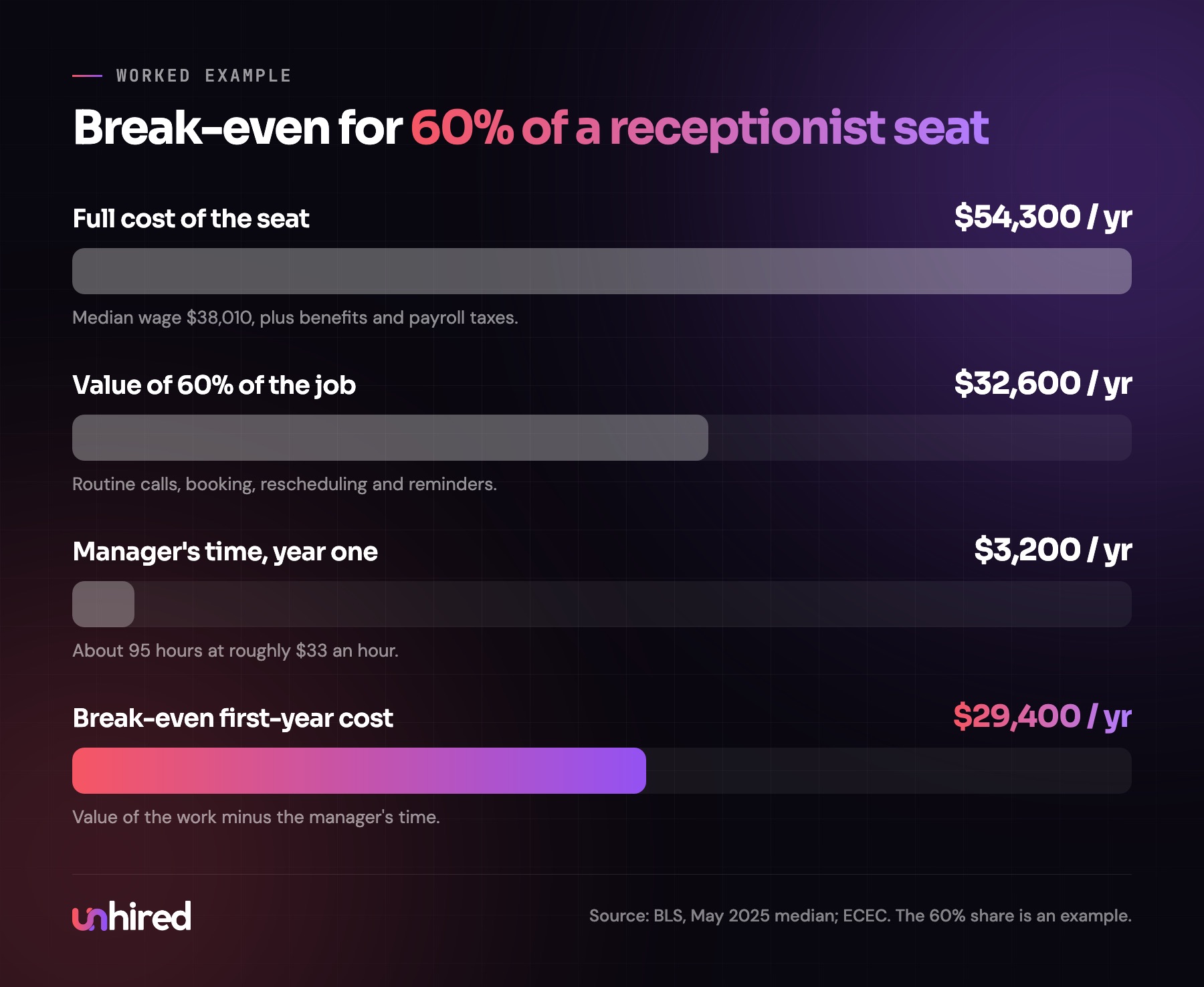
So the break-even is about $29,400. A first year (setup, fees, usage and changes together) that costs less than that pays for itself on the hours alone, before counting a single after-hours call it answers. A first year that costs more needs the undone work to make up the difference, and you'd want your own numbers to show it does.
Change the share and the answer moves a lot. At 40% of the job, the value is about $21,700 and the break-even drops to around $18,500. That's why the duty list matters more than any other input.
Where AI Employee ROI estimates go wrong
Most of the bad estimates I see make the same few mistakes.
The first is counting the whole seat when the AI Employee covers part of it. If the receptionist still has to be there for walk-ins, you haven't saved a receptionist. Count the share.
Next is using wages instead of full cost on the value side while ignoring staff time on the cost side. That flatters the result twice. Be consistent: full cost for the work moved, and full cost for the manager's hours too.
Then there's pricing usage at the average month. A property manager's phones are busiest in the first week of the month, and an online store's in December. Price usage at the peak.
The last is counting freed hours that nobody uses. If the bookkeeper gets back eight hours a week and spends them the way they spent the slow parts of the old week, there's no return. Name what those hours go to before you count them.
What drives the return up or down
Volume helps most. An AI Employee handling 300 booking requests a month returns more than one handling 40, because the setup and management time barely change while the value scales with the work.
Clean rules help next. A job where most cases follow a written process gives a high share of work it can own. A job full of exceptions and judgment calls gives a low share and more manager time.
How it's priced matters too. Assembling it yourself from software keeps the fee low but moves build and maintenance hours onto your staff, and those hours belong on the cost side. A provider's monthly fee includes that work, so the number on the quote is higher and your staff line is lower. My post on what an AI Employee costs covers the four pricing models and how to line quotes up.
Work out your break-even before you ask for a price
Do this on one page. List the duties of the role, the hours each takes in a normal week, and mark the ones that need a person's judgment. Add up the hours an AI Employee could own, price them at full cost, and subtract about 95 hours of your manager's time in year one. That's your break-even.
If you're not sure which duties belong on the AI side, some websites offer free assessments that check whether a role can be filled by an AI Employee. Once you have the number, ask every provider or tool to quote the same duty list for a full first year, and set each total against it. Any quote that comes in under the break-even is worth a serious look. Any that comes in over it needs to show you, with your own numbers, where the rest of the return comes from.
Wage data: US Bureau of Labor Statistics, Occupational Outlook Handbook, May 2025 medians for receptionists and secretaries and administrative assistants; full-cost figures use the BLS Employer Costs for Employee Compensation share of wages in total compensation. The 60% share and manager hours are estimates for the example, the hours from my own work.