
"Where is my order?" Every online store gets that email more than any other, and the answer is nearly always sitting in two places: the order record and the carrier's tracking page. Someone on the team still opens Shopify, opens the tracking link and types a reply, dozens of times on a normal day and far more in the week after a sale.
I've spent the last four years building AI systems and agents for businesses, and ecommerce support is one of the easier jobs to sort. Most tickets are a lookup plus a policy: has the order shipped, and is the return still inside the 30-day window. A smaller share needs someone to decide something, and those are the tickets where a good support person earns their pay.
This post covers what an AI Employee does in an online store's support inbox, what it should always hand to a person, the rules about refund promises and shipping delays, and how the cost compares to a support hire.
What the job involves
A store selling skincare and a store selling standing desks get the same kinds of tickets in different proportions. Customers want to know where the parcel is, how to send something back, whether they can change the order they placed ten minutes ago, and which size to buy. At a store with a few people, the owner answers these at night, or one support person works a shared inbox across email, chat and Instagram messages.
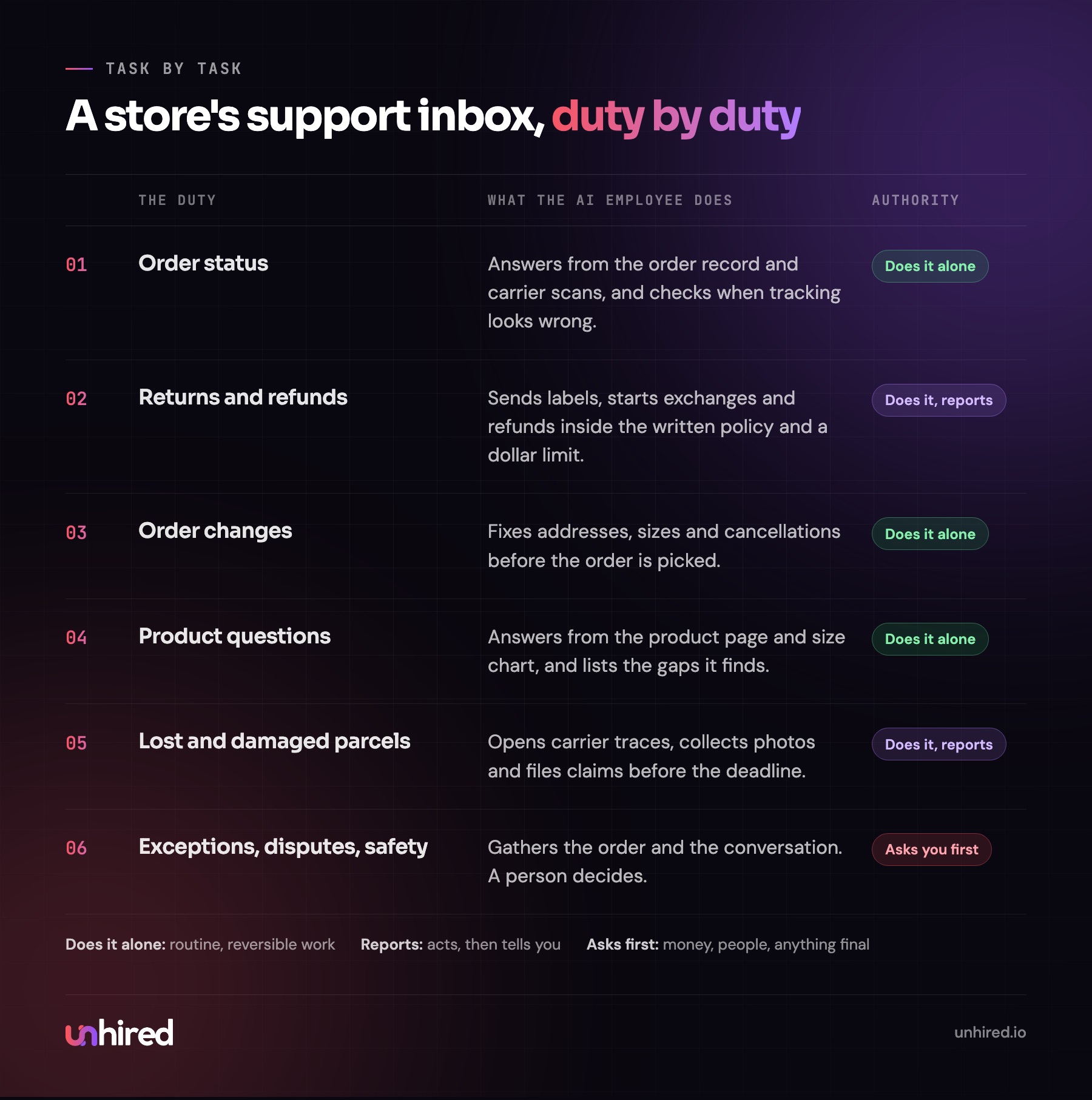
An AI Employee in this role holds that job the way a person would. It reports to the owner or the operations lead, has its own logins to the store platform, the help desk and the shipping software, and works under written rules about what it can do alone. Every action goes into a log. I wrote a general version of this role in the post on the AI customer support employee. For a store, the duties break down like this.
Order status and tracking
It reads the order record and the carrier scan history and answers in plain words: packed yesterday, picked up by UPS this morning, due Thursday. The useful part is what it does when the tracking looks wrong. A label created four days ago with no pickup scan usually means the parcel never left the warehouse, so it checks with whoever packs orders before telling the customer anything.
Returns, exchanges and refunds
The return policy becomes a set of rules: the window, who pays return shipping, which items are final sale, and whether a refund waits for the item to arrive back. Inside those rules the AI Employee sends the return label, starts the exchange and issues the refund through the store platform. It works under a dollar limit the owner sets. A $40 refund on an order inside the window doesn't need a person. A $900 refund does.
Order changes before shipping
A wrong address or a different size is easy to fix when the order hasn't been picked and close to impossible once it's on a truck. The same goes for cancellations, so speed matters more here than anywhere else in the inbox. An AI Employee that answers at 11 pm catches the address typo before the morning pick.
Product questions before the sale
Customers ask whether a bag fits a 15-inch laptop or whether a cleanser is safe for sensitive skin. The AI Employee answers from the product page and the size chart, and tells the customer plainly when nothing written covers their question. I'd keep a running list of those gaps, because each one is a product page that needs a line added.
Lost, late and damaged parcels
When a parcel stalls, it opens a trace with the carrier and tells the customer what happens next and when. For damage, it asks for photos, sends the replacement if the value is under its limit, and files the carrier claim with the photos attached. Claims have deadlines, and filing them is the kind of chore that slips when a small team is busy.
Subscriptions and account questions
Skipping a month, changing the delivery date, updating an address, resetting a password. These are quick and frequent at any store with a subscription product. A customer who wants to cancel gets the cancellation, without a maze of offers in the way.
What it should always hand to a person
These are the situations I'd route to a named person every time, with the order history and the conversation written up:
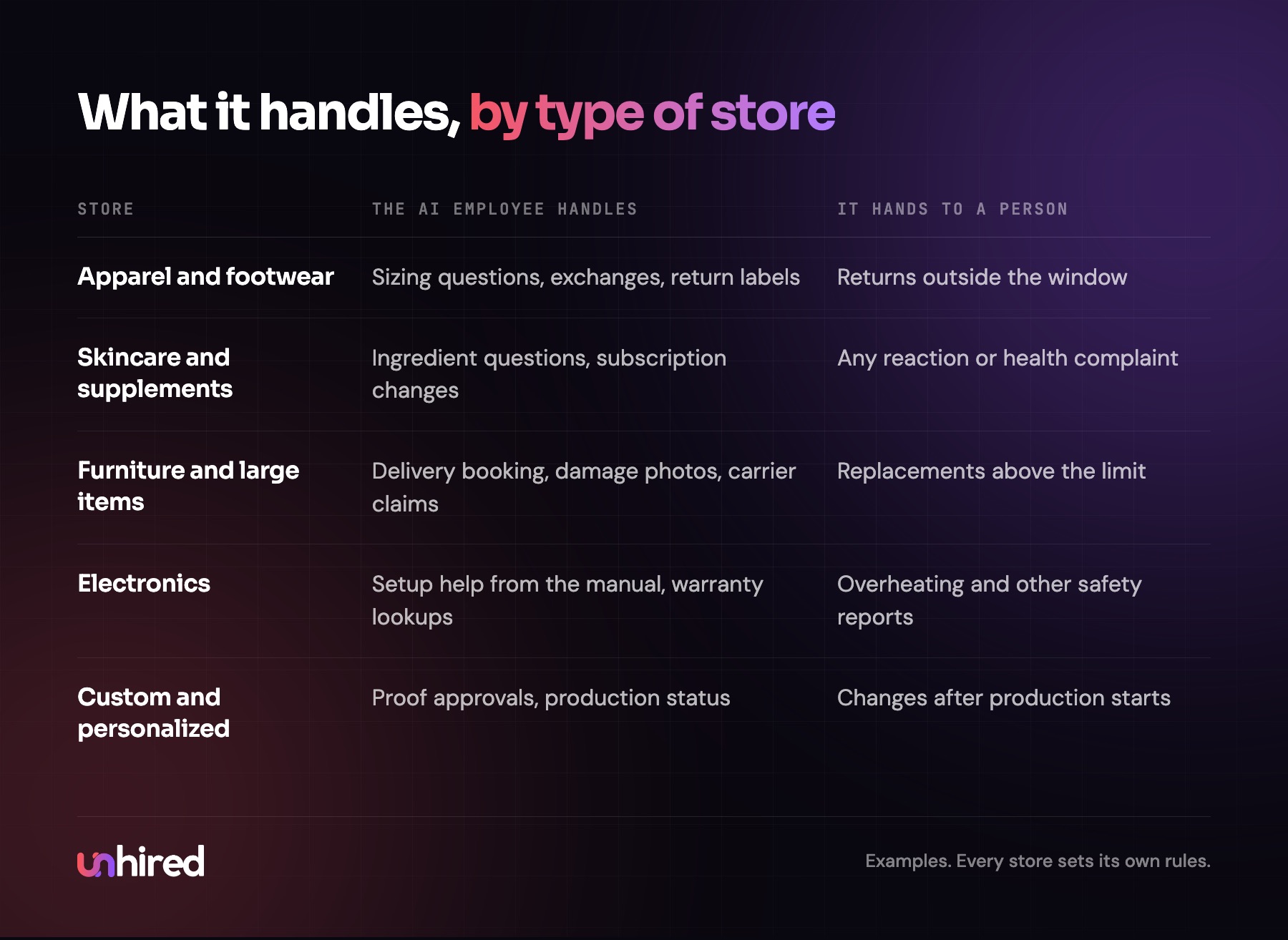
- Refunds and replacements above the limit, and any request outside the written policy. A return 12 days past the window might deserve a yes, and a person makes that call.
- Card disputes. A chargeback notice has a deadline and needs evidence. The AI Employee gathers the order and the tracking, and a person responds.
- Signs of fraud, such as a request to reroute an expensive order to a new address right after payment.
- Anything about safety or health. A rash from a face cream, a charger that overheated, a child's toy that broke into small parts. It stops, apologizes, and sends it to the owner the same hour.
- Wholesale inquiries and creators asking for free product.
- Upset customers and anyone who asks for a person. That handoff happens on the first request.
Customers should also know when they're writing to an AI Employee. I covered the wording in the post on whether customers should know they're talking to an AI Employee.
Refund promises and shipping rules
Two rules shape the setup more than any software choice.
The first is that the store owns whatever its AI tells a customer. In 2024 a Canadian tribunal ordered Air Canada to pay a customer after the chatbot on its website gave him wrong information about a bereavement fare. The airline argued the chatbot was responsible for its own words, and the tribunal rejected that (Moffatt v. Air Canada). For a store, that means the AI Employee quotes the written policy and nothing else. If the policy doesn't cover a situation, it asks a person before it answers.
The second is shipping delays. In the US, the FTC's Mail, Internet, or Telephone Order Merchandise Rule requires a seller to ship within the time it advertised, or within 30 days if it gave no time. A seller that can't must tell the customer and offer the choice to wait or cancel for a refund. An AI Employee is well suited to this, since it can watch for orders about to pass their promised date and send the notice before the customer writes in. Someone still has to decide what the new date is.
Card details stay out of it entirely. The payment processor holds them, refunds go back to the original payment method through the store platform, and the AI Employee's login has no access to payment settings.
A day after a sale weekend
Here's an example Monday for an AI Employee at a store that ran a promotion over the weekend. Three items go to a person.
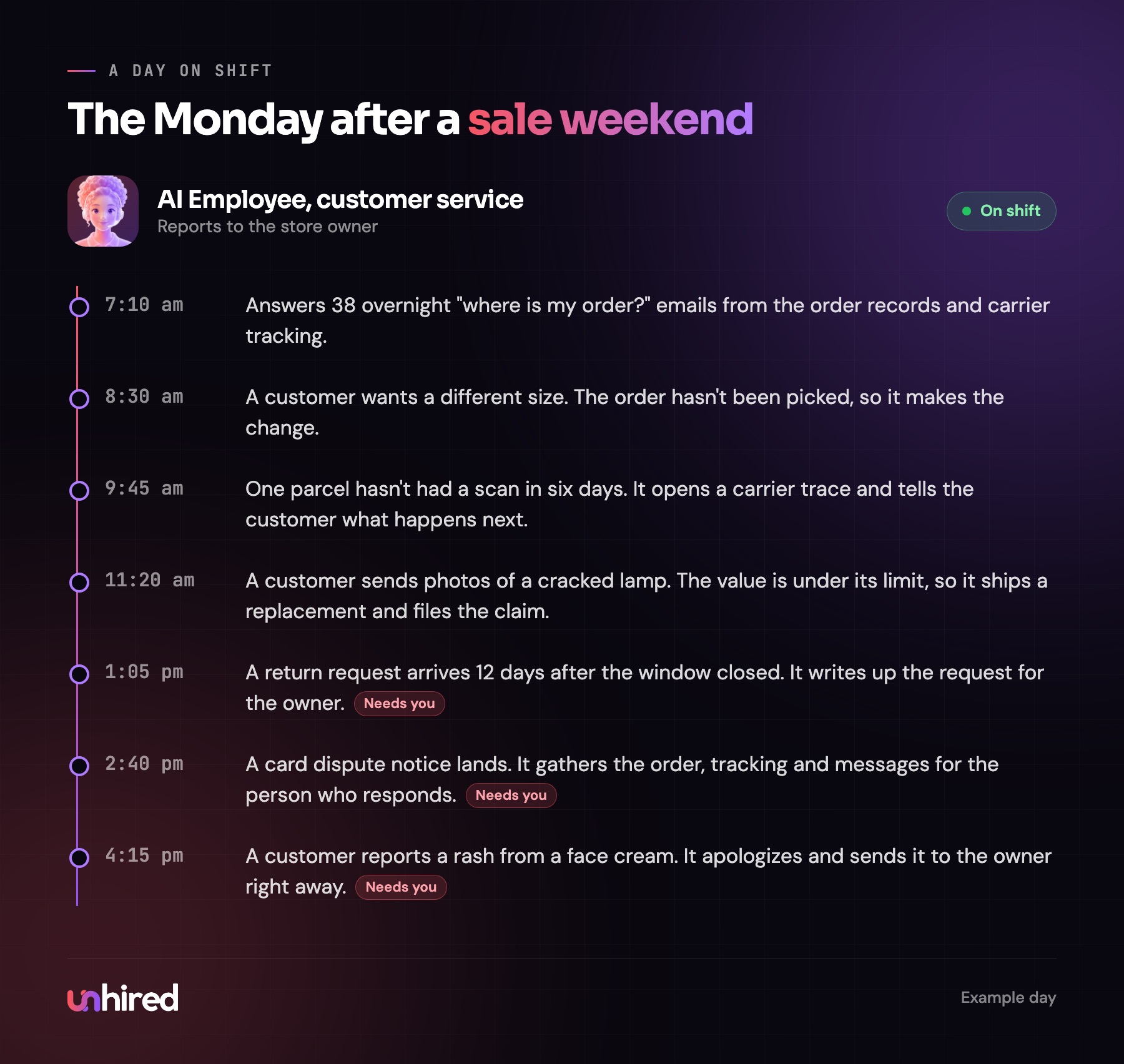
The overnight order status emails are answered before anyone logs in. The size change gets made because the order hadn't been picked yet. The late return, the card dispute and the skin reaction each land with a person, with everything needed to decide already attached.
What the seat costs a person
The US Bureau of Labor Statistics puts the median wage for customer service representatives at $44,770 a year as of May 2025, or $21.53 an hour.
Wages are only part of it. Across US private industry, wages and salaries are about 70% of what employers spend on compensation, according to the BLS Employer Costs for Employee Compensation report. At the median wage, that puts one full-time representative at about $64,000 a year before recruiting and training.
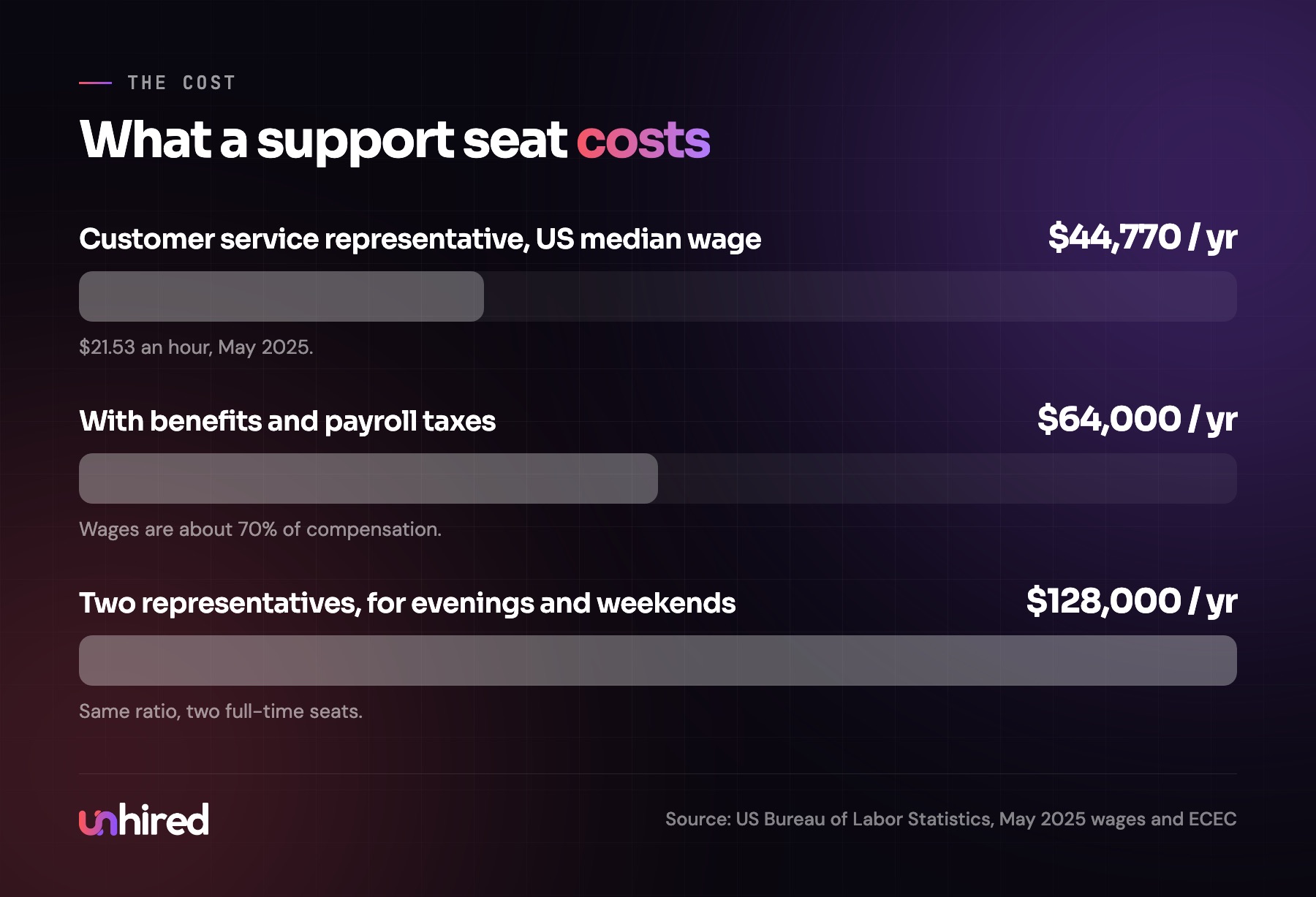
One person covers about 40 hours a week. Orders come in on all seven days, and a store that wants replies on evenings and weekends needs a second person or a lot of the owner's time.
How much you'd pay for an AI Employee at an online store
You can assemble one from software. Most help desks now sell an AI add-on, often priced per resolved conversation, and an AI agent platform can be connected to the store platform, the shipping software and the carrier accounts. The subscriptions are the smaller cost. The bigger one is someone's time turning the policies into rules, setting the limits, testing it on real tickets and updating it before every sale.
Or a provider builds and maintains it, usually for a monthly fee. You pay more than the bare software, and someone else handles the setup and the updates when your policies or your carriers change.
The price moves with ticket volume, the number of channels (email only, or chat and social messages too), how many systems it connects to, whether it can take actions like refunds or only answer questions, and how much maintenance is included. Per-conversation pricing looks cheap in a quiet month and can jump in November, so ask what a peak month would cost.
To compare quotes, set them against the full cost of the seat: about $64,000 a year for one representative at the US median, for 40 hours of coverage a week.
How an AI Employee is set up at an online store
Setup looks like training a new support person, with more written down.
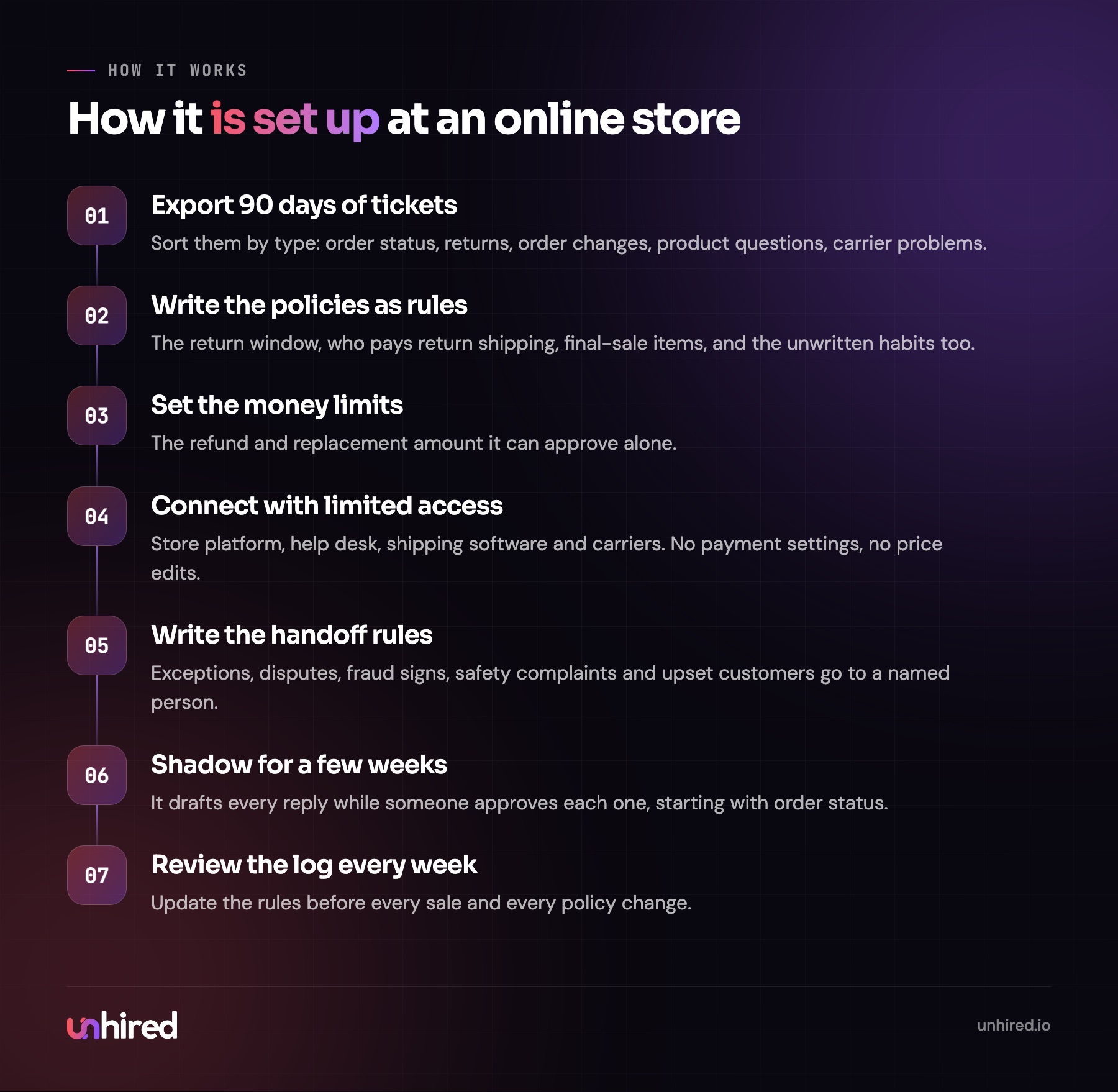
The policy step takes the longest. Most stores have a returns page for customers and a second, unwritten policy in the support person's head: a damaged item under $50 gets replaced without being sent back, regulars can return late, shipping is never refunded. The AI Employee can only follow the version that's written, so the unwritten one has to come out and be agreed on.
During the shadow period it drafts every reply and a person approves each one. It takes on ticket types one at a time, starting with order status, once its drafts stop needing edits. After that, someone reads the log weekly and updates the rules before every promotion, because a sale changes the return terms and the shipping times at once.
Is your store a good fit?
If you get a handful of tickets a day and most are custom requests or conversations with repeat buyers who know you by name, there's less here for an AI Employee to do. Those conversations are probably part of why people buy from you.
If the same five questions fill the inbox, replies wait until morning, and the week after every sale buries whoever handles support, the seat is a strong candidate. Your team keeps the exceptions and the customers who need a person.
To check your own store, export the last 90 days of tickets from your help desk and tag each one by type: order status, return, order change, product question, carrier problem, other. Then mark which ones were answered straight from the order record and the policy, and which needed a decision. AI Employee assessments, such as the one offered by Unhired, can be a good place to start once you have that split. Whatever you decide, write down the unwritten return policy this week. Every person who answers your customers, new hire or AI Employee, will give better answers for it.