
Open the aging report in QuickBooks or Xero and look at the 31 to 60 day column. In my experience, most of what sits there is late for a boring reason. The invoice went to a contact who left the customer's company in the spring. It was missing the purchase order number, so their payables team parked it. Or one reminder went out, nobody replied, and the person who sent it got pulled onto payroll.
Very little of that is a customer refusing to pay. It's follow-up that didn't happen, and follow-up on a schedule is work an AI Employee does well. This post covers what an AI accounts receivable clerk does between the invoice and the matched payment, what it should hand to a person, how one is set up and what it costs next to a hire.
What an AI accounts receivable clerk is
It's an AI Employee that holds one seat: the money owed to the business. It has a manager, usually the owner, a controller or the office manager. It has logins to the accounting software and the inbox invoices go out from, it can read the bank feed, and it works from written rules about what it can do alone and what needs a person. Every email it sends and every payment it matches goes into a log.
Accounting software already sends automatic reminders, and they help. They also send the same reminder to the customer who paid by cheque yesterday, the one who is disputing the invoice, and the one whose payables team has asked twice for a PO number. An AI accounts receivable clerk reads the reply, checks the bank feed and looks at the account before it sends anything.
It's a narrower job than the one in my AI Bookkeeper post. A bookkeeper also codes bills and closes the month. This seat only works receivables, which is the right scope when invoicing volume is high or when collections is the part that keeps slipping.
The receivables cycle, step by step
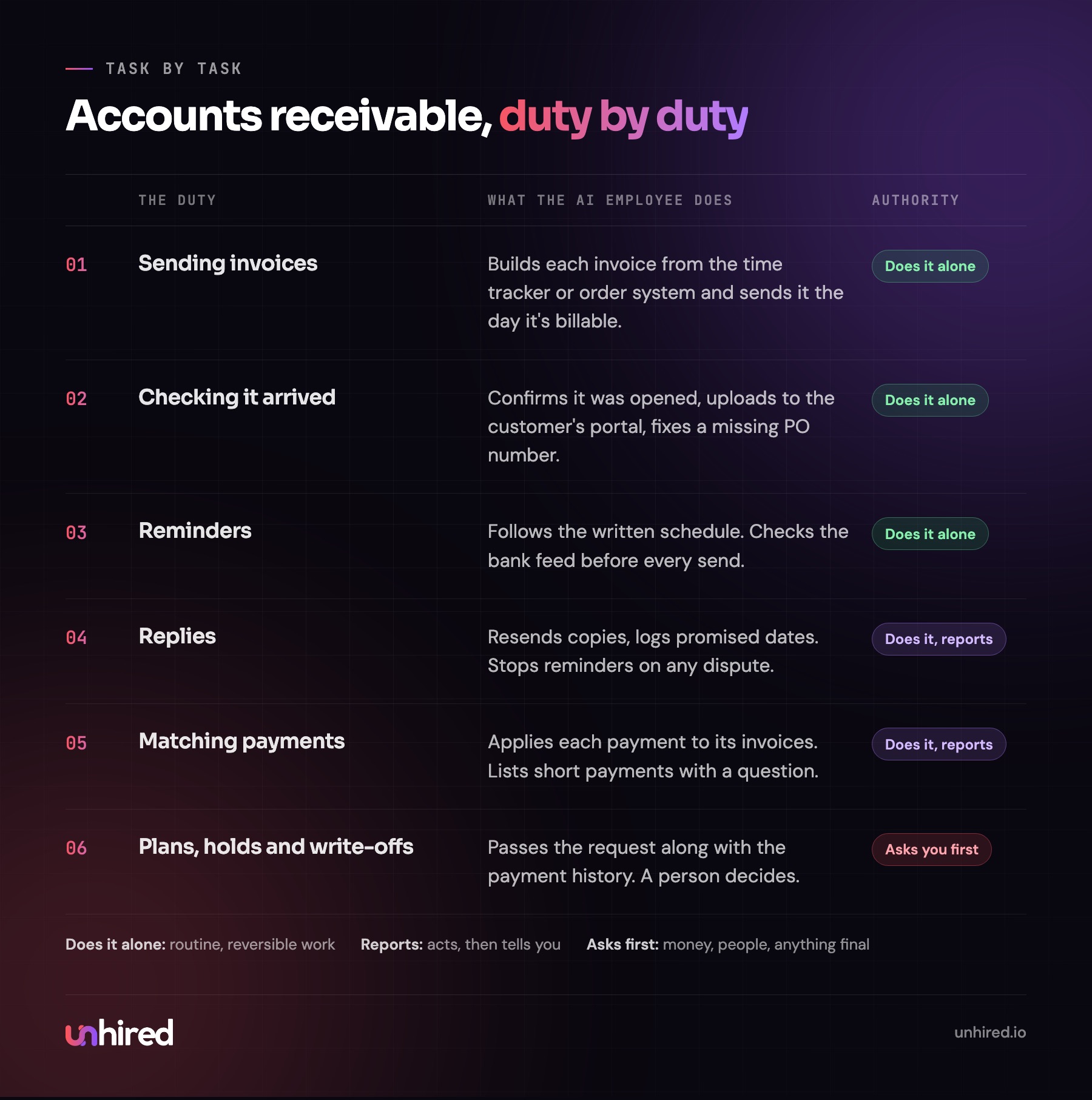
I'd split the job into six duties, each with the authority level I'd give it.
Getting the invoice out
An IT services firm bills managed-service contracts on the 1st and project hours when a ticket closes. A staffing agency bills every week from approved timesheets. A wholesaler bills when the order ships. In each case the invoice should leave the day the work is billable, and at many small businesses it leaves when somebody has a free afternoon.
The AI accounts receivable clerk builds each invoice from the source, whether that's the time tracker, the timesheet system or the shipping record, checks it against the contract rate and sends it. An invoice that doesn't match the contract waits for a person.
Making sure it arrived
This is the step most businesses skip, and in my experience it's behind more late payments than any other. Three days after sending, the AI clerk checks whether the invoice was opened. If the customer uses a payables portal such as Coupa or Ariba, it uploads the invoice there and confirms the status. If the email bounced, it finds the current payables contact and resends.
It also checks the things a payables team rejects without telling you, mostly a missing PO number or the wrong legal entity name. When a new customer asks for a W-9 before they'll pay, it sends the one you've approved.
Reminders before and after the due date
I'd give it a written schedule, in your wording, and I'd have it stop at a set point and hand the account to a person. Something like this:
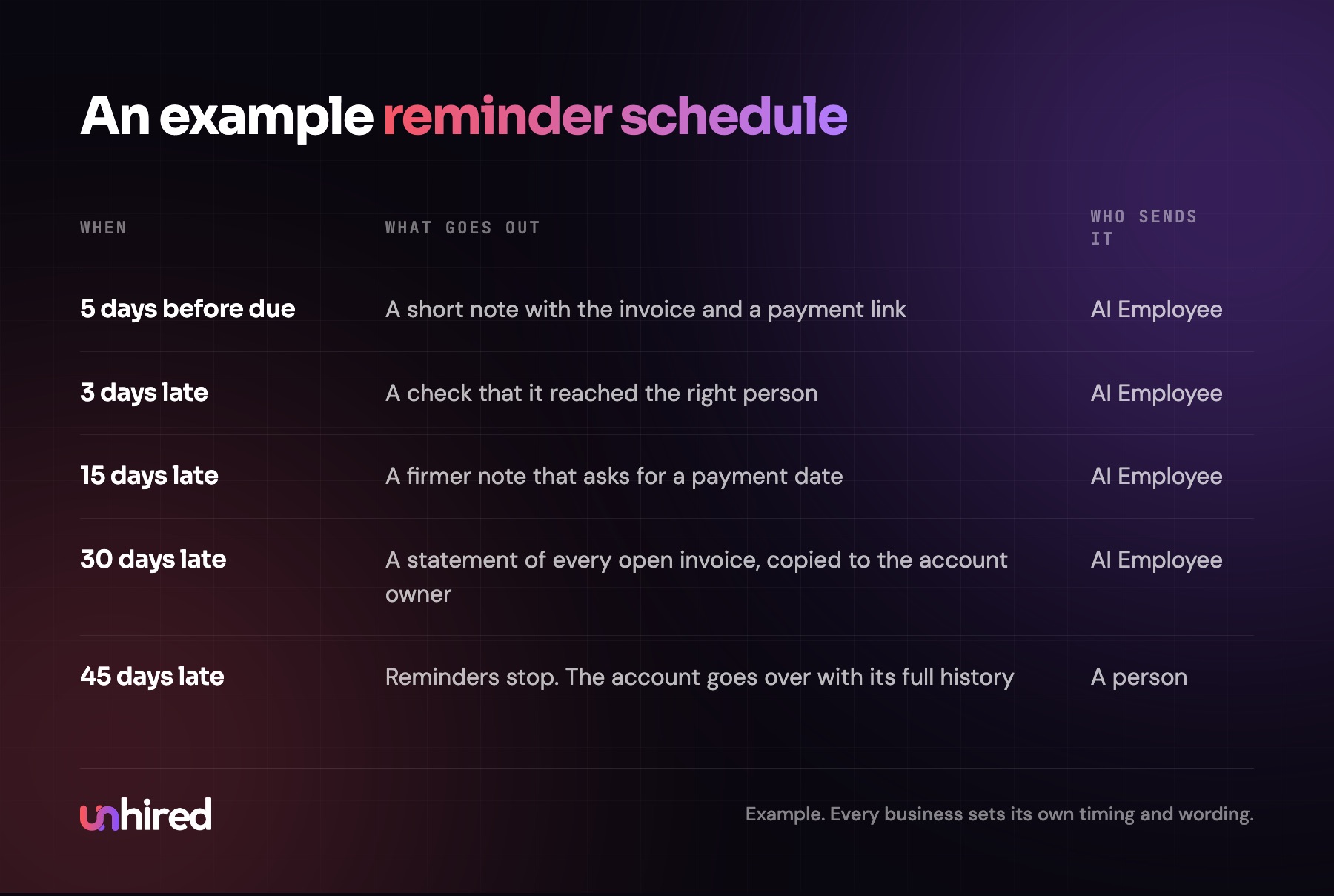
Before any reminder goes out, it checks the bank feed and the mailbox for a remittance notice. A reminder sent the day after a customer paid makes a business look disorganized, and it's the most common complaint about automatic reminders.
Answering replies
Customers reply to reminders, and the replies fall into a few groups. "Can you resend it?" and "Which PO was this for?" get answered on the spot. "It's scheduled for Friday's payment run" gets logged, and the next reminder moves to the following Monday. "We're not paying this, the work wasn't finished" stops every reminder on that invoice and goes to the account owner the same hour.
Matching payments
Payments rarely arrive tidy. One $18,240 transfer covers four invoices with a $60 bank fee taken off. A cheque comes in $200 short with no note. A card payout from Stripe bundles nine customers into one deposit. The AI clerk matches each payment to the invoices it covers using the remittance advice and the customer's history, and applies it. A short payment or one it can't place goes on a list with a question attached.
The weekly aging report
Every Monday it sends the manager one page: what's owed by age, which accounts moved a column since last week, which customers have promised a date, and the three or four accounts that need a person's call. A good aging report is short enough that someone reads it.
What it should hand to a person
Collections decisions are relationship decisions, so the list of things I'd keep with a person is longer here than the software suggests.
- Payment plans and extended terms. The AI clerk passes the request along with the customer's payment history. A person says yes or no.
- Disputes. If a customer questions the work or the price, reminders stop and the account owner takes over.
- Credit holds and stopping work. Cutting off a customer is the owner's call.
- Write-offs, credits and discounts for paying early, unless they're in your written policy.
- Sending an account to a collections agency or a lawyer.
One more belongs on the list for fraud reasons. Criminals send customers emails that look like yours, saying you've changed banks. The AI clerk should never send new bank details by email, and any real change to how customers pay you should be announced by a person, by phone, to a contact already on file.
If you bill consumers, such as patients or tenants, the rules on contacting people about money they owe are stricter than for business customers, and they differ by country. Have whoever advises you on that read the reminder wording before it goes live.
A Tuesday in receivables
Here's an example day for an AI accounts receivable clerk at a 25-person IT services firm. Three items go to a person, and that's how it should look.
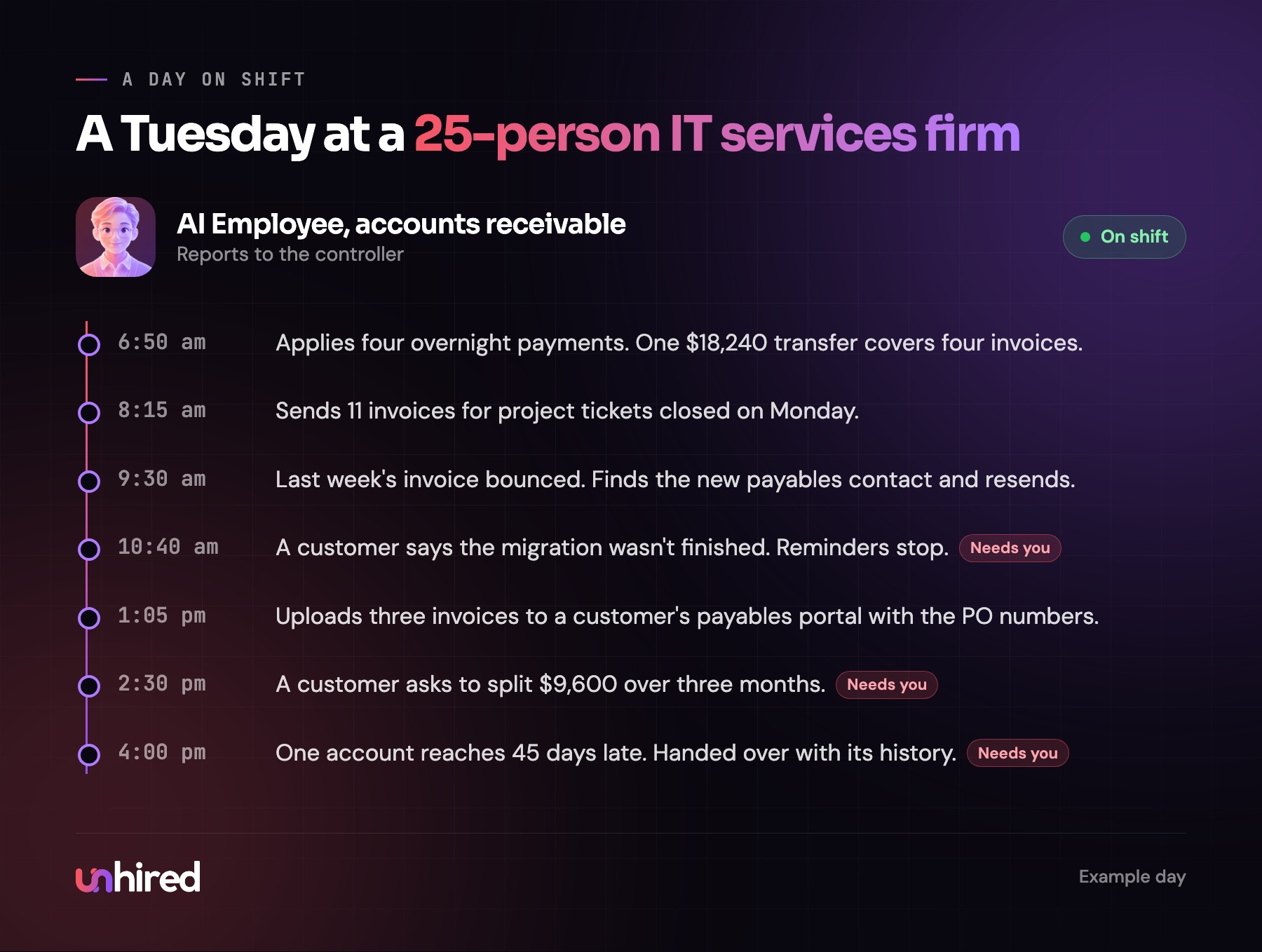
The overnight payments are applied before the controller logs in. The customer whose invoice bounced gets it again at the right address. The dispute, the payment plan request and the account that has reached 45 days all land with a person, each with the history attached.
What a receivables hire costs
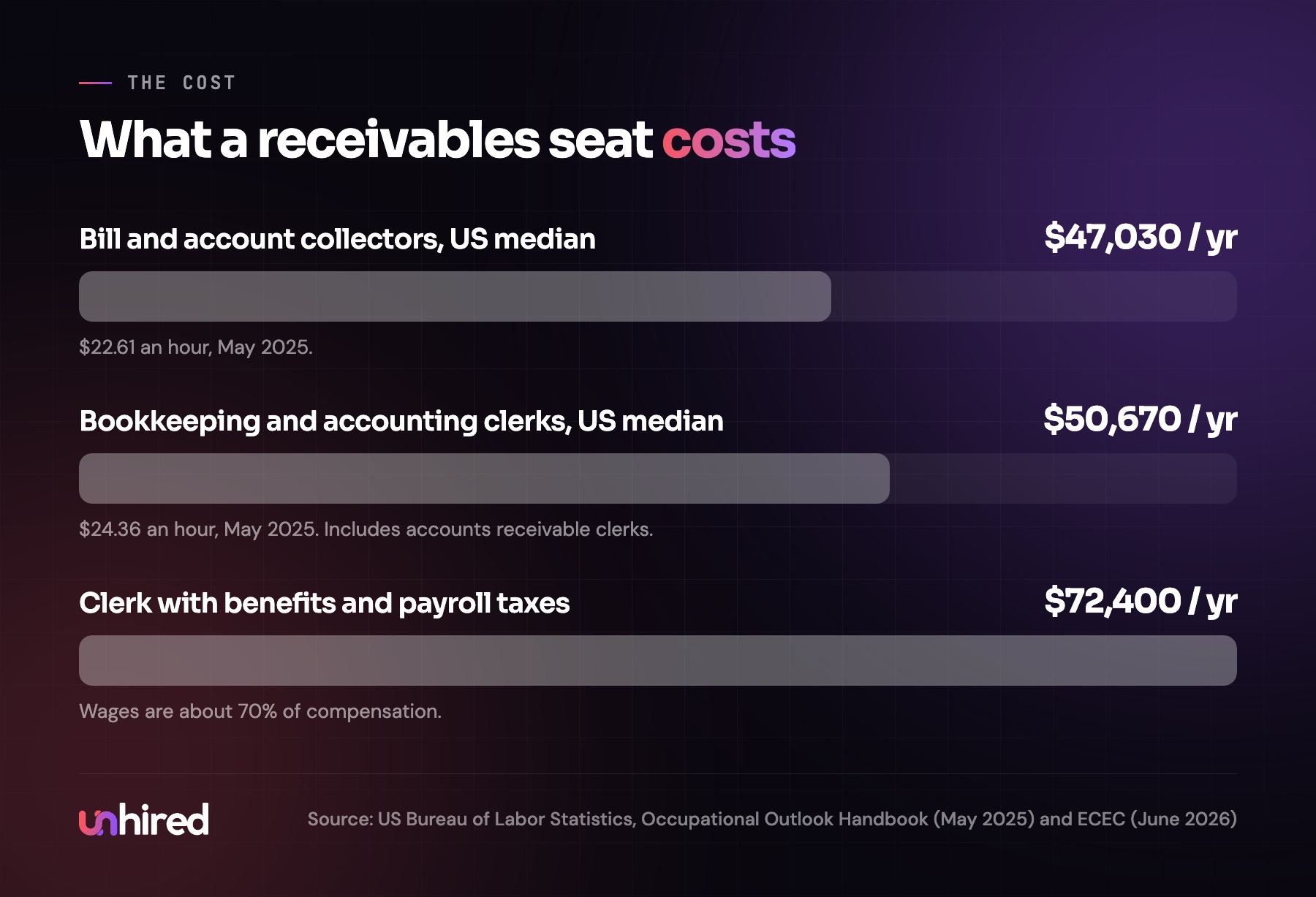
The US Bureau of Labor Statistics counts accounts receivable clerks within bookkeeping, accounting and auditing clerks. The median wage for that group was $50,670 a year, or $24.36 an hour, in May 2025. Businesses with a dedicated collections person can also look at bill and account collectors: a median of $47,030 a year, with employment projected to decline 10 percent from 2025 to 2035.
Wages are about 70% of what private employers spend on compensation, according to the BLS Employer Costs for Employee Compensation report for June 2026. At the clerk median, that puts the full cost near $72,400 a year before recruiting and training.
Plenty of small businesses have no receivables clerk. The office manager sends invoices between other jobs and the owner makes the awkward calls. The cost there is harder to see: invoices that leave a week late get paid a week late, and money in the 60-day column is money the business is lending out for free.
How much you'd pay for an AI accounts receivable clerk
There are two ways to get one.
Building it yourself. Accounting software has built-in reminders, and there are receivables add-ons and AI agent platforms sold by monthly subscription. The software is the small part. Someone has to connect the systems, write the reminder schedule and the stop rules, test it on real invoices and keep it current.
Having it built and maintained. A provider connects your systems, learns your customers and your wording, and keeps it updated, usually for a monthly fee.
The price depends on how many invoices go out in a month, how many customers need a portal upload, how messy incoming payments are, and whether it works one company or several. A consultancy sending 40 invoices a month needs much less than a distributor sending 900.
When you compare quotes, ask what happens at the edges: who handles a disputed invoice, and who updates the rules when your terms change. Then set the number against the full cost of the seat, about $72,400 a year at the US median, or against what your current mix of office manager time and owner time adds up to.
How an AI accounts receivable clerk is set up
Most of the setup is writing down rules the business already follows without having written them.
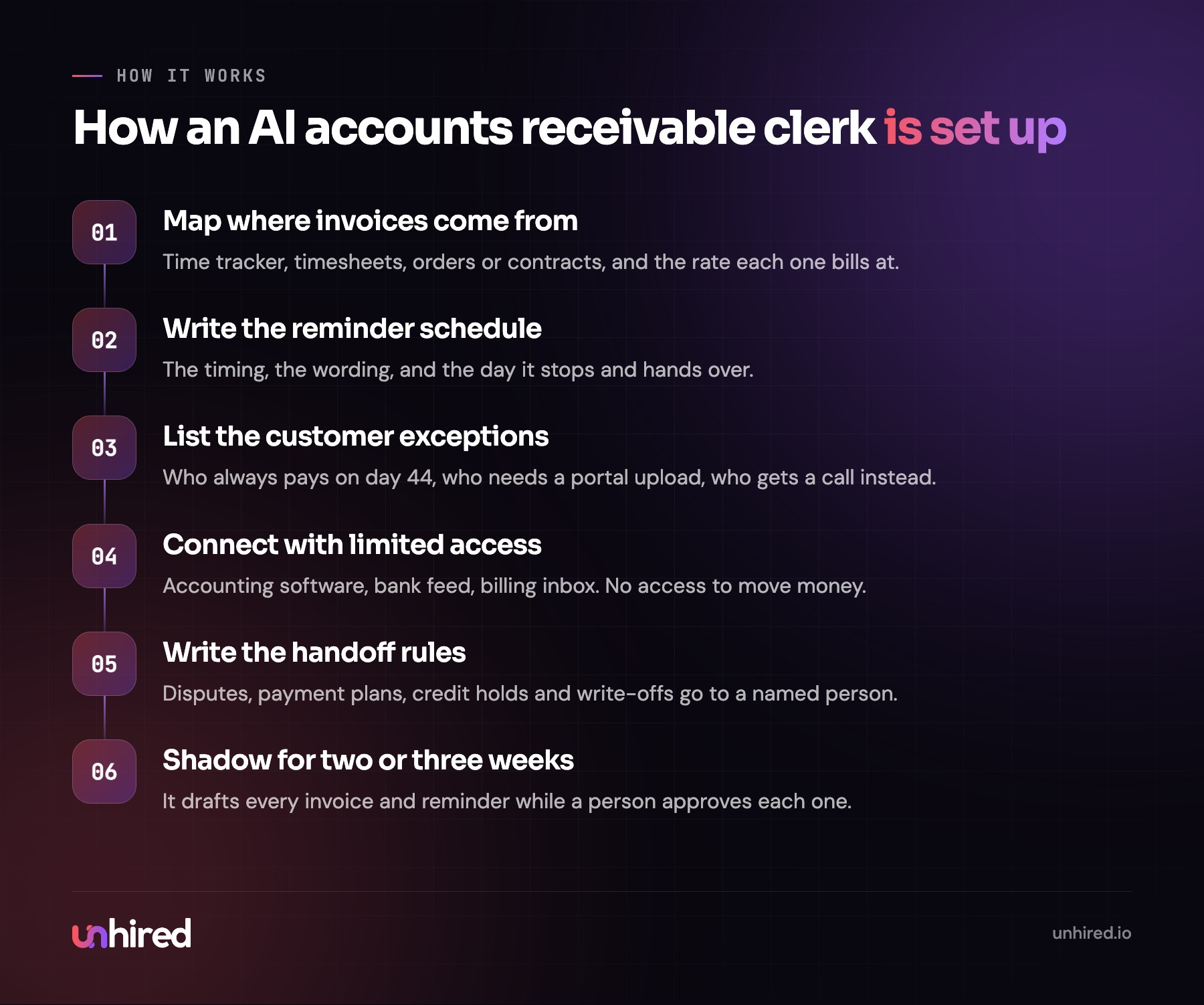
The customer list is the step that takes longest. Every business has customers who always pay on day 44 and shouldn't get a firm email on day 30, and a few who need a nudge on day one. I'd write those exceptions down before it sends anything. Then I'd run it in shadow mode for two or three weeks: it drafts every invoice and reminder, a person approves each one, and it only starts sending alone once the drafts stop needing edits.
When a person should own receivables
If you have a handful of large customers and each invoice is a negotiation, keep a person on the accounts. The same goes for businesses where being paid depends on a relationship, like a subcontractor waiting on a general contractor's draw. An AI Employee can still prepare the invoices and match the payments underneath.
If you send dozens or hundreds of invoices a month on standard terms, the seat is mostly schedule and matching, and an AI accounts receivable clerk can hold it. Some websites offer free assessments that check whether a role can be filled by an AI Employee.
Before you decide, take the ten oldest invoices on your aging report and write one line beside each on why it's late. Sort them into two piles: late because of something on your side (wrong contact, missing PO, no follow-up) and late because of the customer (dispute, cash trouble, slow payer). The first pile is the work an AI accounts receivable clerk would own, and in my experience it's usually the bigger one.
Wage data: US Bureau of Labor Statistics, Occupational Outlook Handbook (May 2025) and Employer Costs for Employee Compensation (June 2026). The Tuesday schedule and the reminder schedule are examples.