
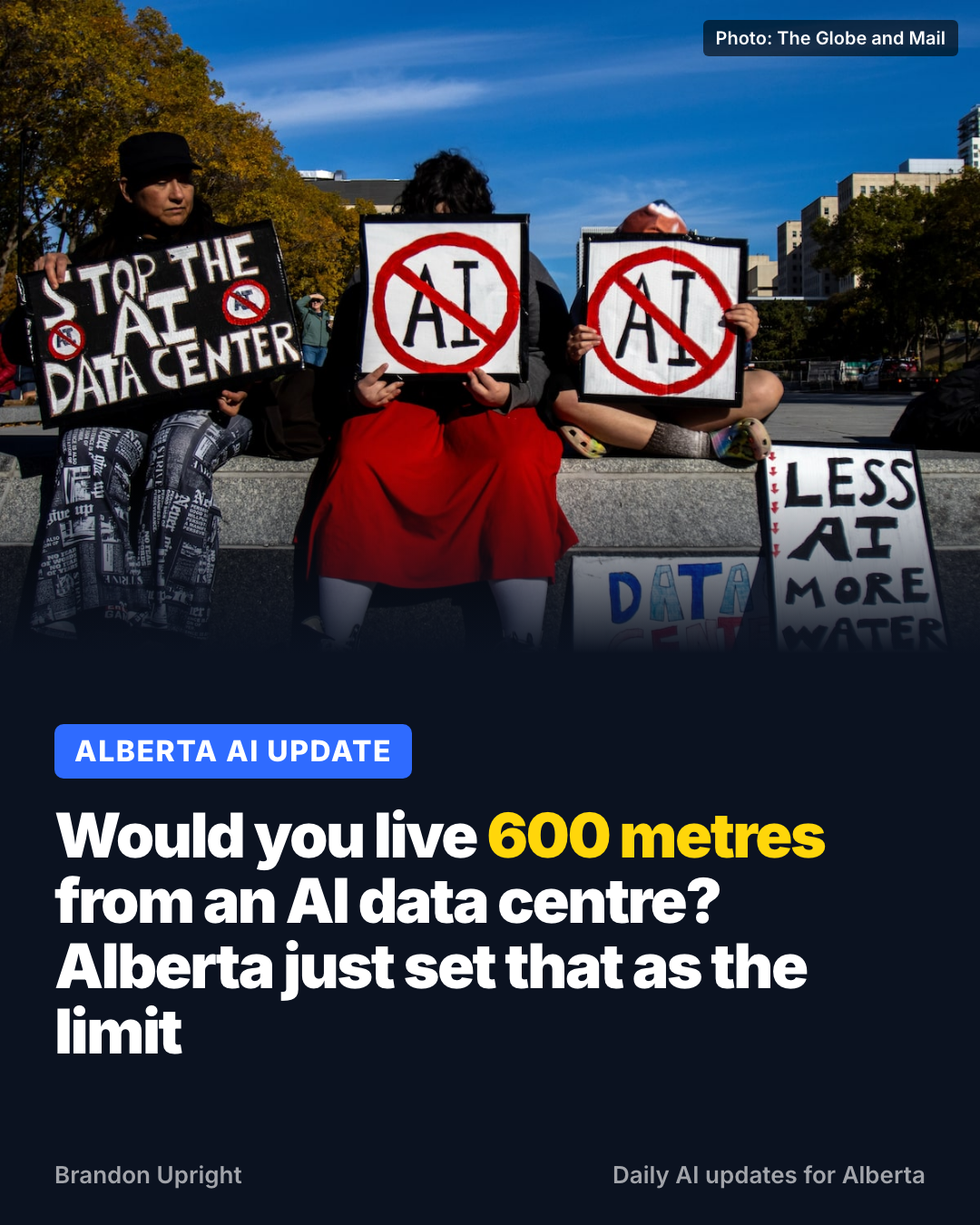
Alberta has spent two years inviting AI data centres to build here. On November 18 the province tabled a bill that says where they can't go.
It is called Bill 42, the Energy, Environment and Utilities Statutes Amendment Act, 2026. Technology and Innovation Minister Nate Glubish introduced it. It has not passed yet, and the detailed rules will be written later in regulation.
What the bill would do
The rules apply to data centres that draw 10 megawatts of power or more. For scale, the largest proposals in Alberta are measured in gigawatts, which is a thousand megawatts.
- A large data centre could not be built within 600 metres of the nearest home.
- None could go on irrigated land, or on about 14 million acres of Class 1 and Class 2 farmland.
- Cooling water use has to be close to zero.
- Waste heat has to be recoverable, so it can warm greenhouses, industry or homes.
- Companies pay for their own power infrastructure. The province says none of that cost can be passed on to ratepayers.
The Alberta Utilities Commission becomes the main regulator for these projects.
Who is exempt
Industrial zones, brownfield sites and existing power plant sites are exempt from the 600 metre setback, according to the Edmonton Journal. Municipalities can also ask for a different distance. Projects that are already approved are not affected.
Why now
The province held four town halls in August and September and ran a survey. Global News reported that hundreds of people attended, and many were angry.
The flashpoint was Olds. In August the Alberta Utilities Commission rejected a 1.4 gigawatt gas power plant planned for a data centre there. According to the Globe and Mail, it sat 30 metres from the nearest properties and within 800 metres of more than 700 homes.
Glubish put the new position plainly: "We don't need every data centre to get built in Alberta."
What critics say
Bek MacIntosh of the group Little Town Big Data told Global News the buffer should be 2 to 5 kilometres. NDP MLA Nathan Ip said the bill doesn't require environmental impact assessments.
What it means for you
If you live in a town or on an acreage, the practical change is that a project next to homes becomes much harder to approve. If you farm irrigated land, it is off the table for these projects.
If you pay a power bill, and everyone does, the part to watch is the cost rule. Data centres use enormous amounts of electricity, and the worry has been that households would help pay for the lines and substations that serve them. The bill says they won't. Whether that holds depends on the regulations that come next, so that is the part I'd keep an eye on.
About 70 data centre projects are in the province's pipeline. The government says roughly 30% of them could be affected.